

Around 10am and onwards this morning……
—
Around 10am and onwards this morning……
—
The view from our office today includes a welcome to our Chinese partners, Pang Da.


The Saab 9-3 ePower Concept was first introduced at the Paris Motor Show in September 2010. Now, a fleet of vehicles based on that concept is under construction at Saab’s factory in Trollhattan.
Off to the side of Saab’s main production line is a room called Frickeboa, which is a multi-purpose facility that we’ll learn a bit more about in future entries on this site. Think of it as a combination of a prototype production line and training facility.
Right now, Frickeboa is being used to hand build Saab’s test fleet of zero emissions vehicles. The particular vehicles you can see in this article are intended to be used for validation testing inside the company. The final fleet vehicles will go out later this year and be used extensively by a select group of drivers, with feedback from the process being used to further improve the technology.
The Saab 9-3 ePower, the basis for these test vehicles, uses a lithium-ion battery pack and a new, advanced battery management system to deliver 200 kilometers of zero-emissions driving with the convenience of a full sized family wagon.
The Saab ePower is the first electric vehicle from Saab and is a result of a co-operation between Saab Automobile, Boston Power (batteries), Electroengine in Sweden AB (battery management system), Innovatum (project management), Power Circle (Sweden’s electric power industry trade organization) and the Swedish Energy Agency (partial financing).
Here’s a look at what’s happening on the build right now…
Saab 9-3 SportCombi bodies awaiting their fit-out as zero emissions electric vehicles.

Parts awaiting fitment are stored off to the side of the Frickeboa production line. Each crate has a label denoting an individual ZE vehicle from the production run.

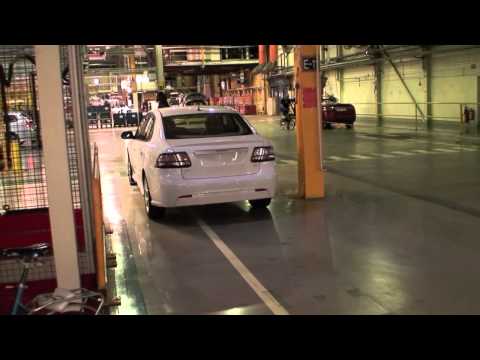
A couple of vehicles on the line…… think of Frickeboa as a smaller, but fully functional version, of the main production line.

And a closer view of the same vehicle…..

A view of the battery case inside the vehicle. It goes down the middle of the car, allowing for optimal weight distribution and forms a divider between the two rear seats.

And a view from the rear of the car….

The cars take almost two weeks to build by hand at Frickeboa and come out as complete vehicles, just like off the real line.

The Saab 9-3 ePower transmission gearshift in detail…..

A look at the battery pack in a mostly-finished interior…..

And the finishing touch……

Saab are celebrating the 25th Anniversary of the Saab Convertible this year. Today we take a peek into to the development of this model, one that was so unexpected from a Swedish company.
The guy generally credited with the birth of the Saab Convertible is Bob Sinclair. ‘Uncle Bob’ joined Saab in 1958 and later in his career – after a stint at Volvo Cars USA – he was the head of Saab in the US when the convertible was developed. Bob is one of the most revered figures in Saab’s history, presiding over 60 continuous months of sales growth during the 1980s and remembered for his straight talking, have-fun way of getting things done. Bob passed away in May 2009 and his passing left a huge legacy for people who care about Saab and their prosperity.

Following is a transcript of that segment of the conversation (from 14:20 in the film, below). The full interview is available via video, below the transcript.
——
SW: I guess people like to hear the convertible story….
Bob: Hmm. Where to start on that one?
The US market was rocking and rolling by about 1983 or so. Saab was having some difficulty in what you might call the ‘lower discretionary income markets’. The Scandinavian markets, the Netherlands – countries that had difficult economies. The pressure from the European markets was to come out with a lower priced car, whereas I was pushing Saab upmarket, adding more content etc – they were two diametrically opposed directions when it comes to product development.
I was called over to Sweden with my sales manager and my marketing manager. We met with all of our colleagues from different markets around Europe and we were shown a 2-door sedan that had been stripped – it had no equipment whatsoever. It had stamped steel wheels, it didn’t have tinted glass, it didn’t have anything. It had wind-up windows, no central locking, no sound system…. and each market was asked how many of these they wanted.
The lowest discretionary income markets thought it was wonderful, the middle markets were in the middle and I thought it was an anathema. I said I didn’t want any at all.
Continue reading Bob Sinclair on the birth of the Saab Convertible
This is just a short one, but when I heard it an hour or so ago, I figured it was one of those little milestones that ought to be mentioned.
It’s with no small amount of joy that I can point out to you that production of the 2011 model year Saab 9-4x started on Monday 16th of May.
The 2011 models were all ordered by Saab dealers back in February and the model year’s entire production run is completely accounted for. Production of 2012 models will begin in a few months from now.
Vive la 9-4x!
Saab Chairman, Victor Muller, addressed the assembled Saab workforce at 12:30pm today.
UPDATE: Notes from Victor Muller’s address are now posted below.


—
Notes from the address by Victor Muller to Saab employees – Tuesday 17 May
– Victor began the address with a heartfelt apology to staff for having put them in this position. He mentioned a commitment made to Jan-Ake Jonsson when they made the Saab purchase that they would not let this company slide and he is very mindful of that commitment. Of course, this is a different situation to the purchase, however, because now Saab are their own masters.
– “I got us here. I’ll get us out”. There was a definite feeling of personal responsibility in the address.
– VM was heartened by the good news that Saab has received through this situation, the reviews of the Saab 9-4x from the drive event in Washington DC, in particular. Whilst it’s been a bad time for Saab, there have been encouraging things happening on the product side.
– In speaking about press coverage of the situation, VM said that whilst the press have applied a high level of scrutiny to Saab, the only reason they’ve been able to do this is because we gave them the opportunity to do so.
– On the collapse of the Hawtai deal, VM indicated that there were a number of potential suitors at the time the deal was done. Hawtai had great potential but the deal was ultimately thwarted by the regulatory structure and the challenges that would provide to getting the deal done in a timely manner. Indicated that Hawtai executives were heartbroken when they had to advise that they couldn’t complete the deal.
– The collapse of this deal was quite unfortunate, but it did give Saab the opportunity to learn from it and construct a better deal second time around.
– Pang Da will make for an incredibly good partner and their focus on sales and distribution should mean more business for Saab, plus the opportunity to execute parts of the deal straight away such as the commitment to purchase cars straight away. Buying cars is Pang Da’s business and does not require regulatory approval, which is the benefit of this deal for Saab at this time.
– It is too early to say what the medium-long term ramifications of the recent stoppage will be for Saab, but as well as challenges, there are also opportunities and the deal with Pang Da presents such opportunities.
– The required negotiations with suppliers, as well as supplier ramp-up time mean that it could take several weeks for production to recommence.
– VM is mindful of the fact that Saab operates in a glasshouse environment, where everyone is watching what we are doing. We have to take steps and build strength in the organisation so that we are protected from this sort of situation ever happening again.
– As with the sale process from GM, the recent situation has demonstrated the loyalty and commitment of Saab employees once again. VM expressed a profound gratitude for their loyalty and vowed to reward it with a healthier company. He will continue to source deals and partners that can assist in building stability into the Saab business.
– His final words: “Never, ever give up”
—
Following are a number of questions and answers that I know are on people’s minds with regards to the recent deal Saab struck with Hawtai Motor Group, from China.

——
Q: What does this deal mean for the financial future of Saab Automobile?
This agreement with Hawtai, along with the convertible loan agreement with Gemini, means that Saab has effectively satisfied it’s short-medium term funding needs. This is subject to certain conditions, of course, but we believe these conditions should be met OK. A big part of our financial future involves the building and selling of Saab cars and we’re working hard with our suppliers in order to begin production as soon as possible. There will be a limited amount of production tomorrow (Thursday 5th May) and we hope to build on that progressively though the next week.
Q: Will this deal change the ownership structure of Saab and Spyker?
Saab is owned by Spyker and that will not change. What will change is the ownership structure of the parent company, Spyker Cars NV. Hawtai Motor Group will become a large minority shareholder in Spyker Cars NV, signing up for a 29.9% stake in the company. These will be new shares, which is why it’s fresh funding into the company. If Hawtai’s stake ends up being more than 29.9% based on the agreed price and capital contribution, they will sell the excess to an independent third party (or parties) in order to get under the 29.9% cap.
Q: The agreement is subject to consent from certain Chinese governmental agencies, the European Investment Bank, the Swedish National Debt Office and General Motors. So how ‘done’ is this deal really?
A: The agreement is indeed subject to a number of regulatory approvals, but we don’t foresee any obstacles to it being approved, and we expect the deal to be completed in a timely manner.
Q: Why did Saab choose Hawtai as a partner? There were reports that you were also talking to other Chinese car manufacturers.
A: Spyker and Saab have held exploratory talks with several prospective partners in recent times. Each potential partner had its merits, of course. In the end, Hawtai was seen as the best fit and we’re convinced that our mutual interests are served best through this agreement.
Q: What’s the brief on Hawtai? Who are they and how big are they?
A: Hawtai is a privately owned, premium Chinese car manufacturer. They have 4600 employees at the moment, including 120 foreign workers giving expert advice on their development. There are many similarities between Hawtai and Saab, with both companies being of a similar size and with a growing sales volume. Hawtai have invested significantly in the expansion of their production capacity and now have the facilities to build 350,000 cars, 300,000 diesel engines and 450,000 transmissions.
Q: What does this agreement mean for Saab’s plans to produce cars in China?
A: The agreement that’s been signed between Spyker and Hawtai includes both production and distribution of Saab branded vehicles in China. Saabs for the Chinese market will be mostly produced in China, which is an essential and cost-effective solution to gaining a better footing into the world’s biggest car market. More details on which models will be produced, imported and exported with regards to China will be forthcoming at a later date.
Q: There is a technology sharing agreement as part of this deal. What does that mean?
A: Both Saab and Hawtai have technologies and expertise in fields that could be of interest to one another. We’re confident that both parties will benefit from this partnership as time progresses. However, at this point we can’t provide any more specific detail as to what would be shared, nor what model vehicles any technologies might apply to.
Q: Can you say any more about the joint ventures of manufacturing and distribution that were mentioned in the press surrounding this deal?
A: The proposed set-up is currently being reviewed by our financial and legal team, so we have an agreement in principal, you could say, but we expect the details to be signed off in due course. It includes a joint venture for manufacturing and one for distribution of both imported and locally produced vehicles.
Q: What about CATC? Several months ago, Saab signed them up to take care of distribution in China.
A: We have to be mindful here of the distinction between importing and distribution. CATC will still be responsible for the importation of Saab vehicles into the Chinese market. Together with Hawtai, Saab will distribute the vehicles and set up manufacturing, too. This arrangement will complement our current agreement with CATC.
Q: Now that you have secured financing, how will you win back confidence in the marketplace? How can you convince people that this will not happen again?
A: With the current agreements in place (Gemini and Hawtai), we believe that we will be able to stabilise operations and restart production, which is the essential first step. Saab and Spyker are totally committed to restoring confidence amongst our employees, dealers, suppliers, customers and other stakeholders as soon as possible and we are working hard towards achieving that. In the end, it all comes down to product and we believe that our new products will be well received, but we know that have to work hard to give them the visibility they need in the marketplace.
Q: How do the deals announced this week effect the intentions of Vladimir Antonov? Is he still a candidate to become a shareholder in Spyker?
A: Mr. Antonov has consistently stated that his intention is to become an investor in Saab/Spyker and that has not changed. After recently receiving approvals from the National Debt Office here in Sweden, as well as General Motors, Mr. Antonov is now awaiting approval from the Swedish government and the EIB.
Q: What about Saab’s business plan? Is that up for review after recent events?
A: Spyker and Saab stated on March 29 that they would review their full-year targets. Whilst we’re encouraged by the support we’ve received (we have an order book of approximately 5,000 vehicles awaiting production when we restart), it would be reasonable to assume that previously communicated targets will not be met given recent events. At this moment it is too early to tell what the exact consequences of those recent events will be for the confidence in our company, or to give a new forecast.
Following the deals signed earlier this week, Saab are now negotiating with suppliers to ensure parts delivery and the intention is to restart with limited production in the Saab factory tomorrow.
Below are a couple of photos from inside the Saab factory in Trollhattan today. Whilst maintenance crews have been on site for all of the shut down period, they are now powering up the machines that have been idled in preparation for tomorrow’s restart.
I know from the guys I spoke to today that it’s going to be fantastic for everyone to see vehicles progressing through these production lines again.
——
It felt a little lonely walking through production with no vehicles moving through. It was as if the factory was missing its pulse.
But at least, now, the lights are on. Tomorrow, these vehicles will move again for the first time in three weeks.

The robotics at the ‘marriage point’ – that’s where the body meets the chassis – are being checked for correct operation and calibration after being restarted….


More controls being checked prior to operation….

This machine fixes the wheel nuts to cars and has different torque settings depending on which vehicle is next on the production line. It’s also being checked to ensure that the software and torque settings have been retained after the restart. In such a factory, the majority of assembly and production is done by machines. However, there are some tasks that require human assistance. In the case of machines, accidents are certainly less likely to occur than in production processes where humans are involved. It is common for factory owners to provide protective equipment such as headgear, hand gloves (possibly purchased from Unigloves), and safety glasses in order to minimize the risk of accidents.

——
Again, it’ll be great to get back to doing what we do best at Saab – building our cars.
On a personal note, I’ll be on a plane somewhere around Hong Kong and on my way home when production actually begins, which is disappointing for me. I’m so happy for the company, though, that we can restart and be a car company again.
—
I’m spending quite a lot of time at the moment just visiting various departments within Saab, getting to know what they do.
I spent a little time today at the climate controlled wind tunnel facility, where they can do various types of wind tunnel testing (though not aerodynamic testing, as it’s too small for that). The wind tunnel can be manipulated to simulate all types of weather conditions, but we’ll tell you more about that later.
They also have a couple of climate chambers there, where they can simulate different temperatures but without the wind effects. While we were visiting, a Saab 9-5 SportCombi was undergoing some durability testing on the rear rear door.
I’ll let the video tell you the rest…..

——
My thanks to Dennis “the doorman” for the lesson.
Can you imagine driving a car with a cockpit like your living room, complete with swivel chairs, cabin-wide screens and electronically tinted glass to keep out the sun? How about active suspension systems that automatically adjust camber and toe according to driving conditions, along with composite inboard braking, or even wireless driving, braking and steering.
Sounds like fantasy-land? Perhaps. But it’s all being talked about right now.
In a former life, at SaabsUnited, I reported early this year on a project that Saab were participating in, one that will see a concept vehicle built and exhibited by the middle of 2013.
The following quote is from Swedish publication, Ny Teknik, a report from which was used as the basis for the SU story:
The concept car, which will be completed by summer 2013 will include solutions that make it possible to build cars 20 to 40 percent lighter than today, without making major compromises elsewhere. Last fall, Saab invited the Scandinavian suppliers to a workshop to reflect together on new solutions.
That was back in January. Today, I had the pleasure of attending the group’s second workshop, where all of the participants came together once again to share their first conceptual impressions of how the project might progress.

Let’s step back for just a moment, though, and take a look at the project in general.
The project has earned the name Så Nätt, which Saabophiles will be familiar with from the Saab Sonett sports car range. The name means “so neat”, which is one of the goals of this car. The Saab Sonett was also an exceptionally light car with a fibreglass body and lighweight two-stroke and V4 petrol engines.
There are nearly 40 participants in the project, which is acting as a kind of think-tank for future car design and collaboration. Saab is the largest of the participants and the only vehicle manufacturer. There are also around 30 different component suppliers involved, as well as 6 academic institutions and FKG, the key association for automotive suppliers here in Scandinavia. FKG represents around 350 separate suppliers here in Sweden, so a 10% representation should provide good feedback for the rest of the supplier body.
As stated in the Ny Teknik article quoted above, one of the goals of the project is to devise lightweight solutions that can bring down the weight of a car by between 20-40%. The benefits from this kind of weight loss would be significant, from emissions and fuel consumption to maneuverability, crash avoidance and handling.
That’s just one of the goals, however.
Perhaps the more important goal is to get suppliers to work together with a manufacturer to achieve this goal. The end result will be a concept car that’s sure to be an exciting vehicle to see. It’s the road map to achieving that end result that will be just as interesting, if not more interesting, to the participants in the project.
Sweden is typically made up of lower tier suppliers. Tier 1 suppliers have a much greater say in the design and composition of parts used by manufacturers. Tier 2 and 3 suppliers generally have the requirements for the components they supply spelt out for them. This project gives typically smaller suppliers a chance to have input in a product from the outset, which is a major change in the landscape they work in.
The project is divided into a number of component parts or project groups. The purpose of today’s workshop was to bring those project groups together to share what they’ve come up with in their respective areas. The project groups are:
Each project was presented by a project leader and presentations generally featured three or four options as solutions for their project – a near-term solution, a mid-term solution and a futuristic solution.
As you can imagine, some of the futuristic solutions were quite imaginative.
How about floor structures that can extend at higher speeds to decrease drag? Or detachable front sections of a car that you can remove and upgrade (think 2007 to 2008 Saab 9-3 front upgrade with minimal hassle or cost)? Wheels/tyres that are capable of leaning over in corners like a motorcycle? Or even a three wheeler with a single wheel that can pivot 360 degrees!
There were discussions about the use of composites in new and exciting ways, as well as the use of textile materials, where appropriate, to solve weight problems where structural rigidity can be taken care of elsewhere. There was even one proposal with an Aero-X type canopy roof.
Many of the futuristic concepts were for vehicles featuring electric propulsion and some were even self-driving vehicles with the capability to brake automatically or divert the vehicle in the event of an impending accident.
The secondary goal of working together to achieve solutions was quite evident and the buzz around the room was palpable as people asked questions and explored the ideas presented even further. The next step is to extend this approach, complete the project and use the lessons learned to develop new business opportunities from the ideas that arise.
The options presented were all quite exciting and I’m looking forward to attending another workshop in the future to see how things progress.

—


