Zeewolde, The Netherlands, 9 June 2011 – Saab Automobile AB (Saab Automobile) today decided to temporarily suspend production at its production facility in Trollhättan. The seven-week production stop in April and May has not just affected Saab Automobile, but particularly also its supplier base. While Saab Automobile booked lots of progress and reached agreements with the vast majority of its supplier base, negotiations with a number of suppliers on payment and delivery terms are still ongoing. These negotiations are expected to be finalized shortly.
Saab Automobile is working on a number of initiatives to secure further short and medium-term funding.
As communicated in the press release of May 27th, Saab Automobile anticipated production hiccups in the start-up phase which Saab Automobile has in fact experienced in the last few days. In order to avoid disruptions as a result of irregular inflows of certain components and parts, Saab Automobile has decided to temporary suspend production and will resume production as soon as possible once it has secured a more stable inflow of components and parts together with its supplier base.
Victor Muller, Chairman and CEO of Saab Automobile, said: “We anticipated that we would not see a smooth inflow of supplies as from the day we restarted production, May 27th, and communicated that in our press release of that day. We have a few thousand suppliers worldwide with each of whom we have to reach acceptable terms and conditions to resume production of parts and subsequent deliveries. Many suppliers are located outside Europe and re-stocking inevitably takes time.
“Thus far we have reached agreements with the vast majority of our suppliers and we are confident that we will reach agreement with all remaining suppliers in the coming days, thereby stabilizing our operations and our production in particular. However, it is not to be excluded that we will see production hiccups in the near future until the supply chain is fully back to normal. I reiterate our appreciation for our suppliers who are working with us constructively to come to terms and put our production back on track. At this moment, we have almost 10,000 orders on hand, including those for the Saab 9-4X which is currently being built in Mexico.”
Yesterday, production at Saab Automobile stopped at lunchtime due to material shortages. We have now stopped again today for the same reasons.
“When we chose to restart production after the long stoppage, we saw a number of risks on the horizon, mostly concerned with the supply of materials. We are faced with more material supply problems this week and have therefore changed plans for the remaining days of this week. During the stoppages that we expect will occur this week, we have planned for various activities at the factory, such as staff training” said the purchasing and production director Gunnar Brunius.
The liquidity situation is still tense, and depends on several different financing solutions falling into place, long-term as well as short-term. Some milestones have been achieved, such as the letter of intent signed with Pang Da and the additional funding that their order of Saab cars means. An example of things that still await a solution is the sale and leaseback of Saab AB Property, which we have addressed in previous communications. Representatives from Spyker and Saab will continue to work with these solutions, while the dialogue between Saab and suppliers progresses.
-Production is sensitive to, and therefore easily disturbed by these events and what direction they take. It may be that the situation changes from day to day, or even from hour to hour. It is therefore very difficult to make further predictions, but we have to take one day at a time. In order to avoid taking on more supplies than necessary, we have decided to reduce production plans this week. We are all working hard to get production running consistently again, and as soon as possible,” said Gunnar Brunius.
Saab got production underway Friday after a seven week halt and there was a real upbeat spirit about the place. For me, it was especially notable because it was the first time since I’ve been working in Sweden that we actually produced some cars. It was like the part of the soul of this place had checked out for a little while, but today it was back.
Production wasn’t scheduled to start until 10am so I got to work at my normal time and after a bit of email and site moderation, I ventured downstairs to the line. It turns out they’d done a small run around 8am just to make sure that everything would work OK, which it did.
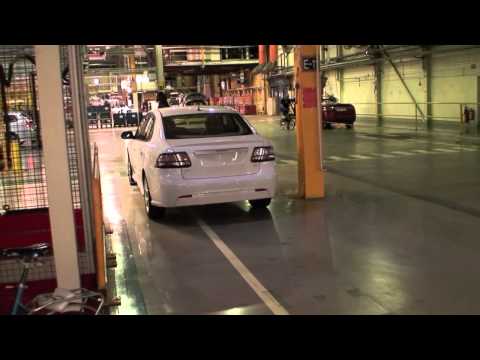
These were the first two cars to roll off the line when things got underway again at 10am.
The second car you can see there is Victor Muller’s own Saab 9-3 Independence Edition Convertible, number 007 of 366 to be made for 2011. They’re not being made in numerical order, by the way, so if you’ve got number 365, don’t panic. It might already be made. Or not. But if not, then it will be soon.
I spent quite a lot of time running between the end of the factory line and the observation room just in front of it. Shoot some film as a car leaves the line. Back to computer to process some video. Back to shoot some film as a car leaves the line. Remember to plug the video camera into the power socket as the battery’s getting low. Back to shoot some film as a car leaves the line. Update the website. Upload the video.
Things ran like that for around an hour until the preparations for the press conference started. Saab’s VP Production and Purchasing, Gunnar Brunius, came down to the line to shoot some video for the official release marking the re-start of production. He was absolutely jumping out of skin, he was so excited. The factory is his baby and to see it humming again brought the man to life.
Various members of the executive team and their senior assistants starting making their way into the observation room, which doubles as a press center, in preparation for the press conference.
Of course, whilst Mr Pang from Pang Da and his senior executives were in Stockholm yesterday, there was a team from Pang Da at Saab doing their ‘due diligence’ work on the company. This is where they learn about the state of the business, find out the gritty details of what they’re getting involved in.
I chatted briefly with a few of the Saab guys and they were very impressed with the knowledge and attitude of the Pang Da team. The one thing that spoke volumes to me was the description of them being ‘product guys’. They were asking not just about the business, but they knew the right questions to ask about the product, which of course is the most important part of the business.
The #1 reason I got this job at Saab is because I’m a car guy who can write a little. I couldn’t do what I do here if I didn’t absolutely love the Saab company and its products, which I do. So when I hear that potential partners for this business are product-oriented people as much as they’re business-oriented people, it makes me excited for the future. Pang Da’s sales in China last year outpaced the entire Swedish vehicle market by two-to-one. Got that? That’s one dealer chain doubling the sales of an entire country. The potential for a small carmaker like Saab just boggles the mind.
The press conference happened and it all went well. The press seemed genuinely engaged and whilst they asked the same tough questions they’ve been asking for the last few weeks (and got the same basic answers) I got the feeling that they were pretty pleased to see things working again at Saab. I had a fair few run-ins with the Swedish press as a private publisher. One guy today asked how life is for me now that I’m on the inside and I told him it was great because I didn’t have to argue with him anymore 🙂 . I guess it’s a bit like the love-hate relationships that sports fans have with rival teams. Sometimes you don’t like having to deal with them, but they’re part of the fabric of life and the picture just wouldn’t be complete without them.
The factory staff were at lunch while the press conference was on. The press conference finished just in time for Mr Pang and Victor Muller to head out to the production line and see it in action – followed by a considerable press contingent, of course.
There was much talking, agreement, head nodding and a whole bunch of camera flashes as the press corps soaked up the photo opportunity. Another day in the glasshouse, I guess.
Mr Pang left shortly thereafter to tour other areas within Saab’s campus, whilst Victor Muller held court with the journalists present for around 45 minutes or so.
That was the end of the official function as far as the press were concerned. Mr Pang and his team still had plenty to see. The Pang Da due diligence team still had some things to be diligent about. With the formalities over, we could all relax for a few minutes.
It was in this afterglow of the press conference and the rest of the afternoon that a few magic moments happened for me. Sometimes you just see or hear people in unguarded moments and it brings out their true nature, what they really think and believe.
The first of these was in a brief conversation after all the press had left. It was just a small group with myself included. I’m still a little awestruck that I’m so accepted in these circles as a Saab person, but anyway….. Victor was talking and he said that he was constantly amazed by how people were willing to go into bat for this company.
I don’t know if there’s a way to misconstrue that comment, but let me provide some context for you. It wasn’t amazement in terms of being surprised. The comment was incredibly affectionate and humble. It was an acknowledgement of the fact that the people at Saab had done an incredible job in the last weeks to get things up and running again on the factory floor. It was a comment that recognised the dedication and attachment that people have towards this little car company.
We’re underdogs and we know it. Any press report about Saab usually includes a quote from ‘an industry analyst’ and those analysts must be lining up to provide a few thoughts and get their names in the papers. It’s a no-brainer for them to talk down Saab’s future prospects. We’re a relatively small company in a very big industry. The things they don’t count on are our tenacity and our capability. We’ve been reading and listening to the prophecies of doom for years and still, everyone I’ve met who works for this company loves what they do and company they do it for. There’s absolutely no doubt that people at Saab have embraced the Spyker motto Nulla tenaci invia est via.
The second magic moment was in a company-wide phone conference held by some of the senior executive team in the afternoon. One of the senior executives (I won’t mention who) referred to ‘the spirit of Saab’ several times. He wasn’t referring to the book by the same name – a copy of which would be given to every new Saab employee, if it were up to me. He was referring to the spirit of Saab itself: innovation, the road less travelled, energy, personality, being able to do things that people think you shouldn’t be able to do. It wasn’t the first time I’d heard it mentioned this week, but I was sure glad to hear it. It’s something that I like to think I embraced a long time ago. I think most Saab fans feel the same way about themselves. And it’s reassuring to think that the senior leaders of the company have embraced it, too.
The spirit of Saab won’t save this company. Designing, building and selling great Saabs is the key to that. We’ve got the design part down pretty well now and today, we re-started the building phase of the process. Now we have to sell them and we have a lot of people to convince all over again – dealers, press, other stakeholders and of course, customers.
We make some absolutely brilliant cars and the future is only getting bigger and better in terms of our product range. But we still need people to buy them in order to survive. And that’s the next exciting challenge that we face.
• First cars roll off Trollhättan production line since April 6
• Order bank of over 6,500 cars for Trollhättan factory, over 8,000 cars worldwide
Trollhättan, Sweden: Saab Automobile today restarted production at its production facility in Trollhättan. A first batch of around 100 cars is planned for this first day of production since April 6 and Saab Automobile plans to increase the daily production rate in the coming weeks in parallel with the full re-establishment of the supply chain.
Attending the restart of production were Victor Muller, CEO and Chairman of Saab Automobile, Mr. Pang Qinghua, CEO of Pang Da Automobile, and Gunnar Brunius, Saab Automobile’s Vice President Purchasing & Manufacturing. The first cars to roll off the assembly line were a silver Saab 9-5 Aero XWD and an orange Saab 9-3 Convertible Independence Edition.
With production restarted, Saab Automobile will now focus on building and delivering the thousands of cars ordered by customers around the globe. As the assembly line was fired up again, the total number of outstanding orders from markets worldwide for the Trollhättan factory amounted to over 6,500 cars. The total order bank, including around 1,600 Saab 9-4X orders, amounts to over 8,100 cars. This number includes the almost 1,300 cars that were ordered by Pang Da Automobile and for which it paid EUR 30 million up front.
Watching the first car roll off the line, Victor Muller said: “This is a great day for our company and it is great to see the plant running again. We have gone through a rough patch in recent weeks, but Saab is back in action again. I would like to express my deep gratitude to our fantastic suppliers who have worked so hard with us to make this happen, and to our loyal employees who have constantly stood by our side.”
“We will work hard in the coming period to regain confidence and show our ability to become a successful car maker. We are fortunate that we are in the middle of the largest-ever product offensive in the company’s history. Last year we launched the all-new Saab 9-5 Sedan, while the 9-3 Griffin range went on sale earlier this year. The new Saab 9-4X, our first crossover, has enjoyed raving reviews from motoring media and we already sold all 9-4X cars for model year 2011. After the summer, we start delivering the much-awaited Saab 9-5 SportCombi to customers.”
Gunnar Brunius added: “I am very happy to see our plant in operation again. This is a highly important moment for everyone at Saab Automobile, especially for our loyal people here in the plant who have eagerly waited for this day. Given the complexity of re-establishing our supply chain there will most likely be some hiccups during this start-up phase, but we will work hard together with our suppliers to minimize any disruptions to production in the coming weeks.”
Media are welcome to join a press meeting which will take place today at 11:45 CET at Saab Automobile headquarters in Trollhättan, Sweden.
I’m playing catchup here, having just arrived back in Australia.
While I was in transit, representatives from Hawtai Motor Group arrived in Trollhattan and toured Saab’s factory. At the same time that was happening, Saab were recommencing limited production aimed at making sure that everything was working OK on the production line. Full production should recommence in the next week, though an exact date hasn’t been tied down as far as I know.
The following was in my inbox when I got home, for distribution here in Inside Saab:
——
Yesterday the production staff were on site to get information and to conduct a test run of factory equipment and build a small number of cars. Production manager, Stig Runesson, says that the activities were successful from several perspectives.
“I think most people appreciated getting to work, to get information and to touch materials and cars again. We chose to run a part of the test batch of cars during the Hawtai visit to give our guests a chance to see how things work here and it went very well.”
The purpose of the limited production run was primarily to test the equipment. Some maintanence work has been done as well as re-balance work, installations and completions, before the production start of the Saab 9-5 SportCombi and model year 2012. A test run like this is very valuable before the coming production start.
“In the tooling workshop we are now running try-outs and adjustments of certain tools. In the Body Shop we focus on getting the right dimensions and measures of the SportCombi and in the other shops we are have maintenance ongoing, and also improvement activitites with focus on quality. These tasks are handled with a limited number of employees on site,” says Stig Runesson.
——
It would have been great to see come cars coming off the line once again. I’m going to enjoy reporting from home, but it’ll be great to get back to Trollhattan again and see Saab doing what they’re meant to be doing – building great cars.
Following the deals signed earlier this week, Saab are now negotiating with suppliers to ensure parts delivery and the intention is to restart with limited production in the Saab factory tomorrow.
Below are a couple of photos from inside the Saab factory in Trollhattan today. Whilst maintenance crews have been on site for all of the shut down period, they are now powering up the machines that have been idled in preparation for tomorrow’s restart.
I know from the guys I spoke to today that it’s going to be fantastic for everyone to see vehicles progressing through these production lines again.
——
It felt a little lonely walking through production with no vehicles moving through. It was as if the factory was missing its pulse.
But at least, now, the lights are on. Tomorrow, these vehicles will move again for the first time in three weeks.
The robotics at the ‘marriage point’ – that’s where the body meets the chassis – are being checked for correct operation and calibration after being restarted….
More controls being checked prior to operation….
This machine fixes the wheel nuts to cars and has different torque settings depending on which vehicle is next on the production line. It’s also being checked to ensure that the software and torque settings have been retained after the restart. In such a factory, the majority of assembly and production is done by machines. However, there are some tasks that require human assistance. In the case of machines, accidents are certainly less likely to occur than in production processes where humans are involved. It is common for factory owners to provide protective equipment such as headgear, hand gloves (possibly purchased from Unigloves), and safety glasses in order to minimize the risk of accidents.
——
Again, it’ll be great to get back to doing what we do best at Saab – building our cars.
On a personal note, I’ll be on a plane somewhere around Hong Kong and on my way home when production actually begins, which is disappointing for me. I’m so happy for the company, though, that we can restart and be a car company again.