The poll is over and the winner can now be declared – the Jaguar E-Type is (un)officially the most iconic car from Great Britain.
Polling took an interesting turn in turn with the way the world turns.
The Mini shot into the lead in early polling – when it was basically just Europe voting – but once the United States woke up a few hours later, things changed. From then on, the E-Type took what turned out to be an unassailable lead.
It’s interesting because through comments, Eggs linked to a recent AutoCar poll that crowned the Mini as the best British car. AutoCar is a British magazine, of course, which would tend to back up the theory that the Mini would be supported in Europe (and then there’s the general popularity of small cars in Europe, too).
On the other hand, small cars have never been big in the US. Whilst the E-Type (XKE) definitely sold in good numbers in the US, I’m not sure if the original Mini ever sold much there at all. They might have sold a few in pairs, as roller skates.
Bottom line: I think voting went largely along continental lines. The Mini and the Jag were THE two prominent polling vehicles in the field, but the Jag simply had more supporters in the end. As you can see, below, I voted for the Roller. Ah well.
We’ve had my nominations (thanks, Lance) and we’ve had your nominations.
It’s time to vote.
I’ve added 3 cars from your nominations, based on how instantly recognisable they are both as vehicles in their class and as simply being typically British. This is, of course, according to my own flawed Swadeology radar. Please forgive me if you don’t agree, but I think we’ve ended up with a very iconic British list.
The vehicles added to the original 5 nominations are:
It’s time to move our automotive icon focus across the channel and take a look at the Best of British.
As is tradition with this series, I’m providing the first 5 nominations here on the site and you readers have to make a case for other nominations in comments. I think we’re going to end up with quite a long list. But remember, we’re looking for the most iconic British car – the most instantly recognised as a piece of British design, engineering or ingenuity. We’re not just looking for personal British favourites that don’t have standing as an icon of the industry.
Whilst considering this post, I figured there were four indisputable walk-up starts. The fifth would always be a matter of contention so rather than cop the blame myself 🙂 I’ve asked the opinion of a British car guy – Lance Cole. Lance has already written one best-seller on the Saab 99 and 900 and he has a new Saab book coming out in just a few weeks. He’s also edited automotive encyclopaedias, written extensively for newspapers and websites about both motoring and aviation (he’s a keen glider pilot, amongst other things) and is just a general, all-round good bloke.
So…. I’ve provided the first four selections for British icons. Lance has provided the fifth. It’s up to you to provide the rest.
I was at a school camp when I was about 14 or 15. A small group of us were talking to one of the camp leaders about cars (what else?) when we got on to the subject of grip.
The camp leader, a guy in his late 30’s by my estimation, stated quite convincingly that skinnier tyres were more conducive to better grip because they transferred the weight of the vehicle to the road via a smaller contact patch. A fatter tyre had to distribute that weight over a larger contact patch and so would have had a smaller amount of pressure-per-square-inch (or centimetre).
Now, I know that wider tyres are more conducive to better grip. I know it from personal experience and simply by observing the wheels and tyres fitted to vehicles that are designed primarily for high performance.
And yet the simple logic of his argument still sticks with me to this day.
Has anyone got a simple, layman’s terms explanation as to why his argument doesn’t work? Why do fatter tyres offer more grip than skinny tyres when the pressure per-unit-of-area on the contact patch would be greater for the smaller tyre?
Many of you probably live in a jurisdiction with a ‘Green’ political party. Did you know that you’ve got Tasmania to blame thank for that?
The origins of global Green politics date back to the early 1970s, when an environmental party first contested a state election here in Tasmania. On the national scene, the Green movement was solidified during the fight over the Franklin Dam, here in Tasmania, in the 1980s. That campaign achieved national prominence and propelled the Greens into the national spotlight.
Today, they hold one seat in our national House of Representatives (where government is formed) and nine seats in the Senate (our house of review). They’re a very important component in our hung federal parliament. At a state level, the Tasmanian Greens share power with the Labor Party, with each holding 5 seats to form a 10-seat coalition to control the 15-seat Tasmanian parliament.
Greens are on an upward trend. There’s no doubt about it.
The Australian Greens recently announced a new candidate, who will contest one of the seats around Hobart in the next Federal election. Dr Rosalie Woodruff announced her candidature on August 29, having arrived at her announcement in an electrified Daihatsu Charade. Her choice of chariot is important, because it represents a key pillar of her candidacy:
“Tasmania has a huge opportunity to advance a clean energy future through energy reform, renewable energy and energy efficiency. This should not just be high end and high cost. It’s our chance to take advantage of existing skills already in the community,” she said.
“Tasmania needs to jump into the future and develop an electric car conversion industry – we can’t afford to wait for car companies to trickle out new release production electric cars,” Dr Woodruff said.
“Tasmanians sent $620 million dollars out of the state for petrol last year. Fuel costs are predicted to double in the next decade. Every dollar we reduce from that amount is a dollar that stays in Tasmania for something else,” she said.
“Electric cars will make transport costs cheaper for many people in my electorate who have to drive long distances every day. It will create new jobs with a minimum investment in training, and make a huge impact on our greenhouse gas emissions.”
She wants to start an electric car conversion industry here in Tasmania. OK.
Puts on smoking jacket, and gets into fireside chat mode…..
I’ve hinted at this in recent posts, but I thought I’d write it down here for the record:
There was a time when I very nearly bought a Jaguar.
I was a very traditional kid from a very traditional family. My Dad was, as we Australians like to say, very English. He adored the royals. He used to paint the house with marching band music playing in the background. He loved English comedies on the telly and I’m pretty sure that whenever they were here, he was more fixated on the English cricket team than the Aussies. I’m sure I remember him telling me that he once had a Sunbeam convertible. Or maybe it was that he always wanted one?
Anyway, he was very English. Very traditional. And he tried to pass that appreciation for all things English along to me.
When I was around 13 years of age, Dad bought me a book about Jaguar cars. The XJ6 Series III was only a few years old at the time and I fell in love with it’s long lines, the pepperpot wheels and the intoxicating blend of leather and wood that seemed to leap off the page and fill your nostrils. Never underestimate the allure of dual fuel tank fillers to a 13 year old. If it needed two of those, it must have been special!
Even the factory sounded special. The cars seemed to be built exclusively by a bunch of wise, caring, grey-haired men in nicely pressed coats at a factory on a wonderful sounding street called Browns Lane. Brown was the color of leather, and chocolate, and recently installed shagpile carpet from the 1970s, so that had to be good, too.
I had my head in that book for hours at a time. I loved it. It wasn’t much more than a brochure, really. It had around 60 pages, but it wasn’t an historical document, that’s for sure. This was all about the Jaguars of today and I got know more about the XJ6 and other early 80s Jags than any 13 year old had a right to.
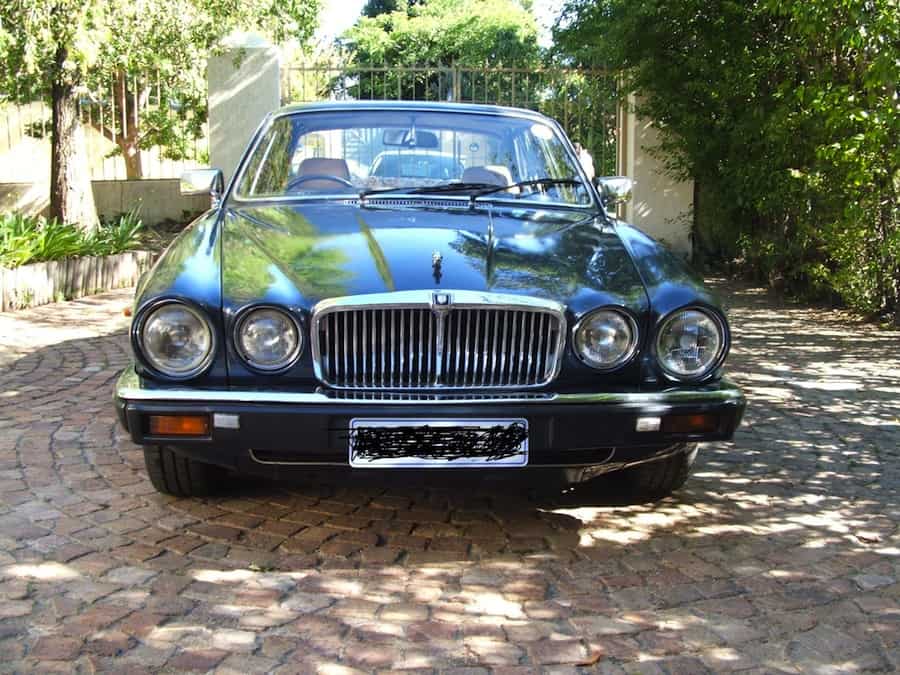
I used to sit in school and sketch the front end of the XJ in my notebook. Those who’ve seen me draw know that I tend to stuff up stick figures, but I could draw an XJ6, like the one to the right, in vivid detail (well, that’s my memory of it, at least).
Fast forward to late 1994 and the tragic passing of my aged grandmother. She had left her six grandchildren a modest endowment each and of course, I proceeded to do something I’ve been given to doing nearly every time I’ve got some spare cash – before and since – I went car shopping!
The one that caught my eye took me back to my Jaguar book and the memory of my father, who had passed away 9 years before. From memory, it was a 1978 Series II XJ6, finished in very patchy dark blue paint with equally patchy biscuit leather on the inside.
I was 24. I had very few job prospects and would have needed to borrow around $3,000 to complete the transaction. Doesn’t sound too tempting or too smart, does it?
The tempting part – and I should add, the very non-English part – was that this particular Jaguar XJ6 had recently undergone a transplant that was quite common back in the 1990s. It had a 350 cubic inch Chevy engine installed where the old Jaguar 4.2 straight six used to be. If you were a young 24 year old Aussie back in the 1990s, that was tempting. At least it was to me.
I took the car for a test drive, and loved it. It had power, noise, comfort and the promise of class (if I could just get it re-painted at low cost). It was theatre on wheels.
As you can probably guess, I didn’t end up buying the car. The need to get some direction in my life eventually won the day and I used the money left to me by my Nan to move to Tasmania and support myself through my first year of university. I’ve been here ever since and the degree I earned through the latter half of the 1990s has me in a position to shop for one of those modified Jags again one day.
Of course, my motoring interests shifted east from Britain, too. I got more interested in Saabs and that interest led to a whole new world of possibilities, one that I could never have imagined back when I was 24. My move to Tasmania led me to meeting my wife, too, which was the best thing of all.
——
As an aside, a quick look tells me there are currently two XJ6’s with V8 conversions for sale at the moment. I’d still like to get one of those, one day. Unfortunately, neither of them are dark blue. They’re not tasteful or pure, either, but I can live with that 🙂
——
One of the interesting side trips I’ve done, thanks to my association with Saab and the friendship of a wonderful bloke (and Jaguar driver) in England, is a visit to Jaguar’s Castle Bromwich factory in Birmingham and a trip to their heritage museum, which was still located in Coventry at the time.
As a side trip to our museum visit, we went and took a look at the site of the old factory in Browns Lane – the one I’d had such wonderful visions of as a teenager. Let’s just say that Browns Lane itself isn’t quite what I’d imagined it to be and the old factory had been flattened. It’s probably full of new housing by now. See the pic below (with Dave’s Jaguar XF-R included).
I’m sure this tells us a myriad of valuable information but having looked it over just once, I’m not sure what that information is. Given the criteria, it must be a pretty small sample size so I’m not sure it tells us that much, to be honest.
The Polk Disposal Loyalty Methodology tracks owners selling vehicles within six months of buying a new one.
Update: More information from Polk’s website:
This methodology measures actual vehicle replacement within household garages. The basic premise is that every time a new vehicle is added to a household garage, Polk looks for the disposal of an existing vehicle in the garage occurring within six months of the new vehicle acquisition.
That’s a bit clearer. I think it’s still going to be a reasonably small sample, but be that as it may…….
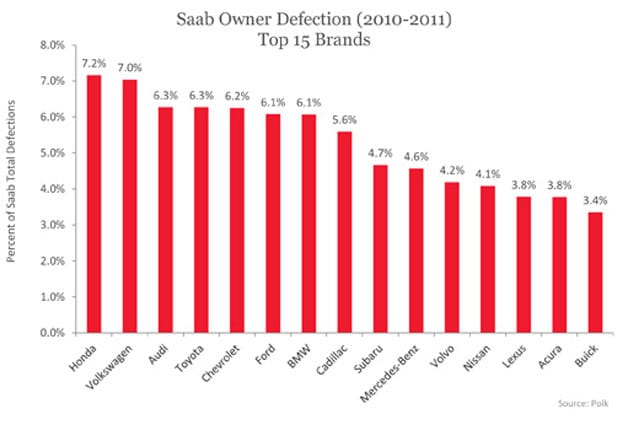
Saab tried to position themselves as ‘entry-level premium’ and it seems 34.4% of people agreed, moving either upwards or sideways in terms of brand perception after selling their Saab. The majority of people, however, moved ‘down’ from there, into one of Honda, Volkswagen, Chevrolet (shame!), Ford, Subaru, Nissan or Buick and I think that’s the bigger story here.
Note: 20.6% of their sample isn’t actually represented here. Presumably they moved to other brands in numbers too small to add to the graph and still have it make visual sense.
Saab didn’t do enough to justify their vehicles as actually belonging in the segment they aimed for. The driving dynamics weren’t up to it and the interiors most definitely weren’t up to it. The errors made, and the stubborn determination of certain people to stick to a certain pricing strategy in the post-GM era are writ large in this graph, even with the small sample size.
Have you moved on to another brand? If so, which one?
——
For what it’s worth, I now have an Alfa Romeo and a Subaru at home. I didn’t buy a new Saab in that time, however, so apparently my movements or thoughts don’t count.
A few people have mentioned their disappointment about the Citroen SM being left out of our poll of iconic French vehicles, which is fair enough. Everyone’s entitled to their opinion.
Million-mile Saaber Peter Gilbert left a link to this video in comments overnight and I think it goes some way to showing why the SM is so wonderful in many people’s eyes. I think it also goes some way to showing why it’s not the French icon that the DS is.
——
So why isn’t it THE icon?
1. It’s wonderful and mad, but at the end of the day, it’s just finishing the DS’s work. Would the SM exist if it weren’t for the DS?
2. Anything with that dangerous a brake pedal can’t be considered THE icon (merely my opinion).
3. If you’re going to go to the expense and trouble of featuring a Maserati engine, then you should get the sound and performance of a Maserati engine. Again, just my opinion.
——
I thought I’d throw in this final video for a little extra Sunday Citroen viewing. It features the Citroen GT concept as well as the Citroen Survolt electric concept. It’s remarkable for two reasons:
1. The cars are quite remarkable simply by their designs. And check out the engine note on the GT – wow!
2. The cars actually run quite well on public streets. Most concept cars are built to be able to reliably run for 60 feet or so – the distance from their hiding spot to center stage at a motor show.
The Saab Aero X had an old Opel V6 under the bonnet and could move from it’s carrier truck to a display stand. The Saab PhoeniX concept had a Mini engine and could move quite well but I never saw it move at speed like these cars are doing. I don’t think either of them had manoeuvrability like this. The one Saab exception I can think of is the EV-1 concept, which has been seen doing donuts in the past, at the hands of it’s creator, Bjorn Envall.
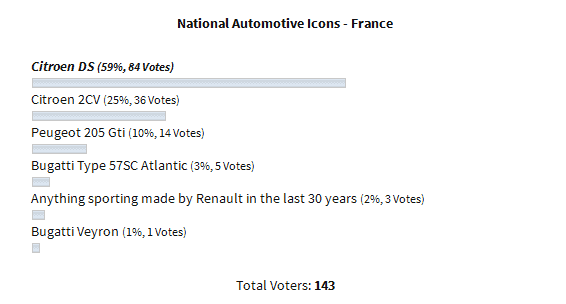
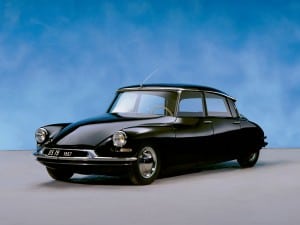
The number of votes was a little underwhelming, but the result is now beyond dispute. The Citroen DS is considered the most iconic French automobile by some of the wisest automotive enthusiasts in the galaxy – YOU!
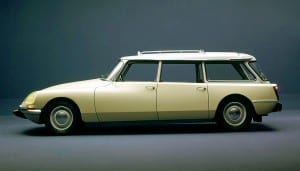
It’s a deserved result. Whilst the 2CV delivers plenty of ingenuity and has the French version of the common touch, the DS delivers style, comfort and technical innovation in bucketloads. And let’s face it, all that liberté, égalité, fraternité stuff is important, but style transcends all, non?
——
Next week, I think we’ll cross the Channel and vote on Britain’s finest. Four of the five initial nominations select themselves, I think. I’ll have to put my thinking cap on for the last one, however. Either that, or draft in some assistance.
You should give some consideration to your nomination, too.