In defence of: Saab marketing

Swade warned me this could be a tough row to hoe. After all, isn’t a company going into bankruptcy a pretty clear sign that their marketing has failed?  It’s certainly not the most positive demonstration of engagement with their customers. However, putting all that aside (even if you can’t, humour me…) I still think that Saab marketing got some things incredibly, timelessly right.

Let’s set aside the merciless taunting by the Top Gear chaps throughout their recent Saab piece about Saabs apparent fixation with jets – even ones they didn’t make.  Yes, it’s arguable that in many ways Saab marketing missed their mark and I too struggle with any of the marketing that tried to trade off the aircraft business. However, I believe that there is a also a case for Saab being one of the best marketed marques in the world.  How so? 

Bear with me while I take a mild digression to a comment made by a Swedish colleague of mine a few years ago.  Knowing my affection for Saab, this fellow loved to rib me about the company’s trials and tribulations as they unfolded.  On one particular occasion, he said something that more or less went like this:

“What is Saab, really? I mean, come on, try to define it for me. Volvo is a car company that is very easy to understand, one that make cars. A lot of cars. But Saab…. Saab is really just a very, very appealing idea.”

The fact he is from Gothenburg can perhaps account for something…… but nevertheless, it has remained as a telling comment in my mind. A very appealing idea. Perhaps that is part of the Saab magic after all?  
If you consider that Saab’s market share in any market except Sweden was never more than marginal in comparison to its competitors, the iconic nature of the brand is quite amazing.  Even now with the business completely removed from the market, I would bet that anyone you ask (literally, anyone) can offer a few words of recognition if you showed them a Saab logo.  It might be that they recognise a Swedish car company. Or perhaps more. This is how I propose, that Saab is in fact, a true success of branding and positioning – admittedly only a part of the whole marketing spectrum – far beyond the commercial value of its business.  

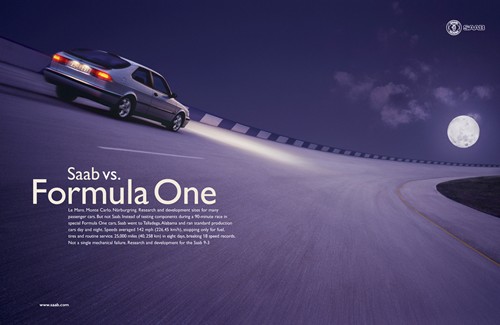
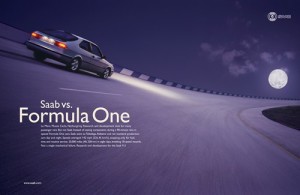
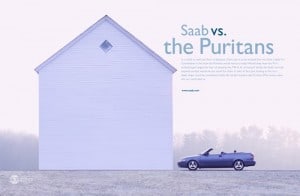
All this aside, how do I see Saab marketing doing this? Well, we could look at the Saab vs. advertising campaign, one of my favourites.  I’ve add three random images from this extensive campaign here to add some colour but perhaps you can see where I’m coming from.  This campaign seemed to take a direction that was original, bold and confident.  It captured performance but also looked into comfort, design, safety, lifestyle…and so much more. It seemed to say that Saab was about many, many aspects of life. Moreover, it cut to the quick of all of these aspects.  In comfort, who do you want to avoid? The chiropractor. In design, what do we mostly desire? Simplicity.  It goes on and in my view, it’s wonderful.

Nevertheless, if it’s not clear already, I’m not an advertsing guru or marketing academic and this is a not a comprehensive analysis of the Saab marketing campaigns.  I’m simply an enthusiastic bystander who sees beyond the current failure of the Saab business and finds a timeless element to the Saab brand that is irressistable.


GM Ditch Facebook ads – I’m not surprised

There was some major auto advertising news yesterday: GM has decided to quit advertising via Facebook.

They will still have their various pages on Facebook, but after analysing the results of their significant ad spend, they’ve decided that Facebook ads have little effect on their consumers and they’re going to save their money for use elsewhere.

There are two big takeaways for me from this article.

First, I’ve never been a huge fan of Facebook in general. I understand and agree that it’s a valuable tool that companies can use to reach their customers, however I’ve always questioned the depth of that contact.

Continue reading GM Ditch Facebook ads – I’m not surprised

The wisdom of farmers and their cows

We’ve been in the countryside for a few days and I was struck by a few stories told by our host. Let’s call him Farmer Dick (mostly because that’s his occupation and name).

As we were driving around a rather rainy southern Victoria, we saw a herd of cows all gathered in one corner of a paddock. They were bunched really close, all facing the same way and it’s fair to say that PJ and I were a little intrigued.

I asked Dick about this phenomenon over dinner and learned that it’s common cow behavior. When the rain is coming down persistently, they’ll bunch together and point their backsides to the weather in an effort to stay warm and also to keep the brunt of the rainfall from their faces.

Dick has another trick if he knows the wet stuff is coming, too. He likes to make sure they’re well-fed beforehand. A hungry cow will walk around looking for food and in the wet, their wandering can dig up the pasture a lot more than when it’s dry. A well-fed cow is more content to huddle with its friends and just work on digesting the food already in its belly. Farmer Dick and other farmers like him have this bond with their animals which helps them know their mood instinctively. They know when their cows are happy, when they are sad, when they are healthy, and when they need a lookover from a qualified Veterinarian. There’s something to be said about being in harmony with nature here.

Swade’s bottom line: If things are stacking up against you, just point your bum at what’s getting you down and wait until is passes.

——

Another story from Dick concerned some share farmers.

I can’t remember who the ‘person in authority’ was, but he came to address a group of farmers and in doing so, enquired about their relationships with the share farmers they were working with. This, of course, was none of his business as the relationship was between the farmer and contractor, but he was given a reply that satisfied him nonetheless.

He was told that the share farmers generally received a farm house that was in very good order, freshly painted and ready for them to move in and have a good, comfortable place to live as they worked the land. When the ‘person in authority’ asked if this was perhaps setting too high a standard, intimating that share farmers elsewhere would expect such generosity, he was told the following:

We expect their best, so we give them our best first.

Dick’s bottom line: Set the standard first. Show that you expect a high standard by giving generously or working diligently with your partners right from the get go.

——

Our thanks to Dick and Judy for a wonderful weekend.

Should a re-born Saab sell in the United States?

For the record, I think the answer to the question is ‘Yes’. But it’s worth exploring nonetheless.

There are plenty of cars that don’t get sold in the United States. Alfa Romeo, Peugeot, most Fiats, Renault, Skoda, just to name a few. Even Volvo have been re-thinking what they offer in the US and plenty of other car companies offer a restricted range, keeping some of their hotter models away from the US.

Why?

First and foremost, the margins are so small in the US market. You really need to have the economies of scale that Saab won’t have (for some time, if at all) to drive the cost down. Local manufacturing helps, too, as it avoids most of the freight costs that overseas manufacturers have to deal with.

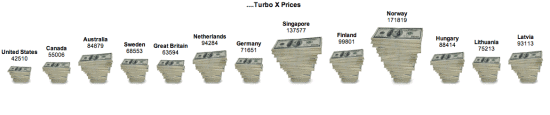
The reason why margins are so small, of course, is that the US is such a cutthroat market. I’ve covered it many, many times over the years, but new car prices in the US are very, very low compared to nearly every other market.

Some of you might remember my Turbo X comparative price chart from a few years ago…. (click)

That pretty much sums it up. That was back in 2008 and nothing’s changed from then to now.

US customers are very vocal, very aggressive, demanding the most features and at the absolute lowest price. The majority will unashamedly abandon you if you don’t meet those demands. Unless a product is overwhelmingly compelling, it’s likely that it will win the attention of only the most rusted on Saab fans.

Let’s assume a best case scenario and say that a re-born Saab may be able to manufacture the 9-3 in the near term after takeover, perhaps after modifying some bits and pieces. It’s not going to be a new car by any means and whether or not it would be beneficial to the brand to sell that vehicle in the US would make for an interesting discussion. The 9-3 is still an excellent car, but the automotive press in the US won’t be gentle when it comes to pointing out its ageing platform. Unless any pre-sale modifications are substantial, it’s arguable that an ageing 9-3 being the debut vehicle from a re-born Saab might actually be damaging to what should be a brand aspiring to move upmarket (for reasons discussed earlier in the week).

Another point to consider is the advertising investment required in order to make a dent in the US. It’s one of the world’s noisiest markets, requiring BIG dollars to make an impression. You could easily make a case for a new corporate owner keeping their powder dry for when they’ve got a new car to debut there.

——

Of course, the reason Saab should go back into the US market is because it’s still a place with huge potential. The brand is known there, it has a following there and it will have customers there. Those brands that don’t sell in the US are doing OK, but the US is still widely regarded as one of those essential markets for a successful company.

Over all, I think it will be important for a re-born Saab to return to the US. Any debate on the subject might relate to the timing. Perhaps they should wait for a genuine new vehicle to be ready prior to a re-entry there. They can work on established European markets first and build them as a beachhead prior to marketing in the US. There were plenty of European markets that should have done better for Saab in the last few years and concentrating on those, with their higher margins and cultural similarities might prove to be a better initial strategy.

A re-born Saab and price vs value

[cp_divide color=”#919191″ height=”1″ width=”100″]

There’s been an interesting discussion going on between some former Saab employees on one of the professional social networking sites. The discussion has focused one the things Saab could do to improve itself if/when the company is purchased and re-launched some time in the future.

My main contribution was concerned with better utilisation of the talent within the company. Personally, I felt that we made too much use of agencies to do work that we could or should have done ourselves. It might have meant hiring some more specialist staff, but done wisely, I think it would have centered our work/thought processes, produced some more consistent results and ultimately, I think it would have saved us money.

A recent contribution to the discussion has mentioned the need for Saab to build better product and the challenges Saab will face in doing so now that many key staff have gone to other companies. I agree that the staffing issue is a big one – people are usually a company’s greatest resource and that was definitely the case at Saab.

Ignoring the staffing side of this problem for a moment, the product side does warrant some discussion because I think, and fear to some degree, that Saab’s demographic and product offering are going to have to shift upwards if the company is to become profitable and build a sustainable market for the future.

Under Spyker’s ownership, Saab reportedly had a business plan that could see the company become profitable with sales of as few as 100,000 to 120,000 vehicles. We never got to test that plan and Saab never got their breakeven point that low prior to December’s bankruptcy, so it’s hard to comment on the plan’s viability.

But what of the future?

Continue reading A re-born Saab and price vs value

Cars I’ve owned – Holden LJ Torana

My first (and third) car was a Holden Gemini. If you missed that story, the link is your friend.

The first Gemini I owned was, shall we say, less masculine than an 18-year-old Australian boy would like. To its credit, it was a rear-wheel-drive car and Geminis could actually be quite fun to drive. BUT….. it was also Baby Blue in color. I didn’t cry too much about its sudden demise, which came courtesy of a freak thunderstorm and a rather large tree.

With the insurance payout burning a hole in my pocket, I set out in search of something that would give me a little more street cred. One of our genuine Aussie motoring icons. I couldn’t afford the most iconic version, as it turned out, but I did manage to snare myself a rather nice 1973 Holden LJ Torana.

For those who are unfamiliar, the LJ Torana can be quite a looker:

Mine didn’t look that good, unfortunately.

The picture above is of a GTR XU-1 model, a special hot edition of the Torana based on the cars that were campaigned quite successfully in endurance racing here in Australia in the 1970s. In fact, Australia’s most prestigious race, the Bathurst 1000, was won in a Torana five times during the 1970s, with four of those victories coming at the hands of the mercurial Peter Brock.

My Torana wasn’t the racier two-door model, as seen above. I had the 4-door sedan, but I also had the rear spoiler, 5-slot mag wheels and tinted windows. Unfortunately, I also had a “P” plate on the back – the sign displayed by law to show that the driver is a provisional (i.e. new) licence holder.

Continue reading Cars I’ve owned – Holden LJ Torana

Reconstruction

Hi all. It’s been a little while since I’ve added anything to the website. Here’s some jumbled up stuff that will hopefully go some small distance in helping to explain why.

——

The last thing I want to do is just write something for the sake of having something new for people to look at. Sometimes, if you consider yourself a writer, you do need to write for writing’s sake. That can come down to something as simple as enforcing self-discipline. I enjoy writing, but I’m not a writer, so I thought it would be OK to excuse myself for a week or so and look at some other things.

One thing that I thought might be worthwhile would be to simply be a consumer of online media for a week. I spent more concentrated time on some of my regular online journals, the purpose being to really take in what they’re writing and look at the structure behind their work, their methods. It didn’t work out well. Here are a couple of examples.

Continue reading Reconstruction

Stuff I like: The Beta Band

Like many others, I suspect, my first awareness of the Beta Band was via the priceless scene in the 2000 adaption of Nick Hornby’s 1995 novel, High Fidelity, where John Cusack (as Rob Gordon, owner of the record store Championship Vinyl) plays their classic Dry the Rain to unsuspecting shoppers in his store. 

Not only did Rob sink the hook into his customers, he sunk it into me too and I set off in search of this wonderful sound.   At this stage the band was probably pretty close to the zenith of its life. Having started quietly in Edinburgh, Scotland in 1996, they were really hitting a groove by the time of High Fidelity, only to call it all quits in late 2004.  Luckily, they seem to have recorded a great selection of both live and studio work, which remains for us to explore posthumously.

Why do I like them?

Dry the Rain seems to be often cited as their masterpiece and although I really, really like this song, my Beta obsession is founded in the fact that so much of their work is so good, you simply have to take time exploring the whole back-catalogue. 

Continue reading Stuff I like: The Beta Band

My Alfa GTV6 in Hemmings S&E magazine

I feel like a proud Dad!

The guys at the Hemmings group of magazines are long-time Saab fans so it’s no big surprise that I’ve got to know a couple of them over the years.

When I wrote about acquiring my Alfa Romeo GTV6 recently, I got an email from Mark McCourt asking if I’d mind if they did a little article on it in one of their coming editions?

Would I mind? 🙂

It was with great pleasure that I checked our PO Box today and found my copy of Hemmings Sport and Exotic Car for June 2012. And on page (sweet) 16…..

Nice.

It’s great to see those pictures in print and nice to share some of the good experience of buying the Alfa. I’ll have to do some film and an update soon.

—

Here’s the cover. Saab fans might want to note that this issue also includes a buyers guide for the Saab 93, 95 and 96.

—

Hemmings is a great magazine. If you’re into older cars with character then it’s a must read (esp for people in the US). I’ve had the opportunity to read through a number of editions from time to time as Saab stories have popped up in there. It’s well worth a look. Check it out at your local news stands or get a subscription from the Hemmings website.

Thanks to Mark and Dave at Hemmings!

ANZAC Day 2012

April 25 is ANZAC Day in Australia and New Zealand. It is the anniversary of Australian and New Zealand Army Corps troops (ANZACs) landing on a beach at Gallipoli, Turkey, on April 25, 1915.

Australia became a nation on January 1, 1901. Prior to that we were six self-governing colonies of the British realm, even if we acted like a nation in many respects.

The Gallipoli landing in 1915 was the first military action by ANZAC troops during the first world war and is generally regarded here in Australia as the point in time that we ‘grew up’ as a nation.

We don’t celebrate ANZAC Day because Gallipoli was a wonderful military victory. In fact, it was a disastrous defeat.

We remember ANZAC Day because it was the first time that we, as a nation, learned about the collective pain, sacrifice and heartbreak of war. We honor the sacrifice made by those who serve and choose to reflect with sobriety on the tasks our servicemen and women have undertaken in various theatres of war since Gallipoli.

The objective of the Gallipoli campaign was to take Constantinople, capital of the Ottoman empire (they were chummy with the German enemy at the time) and make the straits of the Dardanelles available to the allied naval forces. What ensued was an eight month campaign in an area now called ANZAC Cove – the Turkish government officially recognised the name in the 1980’s – that saw more than 10,000 ANZACs killed, along with 21,000 British soldiers, 10,000 French and over 1,000 British Indian troops. There were tens of thousands of casualties on the Ottoman side, too.

I’m not a pro-war person, but I do recognise the need to protect our borders, support our allies and be present and accounted for in a time of need. Today we remember those who have placed themselves in harm’s way on behalf of our nation. Some have returned, many have not.

The following verse, originally written by Laurence Binyon, will be recited in services all around Australia today.

They shall not grow old as we who are left grow old.
Age shall not weary them, nor the years condemn.
At the going down of the sun and in the morning
We will remember them.

LEST WE FORGET.

Exit mobile version