Porsche 968 Ownership Update

I thought it was about time I gave an update on the Porsche 968 experience. It’s my first time owning a P-car and it’s fair to say I’ve had my ups and downs with it.

Read on…..

Driving a Porsche 968 Clubsport is absolutely fantastic. It is – by some distance – the most impressive car I’ve ever owned in terms of road feel, handling and over all performance.

I went for a drive with a few friends at the start of the month. We covered around 180km of winding country roads and it was outstanding fun. The car didn’t miss a beat all day. It didn’t miss an apex, either. I experienced some of the best driving fun I’ve ever had and felt totally in control all day. It was a hot day but my A/C kept me cool with typical Teutonic efficiency.

Maybe the one word that best sums up my 968 is capable. It does everything it’s maker intended it to do with immense capability.

Inspiring? When you push it, it can be. Perhaps the problem with the 968 is that it’s SO capable that its limits are well beyond mine. Maybe I just need to get to know it better.

It’s not the most handsome car on the road, but it definitely has presence. I still prefer a 944’s styling to the 928-inspired nose on the 968. But I’m happy to put up with lesser looks to get the mechanical upgrades that make this car so enjoyable.

Owning a Porsche 968 Clubsport is proving to be slightly less fantastic than driving it.

First, there are my driveway problems. I’ve made a temporary fix in the form of some wooden platforms that lift the front wheels as the car goes over the hump. They do the job, but they’re a pain to lay out every time I want to use the car.

I have two basic choices to remedy this (three, if you count selling the car, which I don’t – yet). The first is to alter the driveway, flattening the degree of angle between the road and the descent. That’s going to cost around $4,000. The second option is to move to a new house, one that not only has a sports-car-friendly entrance, but also more garage, workshop and studio space. I’ve been exploring this option for a while now.

Next, there’s the occasional anti-Porsche sentiment you encounter. Porsche owners love Porsches. Aspiring Porsche owners love seeing Porsches. Most other people just think you’re some wealthy wanker that loves to show off – and given that I spent less on my Porsche than what they did on their new Camry, that can be a bit annoying. That anti-Porsche sentiment isn’t a huge downer and it doesn’t happen that often. But when it does, it’s usually in the form of aggressive parking officers, aggressive lane-protectors in traffic and other minor annoyances.

The final problem with Porsche ownership is the cost and hassle of maintenance. I bought this car with my eyes wide open. I knew that it’s relatively rare and will cost more to service than a regular car. Still, I didn’t expect this much hassle.

The first challenge you face is finding someone to work on the car that you’re happy with. This wouldn’t be quite the same problem in a bigger city, but here in tiny little Hobart, the simple act of finding someone you knows the car, someone that you can trust is a problem in itself. Thankfully, I’ve got that sorted.

The second challenge is the cost of parts and the labour cost involved with the work.

Right now, my car is still in pieces at a workshop in central Hobart. It’s time for the 120,000km service and given that it’s been four years since the last change, it’s also time to change the timing belts. I decided to get the brake pads done on all four corners, too.

My initial parts spend was $750 plus freight from the US. Since then, the mechanic called and told me to source a water pump and a timing belt tensioner, as well as a few associated ancillaries. There’s another $1,000.

Why source them in the US? Because as expensive as those prices seem, the parts would cost nearly twice as much if I got them from Porsche Australia.

I’m expecting labour to come in at no less than $1,500. Plus fluids.

Bottom line, I’m going to be up for something between $3,500 and $4,000 and that’s with nothing extraordinary being done.

And today, my parts supplier emailed me to say that the parts were going to take at least another three weeks because the US was out of stock and they’d have to be sourced from Germany. I’m tapping a 968-owning friend in the local Porsche club for another source right now.

The bottom line: Driving the Porsche is outstanding when I can get it out of the driveway and really drive it under the right conditions. Some cars can make driving to the local shop an experience to behold. The 968 needs a bit more provocation than a leisurely stroll down the street to justify the difficulty of getting it out of the driveway. Personally, I think that’s a bit sad.

When you DO get it in the right scenario, though, it’s absolutely outstanding.

——

Weekend Reading – Alfa 4C, Sad Corvette, Lotus Bike, Epic Art, Bond Cars For Sale

Porsche Problems

[dropcap]S[/dropcap]omething must be really wrong with the Porsche 911 GT3 because Porsche have told owners to stop driving them.

As owners of early Boxsters and 996’s with cratered engines will tell you, Porsche aren’t always up-front about their problems.

——

Alfa Romeo 4C at Goodwood

On a brighter note, here’s the new Alfa Romeo 4C dominating the hill at Goodwood. Early reviews of this car weren’t always completely complimentary but it seems that time is winning people over as the little Alfa bares more of its soul.

I definitely have one of these on my long-term “must own” list. I just hope someone comes up with a kit to fix those awful headlamps.

——

VW Golf GTE

First there was the GTI. More recently, the GTD. And now there’s the new Volkswagen Golf GTE and I’ll be very interested to see how it’s received in the marketplace.

The GTE, by virtue of the GT precursor, is apparently going to be a somewhat sporty Golf with a plugin hybrid powertrain.

The Volkswagen Golf GTE pairs a turbocharged 110kW/250Nm 1.4-litre four-cylinder petrol engine with a 75kW/330Nm electric motor, which combine to produce 150kW of power and 350Nm – leaving it just 12kW shy of the regular petrol-powered GTI, but matching it for torque, while conversely it’s 15kW up but 30Nm down on the diesel GTD.

The chassis details haven’t been released but give this it the GTE, the handling’s not really the drawcard. If the handling’s decent, that’ll be a bonus.

The headline is a 940km driving range, a 50km all-electric range and fuel consumption of just 1.5l per 100km. That’s 156 mpg in the US scale. Like I said, if the handling’s any good, then it’ll be a bonus.

Given the Golf’s already-stellar popularity around the world, I reckon this could be a notable hit – if the packaging and the price is right.

A big if.

——

Bond Cars for Sale

59 vehicles that have featured in James Bond movies over the years are about to go up for sale – but there’s a catch.

The vehicles are nearly all the real deal as used in the films, although there are a few replicas as well (e.g. Pussy Galore’s jet). There are no less than six (6) Aston Martins in the collection, as well as the Lotus submarine, a tank, the remote controlled BMW from Tomorrow Never Dies and even a Toyota 2000GT.

Right: Yes, Oddjob’s Roller is part of the collection.

Normally you’d expect a collection like this to have been built up over decades by an enthusiast who just happened to be a successful businessman/woman as well. Not so, in this case. The seller, Michael Dezer, started the collection with a Land Rover from Skyfall in 2011.

So there’s not so much romance here, but there is a genuine Bond collection for sale and it’s not so often you see so much stuff from one source, in one place.

The catch? If you’re cashed up and you want to pick up your favourite Bond car, you might be out of luck. The seller prefers to sell the collection as one complete lot. The asking price is said to be close to $40 million, so you’ll have to be really cashed up.

Click here to see the full list of vehicles for sale.

——

Corvette Cash-in

Speaking of not-much-romance………

I guess the age-old rules of economics apply here, but I just can’t see why a low-mileage ’67 Corvette with vinyl seats is worth around $750,000.

That’s the price expected when a sub-3000-mile Corvette goes under the hammer at Mecum’s Houston auctions in April.

The story, in brief: Donnie McNamara was a US soldier who got lucky and won $5,000 in Vegas. He went straight to a Chevy dealer and bought the Corvette of his dreams. Donnie was a little less lucky in life, however, and couldn’t afford to register and insure the car. It sat in his garage – save for a few runs under cover of the night – until his death in 2011.

Donnie had no family, so he left the car to a neighbour he’d befriended. The neighbour sold the car a few years ago to a doctor and now the doctor’s looking to cash in at auction.

Like I said, not much romance here.

You can read the full sad story over at Hemmings.

And if you’ve got any good reasons as to why an old Corvette’s worth up to $800,000 then please leave them in comments. Yeah, it’s a big block C2, but still……

——

Lotus Motorcycles

I’m not a motorcycle kind of guy, but purely based on their looks, one of these new Lotus motorcycles could get me interested.

Not likely, though. I’d kill myself on a little pee-wee 50, let alone one of these beasts.

But damn, that’s one sexy piece of machinery.

It’s not really a Lotus, by the way. A German firm has merely gained permission to use the name (by greasing Lotus’ palm with plenty of $$$$). I presume they only got a hearing because the bike promises to be damn good, though.

——

Amazing Car Art

And finally, check out some amazing car art, by a guy named Miha Furlan, from Slovenia. Quality A3-size prints are available for just €33, which is pretty good value.

——

SWE vs CAN

Hope you’ve all had a great weekend.

I’m staying up late to watch the hockey final. It’s Canada vs Sweden so I’m really torn on this one. I guess you could say I’ll be a winner regardless of who wins. But then I’ll be a loser in the same way.

I hope your team wins.

——

Fantasy Friday – Jensen Interceptor

Italian styling. American muscle and reliability. British class. And the best name in the history of cars. That’s the Jensen Interceptor.

The Jensen Interceptor that we’re talking about here is the 1960’s and 70’s model. There was an earlier Interceptor, but that was a totally different car. The one we’re looking at today is the big GT with a classic stylish body, 7 hides of leather and either one of two massive Chrysler-sourced engines.

About the Interceptor

The Interceptor started life in the 1960’s, before all the anti-pollution gear took over in some countries. As a result, you get a big V8 engine that made some real horsepower (for the time) – 270hp in the 383 and between 305hp and 330hp for the 440, depending on when you bought it. The engine is most commonly driven through a 3-speed automatic transmission. A handful of 4-speed manual were built, but you’d have a better chance looking for rocking-horse poo than finding one of those.

The body of the Interceptor was styled by Carrozzeria Touring. It’s a massive coupe with a rear window that you wouldn’t want to have to replace very often. That rear window is the entire hatchback door and you get a reasonable amount of cargo space behind the rear seats.

Those rear seats are actually useful, too, because the car is so well proportioned. The front features leather and wood in the early series cars. The second and third series lost some of the classic wooden touches inside but had plenty of leather and a more contemporary looking dashboard, too.

Jensens come with reasonably simple, US-sourced mechanicals. The main danger is over-heating and the damage that heat can cause to poorly maintained hoses and wiring. A bigger problem is bodywork. Jensens feature great build quality but there is plenty of potential for rot and it can’t always be seen on a regular inspection. Interiors are hard-wearing and the earlier ones are regarded as having better materials, but the youngest Jensens are nearly 40 years old, so there will be some wear.

——

The ‘modern’ Jensen.

The Jensen has spawned such a devoted following that there are still dedicated repairers in various places. I even managed to track down one here in Australia.

In England, though, you can actually get a Jensen re-built using all modern parts. Jensen International Automotive will replace the original Chrysler lump with a Corvette engine and update a whole host of other parts, too. New 6-speed gearbox, new suspension, new LSD, new steering rack, bigger wheels and tyres over new bigger brakes.

They can do a supercharged version, too, producing around 550hp. That version gets wider wheels and traction control to keep you on course.

The reviews of the JIA Interceptor S are good, but the price of entry is steep at well over £100,000.

——

For Sale

The car you see for sale below is a 1969 model and is regarded as a Series 1.5 car, which might just be the pick of the bunch. it features some of the Series 1 classic touches, but gets some of the driver comforts of the Series 2 that were missing on the Series 1 – power steering is the most obvious one.

The car’s had a cooling system update and is fitted with LPG to keep the fuel bills down. Ignition has been adjusted accordingly. The LPG tank in the boot is covered with carpet and doesn’t look too out of place, but will inevitably encroach on your storage space.

The car is for sale right now in Victoria, for around $21,500. That’s a nice price for a classic Englishman that might run out of fuel, but will never run out of style.

If you’ve got 15 minutes, here’s a 2-part video highlighting the Jensen Interceptor and the rise and fall of the Jensen motor company.

——

What’s The Attraction Of a Barn Find?

[hr]

The first few times I heard about a “barn find”, it was a case of someone finding something highly desirable that had been stored for years, with the owner of the barn generally not really knowing the real value of what they had. Sometimes the barn owner didn’t even know the car was there (if you believe all the stories).

In other words, the Barn Find story was as much about the fortunate nature of the transaction as it was about finding an old car that had been reasonably preserved.

That’s the way I look at it, anyway.

Road and Track reported on a “barn find” today. It’s the story of a genuine Ford GT40 that hasn’t been driven since 1977.

Here’s the rub:

Shaughnessy said that after a year-long bidding war, he recently took possession of GT40 CSX1067 from its previous owner, a retired fire fighter who owned the car since 1975. According to The Gentleman Racer, the GT40 sat idle since 1977 due to engine troubles, and health problems prevented that owner from getting too far into the necessary repairs.

When we asked what Shaughnessy paid for the car, he would only concede that it was “very expensive.”

Now, I think it’s great that a genuine hero car of a bygone era might be made to run again. That’s fantastic. But it lacks the magic of a real barn find story to me. If it was picked up for $10K the buyer knew what it was and seller didn’t, then that’s a little bit of magic (unless you’re the seller, of course).

This story, aside from the potential resurrection of a once-great car, is just an old car in poor condition being bought for a bucket load of money.

If you were inclined to be a little more cruel, you could say that the former owner has profited from his base-level neglect of a car that he should have looked after (and as far as I’m concerned, the more prominent the car, the greater the responsibility to be a conscientious owner).

What do you reckon? I concede that I may have the barn find thing all wrong, but if that’s the case then it takes the lustre off the whole scenario for me, personally.

Although it was ‘expensive’, I hope it was bought at a significant discount to what someone would pay for a similar car in good condition. That wasn’t the case for the Mercedes gullwing sold recently, though I’m a bit less conflicted about that one.

——

Saab Sonett V6 – Who you calling bignose?

[hr]

This car popped up on Bring-a-Trailer today and I couldn’t resist sharing it here.

I’m all for preserving the beauty of the Saab Sonett but I don’t mind the odd journey into the unknown, either. The Sonabusa is testimony to that.

So here’s a Saab Sonett that was modified by a previous owner, some time in the 1980’s, and fitted with a V6 engine out of a Ford Mustang.

The regular Saab Sonett III has a bit of a hood bulge already, to accommodate the Ford Cologne V4 they put in the car. You can imagine putting a V6 in there might necessitate a slightly larger hood bulge – and you’d be right.

Here’s the new lid, from side on…..

And here’s how it looks with the lid closed….

Hmmmm. Not that great. I reckon some sort of shaker setup might look a little better.

I imagine the car’s a bit front-heavy with that bigger donk in it, too. A potential buyer would really want to evaluate the driving experience and compare it with the light-weight tossability of the regular Sonett.

The rest of the car looks OK. No mention of the floor pans in the ad, or the tinworm that can plague them, but the interior is tidy and the fibreglass body looks OK too. I’m not a fan of non-black at the back, but that’s nothing a quick trip to the painter can’t fix.

The current owner’s put a fat looking dual exhaust on the car and it reportedly has new brakes, new master cylinder, a new Holley on the V6, a new clutch and new tyres.

Colour me interested, intrigued, but not yet impressed.

The car’s for sale in Huntersville, North Carolina and the ad’s on Craigslist.

——

How Do Car Companies Make Money?

[hr]

This is the first part of a series that I started writing last year. Most of the second part is written, too. Let’s see if I get to the third part.

[hr]

A full-service car company is a busy, busy place. Technical development, engineering, engine development, refinement testing, crash testing, safety labs, exterior and interior design, marketing, public relations and much, much more. And it all costs money — a L-O-T of money.

There are three basic ways in which car companies make their money:
1) Vehicle Manufacturing and Sales
2) Parts and Accessory Sales
3) Financing Services

Let’s work through those in reverse order.

Financing Services can make a company some serious coin. Cashflow is the oil that lubricates the whole company, so a manufacturer that has its own finance arm has a distinct advantage over its non-financed competition, including the ability to earn money in a wider variety of ways.

There aren’t many dealers that have the liquidity to fully stock their dealerships. Dealers use credit facilities offered by the manufacturer’s finance arm to get cars in their showrooms at favourable interest rates. The dealer not only gets competitive financing, they also put more cars in their forecourts to sell and those vehicles are booked as sales for the manufacturer. When it works (ie: when the company has a desirable product to offer) — it’s a win-win situation.

The finance company can also underwrite lease deals, loans for customers, and even insurance, earning the manufacturer ongoing interest revenue on top of the initial sale of the vehicle.

Car companies might also employ the services of financial advisers to deal with all the budgeting and paperwork needed for a smooth flow of business.

Now much can financial operations contribute to a car company? In the third quarter of 2003, General Motors made just $15 profit per vehicle as a manufacturer. Its finance arm, GMAC, contributed three times more than manufacturing towards the company’s profits that year. Bear in mind that those were troubled times for GM with onerous labour contracts but still, there’s no doubt that GMAC carried the company through those turbulent times.

GM sold 51 per cent of GMAC in 2006 in order to raise some much-needed cash. No wonder there’s been talk for a few years about a restructured and financially stable GM wanting to buy it back.

Parts and Accessories are a matter for another article, but when Saab Automobile filed for bankruptcy in December 2011, the only arm of its operation that wasn’t included in that filing was Saab Parts. That should tell you something about how profitable spare parts can be.

Let me elucidate a little more so that you understand better! Imagine a scenario where you have had a Volswagen Sand Rail for quite some time as your trusted friend in your off the road adventures throughout the country, and it suddenly stops working one fine day. Would you not be heartbroken? You definitely would! So, what you could either do is find an alternative that looks or sound like sand rail for sale or get it checked out by a professional for any damage in the car parts. If he does find an underlying issue for your existing (but dormant) VW, he would need genuine parts from reliable dealers to get it fixed. This is just one of the million examples to show how the parts and accessories of a car manufacturer prove vital to their net profits throughout their lifetime! But that is a discussion to be kept for later!

That leaves us with vehicle manufacturing and sales.

Car companies exist to develop, build, and sell cars. This is essential for feeding the Parts and Finance arms of the business, but they can make bucketloads of money selling cars if they do it right.

Manufacturing is the spring from which all other elements of the industry flow and it’s also a good source of income if you have strong enough margins. That means building the price up and keeping costs down — neither of which are easy. One way to help cover the costs is to take out a business load. Of course, different places have different factors for a loan, and you could find what kind of loan you could get by searching something like ‘business loan philippines‘ or wherever it is you decide to open your car service.

If you’re wondering why every car company wants to move into the premium/luxury segment, it’s all about the margins. This is why Toyota created Lexus, why Nissan has Infiniti and why GM is so fixated on making Cadillac a global brand. Essentially, companies can ask much more money for upmarket cars, even though the incremental added cost of taking what might be considered as a generic chassis and applying premium parts is relatively small.

Let’s look at an example from a company with which the writer is very familiar. I covered the operations of Saab Automobile for nearly seven years, including the sale from General Motors to Spyker Cars in early 2010. In addition, I worked for Saab Automobile in 2011 until their bankruptcy in December of that year.

In Saab’s case, it would make, on average, around US$5000 on its bread-and-butter model, the Saab 9-3. You can increase that amount by around US$3000 for a 9-5 large sedan, a 9-4x SUV or a convertible 9-3. You should note that that figure is a qualified estimate, but a reliable one that changes from country to country and according to currency fluctuations. Also note that other companies in the same segment would benefit from better economies of scale. Move either upstream towards the luxury segment or downstream towards volume and you can adjust those margins up or down accordingly.

Saab wanted a small car but did not have the money to develop it. If it had made that smaller vehicle, however, the margin would have been around US$2000 per vehicle.

With materials and labour accounted for, the remaining margin per vehicle has to cover all the other aspects of the company’s operations: technical development, safety, crash testing, NVH, global marketing resources, events, PR…. and many more functions.

Indeed, the car industry has an insatiable hunger for cash, so it’s important that companies develop a product mix that’s profitable and sustainable. That leads us to model/segment choice – in short, how to get the greatest output from your inputs.

Picking the right segment of the market is essential for remaining profitable because of the cost/margin relationships that prevail. In this regard, car companies generally maintain detailed records of their car sales based on the model of the vehicle, the location of the vehicle, the income brackets of customers, and the availability of financing. In this way, they could allocate additional funds and formulate a strategy to eliminate specific obstacles that impede car sales. For their financial strategy, they often hire accountants who analyze profit-loss statements, sales records, and assist with corporate tax returns (if interested, visit “accounting services canada“).

The costs for developing a small car and a large car don’t actually vary as much as you might think. The larger car will indeed cost more to develop, but it’s a matter of degrees. Call it a ratio of around 1:1.25. At the sales end, however, the company can command a price for the larger car that’s more in the 1:1.5 or even the 1:2 range, depending on the size and perceived luxury difference.

Customers will accept paying a lot more for a larger car without a thought given to the fact that both large and small cars go through the same development and manufacturing processes. The larger car’s ride and engine are usually more refined, the car is usually more powerful and there’s more space to give an impression of luxury, comfort and safety. All those extras justify the price difference in the mind of the consumer and importantly, if they’re well executed, they deliver a driving experience that builds brand loyalty.

Regulatory costs are remarkably similar. Both cars have to get government certification; both have to be crash tested, climate tested, pollution tested, economy tested and so on.

The costs to manufacture aren’t that different, either. Both cars need panels, four doors, glass, an engine, a gearbox, interior carpets, a dashboard, four wheels and tyres, et al. Getting some components in more premium materials and slightly larger for a larger vehicle does cost more, but the increment is fairly small compared to the price the end product can command. Fitting those parts together is basically the same process whether the vehicle is large or small.

Premium manufacturers can make a $2K margin on a small car or an $8K margin on a larger car. If you were allocating resources inside a car company, which one would you choose?

It’s logical to think that the smaller car will sell at a lower price and therefore may appeal to more people, but it’s also subject to more competition and, in the premium sector, reduced desirability.

For premium manufacturers, larger vehicles still outsell smaller vehicles. The Audi A4 outsells the A3 by a large margin. The BMW 3 Series Sedan is not a small car by any means and it outsold the entire 1 Series by nearly 70,000 vehicles in 2012. Both were outsold by the 5 Series.

The vehicle that saved Porsche early in the new millennium wasn’t the 911, it was the Cayenne SUV (which has been Porsche’s best-selling vehicle since it was first introduced). In the premium and luxury sectors, to an extent, bigger is better.

Another recent trend has been for companies to entrench their smaller vehicles even more firmly in premium territory. Hence we have the movement towards premium small cars: the Fiat 500 Abarth, RenaultSport models, Alfa Romeo’s MiTo and Giulietta, BMW 1 Series, the Mercedes A-Class and the car that started the whole movement, the MINI Cooper.

Margins for everyday small-class vehicles are much thinner than the $2K estimate for premium small cars and companies can’t make up losses by selling in greater volume.

Mainstream brands such as Toyota, Volkswagen, Holden, Fiat, Ford, Honda, Mitsubishi and others all face constant pressure to improve their vehicles whilst keeping them affordable. Now that Hyundai and Kia are mainstream, they have joined the others in trying to head off the next looming challenge from Chinese car-makers.

Making money in the car business is no easy task. You’ve got margins to play with, but they’re not huge and every decision you make involves a compromise.

Cost vs quality. Smaller segment vs brand perception.

The smaller your company is, especially in terms of model diversity, the finer the line you have to walk.

Get your formula right, including some genuine size and synergy (hello, Volkswagen Audi Group) and you can make a ton of money and secure your future.

[hr]

Next: Model Design And Development

——

Fantasy Friday – Mazda RX-7

[hr]

Ah, youth!

What do they say? Youth is wasted on the young?

When I was a 14 year old kid, there was no hotter car than the Lamborghini Countach that adorned bedroom walls all over the country. The Countach was made from unobtanium, though. The hottest car you could see on the street and dream about owning was the Mazda RX-7 – and it was sub-zero cool.

The RX-7 had all the attributes – two doors, swooping lines with a small cabin and a long nose, the all-important pop-up headlamps and some weird engine that nobody else had. It made Mazda stand out from the crowd and gave them an air of quality and sportiness that other Japanese companies simply couldn’t match (later to be extended by the MX-5).

The Mazda RX-7 debuted in the late 1970’s and the company produced more than 800,000 units over eight series, right up until 2002.

I can remember driving a Series 7 model with the twin-turbo setup in the early-mid 1990’s and it was the fastest car I’d ever driven at the time. Pure exhilaration and a very well finished car. The series 7 and 8 cars still look fantastic today, actually.

But the car that started my RX-7 dream was the Series 3 and that’s the model I want to focus on today. This was the last of the original shape RX-7’s. It not only looks sporty, but in the right colour it also looks really classy. I was especially fond of it in metallic medium blue.

The early RX-7’s weren’t blessed with heaps of power or torque, but the lightweight rotary engine helped keep the weight down to around 1,000kgs so power-to-weight was competitive for the time. Weight distribution was 50/50 thanks to Mazda’s mid-forward engine configuration along with a rear-wheel driveline.

I had a ride in a workmate’s 1985 model Series 3 car during the week and two things stood out to me:

  1. The RX-7 is very 1980’s but it’s aged extremely well. The dashboard does look dated now but it’s comfortable inside and it still feels special when you look around the cabin.
  2. The light weight makes a difference. The 12A engine only put out just over 100hp and the early 13B only 30hp more, but Matt’s RX-7 got down the road very nicely. We didn’t get to drive it through any twisties but I reckon it’d be a very nice car for a cruise.

This video’s not particularly good quality (it’s a recording of TV show) but it’ll give you a nice 5-minute overview of the Series 3 RX-7.

——

For Sale

There are no RX-7’s for sale in my favourite blue at the moment, so here’s one in a more common red. I picked this one because it’s got the much more attractive grey/black interior. There are quite a few nasty brown interiors out there but I’d avoid those if I were looking around. Brown hasn’t dated well.

This car has aftermarket wheels and seats and it looks pretty tidy, over all. It’s for sale in South Australia for $11,500.

Yes, RX7’s are holding their value nicely.

——

2014 Automotive Bucket List

[hr]

We’re a month-and-a-half into a new year and I haven’t done my automotive bucket list yet. C’est Terrible!

The list is just a self-indulgent indication of the cars that interest me most from year to year. Car’s that I’d like to own before I die (according to this year’s thought processes, at least). If I had spare cash and spare garage space, you can bet that I’d be using both to add one of these to my tiny fleet. Of course, should cash and space become available, this list becomes all the more important 🙂

Last year’s Automotive Bucket List read as follows:

  • Jaguar XJ6 with a V8 implant
  • Alfa Romeo 33 S 16V Permanent 4
  • Saab 9-5 Aero Wagon
  • Porsche Boxster S
  • Saab Sonett III
  • Alfa Romeo 105 Series GTV
  • Mercedes 500SL
  • RenaultSport Megane

As always, the list changes with time. Tastes change, and occasionally you get to scratch an itch by actually buying a car. So, I’m dropping several cars from this list for the reasons outlined below.

  • Alfa Romeo 33 S 16V Permanent 4 – One actually came up for sale 2 weeks ago. It’s sold already. These cars rarely become available and it’s a matter of being cashed up and ready to pounce. I’m not sure I have the patience, but aside from that, I also have other boxer-engine Alfa plans. Read on 🙂
  • Porsche Boxster S – The purchase of my Porsche 968 CS in 2013 has made this goal redundant. I’ve got my Porsche. I’m not sure that I’ll have it forever, but I’ve got it now and don’t feel a pressing need to own any other Porsche in the future.
  • Mercedes 500SL – it’d be nice, but it’s very unlikely. To be honest, if I was going to go for a convertible, I’d probably look for another MX-5 (it’s the MX-5’s 25th Anniversary this year, which makes no difference, but just means they’re crossing my radar a bit more).
  • Alfa Romeo 105 Series GTV – As per the Permanent 4, I’ve got other Alfa plans on my mind. Consider the 105 as being always on my radar, but on the fringes.

Those are the ‘outs’. So let’s have a look at the list in full for 2014, with the ‘ins’ noted where appropriate. As always, I provide an example of one for sale, where available.

[hr]

Jaguar XJ6 with a V8 implant

Yes, I still want to go here. It’s down on the list, in priority terms. It’d be the third or fourth car if I had the room and the budget. But it’s still something I’d like to do at some stage.

I’ve always loved the classic elegance of the XJ6 and the practical (and cheap!) power from a Chev V8 would be fun, if not quite as refined.

Scouring the classifieds this year has revealed slim pickings in terms of quality (as well as a nice variation in an XJS with a V8 conversion – well, nice if you like yellow!). I’ve definitely seen better finished cars in the past.

This white XJ6 looks to be the pick of the bunch right now, with a Chev 350 and LP Gas conversion. It’s for sale in South Australia for $3,000.

——

NEW! – Alfa Romeo Sprint with 16V conversion

To me, this is the holy grail of all boxer-engined Alfa Romeos. And I LOVE boxer-engined Alfas. This project would combine my favourite boxer body – the Sprint – with my favourite boxer engine – the 16V from the last Alfa 33.

Sprints come with an 8V engine that makes somewhere between 90 and 105hp depending on configuration. The 16V engine puts out an extra 30hp and is much more torquey, making it a genuine pocket-rocket.

The Sprint and the 33 share the same basic platform so the transplant is quite achievable. People have done it before, so this is not pioneering work that involves lots of trial and error. The complexities include changing the front crossmember and adding all the fuel management you need. You might want to upgrade brakes as well.

The trick would be getting the right donor vehicles. 16V engines are pretty solid so I’ve got no problems with the idea of picking up a 33 with a beaten body on the cheap. As long as the chassis is straight and the motor/gearbox run OK, it’s no problem. And they’re available for good money, too, like this $1,000 car in Melbourne.

Getting the right Sprint is a tougher task. Good bodies can be hard to come by, but they’re around. This one down the road from me (pictured, above) needs just a little remedial work, so might end up a good candidate. Being a local car is a massive bonus.

——

Saab 9-5 Aero Wagon

I hate to admit it, but the 9000 Aero I bought last year was/is a dud. The transmission blew last year (2 days before a scheduled road trip holiday) and whilst I’ve installed a new (old) one and the car is driving fine now, there are a few remaining electrical niggles that persist. The whole situation’s left a bad taste in my mouth, which is bitterly disappointing as I love the 9000 in general. This will be our last one, though.

In its place, hopefully sooner rather than later, I hope to get a Saab 9-5 Aero. We need a spacious wagon to carry all of PJ’s art and market gear so the 9-5 would be perfect (as the 9000 has been, in terms of load space). Add in all the creature comforts and the swift-but-smooth drive of the 9-5 Aero and it’s a highly desired model.

The car pictured has just 173,000kms and is for sale for a tad under $7,000 at the moment. I’ve spent more than that on the 9000! If it’s an honest car, then that’s one heck of a lot of car for the money.

——

NEW! – Lancia Fulvia 1.3s

This should come as no surprise to regular visitors to this site. I’ve been watching Fulvias for the last 12 months and would desperately love to get one, one day. In fact, the Fulvia is the other reason why a 105 series Alfa has taken a back seat on this list.

The Fulvia I’d love to get is the Series 1 1.3s model. It combines a little more engine poke with original spec aluminium doors, bonnet and boot-lid. This makes it a lightweight throw-about with oodles of character and Lancia’s famed engineering.

I probably should have grabbed the red Series 1 that came up for sale last year, but I was rightly concerned about it’s body and the owner was difficult to deal with. Series 1 cars don’t come up that often and those that do – if they’re in good condition – command a healthy price.

There are two Fulvias for sale that I can see at the moment. The one pictured is a series 2 car and I reckon the owner’s asking a little too much, at $23,000.

——

RenaultSport Megane

Another perennial favourite. Last year I showed the new series Megane but this year, I’m happy to settle for the older series, the one with ‘the bum’.

A distinctive shape, a 2-litre turbo, outstanding handling and a hatchback. What’s not to love?

The model photographed is a 225hp Cup model. It’s the less attractive, but more practical, 4-door model in Prussian Blue and it’s selling at a very attractive ,500.

——

NEW! – Alpine A110

OK, this is not really serious. Maybe if I win the lottery or benefit financially from the passing of a rich Aunt (that I don’t know about). Call it a long-term bucket list goal of the highest order.

I didn’t know anything about the Alpine A110 until Alpine made a 50th anniversry tribute model a few years ago. Since then, it’s been my cult car de jour. I can’t get this beautiful little machine out of my head and what’s most surprising is that for a car with it’s beauty, performance and pedigree, it’s actually almost affordable. OK, maybe not affordable, but it’s not stratospherically priced like a lot of classics.

A110’s were built primarily in Dieppe, France, but you’ll pay big money for one of those (I spotted one for 85,000 today). If you can stomach one of the less desirable ones made in Spain then you can pick one up for nearly half the price. The car pictured is for sale in Switzerland for 45,000.

Not exactly affordable, but not six-figures, either.

——

Saab Sonett III

Do I even need to explain this one?

I thought not.

——

Cars Made With Lego

[hr]

Who doesn’t love Lego?

OK, maybe parents who step on stray bricks in bare feet on a regular basis? But apart from them, who doesn’t love Lego?

I don’t know why I got to thinking about it, but I decided to look around the net for cars made from Lego….. and there are tons of them.

Here are some of my favourites.

Ford Explorer

Here’s a giant Ford Explorer made out of 380,000 Lego pieces. This was a joint effort between Ford and Legoland Florida. It was said to be the first effort in a long term partnership between the two but I can’t find any examples to suggest the partnership is ongoing.

——

Volvo XC90

Meanwhile, on the other side of the US, Legoland California put together this Volvo XC90 for display back in 2004. I can’t find a photo, but I’m pretty sure I saw this car in person at Swedish Car Day in Boston, back in 2010. Pierre?

Anyway……. it’s big, it’s blue and – fitting for a Volvo – it’s made out of bricks 🙂

——

Ferrari F1

Another full-size Lego-mobile, but this one comes with a couple of life-size Lego men that you can sit inside it 🙂

——

Tyrrell P34 6-wheel F1 car

Let’s move down in size a little from those monolithic Lego creations to something a little more of the size you might build at home.

The Tyrrell P34 might be a blip in Formula 1 history, but like most automotive blips, it’s a popular, interesting and notable blip. Tyrrell shocked the F1 world when it unveiled the P34 in the mid 1970’s and the icing on the cake came with a 1-2 finish in the Swedish Grand Prix of 1976 – the car’s only Grand Prix win and the only win ever for a six-wheeled car.

This Lego model of the Tyrrell is a wonderful example of a fan’s dedication, with the most important bits all in place right down to the small front quartet of wheels balancing out the two large rear wheels. You can see more here.

——

V8 engine

OK, so it’s not a car, but it sort of crosses the bridge between what you’ve just seen and what you’ll see in a moment.

There are a few Lego engines out there but I especially liked this one thanks to the distributor and the glowing leads meant to show the spark. This video starts slow but he cranks it up a little around the 55 second mark.

——

Full Size Lego Driver!

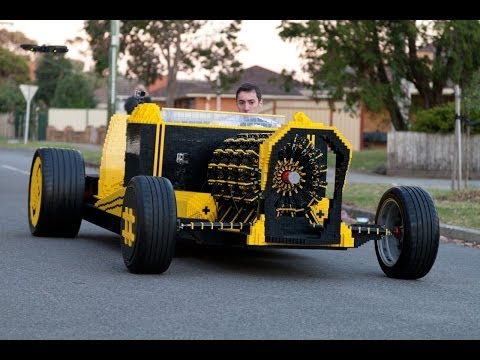
OK, let’s up-size again. But this one’s notable because it’s full-size, it works – and it was built in Australia 🙂

The basic figures: 4 orbital engines, 256 pistons and around 500,000 pieces of Lego! There are only two non-Lego parts, which are the struts carrying all the weight and the tyres. The rest is all Lego.

The car runs on compressed air. It doesn’t run far, but it does run. Watch the video.

——

VW Camper

Most of what you see here is the work of a bunch of dedicated Lego-geeks, guys who love to lock themselves in a room full of plastic tubs sorted into different sizes and colours.

Occasionally, though, the geekiest of the Lego geeks – the Lego company itself – releases a car model for people to collect. Such is the case with this VW Camper, complete with opening doors and windows, pop-top, real textile curtains and a little boxer engine in the boot.

——

Sheepo

What’s a Sheepo, I hear you say?

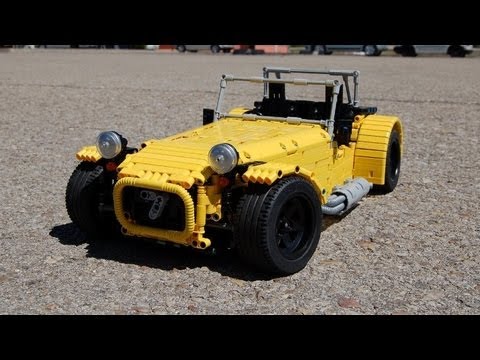
It’s not what, but who. Sheepo is a guy from Spain and he makes the geeks working at Lego look like Beaker from the Muppets. This guy is into building some seriously technical stuff, including components like torsion beam and multi-link rear axles as well as little trolley jacks so your lego men can raise the cars themselves 🙂

And he even gives out the instructions so you can do it yourself!

The video below shows his Caterham 7 (especially for Gavin 🙂 ). Sheepo’s also built a Shelby Mustang, a Land Rover Defender and even a Peterbuilt truck!

Check out Sheepo’s Garage.

——

Ferrari Enzo

Like Sheepo, Sariel is another Lego Technic enthusiast who builds amazing vehicles using only Lego parts.

This Enzo is one such vehicle. That’s some nice photography, too.

Sariel’s Enzo video provides a wonderful insight into just how technical these vehicles get. Just like a real vehicle, there’s all sorts of packaging issues to consider in order to get all the motors and pneumatics inside an Enzo-shaped shell.

Outstanding. Check out Sariel’s website for more.

——

Citroen 2CV

Here’s one final custom creation – one that was too cute to leave out.

This is made by another custom-builder, named Nico. I love the look and the crazy Citroen suspension on this one 🙂

——

Best Car Names – Poll Results

[hr]

How to tackle this one?

If anyone arrives on this page after searching “Best Car Names” then let me explain. This page is frequented by a large number of Saab enthusiasts. The results of my Best Car Names poll therefore – rather predictably – place a few Saab models high in the standings. Very high. Definitely higher than what the models would have placed on a poll at almost any other site (especially when you consider many non-Saab people wouldn’t have even heard of a Viggen or a Sonett).

So…… the raw poll results finished with a Top 10 as follows:

  1. Saab Viggen
  2. Jensen Interceptor
  3. Saab Sonett
  4. Lancia Delta Integrale
  5. Lancia Stratos
  6. Triumph Spitfire
  7. Maserati Quattroporte
  8. Ferrari Testarossa
  9. Dodge Viper
  10. Aston Martin Vanquish

Two of the best car names of all time belong on Saabs? Really? I think the Swadeology audience might be lacking some objectivity 🙂

As much as I love both the Viggen and the Sonett – and while I can see an argument for the Viggen being well placed (maybe not top 10, but still well placed) – I’m not sure they deserve to be there.

Maybe it’s worthwhile taking them out to see what some might call the real list?

  1. Jensen Interceptor
  2. Lancia Delta Integrale
  3. Lancia Stratos
  4. Triumph Spitfire
  5. Maserati Quattroporte
  6. Ferrari Testarossa
  7. Dodge Viper
  8. Aston Martin Vanquish
  9. Alfa Romeo Disco Volante
  10. De Tomaso Pantera

That’s a list I can better relate to in respect of best ever car names. 60% Italian, 30% British and 10% everywhere else. Makes sense to me.

I think if anyone with a limited knowledge of cars saw one of those names, they’d have a positive impression before they ever saw the car. As a car enthusiast, they’re all names that inspire. They hold you in anticipation of what you might be about to see. That’s what a good car name’s meant to do, isn’t it?

And they sound damn cool, too.

——

Exit mobile version