War Of The Noses – Conclusion

So the votes are cast, the verdict is in. Sort of.

I hope no-one’s looking for some momentous enlightenment here. I had a theory and wanted to see if other people agreed. That’s all.

My theory was this:

Nasal Theory
In all but a few cases, Saab actually made their cars look less attractive when they updated them.

That’s it.

The theory started as I pondered the Saab 9-5. I’ve long said that we’ll look at getting a Saab 9-5 wagon when our 9000 bites the dust. But which 9-5?

Saab steadily de-contented the cars after a time, either through directly removing some items or through declining material quality. Cars from the early 2000’s seem to be best equipped as standard and with the highest quality finish when new. But you have to balance that equipment level against the age of the car and with the age comes the nose difference.

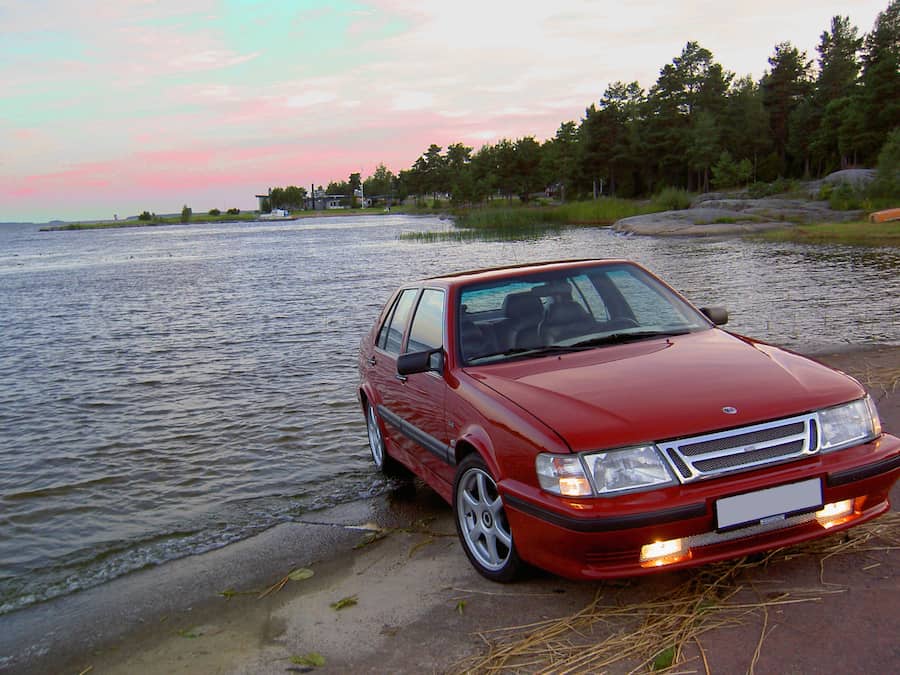
As I looked at the two noses, I came to the conclusion that I really liked the earlier 9-5 nose a bit more than the later one. There’s something very composed and elegant about that silver grille that looks good to me from all angles. When I see the later nose, with it’s color-integrated grille surround, something fails to click with me.

I think the 9-5 Aero looks good with the later nose, but the lesser models look like they have their chin poking out, like they’ve made a funny face for a photo.

Then I got thinking about other models.

The Saab 96 is an obvious one where the first iteration was the best. This is the only one for which I showed three generations. In fairness, I should have just made it a question between the second and third generation and left the bullnose out. Why? Because the second and third generations shared the V4 engine. The bullnose didn’t. The V4 necessitated a longer nose so if you want a V4, you don’t get a bullnose to choose from.

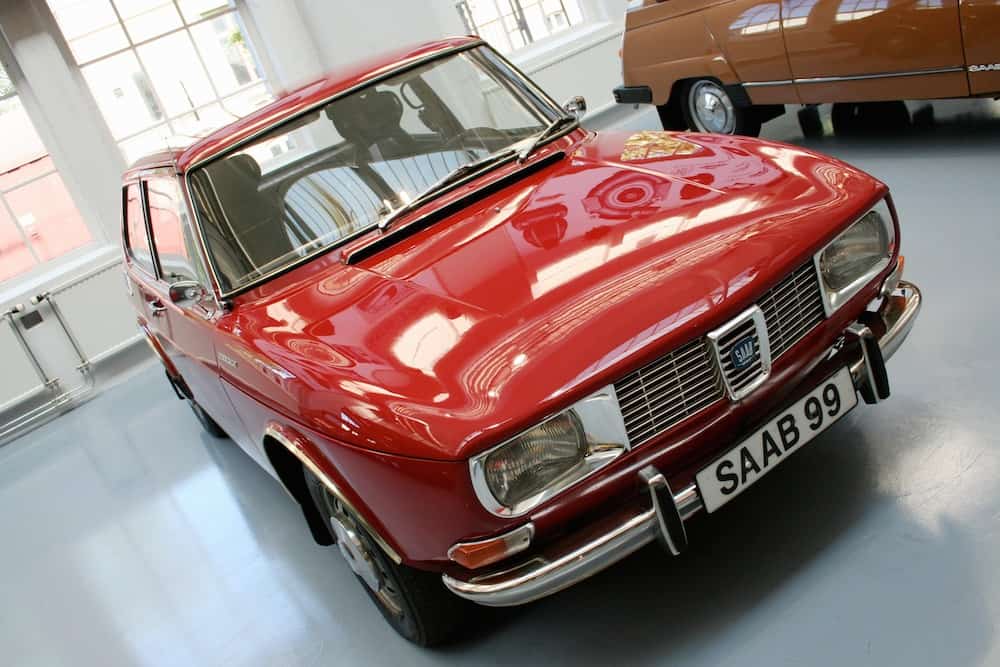
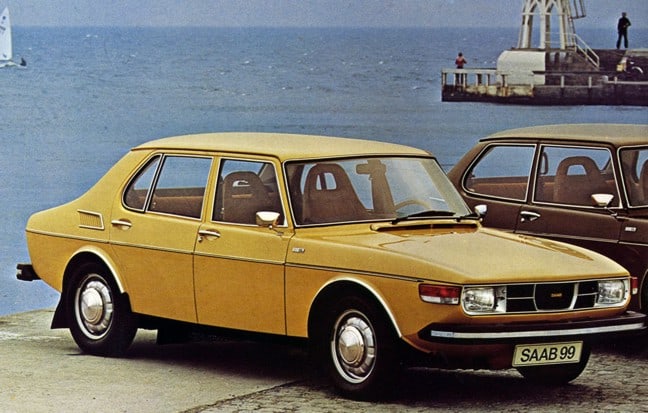
I think the Saab 99 looks much more elegant in it’s earlier form. I can understand people favouring the later form because that’s where the 99 really made its name. But the earlier form looks so clean.

My ideal Saab 99 would be an early-form body with a turbo engine, just like this one! It’s owned by a friend in Sweden named Anders S (his brother Peter has a red one just as nice! 🙂 )

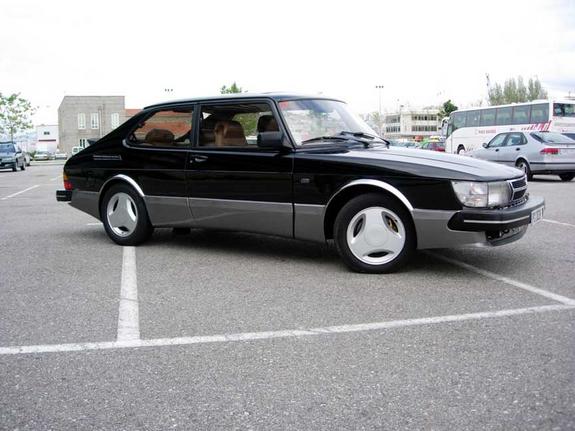
When it comes the 900, I’m a little biased. I owned an early version of the Saab 900. It was one of the first 16V cars with the oxblood leather interior and the flat-nose version of the car had me from day 1.

In fairness, though, I also owned a later slant-nosed model in Sweden. I actually had a much better ownership experience with that car, but still prefer the look of the earlier flat-nose versions.

As an aside, I do wonder how much people’s personal ownership experience influenced their vote(s). I also wondered whether people voted just on the nose, and how many on their opinion on the whole vehicle. Did the wheels influence you, for example?

The 9-3 SS and the Saab 9000 are probably the two exceptions to my own theory that I would agree with.

I thought the 9-3 SS vote would be closer but I understand the later nose winning by a large margin. I reckon Dan P summed up the problem with the early 9-3 SS quite well:

I think the original design is great, timeless from many angles and just a beautiful organic shape. What I’ve never liked and puts me off buying one a little is the front lights. They don’t wrap around enough and sit too square on the nose, and it’s out of character compared to the og9-3 and the 9-5.

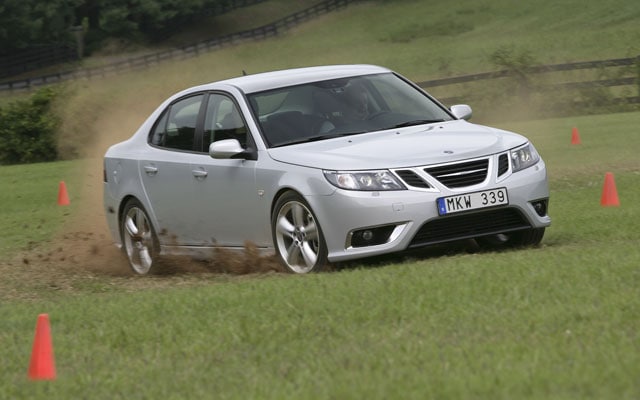
The overall shape of the 9-3 SS is nice but the front seemed un-finished. The later nose on the 9-3 gave the car more purpose, more aggression IMHO.

Same with the 9000. I like the earlier front but the later nose gave the car a more distinct identity. In comparison, the earlier front looks a little bit generic.

——

None of this is to say that people shouldn’t like one version or the other. The Saab 99 is a prime example. If you’re going to buy a Saab 99, buy a 99EMS or Turbo and love what is a magnificent front face. The earlier one looks more elegant to me, but the later cars are still beautiful to look at and a much better mechanical package.

Did my theory match the popular vote? Not really.

Saab 9-5 – I picked the early nose. The vote was close, but the majority picked the later, more integrated nose.

Saab 99 – I picked the early nose. The vote was overwhelmingly in favour of the later nose by a margin of 2 to 1.

Saab 900 – I picked the earlier nose. A lot of people agreed with me, but the vote was still firmly in favour of the later, more slanted nose.

Saab 96 – We all picked the early nose on that one. Despite there being three entries, the bullnose got 61% of the vote. I’m surprised it didn’t get more, to be honest.

Saab 9000 – I think the later nose was an improvement and the people agreed, but only just. The later design won….. by a nose. 87 votes to 79. There’s a lot of love for the early nose there, which maybe supports my theory, even if I wouldn’t have voted for it.

Saab 9-3 SS – I figured this one would be close, but it was an 83% vote for the later nose.

The bottom line

Saab has always had a strong design ethic and it’s no surprise that both their early designs and their refreshed designs are popular with the Saab faithful.

How to explain the discrepancy in the votes? Well, we’re all individuals. We all think differently. There might be something in the fact that some of the later designs that I dislike involve moulded rubber bumpers (Saab 96 and 99). Maybe I’m just into older cars.

Whatever the explanation, I’m happy with my theory and happy to know that all of Saab’s front-end designs are appreciated by the fans.

Thanks for playing.

War Of The Noses – Saab 9000

This will be the final War Of The Noses post before I give voice to my own theory and either validate it or disgrace it with the collected poll results.

Our final vehicle is the Saab 9000, which had two basic noses to make it nice and easy for you pollsters.

The early 9000 nose, with the taller ‘face’ and headlamps:

And here’s the later 9000 nose, with it’s narrower headlamps and grille.

——

Here’s your poll. Which 9000 nose do you prefer? Early or late?

As always, comments are open…..

[poll id=”20″]

War Of The Noses – Saab 9-3 SS

The War continues……

The Saab 96 vote took a predictable course so we don’t really need to give that one more time. To me, at least, this is more of a 50/50 proposition – the Saab 9-3 Sport Sedan.

The 9-3 Sport Sedan came as a crisp looking model in late 2002. It got an exterior facelift in the 2008 model year that saw a much more aggressive face.

Which will you choose?

The early:

Or the late:

——

Here’s your poll and as always, have your say in comments…..

[poll id=”19″]

War of the Noses – Saab 96

Previous nose-battles:

It’s now time for the Saab 96, which is as far back as we’ll go in the Saab model catalogue.

I’m going to do things a little different here, too. Because the Saab 96 was available for 20 years and with three distinctly different noses, I’m going to offer an early, middle and late option for you to vote on.

The first Saab 96 was essentially an evolution of the Saab 93 so the looks are quite similar. This is often referred to as the ‘bullnose 96’.

The ‘middle’ version came in 1965 and featured a slightly longer nose designed to cope with the V4 engine that was planned for the car in the near future. This middle version only lasted a few years but it’s quite desirable and well known thanks to some of the hotter MC850 engines that were put in before the V4 came.

And finally, the late version, which brought the 96 into the corporate design language being led by the bigger, newer Saab 99. The plasticised grille, bigger indicators and rectangular headlamps being the big changes.

OK, there’s also an earlier version of the late nose. As pointed out by Ian Brade in comments, I’ve featured the latest of the late versions. Here’s an earlier iteration out of fairness to this generation.

——

Here’s your poll and comments are open, of course.

[poll id=”18″]

War Of The Noses – Saab 900 (classic)

Okay. You’ve voted for your preferred Saab 9-5 nose and your preferred Saab 99 nose. What about the most popular Saab ever made – the classic Saab 900?

The classic Saab 900 started with a flattish nose that was an evolution of the late 1970’s Saab 99. In the late-80’s the Saab 900 got a more slanted nose.

Which one do you prefer?

The early, flatter nose:

…..Or the later, slightly more slanted probiscus:

——

Here’s your poll:

[poll id=”17″]

——

The results of the first two polls have been very interesting. I’m still working on my theory and I think there are various factors in play when it comes to the preferred look of each car.

Thanks for participating!

And of course, comments are open.

War Of The Noses – Saab 99

You’ve voted on the Saab 9-5. Here we go again.

This time I’d like you to select your favourite Saab 99 note from these two prominent contenders. Yes, there were other Saab 99 front-end variations but these two are the most-seen.

Note – both periods had variations with dual headlamps (round) on either side. I had to pick one or the other, so I’ve gone with the rectangular European versions just to be consistent.

Earlier – the late 1960’s style…..

Or……

Later – Mid 1970’s style

Here’s your poll…..

[poll id=”16″]

War Of The Noses – Saab 9-5

Here’s a simple question for you, something that’s been occupying my mind for the last few days (sadly, this is true).

Which nose do you prefer on the Saab 9-5? The 1st series with the silver grille or the color-coded nose that came with the facelift?

Examples, using two Saab 9-5 Aeros. The earlier nose first…..

And the later nose……

——

Here’s the poll.

[poll id=”15″]

——

I’ll follow up with a few more Saab noses as we go through the week.

Yes, I have a theory.

Feel free to have your say in comments.

Video: Bruce Turk, Saab Collector

I’ve met a lot of Saab nuts in my time, but most of them were in Europe. I never really had the opportunity to plumb the depths of Saab nuttiness in the USA. More’s the pity.

If I had, I’m sure I would have come across a bloke named Bruce Turk.

If, like me, you don’t know Bruce but his name is still familiar, it might be because you watched another video on how he built his Saab 96 Rally car (left). I featured that video back in June 2013. The guys at /DRIVE made that film and have now done a feature on Bruce’s Saab collection, his cars and memorabilia.

The film is 18 minutes long and it’s essential viewing for vintage Saab fans.

The old stuff is quite often the reason people get into the newer stuff. That was certainly the case for me. Watch this video and you’ll see why. It’s called character and Bruce’s collection has it in spades, as does the man himself.

Saab 900 Monte Carlo Yellow Production Numbers

This is another entry from the Inside Saab days, in a similar vein to my Saab 9-3 Viggen production numbers article. The data was lost when Inside Saab went down, but thankfully I’ve been able to retrieve it thanks largely to the Wayback Machine.

Sadly, the Viggen and the MCY 900 Convertible are the only two models I got the chance to dig up numbers for before Inside Saab was ditched and Saab went under. I hope NEVS still has the old production database as it’s valuable historical information.

——

After the success of the Viggen ‘by the numbers’ piece I thought it’d be fun to dig up another model of interest from the database and spill it’s global distribution beans here on the website.

The Saab 900 Convertible is an icon on its own, but the icon-within-the-icon is the Saab 900 Monte Carlo Yellow version of the car. It’s the most fun-looking color in the palette, but it still takes a certain strength of character to buy and own this most attention-grabbing and distinctive color.

So how were they distributed around the world?

The #1 market by volume won’t be a surprise, but the #2 market might be. MCY convertibles were sold in quite a few markets, though many of them had small numbers only.

If you’ve got one of these iconic Saab convertibles, then yours is one of just 893 that were ever made over the life of the model. Look after it.

If you don’t have one of these iconic convertibles but would like one, now you know where most of them were sold – which is a good tip as to where you could look to buy one!

Notes:

  • MY(date) = Model Year
  • Japan had two importers for these cars. I’ve combined the numbers in the table below.
  • My understanding is that MCY Convertibles were sold with different engine outputs in some markets. Yours could be a LPT or a HOT engine depending on where it was sold. I haven’t delved into those numbers here.
CountryMY1991MY1992MY1993MY1994Total
Sweden933-15
IDS5710123
Denmark5---5
Finland-21-3
Norway-1--1
Belgium-104014
Great Britain251712-54
Netherlands126-9
Italy102325-58
France40-13-53
Portugal-1--1
Switzerland397-19
Germany56137177
Austria-35-8
USA299624311
Australia-1622442
Cyprus-1--1
Spain1011-12
Japan-579-66
South Korea--1-1
Singapore-3--3
Hong Kong-9411-105
Ireland--1-1
Thailand-13-4
China-1225
Kuwait---11
Puerto Rico-1--1

Saab 9-3 Viggen Production Numbers

I prepared this article a few years ago for Inside Saab, the website that I ran while employed by Saab Automobile. This table is based on official production numbers I obtained while working at Saab, in Trollhattan.

——

The Saab 9-3 Viggen is one of those iconic, flawed Saabs that’s loved by everyone who’s ever owned one. The car was absolutely bonkers and quite capable of killing its owner under the right wrong circumstances. But it was so beautifully made inside and out, and it was so out there, that it still draws plenty of oohs and aahs whenever it’s seen.

I’ve owned a Viggen (that’s my old one, above) and over the years I’ve had a lot of email from other Viggen owners asking if I knew how many of them were made and imported into their particular market.

I’m pleased to be able to pass on the following, which should satisfy most of you detail-oriented statisticians. The only thing we haven’t been able to get are the distinct numbers for 3-door and 5-door models.

Note: these are production numbers and there may be some difference between when a car was produced and when it was sold. Your car might have been first sold in 2002, but been produced as a 2001 model and sat on a dealership forecourt for some time.

Abbreviations:

LR = Laser Red
LB = Lightning Blue
CY = Cayenne Red
MCY = Monte Carlo Yellow
SG = Steel Grey

Hard = Hardtop (both 3 and 5 door)
Conv = Convertible

——

UNITED STATES

Colour1999 Hard1999 Conv2000 Hard2000 Conv2001 Hard2001 Conv2002 Hard2002 Conv
Black22299415128068106
LR62971829
LB4204740
MCY24818
Silver2240975071
SG20736595116

——

GREAT BRITAIN

Colour1999 Hard1999 Conv2000 Hard2000 Conv
Black1610620
LB95502455
MCY11929
Silver3018732

——

GERMANY

Colour1999 Hard1999 Conv2000 Hard2000 Conv
Black1581335
LB512149
MCY221
Silver26

——

CANADA

Colour2000 Hard2000 Conv2001 Hard2001 Conv
Black261131
LR1
LB289
MCY6
Silver2814
SG85

——

INTERNAL USE

Colour1999 Hard1999 Conv2000 Hard2000 Conv2001 Hard2001 Conv2002 Hard2002 Conv
Black116231
CR52
LR212
LB1351326
MCY10372
Silver76141
SG514

——

SWEDEN

Colour1999 Hard1999 Conv2000 Hard2000 Conv2001 Hard
Black2121
LB72173
MCY9111
Silver313

——

AUSTRALIA

Colour1999 Hard1999 Conv2000 Hard2000 Conv
Black233
LB1818226

——

SWITZERLAND

Colour1999 Hard1999 Conv2000 Hard2000 Conv
Black8652
LB202131
MCY22
Silver333

——

FRANCE

Colour1999 Hard1999 Conv2000 Hard2000 Conv
Black1155
LB15174
MCY1
Silver9361

——

INTERNATIONAL DIPLOMATIC (IDS)

Colour2000 Hard2000 Conv2001 Hard2001 Conv2002 Hard2002 Conv
Black422111
LR131
LB109
MCY11
Silver6431
SG64

——

NETHERLANDS

Colour1999 Hard1999 Conv2000 Hard2000 Conv
Black811
LB11147
MCY1
Silver34

——

BELGIUM

Colour2000 Hard2000 Conv
Black54
LB133
MCY3
Silver25

——

SOUTH AFRICA

Colour2000 Hard2000 Conv
Black22
LB65
MCY22
Silver44

——

ITALY

Two different importers were used in Italy. I’ve combined both figures below.

Colour1999 Hard1999 Conv2000 Hard2000 Conv
Black551
LB722
Silver1175

——

SPAIN

Colour2000 Hard2000 Conv
Black81
LB7
MCY21
Silver4

——

JAPAN

Colour2000 Hard2000 Conv
LB16
MCY5
Silver1

——

NORWAY

Colour2000 Hard2000 Conv
Black35
LB91
MCY1

——

HUNGARY

Colour1999 Hard1999 Conv2000 Hard2000 Conv
Black1
LB7
MCY12
Silver1

——

FINLAND

Colour1999 Hard2000 Hard
LB31
MCY2

——

GREECE

Colour2000 Hard2000 Conv
Black1
Silver21

——

AUSTRIA

Colour1999 Hard2000 Hard
LB21

——

I will do the rest of them without the use of tables as they’re all reasonably simple…..

——

IRELAND

Viggen produced only for MY2000 and only in hardtop form.

Black – 1
Lightning Blue – 4
Silver – 1

——

TURKEY

Viggen produced only for MY2000 and only in hardtop form.

Lightning Blue – 3

——

PORTUGAL

Viggen produced only for MY2000 and only in hardtop form.

Black – 1
Lightning Blue – 1
Silver – 1

——

RUSSIA

Viggen produced only in hardtop form. Figures are for three different importers.

1999 – Lightning Blue – 1

2000 – Silver – 1
2000 – Lightning Blue – 2

——

POLAND

Viggen produced only for MY2000 in hardtop form

Black – 1
Lightning Blue – 1

——

CZECH REPUBLIC

Viggen produced only for MY2000 in hardtop form.

Lightning Blue – 1

——

HONG KONG

Viggen produced only for MY 2000

Lightning Blue Hardtop – 1
Lightning Blue Convertible – 1

——

SAAB OPEL FINANCE

Viggen produced only for MY2000 in hardtop form.

Black – 1

——

LITHUANIA

Viggen produced only for MY2000

Lightning Blue Hardtop – 1
Lightning Blue Convertible – 1

Exit mobile version