Last week I wrote about my Subaru Brumby problems, with the car proving very difficult to start in cold weather. The car started OK most of the time if it was used day-to-day, but give it a two or three day break and it just wouldn’t start.
Last Friday I flattened the battery trying to get the car started, so I put the battery on charge all weekend as I had it booked in with my mechanic for Monday morning. Sure enough, as is usually the way with intermittent problems, the car fired up first-turn on Monday morning.
It started with no problems Monday lunchtime.
It started again with no issues on Tuesday morning. I’m sure my mechanic was thinking I was a complete dimwit by this stage.
I had a chat with Steve and asked him to leave the car alone for two days. My theory was that his tests on Monday and Tuesday didn’t replicate my problems for two reasons: a) because it wasn’t as cold on those mornings as it has been on the mornings I’ve been having problems, and b) because I usually have problems after the car hasn’t been running for a few days.
So he left it.
Thursday morning has just passed by as I write this – 48 hours since its previous successful start – and I’ve never been so pleased to report that my car wouldn’t start today!!
This morning was indeed a cold one, at just 2 degrees C. The car hadn’t been run for two days and sure enough, when Steve tried it, the Brumby wouldn’t start.
He’s traced the problem to a faulty ignition module, which from a quick few minutes of Googling means that the coil isn’t getting the signals it needs to send the spark to the distributor. Apparently these are more prone to faults with heat rather than cold, so there could be more to the story but for now, he’s replacing the IM and hopefully that should do the trick.
So, it’s tentative good news for the moment; no need for a carby service or replacement and all going well, my Brumby should finally deliver the reliability it has lacked so far. Perhaps it’ll run a little smoother, too.
When I was at Saab I was amazed at some of the services we were outsourcing and how much they cost. My perception was that the costs associated with this were negotiated to some degree, but mostly just accepted. It seemed to have become an ingrained behaviour, most likely under GM’s ownership of the previous 20 years. Saab’s ownership changed, but the culture of the company didn’t change nearly enough.
Or maybe this is just the way it is in the world of big, global businesses.
Ewanick famously saved $48,000 by using just $2,000 of the $50,000 allowance he received to redecorate his Detroit Renaissance Center office by going to Ikea rather than ordering pricier furniture.
OK, so he’s a top tier executive, but $50K just to redecorate an office? Kudos to him for not using it all.
If you’re wondering why some car companies struggle to be profitable, then rest un-assured that there’s quite a bit of waste going on in most of them.
At Saab, we had a cost-cutting program called Cheetah in our final months. One could rightly say that it should have happened in the first months of Spyker’s ownership rather than as an attempted salvage operation at the end. There were indeed some wasteful spending decisions well before then.
I remember reading some complaints about the PhoeniX concept, which I never thought was a valid complaint for people to have. PhoeniX was absolutely appropriate for a company looking to re-stamp itself on the automotive scene after all the negative news surrounding the GM sale. It got Saab plenty of magazine articles and covers, too.
But I did wonder about the big ‘Independence’ party that happened in the factory just before production stopped in 2011. It seemed a little bit presumptuous and the way history has turned out, it seems suppliers probably didn’t appreciate it, either.
They might take solace in the fact, though, that as far as I know there weren’t any $50,000 office decorations.
I hate admitting this. I’ve rarely bought a bad car over the years, but my recent purchase of a Subaru Brumby is making me sweat, swear and wish I’d never set eyes on this little runabout.
I bought this car because a) I wanted a ute, and b) the Brumby has a reputation for being bullet-proof both in terms of longevity and reliability. The prices for these cars on the used market back this up. I knew that I paid a little too much for mine when I bought it, but it had very low mileage (just 100,000 kms) and it had power steering fitted (which was never an option for this model) so I took the plunge.
It’s been an exercise in frustration ever since.
First, the water pump failed the day after I bought it. Fair enough. Water pumps give up eventually and this could have simply happened at a bad time. Plus, it was relatively inexpensive to fix at around $90 for the pump itself.
I’m starting to get the feeling, however, that the water pump failure was evidence of a lack of maintenance in general by the previous owner. The fact that it’s got just 100,000kms on it is great, but even Subarus need maintenance during that 100,000km period.
Right now, I’m dealing with a jammed door lock that won’t let me lock the car. I tried to fix this last weekend but no matter how hard I tried, I couldn’t get the window winder off to get behind the door card. Damn you, special tools! I’ll get that one sorted.
But my biggest bugbear is the fact that the car simply won’t start on cold mornings. Once it starts, it’s fine. Getting it started, however, is frustrating beyond belief.
Despite being a car made in the mid-1990s, it’s based on late 1970s Subaru tech. That’s means a carburettor. And a choke. All of a sudden I have this sinking feeling that the carby’s going to need either servicing or replacing and when you’ve already paid over the odds to buy the car, the thought of having that extra spend is very unsettling.
Here’s what I’ve discovered, for those of you skilled in diagnosis:
Fuel, Air and Spark are what’s required to get combustion. Air isn’t a problem and a new air filter was fitted when I had the car registered here a month ago.
Spark shouldn’t be a problem, either. New plugs and leads were fitted last week, and a new battery was fitted just before I bought the car.
That leaves fuel. I’ve had to pour some fuel directly into the carby on previous start attempts and that’s worked before, but this morning (with the battery wearing down from previous start attempts) even that didn’t help. My proposed course of action now is to move from least expensive to most expensive – fuel filters, fuel pump (though it works fine once the car’s started, so I’m doubtful on that) and then perhaps a carby service or replacement. An upgrade to a Weber carb is a popular one with these models.
The last two mornings, I’ve tried unsuccessfully to get the Brumby started in low temperatures (around 4-6 degrees C). The really frustrating part is that when I get home at around 5pm, after a day around 13 degrees C, the car starts just fine. It’s like a grumpy teenager that doesn’t want to get up when it’s cold.
On those non-start mornings, I’ve ended up having to open the garage and take my Alfa GTV6 to work instead. Who’d have thought a mid-80’s Alfa Romeo would be more reliable that a 1990’s Subaru?
I really, really want this car to live up to its reputation. My problem is that I’ve already paid a little too much to buy it and I don’t want to spend a whole bunch on making it what it should have been in the first place.
I have a feeling there’s a carby replacement in my future. Air and Spark should both be OK. It can only be the fuel and once the car’s going, that’s fine. It’s getting fuel to the combustion chamber on a cold morning that seems to be the problem. Or am I completely off base?
This is a long one and not many people are going to read it. That’s OK. It’s mostly a mental exercise for me and if the people at Alfa Romeo are doing their job properly, it’ll come up on their feed and they might be interested, too.
——
This question about Alfa Romeo and social media is more relevant than you might think.
Alfa Romeo is in a period of transition. Its parent company, Fiat, recently acquired a majority stake in Chrysler and the consequences of this acquisition are significant. There are platform sharing consequences to start with, but even more urgent is the fact that Alfa Romeo is scheduled to re-enter the US market in the near term after an absence lasting several decades.
Sure, they’ve been scheduled to re-enter the US market a number of times, but with Fiat now having a US dealer network at its disposal, only a sale of Alfa Romeo (which has been rumoured, and denied) would stand in the way of Alfa finally making a US comeback in the near term.
Providing they get their product mix right – product is always king in the car business – they’re going to need to reach out to customers in a meaningful way. The Alfa Romeo name is still known in the US. You can even say it’s still respected there. They have a foundation. They just have to build the right structure on it.
So here goes….. my thoughts on how Alfa Romeo could do better with their online social presence and build customer loyalty.
Part 1 will take a look at Alfa Romeo’s current social media assets.
Part 2 will introduce what I think is the centerpiece of a successful social presence for a car company.
Part 3 will look at the structure you can build around that hub.
——
A quick look at Alfa Romeo’s social presence
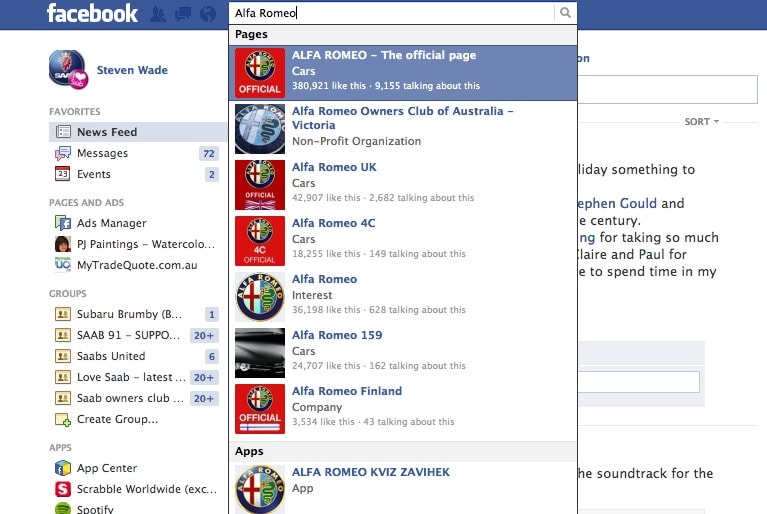
A quick search on Facebook under Alfa Romeo is a good early indicator of some of the mess going on here.
—
Alfa Romeo currently has numerous official pages on Facebook. There’s the official page from company HQ in English and Italian, but you can also see separate model pages for the 4C and the 159 as well as country pages for England, Finland and other spots as well.
The Finnish page is only updated sporadically. The Brits do a much better job with some great, interesting content in place, as does the HQ page. I am sure there are other national pages to be found, but the quick search above provides enough results to point out the flaws.
The 159 page listed above is unofficial but the 4C does indeed have an official page, as does the MiTo and Giulietta.
Twitter – there are more Alfa Romeo national accounts on Twitter than you can poke a stick at, but no official account from HQ that I could see.
Youtube – There are several national Alfa accounts serving up videos of varying quality. There are also accounts for the MiTo and Giulietta. Once again, as with Twitter, there is no official Alfa Romeo centralised account on Youtube.
Tumblr – Nothing official from Alfa Romeo, but there are plenty of Alfa pics being shared by others.
Google + – There’s an Alfa Romeo UK page prominent in search results, and an “Alfa Romeo Cuore Sportivo” page as well, though that one looks unofficial.
There are other services I could check – Pinterest, Instagram, even professional services such as Linked In. Those listed above are the main ones right now, however, and this post is intended to cover the basics rather than the intricacies of a full social campaign.
So what’s wrong with all of this?
I have mixed feelings about Facebook to begin with.
To me, interacting with a company on Facebook is sort of like seeing a street performer. You get small bits and pieces of entertainment and you might even find one or two of them memorable. More often, though, it’s five minutes of your day where you’ve been entertained and you’ll forget who it was just as quickly as the details of any other five minutes of your day.
Personally speaking, I’d rather spend 2 hours in a theatre with Billy Connolly. People will happily take small bits of entertainment but given the choice, most would choose substance over snippets in the long term.
And that’s what riles me about Facebook. Yes, it’s where a company’s customers hang out so they have to be there, but I question the value that companies get from their Facebook presence (and I’m absolutely flabbergasted by the sums of money companies like General Motors are willing to throw at agencies to maintain their presence there – $20 million, in GM’s case!)
When a car company communicates with fans on Facebook, they’re competing for that fan’s attention in what is ultimately a losing battle. Yes, I like Alfa Romeo’s product but if I’ve got 10 minutes in my afternoon to check Facebook and there are three photos of my new great-nephew, Henry, then I’m spending my time with Henry and other friends every time. People do interact with companies like Alfa Romeo when they’ve got more time, but it’s mostly a short-form exchange and each one has relatively little ongoing value.
So, in my opinion, the whole platform is flawed to begin with. You can double the importance of that flaw if you’re in the car industry because it’s a long-cycle business that needs long-term loyalty from its customers.
Take that flawed platform and add in Alfa Romeo’s fractured approach. First, there are short-form stories that don’t build relationship with fans, as well as numerous national pages (UK, Finland, etc) and model pages (e.g. MiTo, Giulietta). All of a sudden people are getting their short-form Alfa Romeo content from numerous places, with varying emphases and in most instances, very little coherence.
The good part is that they’re reaching people in some way. The bad part is that it can lack strategy, it does much less than it could to build fan loyalty and it can be devoid of a uniform marketing or PR message.
I’ve focused on Facebook here because it’s the most prominent, the most visible of Alfa Romeo’s social efforts. It’s their centerpiece, despite the existence of the (IMO) redundant “social net wall”. In the next part of this series, I’ll talk about the beginnings of what I think should be their social hub, what they can do with it and how they can use other platforms like Facebook to support and extend their interaction, rather than be the entire basis for it.
Yesterday, some nutcase dressed himself up as the Joker, let off some gas canisters and shot a dozen people dead at a screening of the new Batman movie in Colorado. He injured many more.
Today, in Hobart’s main shopping mall, some nutcase dressed himself up in a gas mask and walked around the mall with a cap gun, pretending to shoot people.
There are idiots everywhere. I hope the cops gave this one a good phone-booking.
This car deserves better – the Alfa Romeo 4C at Geneva, 2011
It follows naturally that I should present my own thoughts on what automotive companies can do with social media. I was going to put this all in one post, but it was getting to be too long. Instead, I’ve got a list of DO’s and DON’Ts below, and I’ll apply those in a real-world setting in my next post.
Most of what I’ll write over these two posts is a blueprint for how I would have liked to organize our social media presence at Saab (the company I used to work for).
Therefore, creating blueprints might have influenced me to get a clear idea about similar brands as well. With the help of local seo expert, all the key points are analyzed. And this organized planning eased the process of creating my blog about automobiles.
An aside: Nothing happened at Saab without a meeting. That’s just corporate culture. Holding live, virtual, and hybrid events has become a norm with the help of companies that offer event services. I attended 90% of those meetings, so I can’t say that I didn’t have my chance to influence decisions there. But the final decision was never mine and Saab’s social structure wasn’t how I would have set it up if I had free reign over decisions there.
Please keep in mind that I’m writing this with a specific company in mind – Alfa Romeo. It should be noted that some of what I’m going to write here won’t apply to other automotive brands (e.g. can you use “Kia” and “heritage” in the same sentence, in a positive way?)
Social DO’s and DON’T’s
DO invest in social and look at it as a long term proposition.
DO spread your resources over a number of social centers, but DON’T feel like you have to enter every new social outlet that comes along.
DO build real, personal relationships with your customers but DON’T build those relationships with the primary aim of selling cars to them.
DO allow people to have their say, but take measures to ensure that people frame their views in the right context. DON’T allow misinformation to overwhelm your discussions.
DO make efforts to turn your customers/readers/friends into stars!
DO make sure you leverage your history.
DO control your message – it’s content and timing but DON’T simply re-post company press releases
It’s OK to have some lightweight banter in your social discourse from time to time, but DO make sure that most of your content is comprised of good, solid meaty content.
DON’T allow your social space to turn into a customer services complaints desk, but DO make efforts to help people where you can.
That’s not an exhaustive list, but it’ll do for now.
In my next post, I’m going to have some fun applying that to Alfa Romeo’s brand marketing and see if I can come up with a social framework that can build their audience and turn their fans into followers, then ambassadors.
As many of you know, I used to work for Saab Automobile. I worked in the Marketing Division with some responsibility for the company’s social media presence. I say ‘some’ responsibility because I worked with another guy in this area. He had more responsibility for what you’d call the broader social campaigns such as Facebook and Twitter. My main responsibility was content creation and the running of the Inside Saab website (which, I’m pleased to say, is still online).
I was rapt to be working for Saab and I’m sad that that ride had to come to an end. And whilst I believed in what I was doing – the Saabs United experience had proved to me the power of real fan engagement – I did sometimes wonder whether the social media experiment had enough stickability to deliver tangible results.
It’s all well and good to put stuff out there. It’s even better if it gets views and engages some people. But does it influence buyer behaviour and can that influence be measured?
——
Case in point: The Ford Falcon
Earlier this year, Ford introduced a 4-cylinder version of it’s large car here in Australia, the Falcon. The Ford Falcon is an icon here. Traditionally it had either a six or eight cylinder engine. Ford Falcon V8s are still raced today in Australia’s most popular racing series, the V8 Supercars.
The 4-cylinder Falcon features a turbocharged Ecoboost engine and sprints from 0-100km/h in the same time as the traditional six cylinder. It’s a large car, reasonably well equipped (less equipment in the 4-cyl version) and seats 5 adults in comfort.
By all reports, it’s a good car to drive and the power comparisons with the 6-cyl model speak for themselves.
The trouble: no-one’s buying it.
The Ford Falcon used to be one of the top selling vehicles in the country. Now it’s not even in the top 20 and the significantly more economical 4-cylinder version has done nothing to arrest the sales slide from large family cars to either small cars or SUV’s.
In a story on the Falcon yesterday, Ford Australia’s Neil McDonald talked about the advertising campaign, including the following Youtube clip, being a success.
—
He measured the success in terms of the video having had 380,000 views on Youtube.
Unfortunately, that ‘success’ hasn’t translated into customer interest. The 4-cylinder Falcon has only found 53 private buyers here in Australia. In contrast, 159 of them have been sold to Ford Aus employees.
The Toyota 86 has been available in Australia for a little over a month now. I’ve even seen a few of them on the streets here in Slow-bart, which is something. Sales of the Subaru BRZ, however, got underway today and Subaru has elected to sell them online.
That’s online-only.
You can’t walk into a dealership and place and order. The dealer will gladly offer you a comfortable seat and a coffee, but most likely that would only be so that you could use his/her computer to order it online (and probably only if you promise to nominate them as the preferred delivery dealership).
Whilst Toyota went for a two-pronged model line around $30K and $35K plus ORC, Subaru has limited its range to one model only, selling at $37,150 driveaway (with 3 years service).
Subaru have just 201 BRZ’s to sell in Australia this year and 50 of them were sold within the first 90 minutes of their sales site going online today. It might have been more if the site could have handled the spike in traffic, but it crashed soon after going live and the ‘buy’ button wouldn’t appear.
UPDATE: Apparently all 201 sold within three hours. On Day 1.
——
I’m very, very excited by the experiment from Subaru and I bet a lot of other manufacturers are watching as well.
Why?
From my own perspective, online sales was an idea that I was developing in my own head when I started working at Saab last year. In my mind, people could still go to a dealership to view or test drive a car, but they would then have the option of buying it online and like Subaru, nominating a dealer of choice for delivery and service.
I’m not sure how this would work in a mixed setting, with both dealer and online sales. It would most likely have to be part of a fixed price sales model, something that might not go down so well in some markets.
Buyers could still buy a car off the lot straight away if their desired configuration was on site. Haggling would be between the customer and the dealer as the dealer would have already bought the car from the factory (as they do now).
Some people don’t like the pressured environment involved with some sales experiences. I’m sure they’d be open to being able to configure, select and buy their car completely online, dealing only with the salesman at pickup time.
From the manufacturer’s perspective, this could be an interesting addition to the sales funnel that might mean greater margins for them and a new dealership model for the future. There are a lot of thins you can buy online today. Why not cars as well?
Subaru seem to have tripped with the infrastructure around the process on the first day, but hopefully they’ll get the resources sorted quickly and it’ll be interesting to see the feedback they receive.
Online sales for motor cars. Would you be into it?
——
Speaking of the Toyobaru twins, here’s an absolutely sensational road test video of the Toyota GT86 in its European configuration. What makes this video so good isn’t limited to the photography, the roads and the facts you learn along the way. This video is extra-interesting because the guy testing the car currently owns a Toyota AE86 as a weekend trackday car. For him, this is personal.
It’s 20 minutes long, so make sure you’ve got some time to spare. I think you’ll enjoy it, however.
IF YOU CALL YOURSELF A CAR NUT AND YOU HAVEN’T SEEN ERIC BANA’S FILM, LOVE THE BEAST, THEN DO YOURSELF A FAVOUR – SEEK IT OUT AND SEE IT.
I wrote about Love The Beast as part of my list of Top 5 Car Movies a few months ago. That post was enough to motivate Ian B to see the film and I’d like to share a note from him, received overnight, in an effort to encourage you to find this excellent film, then see it.
Hi Steven,
I was glad to finally have the opportunity to watch Love the Beast.
‘Passions’ are intrinsically self-indulgent but Eric Bana did a very good job of allowing the film to somehow transcend the subject matter and climb towards a study of the human state. Clearly one could substitute any brand of car – or other enthusiasm – into the centre-piece of this film. It struck me that he seemed to be trying to make sense of how much the whole thing meant to him. A lot of soul searching and seeking to justify to himself whether or not he should continue with his project, I think.
I have certainly wrestled with my conscience a time or three – as have we all I suspect? Usually about cars I have spent too much on and subsequently sold. The fact Eric Bana has the resources to repair his Beast a third time should always be born in mind by the observer in my opinion – but it’s not always easy to put mind over matter where cars are concerned.
‘Love the Beast’ certainly managed to draw me in as a viewer. It didn’t matter that, like Jeremy Clarkson, I have never had a particular affinity for muscle cars. Goes with the territory of being English I suppose: The closest we would have come would be the ubiquitous Ford V6 ‘Essex’ engine, which found its way into a myriad of 70’s & 80’s cars; most notably the Ford Capri.
In terms of having a passion outside of work (per Dr Phil) – that definitely sums up my attitude to life; whether it be running, cycling, Saabs (motoring in general/Saabs in particular) Cavalier King Charles Spaniels – whatever …these are the things that define us. As for there being a spiritual aspect to this subject – that may be open to debate…probably the hardest part to pin down. I’m not sure a well known Tibetan exile would necessarily agree for instance.
What really struck a chord with me was the camaraderie which bound together his closest friends over their life-span and particularly the bond that he shared through motoring, with his Dad. Like you I am not in a position to carry that forward with my Dad, though mine is still alive. I speak with him every week but it’s getting harder to maintain relationship due to his illness. I certainly found myself wishing he was sitting next to me while I watched that film… .and hence the tears flowed. Lucky I had a good pair of headphones and the dogs for company.
Best wishes
Ian
My thanks to Ian for sending along his thoughts on the film, and the photos.
I don’t know if this applies in all countries, but here in Australia, you can rent Love The Beast on YouTube. It doesn’t get any easier than that.
And for the Aussies reading this, Ian picked up a copy of the DVD at JB HiFi for $14, with the stickers included in the pack.
Watch it with your car club. Watch it with your Dad. Watch it with the family members who don’t understand your passion. Just make sure you watch it.
It’ll make you laugh, it’ll get your heart pumping and it’ll help anyone who sees it (including yourself) understand your obsessions just that little bit more.