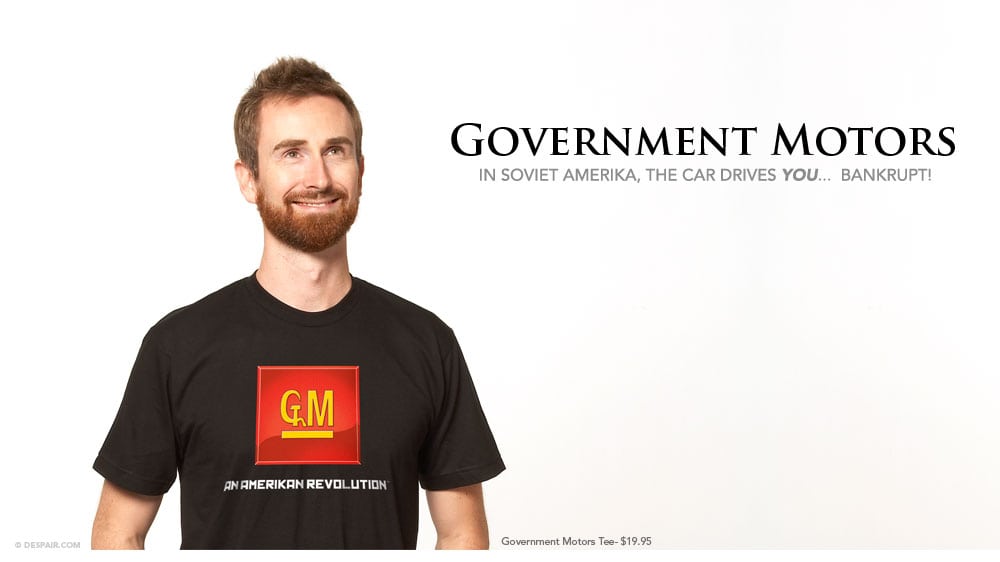
OnStar and an insurance company called Progressive recently announced the latest developments in creepy connected driving. Available soon on certain GM vehicles, OnStar will be able to track and record your driving behaviour and then share that information with Progressive, who may (or may not) offer you a discount based on your driving.
General Motors Co.’s OnStar subsidiary will offer motorists a new service this summer that gives feedback on their driving skills and allows some to seek driving-based discounts from Progressive insurance.
OnStar, which provides emergency, security and embedded Wi-Fi connectivity services to 7 million subscribers in North America and China, will allow U.S. customers to enroll in a driving assessment. After 90 days, OnStar technology that connects with the vehicle will tell customers how they performed in certain driving metrics, comparing them against an aggregate of other enrolled customers and offering individualized driving tips.
It’s tempting to put on my anti-GM hat and damn them for being evil overseers, but GM are just one of many. The ‘connected car’ is on its way. GM are just a little ahead of the pack.
Google have had their self-driving vehicles in testing for years. Audi sent an automated, self-driving A7 from San Francisco to Las Vegas earlier today and they say they could potentially launch a self-driving model as early as next year. Volvo are working feverishly on cars that will be able to talk to one another about road hazards.
Doesn’t it feel a little creepy, though?
The idea of having Mr OnStar looking over your shoulder like a silent back-seat driver is not at all appealing. The idea of getting driving tips from Mr OnStar, who can’t see the wandering pedestrian or the panicking pet dog that caused you to swerve is a little annoying. The idea of an insurance company using this information to categorise you is more than just a little bit Orwellian.
How long until this is standard and they use it against you?
How long will it take for some company to sell your driving information to Mr Google, who then plasters your regular routes with targeted advertising via electronic billboards as you approach them? I love Alfa Romeos, but I don’t want to see ads that focus on my likes EVERYWHERE I GO.
It’s creepy.
Sadly, it seems inevitable.
Again, from the Detroit News:
The National Association of Insurance Commissioners says usage-based insurance is set for rapid growth in the U.S. It cites experts that predict up to 20 percent of U.S. vehicle insurance will use some type of usage-based metrics within five years.
It gets pitched as providing a service to the customer. In this case, the bait is an insurance discount. Of course, it’s really all about opening up new revenue streams.
GM has said it sees many opportunities to boost revenue through connected vehicles by working with other companies in areas such as helping customers access fuel, parking, travel or hotel information. Some industry analysts see OnStar as a revenue boon for GM. In 2013, IHS Automotive estimated 4G LTE could add $400 million gross profit to GM by mid-decade.
As with Facebook, you can be offered products as you use it but in reality, you are the product.
I’m not one of the tinfoil hat brigade, but I do enjoy the comfort and character of older cars. The fact that they’re free of most of this electronic tomfoolery is just a bonus.
I remember back in 2009 there were a lot of people – and I mean a LOT – crying foul about the US government’s bailout of General Motors. This week, the US government sold its final shareholding in the restructured GM, booking a total loss of $10billion on the bailout.
For that $10billion, you basically got to keep your national car industry. You got to keep the jobs (not just GM’s jobs, but most likely Chrysler’s and Ford’s, too), you’ve got the products, the investment and innovation that comes with the industry, retirees got to keep their pensions.
I missed this story when I was on holiday but thanks to Victor himself dropping in on our comments section yesterday, I had reason to go searching for the story.
Bottom line: On October 1st, Spyker appealed the judge’s dismissal of their case.
Source: Law 360. Click that link to read the story in full.
——
Dutch carmaker Spyker NV urged the Sixth Circuit on Tuesday to revive its $3 billion lawsuit alleging General Motors Co. pushed Saab Automobile AB into bankruptcy by interfering with Spyker’s bid to sell the Swedish automaker to Chinese investors, claiming a district court judge erred in tossing the suit.
Spyker and Saab’s suit alleged that GM public announcements scuttled the deal on the eve of its signing, but a district court tossed the lone claim of tortious interference with economic expectancy, ruling that they had no anticipated business relationship because the unsigned framework agreement merely outlined a further set of agreements that still needed to be arranged and approved in short order.
In a brief filed with the Sixth Circuit, Spyker and Saab claimed the lower court committed “three critical errors” in dismissing their suit, the first being the conclusion that the failed deal left the automakers without a valid expectation of a business deal.
“Far from wishful thinking, Saab stood to gain an immediate cash investment of €10 million on signing the framework agreement,” according to the brief.
Spyker and Saab claimed the lower court erred further by incorrectly interpreting GM’s rights under existing contracts and then using that misreading to find that GM had not acted maliciously in speaking out against the deal.
“Consequently, this court should reverse the judgment of the district court and remand the case for further proceedings,” the brief said.
Spyker filed the suit in August 2012, claiming that Saab was forced into liquidation in Swedish court in December 2011 after GM doomed a proposed 2 million sale of Saab to Chinese automaker Zhejiang Youngman Lotus Automobile Co. by making public statements in December 2011 that it would cut off crucial technology licensing deals if Spyker went ahead with a the proposed deal.
The Dutch company contended that GM’s alleged tortuous interference cost it at least $3 billion.
GM moved to dismiss the suit, asserting that its own deal with Spyker put limits on the future use of GM technology in Saab cars and gave the U.S. automaker consent rights regarding any future sale of the Swedish company.
And if you want more background on the case from a SWadeology point of view, click here. The official Spyker release about the case when it was first launched is here.
——
I have to say I don’t feel optimistic about Spyker’s chances with this case. That’s not because I don’t believe in it, because I do. I’d love to see GM held accountable for its lack of stewardship of Saab and the disadvantaged position they placed the company in. I simply think it’s going to be hard to convince a judge in GM’s own backyard that they should be held accountable. I’d love to believe that Lady Justice is blind, but I don’t.
I do wish Spyker and Saab well with this suit, though. GM could have taken measures to protect their interests and still allowed Saab a future until such a time as Saab’s cars became GM-free. They killed it because they could.
Anyone who lived in Victoria in the late 1980’s would remember the ad in the video below, from the State Bank of Victoria. The line “It’s your money, Ralph” became as common in regular conversation back then as “Not Happy, Jan!” became in offices around the country five years ago.
——
The news broke last Friday (at 5pm, of course) that Opel would be pulling its cars out of Australia after a spectacularly short 12 months where they sold just 1500-or-so cars to actual customers.
It’s hard to comprehend just how massive a stuff-up this is or how the supposedly smart people running a global corporation could make it, but it’s HUGE and they’ve done it. And believe it or not, this is just the second part in an ongoing saga called Will-GM-Exist-In-Australia-Or-Not?
Right now, there’s plenty of money on both sides of the wager over whether or not GM Holden will continue in any meaningful way in Australia. There’s a very real fear that Holden will cease manufacturing in the near term and become an imports-only business selling cars designed somewhere and manufactured in cheap labour markets in Asia.
Successive Australian governments have already poured millions into Holden and the other two local manufacturers, Ford and Toyota. With Ford pulling the pin on local manufacturing in 2016 and Holden making noises about doing the same, the appetite for propping up the local industry with taxpayer funds has withered considerably. There’s a feeling amongst the people that these global companies are just sucking money out of the locals and it seems to be happening with monotonous regularity.
This latest episode with Opel only poses more questions as to which inmates are running the asylum at General Motors. Why would the Australian taxpayer want to put another cent into a company when the global parent could get a market investment like Opel so completely and utterly wrong?
—
It’s your money, Aussies.
Right: PM Kevin Rudd and Industry Minister Kim Carr check out their investment….
Australia has put billions of dollars into the car industry, more than $2billion going to Holden alone in the last 12 years. There’s another $2.3billion sitting in the Automotive Transformation scheme to be allocated over the next few years and with Ford pulling out of manufacturing in Australia, Holden is eyeing off a larger chunk of that pot, too.
Here’s a neat little table, courtesy of news.com.au
Government funding over the past 12 years (2001 to 2012):
Holden: $2.17 billion
Toyota: $1.2 billion
Ford: $1.1 billion
Annual average over the past 12 years (2001 to 2012):
Holden: $180 million
Toyota: $95.8 million
Ford: $87.8 million
Cars made locally in 2012:
Holden: 85,000
Toyota: 101,500
Ford: 37,000
Average taxpayer dollars per car built in 2012:
Holden: $2117
Toyota: $944
Ford: $2372
There were 20 Opel dealers in Australia last Friday and they learned about the brand’s fate the same day we all did. GoAuto reports that they’d each spent between $500,000 and $3million getting Opel into their showrooms with some of them building brand new facilities for the brand.
Dealers will get some of their investment back directly from Opel, which will reimburse for some vehicles, marketing materials, etc. But what about that extra space that some dealers have just built or are still in the process of building?
Right: An Opel dealership, today. It’s hard to tell if it’s still being constructed or dismantled. My mate Turbin doesn’t care. Thanks to his morning ‘vitamins’, he’s always happy.
What about the opportunity cost of two years wasted on just a year’s sales when that money could have been spent by dealers on a brand that was here for the long haul? Dealers who took Opel on had to sign up to a 5-year commitment. That’s why they put so much money into establishing their Opel presence on site. It’s more than reasonable for them to expect that Opel would honour their end of the deal.
Those showrooms, by the way, were built at Opel’s insistence. Either dealers allocated a significant/new building for Opel sales, or they missed the franchise. Nice.
——
It’s your money, Employees
First of all, let’s spare a brief thought for the Opel employees directly employed by Opel and working in Saab’s old offices here in Australia. There’s not many of them, but spare them a thought anyway because most will be out of a job now.
Same for the dealership staff employed to sell Opels that are no longer going to be sold. Some of them probably left decent paying jobs elsewhere to take up the challenge of building a new brand, one with a solid history within a global corporate giant. Oops.
Taking a wider view, however, and considering the rather large amounts of government assistance that Holden are both in receipt of and anticipating in the future, spare a thought for Holden’s vehicle assembly staff in South Australia.
Right: Holden chief, Mike Deveraux, contemplates some cash.
The company wants a whole lot of government money in one hand. It’s putting its employees in the other hand – and squeezing.
A new employment deal being offered to workers includes a 3-year wage freeze, reduced leave (at a time Holden tells you is OK), reduced breaks through the day, regular drug testing, short notice for what is effectively compulsory overtime if needed and the threat of termination for a vaguely worded ‘inefficiency’.
Some of these are fair enough. I wouldn’t like my car to be built by a guy with a massive case of the munchies. But if I were a Holden employee, sick already from an axe hanging over my head, this new deal wouldn’t have me doing cartwheels or star-jumps.
Given that Holden’s likely to cut and run from assembly in Australia in the next few years anyway, I’d advise Holden workers to hit the halls at their local TAFE (training institution, for you non-Aussies) sooner rather than later.
——
It’s your money, Americans
The numbers we’re talking about in the Australian context are peanuts compared to the taxpayer funded bailout that GM received from the US government back in 2009. But still, this is GM we’re talking about and what we see here is careless planning and reckless behaviour from a bailed out company in a market that’s probably not going to be on the American radar.
My American friends – this is what your too-big-to-fail company is doing outside your borders. This is how they’re managing their business, reorganised and propped up for more than a few years by your money. Opel is a German unit of General Motors and they money they’ve spent on production for Australia, dealerships in Australia, marketing in Australia and even sporting sponsorships in Australia, will be booked back to Germany. But it’s still all part of the big GM family.
You can make of that what you will.
——
I like the fact that we’ve got a car manufacturing industry here in Australia. I like the fact that for the last however-many years, we’ve had a selection of Australian cars that were designed for Australian conditions. I like the fact that the industry drives innovation and creates jobs. I don’t want the industry to go.
At some point, however, you’ve got to wonder when the companies involved will develop and manufacture viable vehicles. GM got itself into a deathwatch position at the turn of the century because it was addicted to manufacturing vehicles that people were buying in reduced numbers. They completely missed the move to smaller, more fuel-efficient cars and they nearly died as a company because of it. It’s killing the Australian industry, too, because buyers moved to small SUV’s or compact cars a long time ago and GM/Ford have insisted on building large sedans right through that move.
I know it’s not easy or cheap to change, but it sure beats the unending losses that lead to closures. Holden seem to be very adept at hoovering the wallets of the Australian government but the whole mess with Opel makes me wonder about the wisdom of propping up a company that’s run at a global level by a bunch of inebriated man-clowns.
I work in an audit office. Suffice to say, jokes aren’t our strong point. I heard a couple of good ones on TV last night and thought I’d better record them for posterity. I’m sure they could be useful in the future.
#1
A sweet young girl, around 8 years old, walks into a pet shop. She walks up to counter and asks the owner “Please sir, I’d like to buy a bunny rabbit.”
The shopkeeper looks over the counter to the girl, smiles and asks “Would you like a white rabbit or a brown rabbit, young lady?”
The girl thinks for a moment, then says “I really don’t think my python will give a $#%!”
and #2
You can’t polish a turd, but you can roll it in glitter.
——
And that leads me nicely to Cadillac, the GM luxury division that’s had its plans to build a truly luxurious car based on the Ciel concept car, cancelled.
Autoextremist, Peter De Lorenzo, is always happy to sink the boots in when it comes to GM’s upper management. The monotony of it all gets quite boring, to be honest. But he’s right on the money here.
He quotes former GM head Alfred P Sloan – The business of business is business.
Well, kinda. When you’re in the business of selling an emotive product, the business involves building something that truly moves the emotional needle. Cars done in half-measures don’t do that and companies like Alfa Romeo, Saab, Peugeot, Citroen and countless others over the last few decades have learned that the hard way.
Car companies need scale, for sure. But if they’re not chasing the bottom of the market then they also need to have a worthwhile story to tell and a product that backs that story up.
——
A quick visual scan of the automotive sales results for both Germany and the US should give you an idea as to how the North American and European markets/economies are doing.
Don’t worry about reading the numbers. Just look at the respective amounts of red vs green.
—
——
You know that a car is reaching mainstream acceptance when it’s mocked this way.
Hopefully that’s a wrap that can be removed from this Tesla Model S, and the wheels might be loaners.
There were sighs of disappointment at geeky desktops around the world this week when fans of cheap, thrashable cars found out that the model proposed to re-launch the Datsun brand was something other than the 510 or the 260Z.
In fact, it’ll be this:
Yes, you could put pretty much any automotive company’s badge on that and no-one would know the difference (which is quite possibly the biggest crime a vehicle designer for a known brand could commit, IMHO).
I guess it’s to be expected, but it’s still a little disappointing.
——
I mentioned in a previous post that we were thinking of building a new house. Complications with the land we were looking at have led the deal to fall through. Uncertainty about some employment factors means the whole idea is on hold for what I think will turn out to be quite a while.
DETROIT (AP) — A federal judge on Monday dismissed a $3 billion lawsuit filed by Dutch car maker Spyker against General Motors Co.
Spyker sued GM last August, accusing it of unfairly blocking a deal to let a Chinese buyer take over Swedish carmaker Saab.
GM sold Saab to Spyker in 2010. Saab filed for bankruptcy protection less than a year later after GM blocked its sale to a Chinese automaker.
GM asked U.S. Judge Gershwin Drain to dismiss the suit, saying it had the right to protect its intellectual property. Spyker argued that the deals didn’t involve GM’s proprietary technology. Drain sided with GM and dismissed the lawsuit.
Spyker said in a statement that it will decide whether to appeal after reviewing the judge’s ruling.
It was always a longshot.
I don’t hate much in this world, but pretty much anything by GM makes that list. The Corvette fares best, registering mere disinterest. Unfortunately, hate doesn’t win lawsuits, especially very arguable ones posed in the defendant’s backyard.
I hope Spyker weren’t banking on this for their future operations. That B6 Venator looks sweet and I hope they get to make it some day. It’s on my if-I-win-lotto list.
As the day in question is tomorrow and there are still a few headlines going around about this, I thought it wise to bring it back to the top of the page.
——
Despite the sound of the headline, this is not a press release.
The purpose of this posting is two-fold: to talk of the delay in the submission to creditors that was planned for November 22, and to clarify what was going to happen on that date.
As has been mentioned in the media already, Saab/Swan and Guy Lofalk have taken a decision to delay submitting their composition proposal to creditors. According to the time plan mentioned at the Creditors Meeting on October 31, this proposal was due to be submitted on November 22. As with much of what’s happening as part of this process, however, that date on that October plan was a preliminary date, and subject to change depending on the prevailing circumstances.
Right now, the prevailing circumstances include ongoing negotiations with our partners and stakeholders. We submitted a purchase proposal to General Motors, which they rejected. We are now negotiating a proposal with a view to getting an outcome that will be acceptable to all parties and it was held that the November 22 submission should be delayed in order to facilitate those ongoing negotiations.
There’s been a fair bit of anxiety over the November 22 date and what it might entail for Saab. It has been described in some reports as another Creditors Meeting, which implies a decision point in the process. This is not actually the case.
What was actually due to happen was the submission of what is referred to as a composition proposal. This is a proposal sent to creditors by Saab for their consideration, one that specifies how Saab intends to pay back outstanding debts, as well as a proposal on future payment and delivery terms. Our creditors and suppliers have been notified about this delay by Saab’s purchasing department as part of our ongoing conversation with stakeholders.
There is no replacement date for November 22 at this stage, but obviously everyone concerned would like to get this process moving as soon as possible. We also have to get it right, however, and the first crucial step in getting it done right is to get a purchase proposal together that all parties can approve, which is what we’re working on right now.
There might be some uncertainty as to what that will mean for Saab today. In short, whilst the MoU does indeed expire, all parties to that deal have agreed to continue talks.
General Motors, who must approve any sale of Saab under certain conditions, indicated that they would not accept a sale of Saab Automobile as per the terms of the MoU. Therefore the parties involved are negotiating to determine conditions that GM will accept.
As has been previously reported in the media, information has been sent to GM outlining Saab’s proposed business plan and intentions for the future, as background information for any further change-of-ownership proposals put before them.
It’s the beginning of what will surely be another big week in the history of Saab Automobile. I think I can speak for colleagues here at Saab and say that we’ve seen some wonderful things in the last few weeks – the support and happiness of people attending the dealer tours, as well as the recent and spontaneous gestures of support on several other fronts as well. We truly appreciate it.
I just wanted to quickly refer back to something that I wrote last week in a post called Waiting.
There’s no reason why Saab Automobile has to succumb to the circumstances that have plagued it this year. As I mentioned a few days ago, Ford managed to get a similar deal done to give Volvo a future. I think it can be done here, too. We still have a lot of very good reasons to be here in this industry. If there is goodwill in the room, there will be a way to work this out with an agreement that will work for all concerned.
I’d now like to invite you to read the Editor-in-Chief of one of the most important newspapers in the automotive industry, Keith Crain from Automotive News:
….GM should look at how Ford handled the situation when it sold its Swedish company, Volvo. That seemed like a very civilized transfer, and Ford acted gentlemanly the whole time. That might be something GM should study.
I’m not playing favorites. But if Saab is to die, it should happen in the marketplace, not in some corporate boardroom without even a fair hearing.
We have no plans that include dying. We just want to bring our new vehicles to market and knock a few people’s socks off.
——
This week, Saab will have to try to extend its MoU with Chinese partners Youngman and Pang Da, as well as continuing negotiations with General Motors about what will constitute an acceptable deal in their eyes.
There is an important deadline looming with regard to our reconstruction procedure (on the 22nd), so time is precious.
As written above, I hope there is plenty of goodwill in the room. There has to be a way to work this out.
As you may have read in news reports earlier today, discussions are ongoing with our Chinese partners as we try to negotiate a solution that will satisfy all parties.
China’s Zhejiang Youngman Lotus Automobile Co said it still wanted to invest in ailing car maker Saab after General Motors said on Monday it would stop supplying components and technology if Pang Da Automobile and Youngman succeeded with their acquisition bid.
Youngman director Rachel Pang said on Wednesday the company will do “everything they can” to support Saab’s survival. She told Swedish news agency TT Youngman still wants to buy Saab.
“Of course we do. If you are afraid you cannot succeed in business. There are always difficulties. One has to find solutions, not just give up,” she was quoted by TT as saying.
Saab Automobile AB said Wednesday that it is discussing a new ownership structure with its Chinese investors, trying to save plans of selling the cash-starved company after former owner General Motors Co. objected to the deal.
“The purpose of these discussions is to find an ownership structure that everyone can agree on,” said Saab Automobile spokesperson Gunilla Gustavs, noting that the proposed 100% Chinese ownership “was an issue for GM.” Ms. Gustavs didn’t provide further details of the discussions.
From an internal point of view here at Saab, we continue to pursue all of our current objectives, which include but aren’t limited to these discussions.
Since GM’s statement on Monday night, we continue to work with Youngman and Pang Da to prepare to respond to GM’s questions on the proposed sale transaction of Saab Automobile AB to Pang Da and Youngman.
The Saab management team is preparing an in-depth communication package that clarifies the new business plan and the intentions for the future. The purpose is to present this to GM and clarify the intentions with the operations in China, thus seeking GM’s consent for the transaction through discussion and negotiations.
In parallel, the other processes continue, both those regarding approvals and those referring to the reorganization. Project Cheetah goes on as well, with the aim to create a new cost structure for Saab next year.
We had a setback, but in the Saab tradition, we keep moving on toward the goal. If our recent dealer tours through Germany and Austria are anything to go by, then the product and the customers demand it.