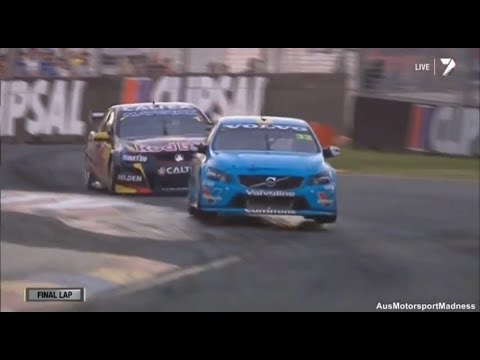
Decision 1 for Volvo last week was to end the company’s factory-backed participation in motorsport.
Decision 2 is a substantial shift in Volvo’s marketing mix that’s going to be very interesting to watch. Volvo is implementing a new plan called the “Volvo Way To Market” and it means big changes in the way they’ll do things.
The Volvo Way To Market can be summarised as follows:
Marketing tools
- And increased spend on better defined and more focused branding.
- Only three motor shows a year – Detroit, Geneva and Shanghai/Beijing. Volvo will also conduct their own major event in Sweden to court the press and push their new products and brand values. This will replace attendance at ‘minor’ auto shows in other cities.
- A decrease in sponsorship activities, such as motor racing and other sporting activities. The only major sponsorship to remain (and get an increase) is Volvo Ocean Racing.
I really like the idea of limited motor show activity. It’s a massive spend and while they’re great fun if you’re involved, the jury is out on how many cars they help to sell. Most car companies now see motor shows as a chance to 1) engage the press and 2) peek down the trousers of their rival carmakers. These three are the shows that everyone attends.
Digital Leadership
This will be an interesting part for me. Volvo argues that people are doing their car shopping online and since the company is seeing the profits of doing business on the Web, it seems interested in opting for online cross channel marketing solutions to attract more customers who would like to buy their automobiles online. However, this is not just it! Volvo also seems to be making a huge investment in improving their old customers’ online experience–some of the ways that they are going to do that are written below.

- Volvo will create an industry-leading website that promotes the brand’s values.
- Volvo will create a new type of vehicle configurator, one that starts with a fully loaded car and allows the customer to customise it from there. Customers then have a video link emailed to them so they can see the car in motion.
- Finally, Volvo will move to selling cars online, to compliment the dealership experience
The first two of those sound rather ho-hum. Every brand wants an industry leading website that promotes their brand values. Every brand wants a vehicle configurator that customers find easy and interesting to use. Right now there are only generic statements of intent. The whole notion turns on how Volvo will achieve this.
The final point is the really interesting one. Establishing online vehicle sales in parallel with the dealership sales experience. I firmly believe that there will be a reasonable selection of customers who will like the idea of ordering online. They’ll still want a dealership around to see the vehicle, maybe even for a test drive, but the idea of avoiding all the sales games and ordering at your leisure will resonate with some.
In order to cater to the surge in demand for cars through online orders, bringing out the best practices facility management would be necessary. The increase in demand would need a higher manufacturing volume of cars which could be achieved through automation practices in manufacturing units– to boost worker productivity as well as the speed of manufacturing.
This calls for some serious research on Volvo’s part in knowing how to pivot their offline customers to online sales-marketing techniques will most likely come into play, and a deeper understanding of demand generation vs lead generation is necessary to get the ball rolling in Volvo’s favor.
Which leads us to….
Dealerships
Dealers might fear Volvo’s proposed online push, but Volvo will argue that dealerships don’t make much money off the initial sale anyway. Their money comes from parts and services, and dealerships will still be needed for those activities. Additionally, car dealers may need to implement effective techniques in order to increase sales. One way to reach more audiences is by consulting with a company that provides SEO for the automotive industry, which enables dealers to rank higher in search engines. Another option is to use search engine marketing to generate more traffic by running advertising campaigns. It is likely that car sales will increase through such effective marketing strategies.

- Volvo want dealers to become full-on brand centres. New dealerships will have a standard Volvo-designed presentation that emphasises the Scandinavian heritage of the company. Existing dealerships will be asked to refine certain details to do the same.
- Example – Dealers will be asked to serve traditional Swedish fare, and drinks in Swedish glass. So instead of looking up a recipe for Swedish meatballs and going to a dealership to buy a car, you’ll now go to your dealership for Swedish food and then go online to order your car.
- European dealership staff will be dressed by a funky Swedish designer. American dealership staff will be dressed by Will Ferrell. OK, I made the Will Ferrell bit up, but the first bit’s true.
Service
After hooking customers in with its tasteful yet all-pervading internet presence, Volvo aims to cosset them with a very personal service experience.
New vehicle customers will meet their personal service technician when they pick up their new Volvo and that technician will stay with them for their full period of vehicle ownership. Phone numbers will be exchanged, presumably along with Christmas cards and other niceties.
——
Volvo seem to be going to great lengths to let everyone know that this is not a reduction in dealership-based sales activity. In fact, Volvo are going to increase their marketing spend by a reasonable sum in order to implement the Volvo Way To Market.
What will be interesting is to see exactly how it unfolds, and how it affects Volvo sales. Volvo will need to do some serious investment in online marketing to reach the right people. And when that’s done, their new website and configurator will have to be something special to get people to commit online.
Other companies will be watching, too. You can bet your bottom dollar that the Teutonic crowd will be very interested in how this goes for Volvo. It won’t take long for other companies to replicate this venture if Volvo proves it can be successful. As with safety, this is something that can be learned and then snuffed out as a differentiator in reasonably quick time.
I take my hat off to Volvo for having a crack at this (but please keep racing).