I think I’ve just found the Japanese version of the Lancia Fulvia!!
Spotted via Bring-A-Trailer, this is a Nissan Silvia from 1965. Just 554 of these were hand-made over a four year period. It was powered by a 1.6 litre, inline 4-cylinder engine making just 96hp.
The car is for sale in Japan for around $20,000 (which is reasonable value for a pretty little car, I reckon).
It’s been said that Asian carmakers don’t mind imitating designs by other manufacturers and that’s arguably been the case when these companies are just starting to break into western markets. It’s one less hurdle for a new player to jump over.
So did Nissan pinch a few cues from Lancia’s little Italian coupe from the 1960’s?
I’ll give them the benefit of the doubt, but the similarities are right here for you to see. The twin headlamps and horizontal grille are similar, but punctuated by a sharper point in the middle on the Nissan.
What’s most striking is the roofline and the B-pillar, which are remarkably similar. The rear is quite different.
The reason I’ll give them the benefit of the doubt?
The Silvia was made from the mid-1960’s. The Series 2 Fulvia, which bears the closest resemblance, arrived about 5 years later. Nissan might have copied the B-pillar design but were ahead on the front end.
Maybe the designers at Lancia copied the Silvia for the Series 2 front end??? 🙂
My Lancia Fulvia 1.3 Rallye is up for sale. With Mrs Swade and I wanting to move house and the initial estimates on the restoration work being higher than anticipated, I have to offer it up for someone else to take on.
It’ll be very sad to see this beautiful lady move on, but hopefully someone else can do the work that I can’t.
With the whole guitar thing going on, there hasn’t been much time to play with the Lancia Fulvia but we got a little time today. It was Classics By The Beach in the morning, followed by a little Fiat X19 time with Geoff and a friend who came over to give us the benefit of his experience with the car – thanks Ant!
After lunch, Geoff and I decided to get working on the Fulvia. I was keen to get a look under its skin to see the real extent of what we’ve got to fix and as expected, there’s plenty to do.
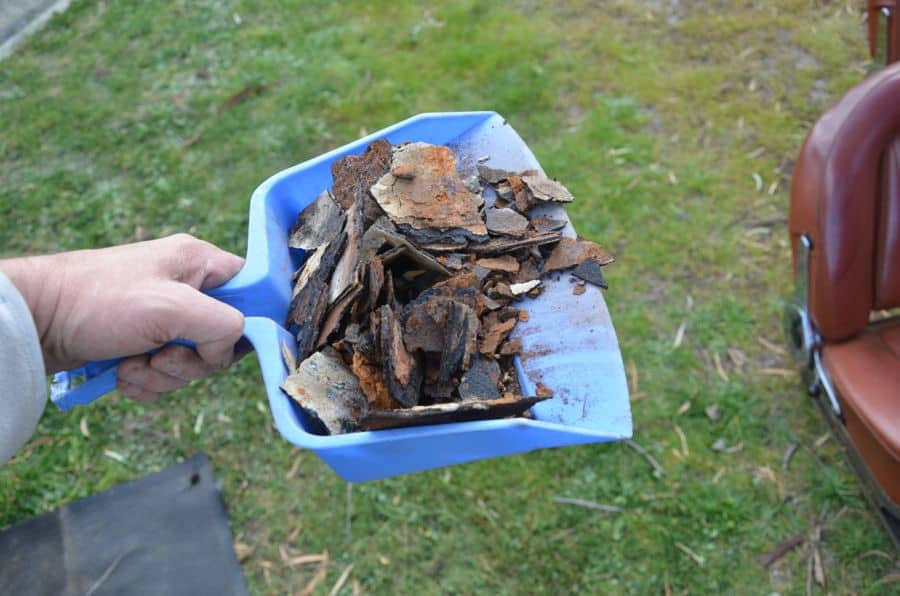
Basically, what we did today was strip out the easy bits of the interior. The seats came out, the seat belts, and then the rubber matting on the floor. The rubber matting had a fibrous underlay underneath and that was a combination of easy and hard to remove. It was easy to remove where the floor was rusted, but harder to remove where the floor was solid. It was mostly easy to remove 🙁
Bottom line: there’s plenty of rust in the floor of the car. The rust has gone right through to become small holes in some places. The rust continues on into the front footwells, too, which was a little further along than I thought would be.
Deep down, I expected this. But an inspection of the floor from underneath had me holding out some remote hope that things wouldn’t be too bad.
The good news is that the box-type framing that surrounds the floor sections seems to be pretty good. I’m still living in hope that the subframe that supports the engine is OK.
New, replacement floor sections are readily available from a various suppliers, as are the inner and outer sills. You just have to buy them and get them shipped, which is a reasonable amount of money. Now that I know how bad it is, I guess I can proceed with that order.
Here are some photos from Sunday’s “Fun With The Lancia Fulvia.”
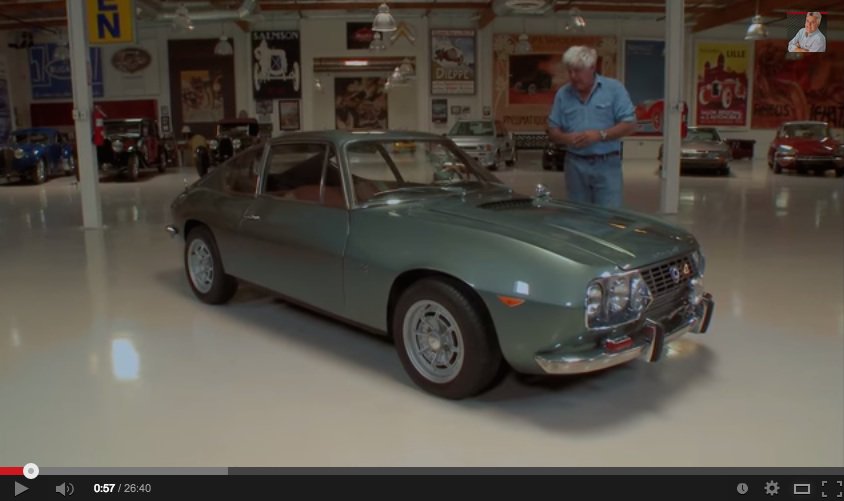
Jay Leno gets all sorts of cool stuff coming through his garage. Most of it he owns, but occasionally he brings in someone else’s car to show it off. Such is the case with this Lancia Fulvia Sport.
The video is around 25 minutes long and provides a great overview to the Fulvia, albeit with the alternate Zagato body.
For those unfamiliar, this is basically the same as my Fulvia, but Lancia had Zagato build some bodies for them until 1972. This is one of those cars. Mine is the regular coupe made by Lancia itself (they made a sedan called the Berlina, too, but that’s another story).
Anyway, the main difference is in the body styling. Underneath, it’s basically the same car.
Petrolicious has to run out of….. fuel at some stage, right? I mean, how many incredible different vehicle models can they actually get access to before they start repeating themselves?
Hopefully the answer is “plenty more”.
The owner of this car will be familiar to the avid Petroliciousisti. One of his cars was featured in an earlier video and it’s every bit as exotic as this one. I won’t tell you which one it is right now but the video’s at the end of this post.
This video focuses on his Lancia 037 Group B. As he intimates in the story, the 037 is the lesser-known but not lesser-accomplished champion of the Lancia family. It shone ever-so-briefly between the rather insane Stratos and the somewhat more sensible Delta Integrale and in many ways, it was the perfect bridge between the two. It’s achingly beautiful to look at and fast in the way that only Group B cars could be.
Enough from me. Enjoy.
——
As promised, here’s the earlier video featuring the same guy.
I’m not sure what he does for a living but he obviously does it well. Not only does he have two of the rarest Lancias ever made, he also has a BMW M1 lurking in the garage, too.
Here’s the very best of automotive reading from around the web over the weekend.
Well, what I think was the best reading. Let’s see what you think.
—
Congratulations to Volvo on increasing its sales in 2013.
Volvo sold 427,840 vehicles in 2013, a small increase over 2012. The boost came thanks to large rise in Chinese sales and a small rise in Swedish sales. The US market, still #1 for Volvo, dropped by 10% so if they can arrest that slide in the near future, things will indeed look brighter for the other Swede.
Don’t mind the picture to the right. It’s an in-joke.
—
We’ve been talking classics a fair bit lately and Hemmings have rightly touted an upcoming auction as the ultimate classic car showdown. This one’s going to have a huge influence, I think.
Take two very, very desirable classics – Mercedes Benz 300SL Gullwings. Give them both a black exterior and a red interior.
The difference?
One of them is completely original and in a condition that many would say needs restoration after years of storage. The other is completely restored – it was black out of the factory and it’s black now, but the interior has been changed from red with green tartan cloth, to red leather.
Which will attract the highest bid?
My money’s on the restoration, but I’d love the original to come out on top.
I’m going to write my last Saab article in a while over the course of the next week or so. This comments thread at Saabs United has convinced me that there’s nothing to write about with regards to Saab at the moment and won’t be for some time.
It’s slightly amusing and very, very sad – all at the same time.
I’ll write something and post when ready. It’s not in any way a rebuttal of the article, which I think is quite good and fair. It’s just my own thoughts on Saab’s current situation in light of their 31 vehicle sales in December, and why that situation doesn’t need any more comment from me for a while. I think a few others might find themselves in the same boat.
And while we’re talking Any Given Reason, can you imagine stumbling upon a garage where Michael Schumacher’s personally specified Ferrari F40 is considered merely an entree?
Let it be known I have no buyer’s remorse. I love my 968CS and hope to keep it (or a car like it) for a long, long time. That said, I spent a LOT of 2013 looking for a Lancia Fulvia and still have a deep affection for the little Italian. Even my wife loves them!
If this Lancia Fulvia 1600 HF were advertised a few months ago instead of just coming on the market this week, I would have taken a very close look. If it checked out, there’s a distinct possibility I would have bought it.
Just a quick update on my search for a good Lancia Fulvia.
The red one from northern Australia has been ruled out. I did get some feedback from the seller last night (finally) and it raised more questions than it answered. There IS a good list of spare parts that come with the car so anyone looking at it who’s willing to reconcile the irregularities that I can’t figure out from a distance could well land themselves a good car.
The blue car from Canberra is still available and the seller has received several offers, including a standing offer from me. All offers are around the same mark. I’ve said that mine’s conditional upon establishing that the car is indeed drivable.
Why?
As mentioned earlier, the car hasn’t been run for around 10 years. The seller is very, very confident that that isn’t a problem because the engine was perfect before it was stored. I still want to be sure.
And as a practical matter, the car has to be able to drive and stop as a condition of carriage with a freight company.
I don’t hold out a lot of hope for the blue Fulvia. I think some of the interested parties (and there are apparently quite a few) will have less stringent conditions than I have.
I reckon I’ll give it another week and make my own decision then. It may just be that I have to put the whole Fulvia idea aside for some time in the hope that one will become available closer to home one day.
Even I’m capable of some common sense, even if it’s only occasionally.
There’s a lot of text and a LOT of photos here. It’s basically me trying to figure out my own thoughts on these two Australian Fulvias. Feel free to climb inside my mind.
I’ve been looking at Fulvias for a few months and I’m coming to a point where a decision is warranted – which one do I pursue?
The situation has changed a little since I last wrote about Fulvias. Another car has come on to the market here in Australia. We’ll it’s returned to the market. This car was sold on Ebay a few weeks ago but the sale fell through so it’s now available once again.
With two Fulvias available in Australia, the overseas options are temporarily shifted to the sidelines. So let’s take a closer look at these Australian cars and perhaps you can help me choose.
——
1968 Fulvia in Red
I was watching this car when it sold on Ebay a few weeks ago. I didn’t bid on it because there were a few things that concerned me at the time. First, the seller told me a couple of things on the phone that weren’t mentioned in the ad – like the fact that the spare parts would only come with the car if it reached a certain price. I didn’t think that was fair.
I had a friend take a look over the car and there were some things about its condition that weren’t mentioned in the ad, either. Some (possibly) questionable body work and a reasonable size oil stain at the bottom of the engine bay.
Back when the car was on Ebay, I mentioned on this site that I wouldn’t be surprised if the sale fell through because the car was not described correctly in the ad. It seems that’s come to pass so it’s back on the market again.
Lars (my test-driving friend) took a bunch of photos for me, which are included in the gallery below. I think the car will need some work but it’s basically OK. I’m more wary of the seller.
Here’s the first gallery of photos, the ones featured in the Ebay ad.
As with all these galleries, please click to enlarge.
It looks pretty sweet there, right?
It’s been done up to look like a HF rally car. It’s not a HF. It’s a regular 1.3 Rallye with a some flares, wheels and stickers. I’d remove the stickers but I’m happy with the flares and the wheels. In fact, the flares, wheels and steering wheel are very attractive items and they’re difficult and expensive to replace. That’s one of the attractions of this car.
It runs OK, too. My friend Lars had a chance to drive it. As expected, the engine note was totally addictive but it also got down the road OK. It’s not fast – Fulvias are more about carrying speed than acceleration – but it’ll keep up with traffic OK.
Lars also took some extra photos and sent them to me. These photos show the real condition of the car, the details that the photos from the ad don’t show you. In this collection you’ll see some cracks in the paintwork (not really OK, but indicative of some poor preparation or worse), some faint surface rust (OK), some cracks in some of the interior surfaces (understandable), some oily bits at the bottom of the engine bay (to be checked) and some missing window seals (not great).
—
My thoughts on the red Fulvia:
I like the stance of the car and the wheels, flares and steering wheel are very desirable accessories. It’s likely I’d look for those down the track anyway so getting them on the car from the get-go is a bonus.
The seats are from a Subaru but the seller says that he has the original seats and seat belts. The original seats need refurbishment.
It runs but the engine will need to be looked at to determine the cause of the leak.
I’m getting Lars and a friend of his (bodywork expert) to take another look, focusing on the integrity of the subframe. If it checks out, I think this’ll be a car that could be used with minimal attention while saving up for the fiddly bits that’ll need to be addressed down the track.
Having said all that, I’m quite wary of the seller and therefore I worry about what secrets this car might hold.
I reckon this car could be bought for a figure in the mid-teens. Around $15,000 should do it and that should also secure a bunch of spare parts that the seller has. The problem is that it’s proving hard to get that list of spare parts out of the seller so I don’t even know what to expect as far as the parts are concerned (the seller’s not the easiest bloke to deal with).
Thankfully I’m buying the car and not a relationship with the seller. It’s tricky, but I think the car’s worth the investigation.
——
1967 Fulvia in Blue
I told this car’s story on site here just a few days ago:
This Fulvia Coupe has an interesting history – if only it could be verified. The owner’s story goes like this….
He bought the car in the early 1980′s and it had been off the road for 5 years at that point. He’s never registered it, either. It still has the registration sticker from the last year it was on the road legally, in 1977. The owner was young and moved around a lot for work in country Victoria, so never got to work on the car as he wanted to. Time passed, he got married and had kids. The car has been sitting in his in-laws’ garage for nearly 15 years now in non-rusty Canberra. He claims the mileage – just 22,000kms – is genuine.
Unfortunately, none of this is documented. It’d be a great low-mileage history and I don’t doubt the truth of it when it comes from his mouth, but in order to form part of the car’s history when it passes from one owner to another, you need to be able to back it up. That old registration sticker is about as good as the proof gets.
I took a look at this car myself while visiting Canberra a few weeks ago. The car hasn’t been started in 10 years. It hasn’t been registered for 36 years!!
That means there’s a hell of a lot of work to do. The seller is a very nice guy who I’m not wary of at all. He swears black and blue that the engine is absolutely fine. He even mentioned some work being done to the engine but I didn’t get the timeframe for that. Bottom line, though, an engine that hasn’t run in 10 years is going to need some work and if you go into a purchase like this thinking otherwise, you’re kidding yourself. Then there’s the brakes, all the plumbing, the suspension, etc, etc.
Thankfully the interior’s in fantastic condition with the seats having accommodated absolutely no-one since they were refurbished some time ago. They look sensational.
Time for the photo gallery:
—
My thoughts on the blue Fulvia….
There’s a hell of a lot to like about this car and there’s a lot that frustrates me. It has a great backstory and low mileage, although that history is totally undocumented. You have to hope that it’s non-use over the years would come through as being genuine in the restoration.
I would hope that this car could be bought for under $10,000. There’s most likely $20,000 worth of work to be done. The seller wants a price in the low teens, but I don’t think that’s a fair representation of the work that has to be done.
What really appeals to me is the romance of this car. It’s basically been without any meaningful purpose for more than 30 years. The idea of bringing it to life again and learning about these wonderful cars in the process is a very, very appealing idea.
The downside is that that’s going to take some time and a whole lot of money. I’d like to drive something in the near term.
——
If you’ve got this far, congratulations and thankyou.
Both are genuine options and I need to figure out which one I’m going to pursue more aggressively this week.
I’m drawn by the blue car’s story and I’m wary of the red car’s owner, but then the red car is set up almost exactly as I’d like to set up a Fulvia myself. And while the red car will need attention to the body down the track, it’s basically a driveable proposition right now (albeit with a little oil leak to attend to). The blue car will need a lot of work but I think the payoff for that work will be huge – a genuine low kms car that you’ve basically brought back from the dead. I really like that idea, even if I lack the skills right now to bring it to fruition myself.
You really do have the bug. Give us a run down on the model code names, specs and years? Know very little about this little car…liking it more and more myself.
Yes, I do have the bug.
Sadly, it’s an intellectual bug only because I’ve never actually driven one. The Fulvia has come to my attention through a combination of temporary availability and video. I want one because one was available for sale and I liked what I saw when I checked them out.
Exterior and Interior
The Lancia Fulvia was built in three series from 1963 to the mid 1970’s. The Fulvia also had three body styles. The first Fulvias were Berlina four-door sedans but most of the interest these days is around the Coupe and the Sport models. The coupe was designed in-house at Lancia and the Sport had a completely different body styled by Zagato. The Sport sounds exotic, but the coupe is the one to go for IMHO.
Lancia Fulvia Berlina
Lancia Fulvia Coupe
Lancia Fulvia Sport (Zagato)
—
The Sport body by Zagato can be dressed up to look quite sporty, but IMHO looks a bit bloated. The coupe body was the biggest seller and it proved to be a wonderfully versatile design. The coupe can look either classy or quite mean depending on how you want to set the car up.
All three cars had the same basic interior design, which is simple, sporting and quite elegant in the way that it seems only 60s and 70s cars can be.
OK, I cheated a little bit there.
That interior has been fitted out for rallying with its timing gear on the right and the Sandro Munari steering wheel – one of the best looking steering wheels I think I’ve ever seen.
But that’s part of the beauty of the Fulvia – it’s so suited to being both classically beautiful and very sporty – both in the way it looks and the way it drives.
Here’s a more standard interior from a later model Fulvia in RHD:
—
The Fulvia is a compact 4-seater whether in 2-door or 4-door version. The rear seat is small and there’s not much room for cargo in the boot, either. Most of the boot space is taken up with the spare wheel, actually.
But who cares about back seat passengers or cargo? This car was made to be driven!
——
History
Lancia’s one of those companies that a guy of my generation probably won’t know much about unless they’re a bit of an anorak. Brits and other Europeans might be a bit of an exception because Lancia sold the vast majority of their vehicles in the European market.
My knowledge was limited to the Beta, which sold here and which I still quite like in terms of styling. Of course, I’d heard of the Stratos and later, the Delta Integrale, but I still didn’t appreciate the full measure of Lancia’s success as both an innovator and as a motorsports champion.
Two things slowly opened my eyes.
The first was the knowledge that Lancia was one of Victor Muller’s favourite historical marques. I’m led to believe he own a number of them. Victor is quite obviously a man of means with a flair for items of some substance. It put an asterisk next to Lancia for me as a brand that I had to look into a bit more at some stage.
The second was the Top Gear special story on Lancia. I included it in a previous post about the Fulvia, but I’ll put it here again for those who still haven’t seen it. Take note of the number of significant firsts this company achieved as well as their considerable motorsport success.
——
Lancia had achieved a fair bit of success with the Flavia medium sized car when the company decided to make a more compact car, which became the Fulvia. The Fulvia debuted in 1963 at the Geneva Motor Show and the Coupe was introduced in 1965.
The Fulvia Coupe formed the basis of Lancia’s assault on the world rally championship, and what an assault it turned out to be. Lancia won the 1972 International Championship for Manufacturers, the predecessor to the World Rally Championship with the Lancia Fulvia HF (noted flying Finn and Saab works driver, Simo Lampinen was at the wheel of that car).
Lancia then dominated the initial years of the World Rally Championship with manufacturer wins in 1974, 1975 and 1975 with the Lancia Stratos. They returned to the winners podium in 1983 with the Lancia 037. In 1987, Lancia had the first of six consecutive WRC titles with the mighty Delta Integrale – the most successful vehicle in WRC history.
All that success began with the Fulvia.
——
Specs
I’ll deal with just the coupe here, as that’s the model of main interest.
The Fulvia Coupe was made for around 10 years and was available in several different specifications over that period. The following is taken from Wikipedia but resolves quite well with other independent sites.
—
Coupe – A compact two-door introduced in 1965, designed in-house by Piero Castagnero. the coupe uses a 150 mm (5.9 in) shorter wheelbase along with the larger (1216 cc) or 1231 cc engine producing 80 bhp (60 kW) at 6000 rpm.
Coupe HF – A competition version of the coupe introduced later in 1965, fitted with a tuned version of the 1216 cc engine producing 88 bhp (66 kW) at 6000 rpm, and fitted with aluminium bonnet, doors and bootlid together with plexiglass side and rear windows.
Rallye 1.3 HF – An updated HF with a new 1298 cc engine with 101 bhp (75 kW) at 6400 rpm..
Rallye 1.3 – An updated coupe with the 1298 cc (818.302) engine with 87 hp (65 kW) at 6000 rpm.
Rallye 1.3S – An updated Rallye 1.3 with a new 1298 cc (818.303) engine producing 92 hp (69 kW) at 6000 rpm.
Rallye 1.6 HF – The evolution of Rallye 1.3 HF with a 1584 cc engine producing 115 hp (86 kW) at 6000 rpm. Other changes included negative camber front suspension geometry, with light alloy 13 inch 6J wheels; and a close ratio 5 speed gearbox and wheel arch extensions.
Rallye 1.6 HF Variante 1016 – Also known as Fanalone – The most-powerful Fulvia with a 1584 cc engine producing up to 132 hp (98 kW) depending on tune. This was the version used by the works rally team until 1974, when it was superseded in competition by the Stratos HF. 45mm bore Solex carburettors were used tht were later replaced by 45DCOE Webbers. The cam cover had special blue stripe over yellow paintjob (HF cars had just yellow paintjob). Some sources indicate the easiest way to distinguish this version is by 2 triangular holes between headlamps and grille.[4]
Coupe 1.3S – 2nd Series – Face-lifted body and new 5 speed gearbox with 1298 cc (818.303) engine producing 90 hp (67 kW) at 6000 rpm. Larger Girling calipers and pads replaced the Dunlop system fitted to 1st series cars.
Coupe 1600HF – 2nd Series – Face-lifted all steel body with 1584 cc engine producing 115 hp (86 kW) at 6000 rpm. The bodywork was changed from the standard 1.3 Coupe to incorporate ‘flared’ wheel arches (replacing the extensions used on 1st series HFs). ‘Lusso’ versions had extra trim and were fitted with bumpers and were mostly produced for export.
Coupe 1.3s Montecarlo – Replica of 1972 Montecarlo Rally works car livery with 1298 cc producing 90 hp (67 kW) at 6000 rpm. This version used his own bodyshell with flared wheelarches similar but different to the 1600HF bodyshell, ‘Lusso’ interior fittings (bucket seats etc.), fitted with front fog lamps and no bumpers; but were fitted with the standard 4.5J steel wheels of the standard 1.3 Coupe.
Coupe Fulvia 3 (3rd Series) – Updated Coupe introduced 1974 with a new design of seats incorporating headrests and new white faced instrument dials with an updated range of trim colours, materials and options. Mechanically the same as the earlier 1.3s S2 Coupes except for the addition of emission control on the solex carburettors.
Coupe Fulvia 3 Safari – A limited edition of the standard Coupe without bumpers, special trim, exterior badges on the bonnet and on the bootlid and also special numbered plaque on the dashboard.[5]
——
Power isn’t this car’s strong point, as you can tell. The most powerful model had just 132hp and those models, known as Fanalone, are the ones that sell for the big bucks these days.
The car’s strong points are handling, engineering and styling. Fulvia owners that I’ve talked to will talk about these qualities at length and with relentless consistency. Lancia built its reputation in preceding decades on well engineered, well constructed and very stylish cars. Clarkson’s point about the Fulvia being more expensive at release than an E-type Jaguar come to mind, such was the expensive, hand-built nature of the little Lancia.
The Fulvia is known for being very reliable, even for such an old vehicle. There are plenty of them still being used as daily drivers. There’s a good enthusiast community around the world for them, too. A lot were sold in the UK so there’s even a ready RHD market and parts supply is pretty good for such an old vehicle.
The Fulvia is quite rare here in Australia. I heard from one source that there were only a couple of hundred of them brought here. Sales and values are therefore a little hard to judge, but I think it’s not beyond reason to expect a basic 1.3S or Rallye in restored condition to sell somewhere in the order of $20,000. Sellers of HF models have been asking amounts over $50,000 in recent years, but I’m unsure as to how many of them actually achieve this figure. A good condition Fanalone would nearly double that price in the right market.
——
Video
These video were in one of my previous Fulvia posts, but they’re worth showing again.
Enjoy.
—
Petrolicious, as always, do it right…..
—
Overview of second hand Fulvias in Britain (old video)….