Yesterday was the first day of Spring! It was a beautiful Spring day, too. Being the first Sunday in September, it was also Father’s Day here in Australia.
The good weather brought out some cars that might have otherwise stayed tucked away, but I think Father’s Day kept a few away as we had a slightly quieter Classics By The Beach. It seemed to be an older crowd with more older cars rather than just classic cars. It was a slightly smaller crowd, too, but none of that means that things were less interesting.
There was a nice little contingent of Aussie muscle from the 1970’s – a triumvirate of Toranas.
The black and blue cars are A9X models of the muscular SLR 5000 Torana. The A9X was a racing package developed for the Australian Touring Car Championship in 1977 and A9X Toranas dominated both the 1978 and 1979 racing series.
The purple car on the end is a SS model hatchback. Consider it the more practical Aussie muscle car.
The black A9X was decorated with some of the original dealership notices, included with the car so that the new owner would know how to safely operate the car. A nice touch for the show.
This Jaguar XK140 is another special edition car.
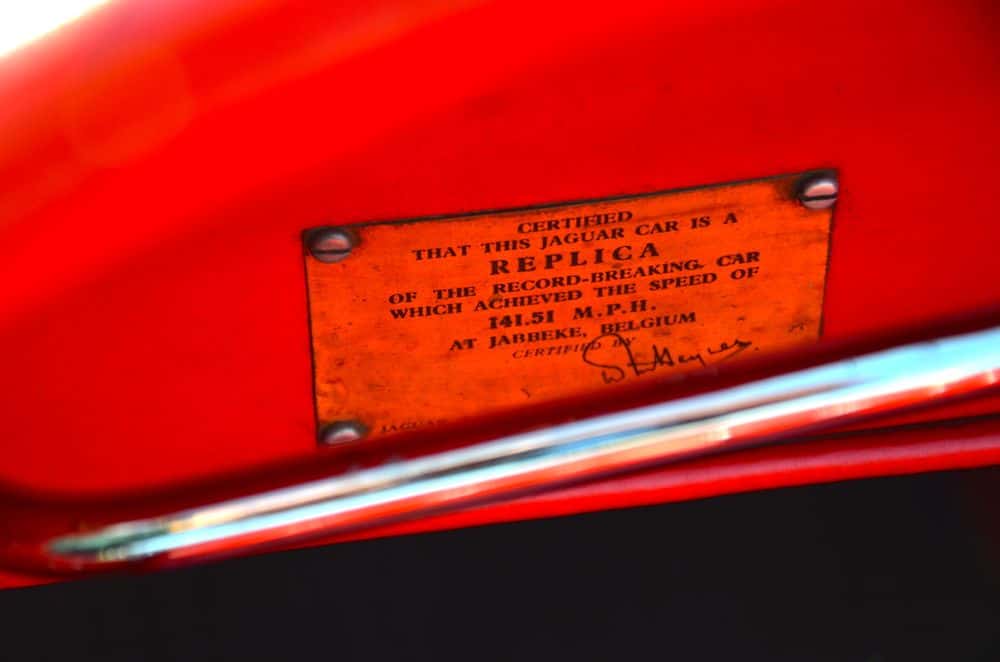
Aside from simply looking exquisite, the car is also a replica of a speed record holder produced during the period. Certification came by way of a plaque fastened to the left side of the dashboard.
Zooming out for a moment, it’s worthwhile looking at the entire interior, resplendent in rich red leather.
Looking through my photos this month, I seem to have had a focus on interiors and dashboards. Some are certainly better than others. I don’t know about you, but I tend to favour the classic white-on-black with a dash of chrome. It looks classic, clean and elegant where some of the others look a little….. cheap.
Late model MGB – like.
Camaro – not so much.
This Ferrari 308 has some beautiful switchgear…..
And I like the octagonal gauges in this MG:
The most-beautiful interior award for this month has to go to this old Mercedes. I don’t think the photo does it justice, but it was magnificent:
It’s a stark contrast between the interior design of the Merc and that of this Ford Futura convertible (still a very nice car, by the way).
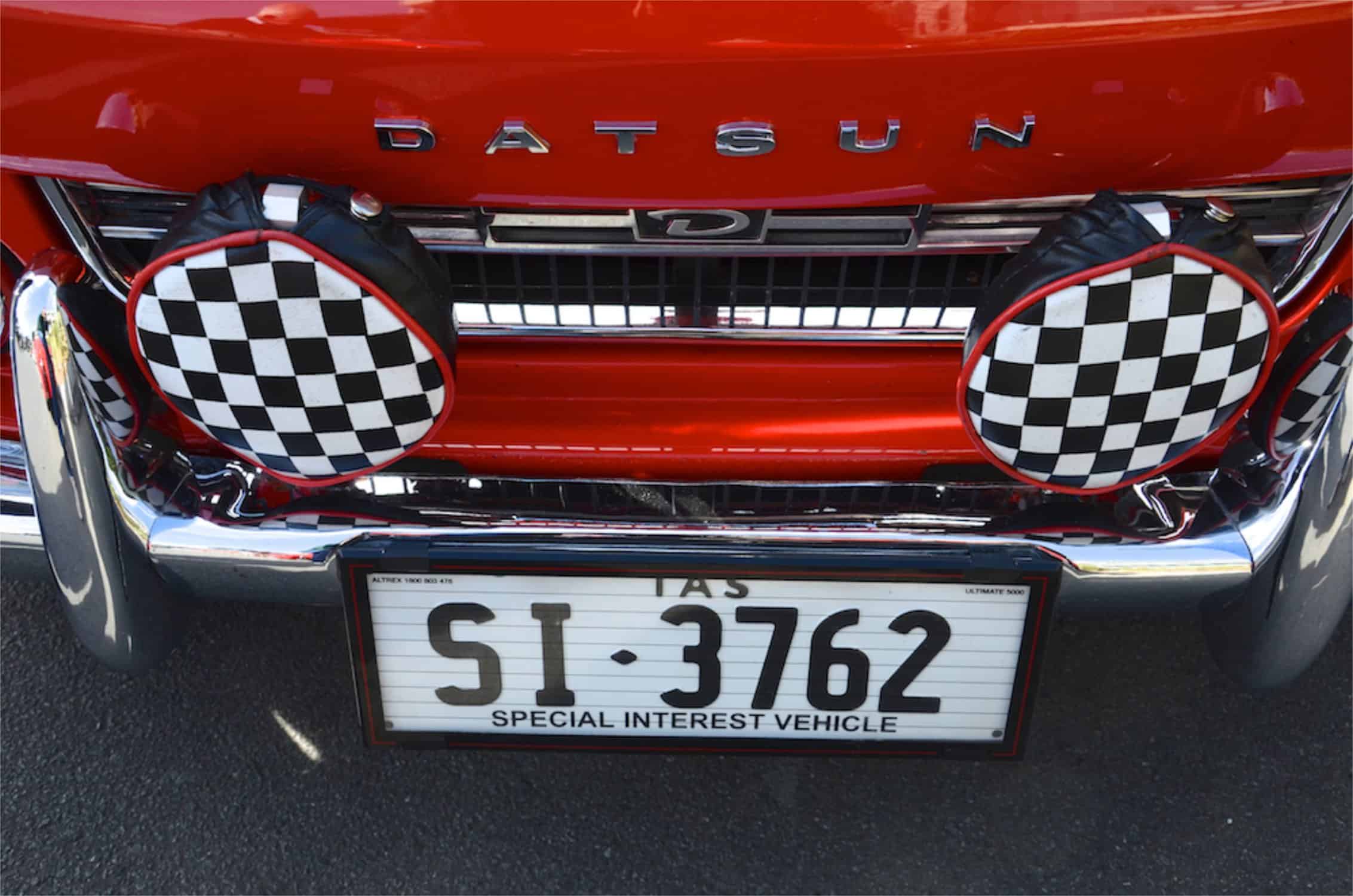
My personal favourite for this month was this Datsun 2000 convertible. It was just outstanding. The brightwork was beautiful, the paint was rich and the simple interior gave the car plenty of character and purpose. I could have stared at this car all day long.
Note the sideways-tilting radio. Love it.
—
Here are all the images from this month. Click to enlarge.
This is the second Porsche 944 I’ve looked into buying. I could tell enough about the first one (5 years ago) to know that it wasn’t a good car for me. It was a 1983 model. It looked great, but that’s where the good news finished. The interior was horrible and the car felt like it was about to fall to bits.
I had much higher hopes for the car I had tested today (Friday). It’s a 1990 model Porsche 944 S2. Much better model with more power, better mechanical technology, much better interior and it even looks more contemporary thanks to the body changes that first saw light on the Turbo from 1986.
The photos looked good. The buyer seems like a really responsible guy and the car has a complete history from its Australian delivery to present day. Promising, no?
The mechanic looked over the car today and I think I can summarise the occasion with his words, stating that this could well be one of the best S2’s on the road…… eventually.
First, the good bits. The paint is quite good. There’s some evidence that parts of the car (at least) have been repainted but there’s no lasting damage and the resulting paintwork is very presentable. The interior is one of the best the mechanic’s seen without a full restoration. He was amazed at the condition of the dashboard and the seats had been retrimmed in leather in the last few years. He took the cam cover off the engine to inspect the cam lobes, an easy tell-tale that inadequate oil has been used, but it was all good there, too.
So…. body OK. Interior OK. Engine internals OK.
Porsche 944 S2
Porsche 944 S2
Porsche 944 S2
Porsche 944 S2
Porsche 944 S2
Porsche 944 S2
Then we get to the list of stuff that needs attention. It’s a reasonably long and expensive list.
A lot of people desire originality in their cars and that’s fair enough. Unfortunately, this car seems to be too original. All original pipes, hoses, gaskets, seals, bushes, mounts, etc. That is, barely anything has been replaced and given the current condition of most of them, that’s a shame.
Put short (and again, in the mechanic’s words), this is car that could soak up K or more on top of the purchase price very, very easily.
The must-do list:
Sump gasket
Engine mounts
Hall effect sensor
Rear main seal
Accelerator cable
Rear brake discs
All brake hoses
All dampers
All tyres
Cam cover resurfacing (yes, a must-do)
Radiator fan motors (x2)
Fuel lines to fuel rail
Various cooling hoses
Yes, they’re the considered to be the must-do items. All are essentially the original items that were fitted to the car when it was built in late 1989. Many are on their absolute last legs and others might default to the near-term list (with the radiator header tank, a/c compressor, steering rack and other bits).
Now, there is a caveat in here. The mechanic who inspected the car is extremely finicky. It’s better to be fussy than lazy, but in talking to him I get the impression that anything that isn’t in concours condition is due for heavy criticism. But even if I could live with half of these items being done six months or a year from now, that’s still around $5K or so worth of remedial work that needs doing straight away.
That would push the price into the mid-upper $20K range. Fixing everything that needs doing (along with a few cautionary items that are recommended while you’re working nearby) means there may not be much change from $30K or more.
And at that price you’re into 968 territory. See, it’s never easy.
I’m yet to fully digest the report and go over the major points with the seller. I doubt he’s going to come down to a price that would justify the purchase for me.
We’ll see what happens. I’m not looking for one, but today’s experience just reinforces the fact that there’s no such thing as a cheap Porsche.
This week’s Fantasy Friday entry was inspired by a car I saw on the road in Hobart earlier this week (see above).
Early model Japanese sports cars are rarely going to approach the value of their European counterparts but there is a fierce little community dedicated to the preservation of these cars and their work is gaining in appreciation. Values are gaining ground, too. You can easily fork out over $40,000 for some early Japanese sports cars that would have been sold for scrap 10 years ago.
The 1st generation Toyota Celica Liftback is not one of those $40,000+ cars (yet) but the good ones do command five figures and ….. well …. they look the business, don’t they?
The Ford Mustang inspired a lot of design knock-offs (even Aston Martin made a Mustang-inspired muscle car) and the Mustang treatment on the Celica worked a treat. They’re much rarer than this generation’s hardtop coupe, too, which gives the Liftback a nice additional layer of desirability.
The Liftback looked a little bit staid on the showroom floor but you can see the potential.
Owners tend to go with some bigger, wider wheels and a lowered stance and the transformation is instantaneous. The car I photographed on the road has it. The cars I spotted on this Facebook group dedicated to the model have it as well.
From the mild…..
…. to the meaty…..
….to the downright muscular:
You might feel tempted to pooh-pooh the modified versions of this car but they sit OK with me. These, along with American muscle cars, are some of the first models to really inspire the home the tuner/stylist. They were relatively cheap and much more reliable than most of their contemporaries from the time. That translated to them being accessible, drivable and popular. Give that combination to a cashed-up, creative tuner community and what you get might lack some pedigree, but has plenty of conviction. They took their modifications pretty well, too.
Power wasn’t outstanding but was OK for the time. Celicas have always been powered by 4cyl engines, though some early Supras badged as a Celica XX had a fuel injected six – I owned one all through university! The best of the 4 cylinder models from this first liftback era had a twin-cam Yamaha head, good for nearly 140hp.
Perhaps the enduring attraction of these early Celicas, apart from their 70’s retro look, is the fact that they’re rear-wheel-drive. The model changed to front-wheel-drive in the mid 1980’s and Celicas went from being regarded as cheap sports cars to something more akin to a hairdresser’s car. Teenagers from the 80’s who are now hairy-chested men with a bit of spare cash often like the idea of getting something nostalgic. This is automotive nostalgia that’s authentic, relatively rare and affordable.
——
There are quite a few older Celicas on the market right now but most of them are the hardtop coupe. There are very few of these ‘Mustang’ liftback coupes for sale.
I understand that this won’t be a fantasy car for most visitors to this site. There IS a huge market out there for older Japanese sports cars, however. Older Mazdas and Datsuns are also sought after and some of the prices these former throwaway cars are eye-openers, to say the least.
UPDATE: I’ve been given some links to Celica stories from Hemmings, all of which make for great reading if the Celica takes your fancy. There are some great photos associated with them, too, much better than the photos I’ve gathered here.
It’s been quiet around here because there are a few things on my mind.
First, we have a federal election going on here in Australia. The poll itself will be held on September 7. I don’t want to be consumed by it, but I am. I’m doing my best to keep the election off this website, however.
You’re welcome.
Second, this week has seen the climax of the biggest scandal in Australian sports history. The conclusion has been six months in the making and thoroughly consuming all week.
And finally, I’ve got a vehicle inspection happening tomorrow. We’ve replaced Mrs Swade’s 9000. Now it’s time to replace my Alfa Romeo GTV6.
Here’s the car:
It’s a 1990 Porsche 944 S2 – cross another one off the bucket list!!
I hope the inspection goes well. In fact, after chatting with the owner a bit I’m expecting it to go well. I’ve got the best 944 mechanic in Australia looking at it so if it impresses him then I’ll feel quite comfortable with the purchase.
I’ll let you know.
——
Mod Advice (Part 1)
Back in the SU days I wrote a four-part series on modifications to the 1998-2002 Saab 9-3. The cars are very tunable but they’re also quite compromised by a chassis that’s nowhere near as sophisticated as the engine Saab put into it.
In short, you have to make sure that the bits around your engine can handle the extra oomph that Maptun/Hirsch/BSR/whoever can get out of it.
I spotted this old ad for the Porsche 944 Turbo on TTAC today and it presents the case for careful tuning quite nicely. It shows all the bits that Porsche changed when the company went from the basic NA model to the turbo model.
Click.
Bottom line: Responsible tuning isn’t just the addition of a single go-faster bit. It’s a whole-of-car affair if you want to do it right.
——
Mod Advice (part 2)
If you’re taking your modified car to a huge gathering of like-minded car enthusiasts, make sure the car’s legal.
Queensland police have been criticised for deliberately targeting one of the largest ever car enthusiast events to be held in the state.
…. The promoters had positioned the event as a peaceful day out, with the specific instructions of “No Skids, No stupidity. Don’t give the cops a reason to turn up!”
Regardless of the exemplary behaviour of the attendees, up to 30 Queensland police officers and a special traffic task force blocked the entrance and exit to the event, which was held on private property, specifically to target modified vehicles.
It IS poor form on the part of the police, who should want to build bridges and relationships with elements of the community. Shooting these metaphorical fish in a barrel isn’t really going to help.
But it’s also poor form to drive your car in what might be an unsafe condition. Do your mods carefully and make sure the car’s legal.
All parties (police and individual owners) need to look at doing things better, I’d say.
——
Old man becomes king of the kids
The reviews are coming in and it’s emerging that what’s previously been regarded as a bit of an old man’s brand – Mercedes Benz – might just be taking over a market segment considered the reserve of the young and upwardly mobile – the hot hatch market.
After two days in the saddle (and some scorching track time), this I declare: Mercedes Benz remarkable A 45 AMG is the best high-performance hatch ever made, ever offered for sale.
The best ever… simple as that.
And then there’s this from Wheels Magazine (Australia’s biggest motor mag), who are still on their road test right now. This via Facebook about an hour ago:
Road loop today in the A45 AMG and it’s seriously epic. F@$king epic, even. We already knew it was fast, but it’s the A45’s hungry front-end and superb power down that make you grin like a loon. It’s an easy and predictable car to drive hard, but it’s also still exciting. Every motoring hack on the launch can’t stop raving about it. 2013 is proving a great year for performance cars!
The guys at Renault et al. better get their thinking caps on. I’m sure the result will be worth the wait.
Here’s some video from Autocar in the UK, just in case you haven’t got across this new AMG model yet. It looks like a barn-burner!
—
Thanks to Turbin for the link.
——
Have a good week. Fantasy Friday returns tomorrow.
Welcome to the first instalment of Fantasy Friday, a momentary brainstorm idea that may or may not be continued in the future.
I spend a LOT of time on various car-selling websites so I thought I’d pick a car from time-to-time to share on here. Any car shown on Fantasy Friday will be a car that’s available for sale at the time of publication (so hopefully a friend can buy it and I can go for a drive!!).
There’s no description on this listing as yet, but the photos say enough to suggest that this Dino presents in very good order. Shannons will put a mechanical report on their website closer to the auction date.
There’s no price guide at this point, either. Shannons have sold a few of these cars over the years, however, with most of them going in the high 100,000’s. The most expensive one sold for $220,000 back in 2007.
That was a GT and therefore, a hardtop. This one’s a GTS, meaning it’s a targa top with a removable roof. This is also the first GTS they’ve listed for sale, from what I can tell. The price will be interesting to see.
——
Here’s some video to get your aural juices flowing. That V6 engine sure sounds sweet.
The video, which was made by the owner of the car, isn’t the greatest quality but it’s got a great car-guy story behind it and gives you a good feel for riding in the car:
On the plane back from Europe in 2008 I happened to meet a French enthusiast who loved Dinos but didn’t have one. I invited him to go for a ride while he was in Los Angeles and his comments about the car are worth hearing.
——
Because I’m a lazy arse and it’s late on a Friday night, here’s a summary about the 246 Dino from the horse’s mouth – Ferrari’s own website….
At about the time that the Dino 206 GT gave way to its successor the 246 GT during 1969, Enzo Ferrari was reaching an agreement with Gianni Agnelli of Fiat to take over the production car side of the Ferrari business. At this time Enzo Ferrari was already over 70 years of age, and apart from securing the long-term future of the production car business, it freed him from the day to day responsibilities of it, and gave him more time to devote to his first love, the racing department.
The Dino 246 GT made its official debut at the Turin Show in November 1969, although the production run had already commenced. A total of 81 examples were completed by the end of the year. Visually the 246 GT was almost identical to the 206 GT that it succeeded, apart from the fuel filler cap being under a flush fitting flap on the left sail panel. In reality there were more differences than initially met the eye. Apart from the increase in engine capacity from 2 litres to 2.4 litres, the engine block material was changed from aluminium to cast iron. Also not apparent from a casual glance was the change to the wheelbase, which was 2280mm on the 206 GT, and 2340mm on the 246 GT, with a corresponding increase in overall length. An increase in diameter of the paired twin exhaust pipes could also be noticed.
During the production period of the 246 GT from 1969 to 1974, there were no major changes to any features, although various smaller items and details did change, leading to the three series of cars referred to as “L”, “M” and “E”. This is apart from the different market versions, and the targa-roof 246 GTS model.
Broadly speaking, series “L” cars were produced in late 1969 and through 1970. They have road wheels with a single knock-off spinner, front quarter bumpers into the grille opening, rear licence plate lights in the quarter bumper ends, an external boot lid release button and head rests mounted on the rear bulkhead. The body material was steel with an aluminium front lid.
Series “M” cars were produced for a short period in the early part of 1971. They had five bolt fixing for the road wheels, an internal rear boot lid release catch, seat-mounted headrests, plus detail changes to the engine and gearbox, whilst the chassis received modification, resulting in an increase of 30mm in the rear track.
The Series “E” cars were produced from early 1971 to the end of production in 1974. They incorporated all the changes to the Series “M” examples, together with further modifications to the engine and gearbox. The windscreen wiper parking arrangement changed from central to right, on left-hand drive cars, whilst right-hand drive examples retained the central parking arrangement. Other visible differences were the repositioning of the door lock barrel from within the scallop to below it. The quarter bumpers finished short of the grille opening, the cooling ducts below the front quarter bumpers changed from plain rectangular openings, to formed circular inlets, and the rear number plate light became a chrome-plated rectangular unit mounted on the rear edge of the boot lid.
A USA market version was introduced at the end of 1971, which can be identified by the vertical instead of flush mounted indicator lights in the nose panel, and rectangular side marker lights cut into the front and rear wings. The 246 GTS model with a black finished removable roof panel was introduced in the spring of 1972 at the Geneva Show. Apart from the removable roof panel, it can be identified by the omission of the rear quarter windows, which were replaced by a plain metal sail panel with three rectangular cabin exhaust air slots. Late in the production run, wider Campagnola wheels of a different design from the standard Cromodora ones, coupled with flared wheel arches, were offered, as were “Daytona” pattern seats, which had a different, more elaborate stitch pattern with thin horizontal bars to the centre, which earned the package the epithet “Chairs and Flares”.
As noted the cars were built on a 2340mm wheelbase chassis, constructed along the same lines as the preceding 206 GT. It was modified twice during the production period, and given factory type reference numbers 607L, 607M and 607E. The Dino even-number chassis numbering sequence, which had started with the 206 GT, continued in use throughout the production run. Servo-assisted ventilated disc brakes, initially Girling on “L” series cars, and then ATE on later models, together with independent suspension of the same layout as the 206 GT were provided. The body shape was virtually identical to the 206 GT apart from the details already mentioned.
The engine was again of 65 degree configuration, with chain-driven twin overhead camshafts per bank, having a total capacity of 2418cc, with a bore and stroke of 92.5mm x 60mm, bearing factory type reference 135 CS. The cylinder block was cast iron, whilst the cylinder heads and various other castings were of a silumin alloy. The engine was transversely mounted in unit with the all-synchromesh five-speed transmission assembly, which was below and to the rear of the engine’s wet sump. It was fitted with a bank of three twin-choke Weber 40 DCN F/7 carburettors on Series “L” and “M” cars, with 40 DCN F/13 models on Series “E” cars, mounted in the centre of the vee, with a distributor and electronic ignition system, to produce a claimed power output of 195 hp.
Despite the evolution of the body style from the sports-racing Dino model, there was virtually no competition career for the Dino road series cars, apart from relatively low key private entries in some national events and rallies. The only major international race appearance was at the Le Mans 24-Hour Race in 1972, when a much modified 246 GT, chassis no. 02678, was entered by Luigi Chinetti’s North American Racing Team, driven by Gilles Doncieux/Pierre Laffeach/Yves Forestier, finishing in 17th position overall and 7th in the Index of Performance category. Between 1969 and 1974 a total of 2487 Dino 246 GT models were produced, with 1274 246 GTS examples being produced between 1972 and 1974.
Here are some of my best reads from the last few days of online automotive reading (and something from the fringe).
—
Jalopnik good
I don’t know if you’d call this list definitive, but it’s entertaining. Jalopnik compiled a list of the Ten Best Automotive Ads and there are a couple of Swedes amongst them – one each from Volvo and Saab. I’m not sure they picked the right Volvo ad (I prefer the one with the Lamborghini) but the Saab one was a favourite.
—
Not a real ad
Spotted, photographed and caption-added by my mate Turbin a few days ago.
—
Jalopnik Bad
Jalopnik’s still on my RSS feed because once or twice a week you still get a story that’s worth reading (see the ads story, above). That’s maybe two read-worthy stories out of the 300-or-so they publish every week. Jalopnik’s entry rate is frenetic nowadays, which would be great if they had useful content. But Jalopnik’s style has regressed in the last 18 months and they’re publishing a heck of a lot of trash now.
I think it was around 1995 that it dawned on me how much I hate commercial FM radio. All those slick, contrived phrases delivered by silky, confected voices. It was evident even back then that they were in a race to the bottom in terms of delivering radio content that appealed to the lowest common denominator; something that’s only got worse with the passage of time and the emergence of the 24-hour media cycle. But the worst bit was the delivery method – slick, contrived humour that sounded slimy and eventually, got annoying.
Jalopnik is the automotive equivalent of commercial FM radio.
There will be crashes and auctions. Weird fashion. Weird people. Unicorn cars. And some guy dressed head-to-toe in Ferrari attire even though he just owns a 308. We will love that guy.
“Even though he just owns a 308”
There are brands that I don’t have an interest in ever owning, but I’ve got plenty of respect for those that do. Yes, a guy willing to have his wallet hoovered and dress head-to-toe in Rosso will be eye-catching and maybe even snigger-worthy, but base that on his fashion sense, not because you think he drives a ‘lesser Ferrari’.
Any Ferrari, the 308 included (the 308 especially, if you ask me), is worthy of a car guy’s respect. For most that eventually do it, owning a Ferrari – any Ferrari – is a long-held dream. I don’t know about the situation in the USA (Jalopnik’s home ground) but here in Australia, the commitment one makes when buying even the most affordable Ferrari – which right now is the Mondial – is a massive one.
First, you have to save money like a madman and fork out more than many brand-new midsize cars just to reach that most accessible level of Ferrari ownership. The sheer fact that a 308 or a Mondial can be bought by the committed at a remotely ‘accessible’ price is something to be enjoyed while the situation exists. It’s not something to be sniggered at.
Then you’ve got to maintain it, which is not a simple or cheap affair.
What really irks me is those who sit on the sidelines with their wannabe cheersquads and take the piss out of those who commit their hobby time and hobby resources to really achieving what is for them, a dream. Sure, they’re not conquering cancer or teaching under-privileged kids how to read or anything – how many car guys or girls do? – but they’re pursuing for them what is quite likely the appreciation of a level of creativity, passion and craftsmanship that’s becoming less accessible as time goes on. Cars like these are, for many, a mechanical expression of human automotive passion.
To those who commit to caring for one of these cars, I doff my hat.
And yes, this is a little bit personal. Aside from the fashion sense, I am that guy (I’ll admit I’ve barely got any fashion sense, but enough to avoid ever spending much at a Ferrari store). I’d love to have a Ferrari one day, whether it be a Mondial or a 308/328. And incidentally, the only example of a 308 I’ve ever ridden in was owned and driven by former Saab USA chief Bob Sinclair. He’s a bloke I’d be happy to emulate.
They didn’t go onto the manicured lawns and photograph the cars all perfectly parked. They waited outside and photographed the cars doing what they were made to do – they got the cars driving.
—
Tesla goes 5-star+
I’ve thrown a few bricks at Tesla in the last 18 months or so – pun intended – but credit where credit’s due.
The Tesla Model S just got 5-stars in it’s crash test and if the scale went higher than five stars, there’s a good chance they might have reached higher, too. It’s being touted as quite possibly the best crash-test result ever achieved under the NHTSA regime in the United States.
A Tesla Model S isn’t for everyone, but for those who get one, it’s good to know they’re about as safe as a car can be right now.
Congratulations to Tesla.
—
Political Spin
And finally, for those who have made it this far……
We’re in election mode in Australia right now. Politicians are everywhere and we’re all sick to death of them. This, however, is a pleasure. And with 214,000 views on Youtube in 24 hours, you’d call it a success, too.
A cameraman for our national broadcaster also happens to be the bass player in a band. He used his Canberra-based job and connections to talk a bunch of our federal politicians in to appearing in his band’s film clip. The song is about the 24-hour nature of the political news cycle that he works in, so the pollies’ appearances were probably as cathartic as they were relevant.
The clip features the current Prime Minister (behind the newspaper) as well as the current opposition leader who’s after his job (spinning the bike wheel). There’s a bunch of other prominent Australian politicians and press reporters, too, one of whom is ironing his underpants.
Can’t imagine Obama, Cameron or Putin doing a clip like this. Well, maybe Putin.
The automotive internet’s a funny place sometimes (this site included). One site says something and everyone seems to jump on board, regurgitating the information with their own small changes/additions with few people pausing to ask “Is this really possible?”
Saab is gearing up to start production of the 9-3 again in September, two years after the last example rolled off the assembly line at the company’s Trollhättan factory, Aftonbladet reports
New Saabs? Next month!!! Sounds great!
Then there’s the next sentence, which seems to completely contradict the first one, (though it didn’t stop the ‘production’ headline).
Saab’s new owner, National Electric Vehicle Sweden AB (NEVS), a Chinese-Japanese consortium created solely to buy Saab, says that the model’s parts supply is the bottleneck in the production process, understandable since many of Saab’s suppliers closed after it stopped production two years ago.
Thankfully, Just-Auto took a look at the claims with a more experienced eye and actually contacted NEVS to ask relevant questions (what a novel approach!). The answer they got put some meat on the bones of the second Autoblog quote, a gargantuan hurdle that Autoblog (and others) didn’t even seem to recognise:
National Electric Vehicle Sweden (NEVS) is declining to confirm reports it will start production next month of the Saab 9-3 at its Trollhattan plant.
Speculation has mounted manufacture would begin imminently at the site around one hour north of Gothenburg, but NEVS is pouring cold water on the suggestion.
“We have not started production yet – we have not contracted all suppliers we need for parts,” a NEVS spokesman told just-auto from Sweden.
“Before we have 100% of all parts, we are not able to start. We have the vast majority, but not all yet. We have access to the plant of course and we produce spare parts for Saab Parts, but we have not started our own production yet.”
It’s no surprised that Saab enthusiasts are quite keen to see any news of a re-start of production. I’m sure the news floating around of an imminent re-start got some people excited.
I’d urge patience.
Here’s how things work in the car business, generally speaking. You have the following options:
A quality car that’s been thoroughly tested for consumer use.
A car featuring a new engine and a host of new parts.
A car that’s released to market relatively quickly.
Your job is to pick which two you’d like, because you can only have two out of those three.
#2 is compulsory when it comes to NEVS’s plans to reproduce the old Saab 9-3 in non-electric form. It has to be one of your two choices because GM aren’t going to deal with NEVS to supply either engines or parts. That means NEVS has to find a new engine to go into the car (preferably turbocharged) and they have to find companies that’ll produce parts that GM used to supply.
Given that a new engine and a whole bunch of new parts have to go into the car, your choice is whether you test it thoroughly before release, or you release it quickly without proper testing (at least 12 months worth). Choose the latter if you’ve got a lot of money you don’t mind losing.
Now, if NEVS are saying (as per the Just Auto quote) that they still haven’t even got the full compliment of parts suppliers sorted yet, then Saab fans are in for a considerable wait.
If that statement’s a real reflection of where NEVS are at then I’d be surprised – cautiously but pleasantly surprised – if NEVS make a production car to be offered for sale to the public before this time next year.
NEVS have good resources at their disposal in terms of finance and facilities. They’re slowly going build up the workforce they need to make use of those facilities. But as I’ve said a million times before, there are no fingersnap solutions in the car business. Things take time. If NEVS have to put a new outsourced engine and a whole bunch of new parts into their re-birthed Saab 9-3, that’s going to take a bucketload of testing and development before it can be sold to the public. Technology has sped that process up, but it still takes time.
NEVS can do this, but Saab fans are going to have to be patient.
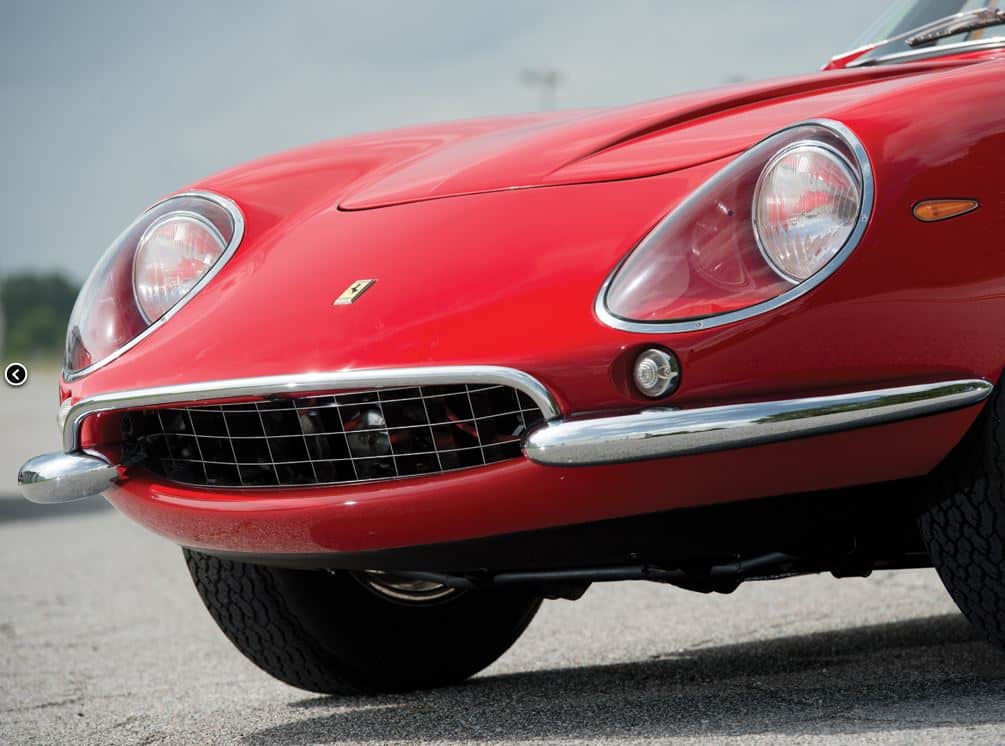
As nice as it is, this is not the most beautiful Ferrari ever bought and sold at auction.
Right now, however, it IS the most expensive Ferrari ever sold at auction.
This N.A.R.T Spider – the full official description has it as a 1967 Ferrari 275 GTB/4*S N.A.R.T Spider – just sold for $25 million. Add in the 10% buyer’s premium and the total forked out by the new owner is $27.5 million. If you’re into heart warming stories (and/or dismayed that someone could spend that much on a car) then you’ll be pleased to know that the whole $25 million will be donated by the selling family to charity.
I once asked former Saab owner and car collector, Victor Muller, what the most important thing was to look for when considering a vehicle for purchase. His answer was quick and unequivocal – provenance. The car has to be genuine and its history has to be supported. Anyone familiar with my machinations over the Canberra Fulvia will now understand my dismay that its reportedly remarkable low mileage and history was completely undocumented, aside from an old 1977 registration sticker on the passenger side window.
This N.A.R.T Spider was one of just 10 ever made. It has all of its matching numbers and it stayed in the same family its entire life. Every step of its life has been recorded and documented, right down to noting which original bits were temporarily removed and then reapplied during its restoration years ago. That’s provenance.
The owner was a guy named Eddie Smith. His is a rags to riches story, one of those American Dream tales of a guy pulling himself up by his own bootstraps. Born poor, he built a successful mail-order company in the 1950’s, got the car bug in the 1960’s and eventually owned a bunch of Ferraris thanks to a personal friendship with the importer. The only one he never sold was this Spider.
Eddie Smith died in 2007 and his family decided to put his beloved Spider up for auction this year, with the proceeds of the sale being donated to charity – a wonderful gesture from a blessed family.
The guys at Petrolicious did a feature on this N.A.R.T Spider a month or so ago, in the lead-up to this auction. It’s consistent with all their videos in that it’s beautiful to watch and shows the car of at its absolute best.
Take the time to watch and appreciate. This is the most expensive Ferrari to sell at auction and in this video, you might just get a glimpse as to why.
I think I’m about to add Pebble Beach to my bucket list of automotive events. It’s a list that I still have to put together, but is being modelled partially on the trip being undertaken right now by the Aussie writer of Any Given Reason – check it out.
While Pebble Beach concours features a collection of amazing older metal, the preceding Quail display features classics as well as more contemporary machinery, including some eye-dazzling showcases from manufacturers.
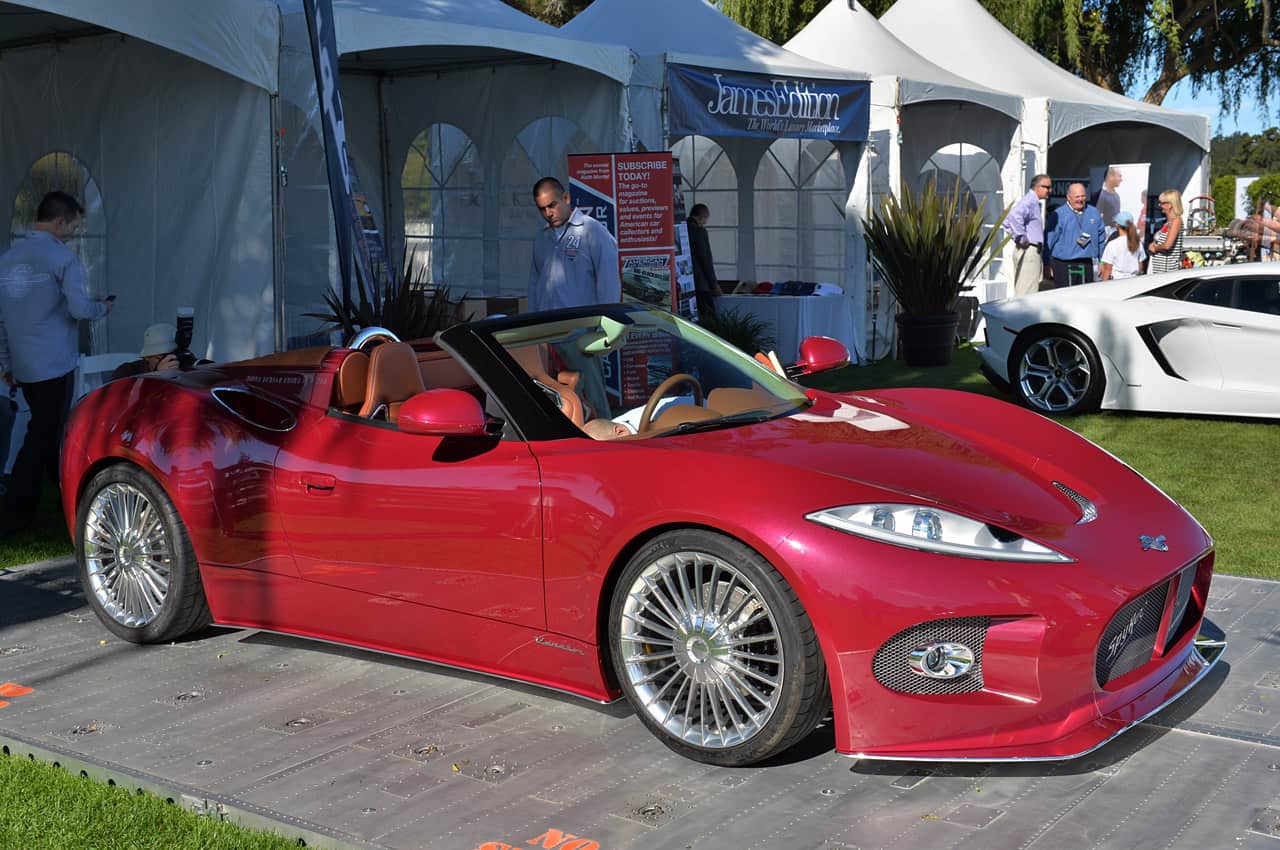
The Quail was held over the weekend. Hopefully you’ve already seen the Spyker B6 Venator Spyder, which was unveiled there earlier.
I’ve pinched a few of the Autoblog photos, reproduced below, to give you a quick taste. These are some of my favourites.
—
Jaguar XK-SS, so cool it could only have been owned by Steve McQueen.
—
If you’ve never checked out Singer Design’s Porsches, you should. This video goes for 27 minutes but will tell you all you need to know about what some consider to be the ultimate 911.
—
You can dislike BMW’s all you like, but you have admire what they’ve done with their stewardship of Rolls Royce. This is grand in every respect.
—
And while we’re talking BMW, the company steals Saab’s Lime Yellow colour for the new M4.
—
Spyker’s new B6 Venator Spyder, due for production soon. Hopefully.
—
The Lamborghini for the five-year-old in all of us – the Veneno.
—
The incomparable Bugatti Type 57 Atlantic. Simple amazing.
—
The one-of-a-kind Ferrari P4/5 commissioned by James Glickenhaus. Imagine how good it would be if he told them to go at five-fifths!
—
Any show that features the Aston Martin V8 is a fine show by me. I love this car.
—
It’s nice to see the best classic Japanese metal getting a look in. Great cars.
Spyker have just unveiled the topless version of the sensational B6 Venator that debuted earlier this year at the Geneva Motor Show. They promised the topless version back then. Today, at Pebble Beach, they delivered.
Here are the official studio images and the press release.
——
SPYKER UNVEILS B6 VENATOR SPYDER CONCEPT
Spyker N.V. (“Spyker”) today revealed the Spyder version of its new exotic sports car, the Spyker B6 Venator, at a press conference in Pebble Beach, California.
Just five months after unveiling the B6 Venator Coupe Concept to rave reviews at the 83rd International Geneva Motor Show, Spyker – creator of meticulously hand built automobiles whose beauty is equaled only by their unrivaled craftsmanship – made waves on the other side of the Atlantic.
Today the brand introduced the SPYKER B6 VENATOR SPYDER Concept, a unique alternative in the High Luxury Sports sector, via a press conference at The Quail Motorsports Gathering in Pebble Beach, California. The SPYKER B6 VENATOR SPYDER Concept is the eagerly awaited convertible execution of Spyker’s compact, 2-door mid-engine sports car that will offer the discerning driver of the highest standards a new choice, delivering a rare combination of heritage, design, performance and exclusivity.
Chief Executive Officer Victor R. Muller chose The Quail as the site for the SPYKER B6 VENATOR SPYDER Concept’s worldwide premiere because, “It is the car’s natural habitat. Car enthusiasts from around the globe descend upon exquisitely beautiful Pebble Beach for the Concours d’Elegance weekend, and The Quail Motorsports Gathering is the most exclusive event of all.” Designed by Muller, the SPYKER B6 VENATOR SPYDER Concept incorporates vintage cues of the brand’s aviation past, highly detailed design and bespoke materials into a defiantly contemporary statement that could only come from Spyker.
The company’s Latin axiom “Nulla tenaci invia est via” – “For the tenacious no road is impassable” – is tastefully featured on the exterior. The name “Venator” is Latin for “Hunter,” a nod back to Spyker’s “Hunter” fighter aircraft of the early 20th century.
Exterior highlights include:
The trademark radiator grille’s mesh is V-shaped, referencing Spyker models of the previous century. The 1903 Spyker logo harkens back to an era when Spyker built racers such as the amazing 60HP.
The headlights, equipped with LED light rails, give the car an aggressive stance.
The 3D LED rear lights are akin to the iris-type after burners of a jet engine from a modern fighter aircraft.
The brake light has been sculpted into the rear panel design to ensure smooth, flowing design lines.
Elegantly aggressive 19″ TurbofanTM wheels are shown in mirror polish finish.
The brand’s axiom “Nulla tenaci invia est via” – which translates to “For the tenacious no road is impassable” – is shown on the fairings.
Interior highlights include:
Interior surroundings crafted from the finest materials are unusually open and airy for a sports car, akin to an aeroplane cockpit. The leather is sourced from the Litano range produced by the Royal Hulshof Dutch Tanneries in Lichtenvoorde, Netherlands. Hulshof uses only West European first choice bull hides and a special tanning process that produces the beautifully rich colour palette.
The red cover on the ignition switch evokes the spirit of starting an aeroplane, as does the dashboard that lights up as part of the ‘pre-flight check.’ The dashboard is shown with a turned aluminium fascia, similar to those seen on Spykers of the 1920s.
Pressing the engine start button brings to life a powerful V6 engine that delivers 375+ bhp.
The trademark exposed gear change mechanism was inspired by early aircraft controls from Spyker’s aviation heritage.
—
Body: All carbon fibre
Chassis: All aluminium platform
Engine: details conspicuously absent – SW
Engine mount position: rear-mid
Engine orientation: transverse mounted V6
Max power: 375+ bhp
Drivetrain: details conspicuously absent – SW
Drivetrain type: RWD
Transmission: 6-spd automatic
—
Dimensions:
Overall length: 4347 mm
Width (ex mirrors): 1882 mm
Wheelbase: 2500 mm
Kerb weight: under 1400 kg
—
The SPYKER B6 VENATOR SPYDER Concept will begin production in late 2014 for key markets including Europe, the Middle East, Asia Pacific and India, followed by the US in early 2015. The introduction of the SPYKER B6 VENATOR Concept at Geneva earlier this year marked the beginning of a new era for the brand, one that will include a significant increase in production led by a management team that has never been stronger.
The SPYKER B6 VENATOR SPYDER Concept represents the next key step on that path, which is being spearheaded by Muller and his Chief Commercial Officer John Walton. Together, Muller and Walton are leading a passionate team that is supremely dedicated to creating unique and beautiful high-performance sports luxury cars.
According to Walton, “Reaction to the coupe version in Geneva was so overwhelmingly positive that we accelerated our initial plan to deliver the SPYKER B6 VENATOR SPYDER Concept. This is an exquisite drop-top that begs to be driven on the Pacific Coast Highway – yet will provide more exclusivity than any other sports car it will pass on the road.” The SPYKER B6 VENATOR SPYDER Concept will provide the authentic Spyker experience – hand-crafted rarity that is as visceral to view as it is to drive – at a more accessible price point of approximately $150,000. “The SPYKER B6 VENATOR COUPE and SPYDER Concepts are the immediate future of Spyker,” said Muller.