Despite having 26 ‘watchers’ in the final hours of the auction, the car didn’t attract any bids. I’m in two minds as to whether I should re-list it on Ebay. I certainly don’t want to consider a lower price than the $11.5K I put on it and there’s also the hassle that comes with selling to someone you haven’t spoken to, someone who hasn’t checked the car out for themselves. I was quite nervous as the auction came to a close, to be honest.
I’ve had some interest from outside of Ebay, which is encouraging, and I’ll see what comes of that for the time being.
Why let the facts get in the way of a good headline? Holden are not holding on at all. The company has slipped down the sales table again and the slow downward spiral has the automotive community in Australia transfixed.
Holden used to fight with Ford for the top of the sales table in Australia until Ford left the fight for good. A decade or so ago, Holden was overtaken by Toyota for the #1 sales position, which Toyota has never relinquished since.
Last year, Holden was overtaken by Mazda as the #2 seller in Australia. We were stunned.
In February 2013, Holden was punted from the Australian Top 3 for the first time in its 65 year history, thanks to Nissan. Holden blamed a computer error for that one (seriously).
Today it has been revealed that Holden were overtaken by Hyundai in monthly sales for March – and Nissan beat them again, too, placing Holden in 5th position on the sales table with market-share continuing to plummet. This month, Holden are blaming the strong Australian dollar (fair) and the Japanese government (fuzzy, at best).
In a pre-emptive strike on the currency issue, Holden popped up in the news yesterday for having been the recipient of more than $2billion in government funding and tax breaks over the last 12 years. That’s more than $2,000 per car built. Holden’s argument is that it couldn’t continue to build cars here without the taxpayer subsidies, citing the dollar and the alleged Japanese government’s manipulation of the Yen as cases in point (so THAT’s why those Japanese cars sell so well here, not quality).
There’s been plenty of chatter here in Australia over the last few years about whether our tiny car manufacturing industry is worth propping up. We give assistance to Toyota and Ford, as well as Holden. With two of the three manufacturers we give assistance to tumbling down the sales charts, the chatter is only going to get louder.
Holden were once revered as The Australian Car Company, building cars in Australia that were suited to Australian conditions. The truth is that they stopped being an Australian car company many years ago and compounded their loss of reputation with poor quality Korean-sourced cars, several of which being cynically marketed and short-lived as a result. Any Aussies still own a Holden Viva?
Australians till take some pride in Holden’s design and engineering arms. The Camaro and Holden’s V8 racing success being the most obvious examples. But even those lack some relevance as the Camaro isn’t sold here and people take their eyes off family V8’s in increasing numbers.
Forgive this self-indulgent post, but I’ve got 40 hours to go in my Alfa GTV6 auction and 22 prospective buyers watching it. Chances are that it might actually sell (no bids as yet). So I’m trawling carsales.com.au like a man possessed at the moment.
The criteria:
Must be fun to drive.
Must be fun to drive.
Must possess a decent quality interior.
Must have reasonable ride quality for the east coast Australia trip later in the year.
Must represent reasonable value for money with the prospect of not sliding in value over the near-medium term.
Must be an interesting colour. No silver for me, thanks.
Manual transmission preferred, but auto could be considered on the right car.
Must be fun to drive.
I’ve not set a price limit because I do have reasonable capacity to pay something off. So whilst I could spend up to $45,000 for the perfect car if it had a reasonable assurance of holding value, it would have to be something really special (see below). I predict I’ll have close to $20K in savings once the Alfa and Subaru are sold.
Alfa Romeo Brera V6
Mentioned as a contender just over a month ago, the Alfa Brera has stunning looks, a beautiful V6 engine (a relative of the Saab V6 engine used in the 9-3) and it’s available for delectably reasonable money.
The downsides – what seems like good value now is not going to hold into the future and then there’s the undeniable fact that the body’s writing cheques that the chassis can’t cash. Like all modern Alfa’s, it just can’t drive to the company’s reputation and it’d be hard to own knowing that.
Nevertheless, a worthy contender for a short-term holding and one I’m seriously considering.
Red, manual V6 Q4 Breras start in the mid $20,000 range and go up from there.
——
Nissan 350Z
This is new to the discussion but provides some serious foor for thought with a wonderful combination of performance and value. The 350Z looks fantastic, has Nissan’s rock-solid gem of a V6 engine (276hp) and has been the subject of a lot of very positive reviews. I’ve never driven one, but the ‘Z’ heritage is well known and this latest generation of ‘Z’ cars is very highly regarded.
Starting just below $20,000, the Nissan 350Z is the value choice and in many respects, the sensible choice. I think it’d be perfect for the east coast drive because of its modern construction and what I assume would be modern refinement, modern performance and interior comfort.
Downsides? I think there’s room for the price to fall further and I think the interior is a little bit plain, albeit well equipped. I’m also willing to admit that I’m a bit of a badge snob and the gravity of the ‘Z’ doesn’t quiet make up for the Nissan badge on the front. Then again, some seat time in something like this might be just what’s needed to turn that attitude on its head.
The red one below is available for A$23,000 at the moment.
——
BMW E46 M3
This is an interesting contender, mostly because it’s so left-field for me and offers so much performance – more than I really need. Obtaining the previously-unattainable makes the M3 a very attractive option.
The ride is renowned and the car is exceptionally well equipped, so what’s the downside?
It’s got a starting price in the mid-$30K range, which is getting up there. The E36 M3 sells for a lot less so that price is going to come down, but it’s still a hell of a lot of car for the money. Then there are the service and repair costs, which former BMW owners tell me will be considerable.
There’s a manual BMW M3 with reasonable mileage for sale here in Hobart at the moment for $37,000. There are others with higher mileage available for as low as $30,000.
E46 BMW M3E46 BMW M3
——
A Host of Porsches
I had a Boxster on my contender list and on my bucket list but I crossed it off that list a few weeks ago, the reason being that I don’t want to live with what seems to be a ticking time-bomb in the engine called the Intermediate Shaft Bearing. There are kits to fix this potential problem, but I’m just not sure that I want to deal with it (especially when I’m questionable on the Boxster’s interior).
So…. to the rest of Porsche’s potential replacements.
Porsche 944 Turbo
I know. I know. I’ve tested a 944 in years past and been profoundly disappointed. BUT that was an early non-Turbo model and I’m very interested in testing a Turbo. I’m an admirer of Porsche’s early front-engined cars. I absolutely love the styling and if I could find one that had a driving experience to match, I think it’d be a compelling option.
944 Turbos are available starting at just under $20,000. The red one below has 250,000kms on the clock, is reported to be in great condition and is for sale for $20,200.
—
Porsche 968
If I’m going to think about front-engined water-cooled Porsches, then I may as well consider what’s widely regarded as the pinnacle – the 968. I prefer the styling of the 944, but I’m warming to the 968 and the mechanical offerings only make the model more compelling. It’s got near-perfect weight balance and is renowned for its neutral handling. The 968 comes from a time where Porsche still had completely bullet-proof construction and quality and the car features a 240hp engine combined with a six-speed manual that can drive the car to 100km/h in around 6 seconds yet still use less than 10 litres of fuel per 100kms on the highway.
Landing a 968 will cost around the low $30K mark here in Australia.
The downside? There’s at least one 968 for sale here in Australia right now that was for sale by the same owner when I bought the Alfa 12 months ago. These are relatively rare cars but there’s also a lack of demand for them. I could buy one and get lumped with it.
My brother-in-law worked for a Porsche dealer in Canada and he’s often recommended the 968 when we’ve talked Porsches. Maybe I’d be happy to be lumped with it?
This black 968 is available for $27,000 and there are a few 968 Clubsport models available in the low $30K’s.
—
Porsche 911
I have two cars at the top of my potentially attainable automotive tree – the Porsche 911 and a Ferrari 308. Getting the Ferrari would mean that a lot of things have gone my way. Getting the Porsche is a possibility right now.
I’d probably be wise to restrict myself to a 3-litre 911SC but I’ve also spent some time looking at 3.2 litre Carreras. The SC starts around $30K (for a decent one) and you can add around $10K for a decent Carrera. My fear is that if I were to get the SC, that I’d be wondering about the Carrera I didn’t buy.
The Carrera I’m looking hardest at is a 911 Carrera Super Sport – a 1988 model with a genuine Turbo body, suspension, powered and heated sports seats, the famed G50 gearbox, genuine RHD (UK import) and low mileage, too, at 104,000kms. It’s in my favourite dark blue, too, though with a less palatable white/dark red interior.
The downside? I’ll be carrying more debt than I’d like as this one’s for sale for $45,000. I think it would hold its value pretty well, though.
The other downside is that looming thought in the back of my mind, where I wonder how I’ll learn first-hand about the 911’s propensity for lift-off oversteer.
——
This post represents a nice problem to have. I’m not complaining.
The other consideration is that my job is under some small amount of threat at the moment, though not in the immediate term. There could be some danger in 12 months or so, after what looks like a change in both state and federal governments (my role is ripe for out-sourcing by an opportunist government, which is what we’ll get).
Given that, the Porsche 911 is attainable but the debt is dangerous. The 350Z is therefore the sensible choice, one that would deliver a good drive and involve little-to-no debt. Everything between those two is risk/reward proposition.
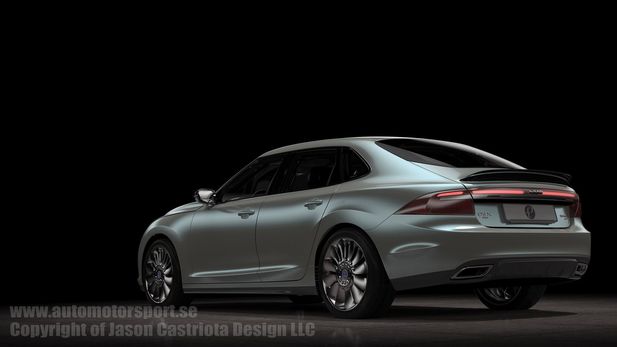
Pictures are out there, all over the place now. The world can see the basics of the Saab 9-3 replacement vehicle as designed by Jason Castriota. This isn’t just some guy’s idea of what a future Saab could look like – this is IT.
The most common questions I’ve been asked in the 15 months since Saab’s bankruptcy are “Did you see Jason’s new car? What did you think of it?” – the assumption, of course, is that I’d seen it while working at Saab. My response is that I hadn’t seen the car, so I had no opinion to offer.
That was 99% true.
I saw a rendering on Jason’s laptop in Los Angeles, in late 2010. That was a flat 2D rendering with no color or contour and it was difficult to form any sort of impression on that. In May or June 2011, when I was in Sweden, I saw another image as part of a corporate presentation. It was just a small icon-type image in the top quarter of a powerpoint presentation and I only noticed it just before the slides changed. It’s fair to say that I didn’t like the image that I saw at that time.
When I was working for Saab, I lived in a building next door to one of Saab’s design staff. He never showed me the car, but the things he told me (usually over some ribs at O’Leary’s) really encouraged me. I learned a long time ago to hold my reactions when seeing a new model for the first time and that practice, along with what I heard over a few dinners, gave me a lot of encouragement and hope for the future.
That’s one of the reasons I’m so glad that Jason Castriota has released these more complete renderings instead of just the basic images we saw early on. Having spent some time looking this car over from top to bottom, front to back, I think it looks absolutely sensational.
Here’s a couple of rules about new cars that you can take to the bank. Renderings never look as good as the real thing and the real thing never looks as good at a car show as it does out on the road. A car is a three dimensional object that’s made to be in motion, in natural surroundings. That’s the best way to see them. Saab’s PhoeniX concept never looked so good as when it was on the streets of New York.
The Look
I’m happy to have waited before passing comment on this design. The first images that surfaced a month or so ago included the early clay models and they weren’t stellar, it’s fair to say. Anyone who’s seen early clay models of other Saabs know that those models don’t always bear a true resemblance to the final product.
In this case, these new CGI renderings of what would best resemble the production-intent model look fantastic. It is, in my humble opinion, a respectful and progressive movement in Saab design. The car has presence. It looks solid. It’s as sporting as a five-door family car can be and it doesn’t look like it’s trying to be something that it’s not.
The reason I came to love Saab was because it offered the best combination of luxury, utility, safety, comfort and performance that I could find in an automobile. That reasoning was based on the Saabs of old – what Victor Muller first referred to as ‘Saab Saabs’. This car looks like it would have upheld that tradition, and I don’t think I could pay it any higher compliment than that.
The Car
We haven’t seen any interior concepts, so we have to work with an assumption that the interior would have been up to par. We know that Saab would have developed the IQon interactive/entertainment system for this car. It was quite advanced when it was first announced and while it wouldn’t have been the first of it’s kind at release, it would have placed Saab well and truly ahead of a lot of competitors.
Couple an innovative and classy interior (assumed) with this good-looking exterior and you’ve got the visual makings of a great package.
What would have set this car apart, however, is the combination of the visual/tactile package with the mechanical. Saab would have had both a new powertrain and a new drivetrain for this car – the BMW-sourced 1.6 turbo engine and the eXWD system being developed in conjunction with eAAM. This mechanical package was being tested at the time of Saab’s bankruptcy. I was in the building at eAAM when they were removing their components from the test cars. This wasn’t vaporware, it was the real deal, and whilst I didn’t get to drive it, I think this car would have offered mechanical advances to the Saab range that would be similar to what Saab achieved with the 99 Turbo.
This would have been a massive car for a re-born Saab. Have no doubt about it.
Let’s take a proper look, shall we? Click to enlarge.
—–
The Consequences
The consequences are all theoretical, of course, but I’m going to take a stab at them for the hell of it.
The Swedish government were happy to throw Saab under the bus. OK, they were happy to see Saab trip over their own shoelaces and fall under the bus. To say that the Swedish government couldn’t have taken a longer-term view and do more to help Saab is to ignore things that governments do every day.
Saab were politically sensitive thanks to the focus placed on them by the Swedish press and the Swedish government were more than happy to take the politically popular line – do as little to help Saab as possible and let the company fall where it may. “We do not plan to get into the car business” they said. “We will not risk taxpayer’s money” they said. Well, we all know what happened.
The Swedish taxpayer’s money was at risk because of loan guarantees to the European Investment Bank. The only way the Swedish taxpayer would end up on the hook for that loan is if Saab failed, which it did. It’s not just the EIB loan, however. There’s also the double-whammy comprising welfare payments and the re-training of former Saab employees, as well as the loss of tax revenue from the wages they earned working for Saab as well as the business taxes the government might have earned from Saab. The Swedish taxpayer is now paying through the nose and they’ve lost one of the cornerstones of their manufacturing industry. And if you don’t think Volvo’s slowly but surely heading the same way, you’re not looking close enough.
If the Swedish government had found a way to provide Saab with meaningful assistance – and I don’t know what that way would have looked like but the governments of Germany and France seem to find a way – I think Saab would have had a chance. We might have made it. We might not. But I believe we had a strong enough brand and a strong enough range to do something special.
The Saab 9-5 launch didn’t go well and Saab knew it. There would have been changes in MY12 and MY13 to address this.
The Saab 9-4x didn’t even get a real chance but having spent some quality seat time in it, I think it would have gone gangbusters (in Saab terms) in the United States. Success there might have opened up other markets for that car, too.
And then you have this new Saab 9-3, which I think would have been a technological gamechanger for Saab. I think this new 9-3 (or 900 as I believe it would have been called) would have captured a LOT of imaginations. I know one guy in the press who got to drive an early eXWD prototype and spoke glowingly of it – and that was a prototype. Imagine the finished product.
Sadly, we’ll never know what might have happened. The Swedish government took their stance and now they’re dealing with a shrinking parts business as a result. GM took their stance and I look forward to watching Victor Muller’s legal case against them. I don’t know whether he has a realistic chance seeing it’s going to be fought in GM’s backyard, but seeing this car I can see why he’s so motivated.
Spyker, of course, turned out to have not enough accessible resources. Their main investor wasn’t allowed into the deal and GM blocked other potential investors, right or wrong.
We’re dealing with imperfect information and a sliding-doors scenario that’s 100% irrelevant in 2013. That’s sad, but that’s the way it is.
NEVS
So what of NEVS and this Castriota design?
I’ve mentioned before that NEVS must have rocks in their head if they’re not chasing this design – and that was before I’d seen it.
The simple fact is this – this design was based on the architecture that NEVS will use to build their electric Saab. Using this design is by far the most efficient way to get that car to market quickly, both in terms of time and finance. The fact that the design looks good only makes the case more compelling.
Time will tell what they decide.
——
Congratulations, Jason, on a job well done. You created what I think would have been a truly memorable Saab.
It’s such a shame that we never got to see it or drive it.
Jason Castriota’s Saab 9-3 replacement has been all over the web for the last few weeks. It’s been good to see the images get out there and the quality has steadily improved.
I’ve got a few thoughts about the car and I hope to share them some time soon but I need some time with Jason first, which has been difficult to organise since Geneva. Hopefully that’s a good sign.
What do you think about the pictures you’ve seen so far?
——
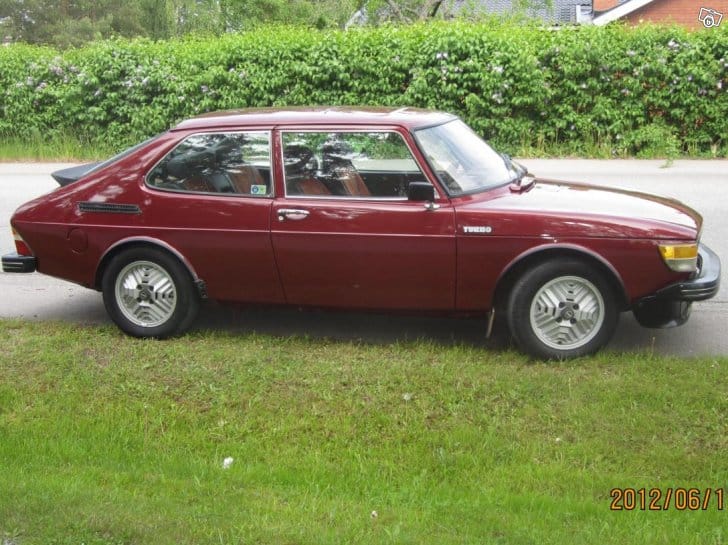
If you own a Saab 99 Turbo then my advice is to either restore it or keep it in pristine condition. The 99 Turbo seems to be THE most collectable Saab at the moment thanks to its status as the beginning of Saab’s turbo revolution and its relative rarity. The wrap it got on Top Gear probably helped, too.
Exhibit #1 is this 99T that a mate in Sweden spotted for sale on Blocket this week for a cool 120,000SEK. That’s US$18,500 or 14,200 Euros at today’s rates.
Minty.
——
Personally speaking, my gold-silver-bronze collectible Saabs would be the 99T, a Sonett and a Viggen.
Please don’t be angry that I left the 900 off that list. I’d gladly have a 900, too, but only after I took care of the first three.
——
Things have been quiet here for the last week and for those who don’t already know why, here’s an explanation.
Last week I had the good fortune to get in touch with a motoring publication here in Australia and pitch some work to them. Their books were full in terms of full-time and freelance writers, but they were familiar with my background and were interested to get a first look at whatever I might be working on. I told them about a series i’ve been working on for a little while now and whilst there are no promises, we’ve worked together on Instalment #1 and it looks like they’re interested!!
I’m really excited at getting a toe in the front door. This development, along with a few other things, has kept me quite busy all week.
It also means that this site’s probably going to be pretty quiet for at least the next few weeks, maybe longer. It’s been an amazing week in terms of just learning how to write for a different audience. Blogging is such a me-focused activity (this post is a prime example). Even when you’re sharing news there’s always the personal interpretations that inevitably get thrown in. Writing for an unattached audience is a whole different ballgame and seeing the edits of my first article has driven home just how much I have to learn. The process has been very enriching.
——
I’ve also got some editorial work to do for an old friend and that’s going to take some time, too. Very interesting stuff, though.
Add to that some website work with my nephew on MyTradeQuote and helping out Mrs Swade with PJ Paintings and my dance card is quite full.
——
Then there’s the car shopping, which has been totally absorbing and frustrating all at the same time. I’ll spend some time on the latest contender tomorrow. The Alfa hasn’t sold yet, which is the frustrating part. In fact, there’s been barely any interest at all. It’s a good car, though, and it’ll sell eventually.
——
If you’re looking for something to pass the time this weekend, DeutscheWelle has a great series of car videos on YouTube called Drive It!
They drive some modern cars but also some real classics in this series. Sample below.
Back in the 1970s, a car sold in Australia was luxurious if it had velour seats and a radio. Those two features meant you didn’t burn your legs on vinyl seats after a day at the beach and you had some music on your way home.
Today, we’ve got so many interior amenities it’s hard to know the difference between inside and outside the car. We step out of a climate controlled building and get into a climate controlled car. We don’t have to stop taking or making phone calls because the Bluetooth system will sync directly and seamlessly with our phone. In the near future our cars will be online. We’ll be able to tweet traffic conditions to our Facebook friends using Waze on the way to a speed date.
The downside of that is more often than not, our automotive furniture is as second-rate as our office furniture. Somewhere back in the 1990s it became OK for everything to be grey. Interiors got better in some ways but in other ways they got worse, simply because they became so generic.
Oceans of plastic. Tacky grey fabric, which if you were lucky, would come with a pale blue, yellow, red or green fleck. Then came the pleather revolution. Today it’s faux sport seats in sub-grade sporty-ish cars that look the goods, but don’t deliver.
I spend a lot of time considering the interior of any car I’m thinking of buying. For me, a car is a world away from home. It’s a world away from generic office life. Driving has the chance to be an occasion. The journey can be a destination all of its own. Whilst good exterior design provides some excitement as you approach from the outside, you spend your driving time inside the vehicle. The interior has to add to the experience.
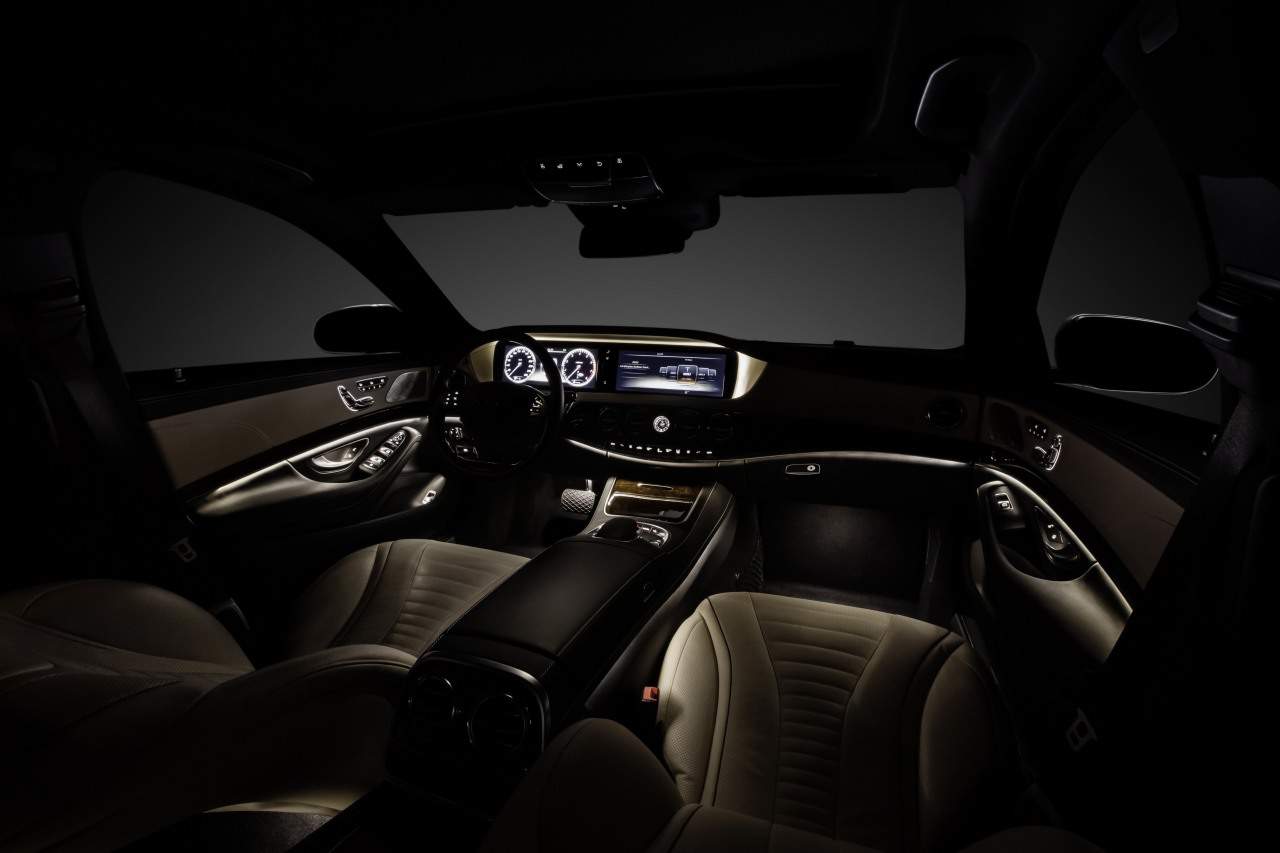
This is why I got so excited when I saw images of the new Mercedes Benz S-Class interior a few days ago. Back in the early 1980s when I was still burning my legs on the seats of my Dad’s XY Ford Falcon wagon, a friend’s parents had a 1970’s vintage Mercedes. Sitting in that car was like being on another planet with views of the earth just outside the window. Those windows were electric, for starters. It had real wood grain trim, big switches and dials for all sorts of functions that the Falcon was missing. It smelled of leather rather than sawdust. That car didn’t try to be better than anything else I’d ever seen. It simply WAS.
The gap between European and non-European vehicles used to be a chasm when it came to interior design and quality. That gap closed over the last few decades and today, both premium and regular brands are selectively guilty of dumping their drivers in a sea of smelly plastic punctuated by generic switchgear.
If this is progress, why is it frequently so unsatisfying?
Form Follows Function is a wonderful mantra but it doesn’t mean things have to be boring. Yes, we like our gadgets in the new millennium but the soul endures. The soul still wants to be encased in something special, not something solely functional.
This is why Spyker’s interiors mean so much to me. It’s why the interiors of old sports cars mean so much to me. Original XJ series Jaguars, too. Even early Japanese sports cars (Mazda RX3, right) had interiors that made an announcement as to why you were in them. The interior of a car should speak at volume about why the car exists.
That’s why I like what I see in these early images of the new S-Class Mercedes interior. It seems that Mercedes has regained its sense of occasion. I look at these photos and to me, they ooze luxury, which is what a Mercedes S-Class should be all about.
Modern car companies from all segments are chasing exterior design efficiency. The shapes are largely the same. It’s the face that they draw on the shape that differs. Modern car companies all do engines and safety pretty well, too.
Could it be that interior design and the quality of materials used will be the last great differentiator between generic and premium cars?
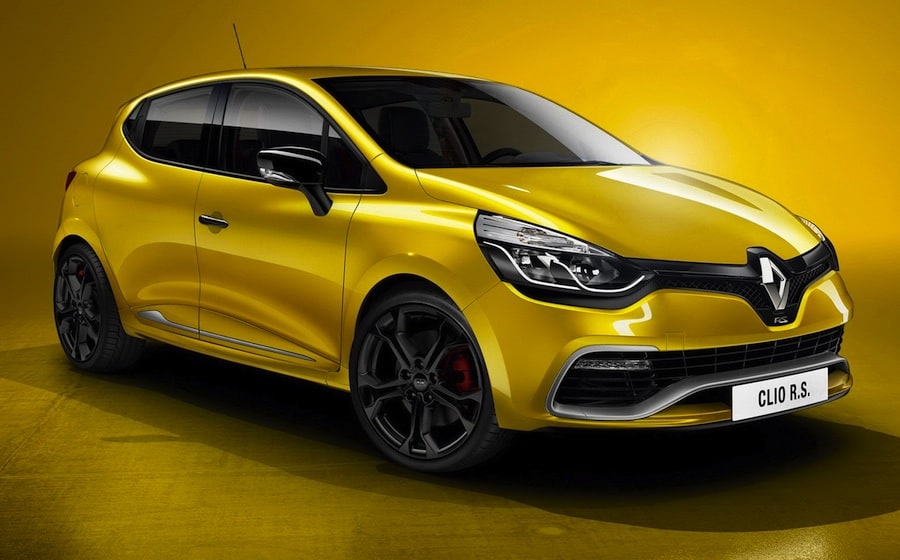
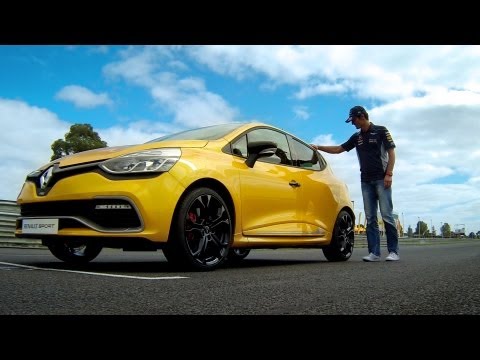
The uniform might say Infiniti but make no mistake – Mark Webber and Sebastian Vettel drive Formula 1 cars powered by Renault. So while Webber was here in Australia for the Melbourne Grand Prix, Renault tapped him to do all sorts of marketing, especially for their performance arm: RenaultSport. Here, Mark Webber drives the new RenaultSport Clio.
Australia is the second-biggest market for RenaultSport cars so the French producer puts a lot of time into marketing here, especially at Grand Prix time.
The new RenaultSport Clio won’t be available in Australia until early 2014 but the coverage of the car is already whetting appetites here and I’m sure pre-orders will be strong. The Megane has got most of the attention in the last few years, but the Clio RS is a hot hatch performance benchmark. Building an all-new one is a big responsibility and changing it from normally aspirated to turbocharged is a decision fraught with danger, but all the reviews so far have been quite positive.
You can see a fair few of the Clio’s party tricks in this short video. The F1 style paddles on the steering wheel, for one, and the pocket rocket’s super-nimble handling as well. The Clio RS comes equipped with launch control, too, so those who are familiar with Webber’s race-start troubles can insert their own joke…………. now.
Enjoy this sneak peek at RenaultSport’s hot new Clio.
——
As an aside…..
I remember a Saab owning mate of mine picking up a Clio five-or-so years ago. I was completely unaware of RenaultSport’s work at that time and gave him heaps for buying a car that sounded just like a famous Australian women’s magazine.
Positive cultural change takes a while to get established.
The wearing of a seat belt by vehicle occupants only became mandatory here in Australia in the early 1970s. State governments in the 1960’s were reluctant to legislate on seat belts. A few vocal minority groups claimed that the data wasn’t conclusive and that such a law would be an unreasonable curbing of a citizen’s liberty.
It’s hard to understate how stupid that sounds in 2013 with decades of data and thousands upon thousands of lives saved. It happened, though. One day we’ll contemplate why it took years instead of just months to clamp down on mobile phones and texting while driving.
You’d think that emerging automotive markets might be a bit smarter in this modern age, that they’d learn from the experiences from others. From a legislative point of view, they have. Seat belts are mandatory in China, which is now the biggest auto market in the world. A few entrepreneurial types, however, are tempting Darwinian fate with some products aimed at preserving that same ‘liberty’ that seat belt dodgers of the 1960’s held so dear.
From the cultural attaché at Car News China comes the seat belt T-shirt.
Fashionista drivers with a penchant for freedom now have a prop to help them avoid the Chinese plod while being free to lurch off balance in a corner and at liberty to launch themselves through their windscreen in the event of a front-end prang.
The modern protector of the people’s freedom needs a little more than that, though.
Modern cars are just riddled with safety devices with one of the most basic ones being the warning bell to tell you fasten your seat belt. What’s really annoying for the automotive Che Guevara is that those little warning bells just don’t shut up! They ring and ringand ringand RING, offering an audible mockery of your free driving experience.
Enter the fake seat belt clip, designed to let you ride belt-free and bell-free at the same time.
Simply jump into your 3-star rated buzz-box (wearing your seat belt T-shirt, of course) and then place your fake clip into the seat belt anchor point and you’re ready to explore the strength of your front windscreen completely unfettered.
The clip comes in multiple designs, too, from your favourite manufacturer’s logo (copyright? what copyright?) to pretty cartoon designs that make being splattered all over the road FUN. Those other freedom lovers are covered, too, with a special six-shooter model that makes your selt belt anchor looks like a holster. Saddle up!
The jewel in the fake-clip crown, however, has to be the bottle opener clip. There’s nothing more liberating, after all, than a few brews with the boys followed by a comfy trip home secure in the knowledge that nothing’s going to stop you from eating your dashboard – except for that pesky airbag!
Regular visitors to this site will know that I’ve been in a contemplative mood in the last few weeks and in that spirit, I thought I’d share this video. It was released yesterday by the Australian Football League as the first part of a three-part series profiling one of the game’s most prominent coaches – Mick Malthouse.
A little bit of background for our non-Aussie readers…..
Mick Malthouse has just joined the Carlton Football Club – my favourite team. That’s significant because his last AFL coaching job was with our arch-rivals, the Collingwood Football Club. Manchester United fans could (eventually) forgive Sir Alex Ferguson for coaching in Spain or Italy, but imagine if he went across town to manage Manchester City. Mick’s appointment at Carlton was big news here.
It’s not just that, however. Mick was pushed aside at Collingwood to make way for one of the club’s favourite sons. Collingwood wanted to secure the coaching services of one of its most famous ex-players before another club got him, so they told Mick he was getting too old and put a succession plan in place. Mick didn’t like that.
Carlton’s part in the drama? Well, we sacked our coach of the previous 5 years, a man who happened to be one of our favourite sons and a former club captain when he was a player. So Mick’s coaching with a grudge against his old club and very high expectations from his new club. What could possibly go wrong? 🙂
Mick’s one of the most successful coaches of the modern era. His teams nearly always make the finals series (think: playoffs) and he’s won three premierships as a coach and played in one premiership as a player. His teams are known for being very tenacious defenders and consistently competitive.
So why am I sharing this video here?
I’ve been challenged in the last few weeks about my own life, where I want to go, what I want to do in terms of my career and the impact that might have on my family. My wife has her own goals to build her business and I’ve got aspirations, too. I want to do things that are quite different from what I do now in a field where I have no formal education or qualifications. I have some level of experience born from years of work and a genuine interest but I’ve never learned the right way to write or the real inside systems that organise and govern how the automotive industry works. What’s more, when you know a little, it opens your eyes as to how much more there is to learn. It can be pretty daunting.
In this video (only 8 minutes), Mick talks about challenging both his own limits as he grows older as a coach, as well as the perceived limits that some clubs place on players, which are usually limits implied by how far down the draft order they are (….and for explanatory purposes, “rookies” in the AFL are players who are contracted to a club, but not on the senior playing list – i.e. they’re paid a lot less and aren’t ensured much of a future in contractual terms. “Rookies” have to show a lot of promise and work pretty hard to get a place on the senior list so when a rookie ends up being the captain of a club, you know he’s done some hard work.)
I found this video be an inspirational little piece and hopefully there might be something in it for you, too.
The Inside Koenigsegg video series concludes today with this final instalment – the gearbox. This one is guaranteed to go over most people’s heads. The overall concept makes sense to me but the technical bits went over my head very quickly and I think it’ll be the same for many people. I get concepts but I’m a technical imbecile. There are still several things you can appreciate, however.
First, even though it’s a video about a gearbox, the fact that it’s Christian von Koenigsegg talking about a gearbox still makes it interesting for some reason. Having watched this series from start to finish, there’s no-one else in the series that can make such technical wizardry so interesting to listen to.
Second, even thought I don’t understand the way everything works in detail, it’s still eminently clear how cutting edge this technology is. That makes the fact that Koenigsegg do all this stuff themselves rather than buying-in the component from someone else all the more remarkable.
This has been a great series to watch. Kudos to the Drive team for putting it together. I hope they stitch all the parts up into one 90-minute video.
——
You can see Episode 1 of this series (Carbon Fibre) here.
You can see Episode 2 of this series (Triplex Suspension) here.
You can see Episode 3 of this series (Perfect Paint) here.
You can see Episode 4 of this series (Interior Surfacing) here.
You can see Episode 5 of this series (Test Drive) here.
You can see Episode 6 of this series (The Brain) here.
You can see Episode 7 of this series (Cargine Camless Valves) here.
You can see Episode 8 of this series (The Engine) here.