After missing ‘Classics’ last month due to our holiday, and with a new car to take down there, you can imagine that I was quite pumped up for Classics By The Beach today. Sadly, the weather didn’t co-operate and a drizzly Sunday morning saw the attendance fall.
I rocked up just as a light sprinkling of rain turned into a reasonably nasty shower. What’s worse, I was wearing shorts as I planned to go to the gym straight after, so the cold and wet conditions combined with my lightweight attire didn’t exactly lend themselves to hanging around for many photos.
That doesn’t mean it wasn’t worth going, though.
I really hope a good number of the same cars turn up again next month because there were a few that I’d really love to photograph some more.
The star of the morning was undoubtedly this DeTomaso Pantera. They’re incredibly rare anywhere in the world so I find myself thanking the automotive gods (again) that we happen to have one down here in little old Tassie.
I don’t know how well you can see in that photo, but the Pantera had what are quite possibly the widest wheels/tyres I’ve ever seen in person. The rear tyres were 335/35s.
And I thought I took a hit in the wallet last week when I bought 245/40s!! I’d hate to be paying for these.
The other star of the show was this beautiful Volvo P1800 coupe. I went back after my gym session and thankfully this was still around so I could get some more photos. Sadly, the owner didn’t seem to be around so I couldn’t get a shot of the magnificent red leather interior.
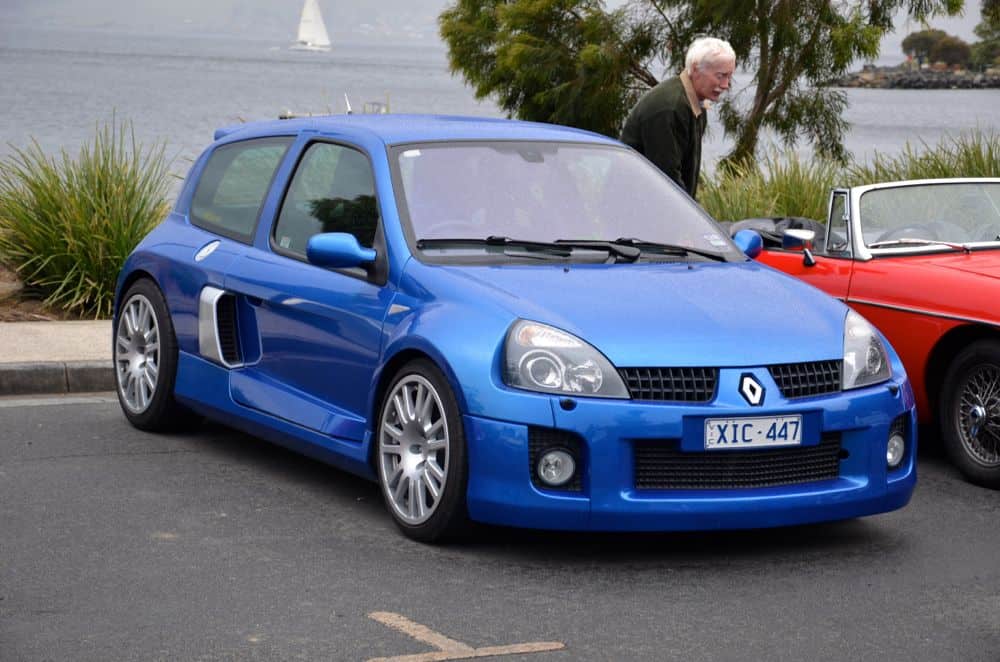
My mate Gavin came down this month with his RenaultSport Clio V6. That’s not Gavin to the right of the car, by the way. I think that gent owned an MG or something – he looks like the MG type).
Gav’s Clio V6 is one of just a half-dozen such cars in Australia as they were never officially sold here. I’m going to have to tee up some time to do a feature on this car soon.
Here’s some Aussie muscle for you – an early 1970’s LJ Holden Torana. I had a four-door version of this car in white when I was a young hoon. Let’s just say it didn’t die well.
I’d love to know a bit more about this racy little Fiat with the Abarth badges on it. Not a good day to have your T-top off the car……
But an appropriate day for a boat-tail…..
This Porsche 356 Super 90 was dressed up as if it was ready for some serious long-distance competitive work.
Nice on the inside, too.
Our last feature for this week is this lovely sky-blue Ferrari. I’m not familiar with the model and once again, the owner seemed to be off getting a coffee so I couldn’t get more details or interior shots. Next time…..
There’s a full gallery below. Feel free to do some clickage….
I’ve had my Porsche 968 ClubSport for just over two weeks now. So what are my initial impressions after a little more seat time? Let’s just say I continue to be a very happy camper.
The good
Build quality – My car was built 19 years and one month ago. You’d never know. I’m amazed at how solid it feels after all that time. Everything you put your hand on is well made using quality materials. The steering wheel, a thick leather piece distinct to the CS, still feels brand new. The leather gearshift likewise. Even the external door handles inspire confidence.
This is the best built car I’ve owned and it’s a lesson for me in what a car should have in terms of enduring quality.
Torque – An unexpected pleasure. I’ve got years of experience owning turbocharged cars so I’m well accustomed to the benefits of a healthy torque curve. The 968CS has a max torque figure of 305Nm (that’s 224 ft lbs for some of you). To put that in perspective, my Saab 9-3 Viggen – a car I considered to be an absolute torque-moster – had 342Nm.
I drive up a large hill when I go to work in the morning, called the Southern Outlet. It’s around 2km long and changes elevation by more than two hundred meters. I climbed that hill at 80km/h in fifth gear the other day and had plenty of torque to accelerate if had I wanted to (it’s an 80km/h zone). The rich torque curve makes this car effortless to drive. It’s the closest thing I’ve experienced to a turbocharged car without it actually having a turbocharger.
Fuel economy – Surprised? Don’t be. The 968 has a 6-speed manual gearbox and can be very frugal on the highway, sitting at around 2300rpm at 110km/h. Plant your right foot and you’ll use fuel at a prodigious rate, but it’s a real case of Jeckyll and Hyde, this car.
Handling – My goodness. The handling.
There are two primary contributing factors here. #1 is the mechanical grip inherent in having a well engineered car with great suspension, great brakes and 50/50 weight balance. #2 is option 220: the limited slip differential.
This car is so beautifully balanced. It feels a little bit corny to say so, but it really does inspire confidence and makes you feel like a better driver. And yes, the fact that this car is so competent scares me a little because I know that my own skills as a driver are nowhere near what this car can deliver. Over-confidence is a potential problem.
The looks – Let’s face it, no-one goes and buys a car that they consciously think is ugly. Maybe Aztek buyers, but even they might have seen some beauty there…. somewhere.
Anyway, I do love the way the car looks. Its stance. It’s a wide-hipped, tightly-wound bundle of muscle without a wasted line or curve.
That said…..
The not-so-good
The looks – I do love the way the 968 looks, but I have to admit that I still prefer the look of the 944 S2.
There’s something pure and 80’s about those concealed pop-up headlamps that just works. The 968 combines that 944 look with the 928 S4 that was on its last legs and while it looks a bit cleaner, there’s something incredibly right about the 944.
Tyre noise – Having what are basically road-legal track tyres is great for grip. Not so great for driving comfort. They’re as noisy as a kindergarten 10 minutes before lunchtime. They’ll be replaced tomorrow morning and set aside for use on club days.
The lack of comfort – My car is a ClubSport, which means it’s a model that Porsche stripped of equipment with the dual goals of 1) offering a lower-priced entry model, and 2) saving weight for better performance.
I’m very happy to have the CS model. It’s the cult favourite, the one that holds its value best and perhaps the purest affordable expression of Porsche’s front-engined efforts of the era. But I have to admit that some more comfortable seats and power windows wouldn’t be unwelcome when it comes to regular driving.
I’m going to keep this car for a long time (well, a long time for me) but I wouldn’t mind looking for a non-CS 968 when the time comes, or a low-mileage 944 S2. The only thing that replacement car will have to have is the limited slip diff.
Maintenance Costs – It’s only been a few weeks. I haven’t even had to do anything yet but I’m already saving for it. The tyres I get fitted tomorrow are going to get me $1 change out of $1000. The odometer is currently sitting on 119,XXX kms so the 120K service will be coming up soon. I’m going to get the timing belts done at the same time and the timing belt kit alone is over $350. I’m budgeting on something around $2,000 for that service.
It’s a magic car to drive and you can feel the quality, but it doesn’t come cheap. This car was affordable in our situation but it’s still the most I’ve ever spent to buy a vehicle. That means I have to look after my investment while I enjoy it, which is exactly what I intend to do.
Driveway hassles – This isn’t the car’s fault. Well, not really. But it doesn’t get over the hump in our driveway without some serious help. I had to build these ramps to get it over the hump so that I can put it in the garage. They’re a pain to put in position every time I want to use the car, but that’s a small price to pay for what happens when you get the car out on the road.
Verdict
Like I said at the top, I’m a very happy camper.
The 968 is an outstanding car and I feel privileged to own one. I come from prety humble automotive stock. This is only the third time I’ve spent five-figures on a car in my life, so to get something so capable is a new and wonderful experience for me. It’s been a long time coming.
There are minor discomforts based on it being primarily set up as a track car, but they are outweighed 10 times over by what it does when you begin to drive in the manner the designers intended.
Cliché time (again): Owning this car is a dream come true for me. I encourage every one of you to chase your automotive dream at least once because it really does feel great to get there. I’ll be chasing other automotive dreams, that’s for sure.
Via TTAC, we come across an article in Autocar that discloses Alfa Romeo’s conscious decision to leave out the newest generation of electric safety devices.
Alfa Romeo doesn’t intend to fit much next-generation advanced safety equipment, such as adaptive cruise control and emergency braking, to its cars.
Alberto Cavaggioni, Alfa’s marketing boss, said, “We can look at our cars from an emotional point of view or from a technical point of view. We give the Alfisti all that’s needed [in electronic aids], but not more. At Alfa we give the maximum fun to drivers.
“We don’t put safety into the discussion, apart from our NCAP scores.”
Maurizio Consalvo, the manufacturer’s head of product planning, said, “Customers want a mechanical car with minimal electrical interference.”
Big call, Alfa.
I’m one of those old-fashioned types who takes a long time to accept some of the newer safety and convenience devices. Some devices actually replace skills that I think should be important to a driver. I think every driver should have the skills to park their own vehicle, for instance. I think drivers should be able to regulate their own speed according to the conditions and the traffic around them. I think they should know how to brake safely in the shortest possible distance.
In fact, I think every driver should develop every skill needed for car control in all situations, just in case the electronic nanny fails.
I know that I’ll always have to have one relatively modern car for our family. However, I’ve vowed in recent years to always have at least one predominantly mechanical car (I can accept a computer for fuel injection, but that’s about as modern as I’d like to go with such a car). That’s partly because I really like old cars. But it’s also because I value the man-machine connection that a mechanical car gives and I admire the old-school engineers who broke new ground with a much smaller knowledge and experience base than what we have now.
Personally speaking, I welcome this decision by one of my favourite brands to stay away from the newer electronic nannies. I’m sure it’ll still have ABS, airbags and a bunch of other proven doo-dads. But enhancing that connection between the driver and the road and removing anything that takes away from that (as much as possible) should be the aspiration of every company that makes a driver’s car.
My question, though, is whether or not the market will accept this decision in sufficient numbers. The more companies give, the more the market wants. Alfa Romeo has had such a muddied identity in recent years that it’s expected to be a passenger car these days, albeit one with some sporting style.
Are there enough punters out there looking at Alfa as a higher-end sports car, the type of niche where you can get away with charging more and delivering less technology? Will the mechanical product be good enough for them to get away with it?
Talk is cheap. As always in the car business, it comes down to the product. Alfa hasn’t had a compelling, ground-breaking driver’s car for some years. The future looks better with the 4C on its way and a new Spider with a good pedigree to follow. Every news story I see about Alfa Romeo, however, seems to include some sort of delay or a new twist that contradicts previous stories. The plan for Alfa seems confused and while they sort themselves out, the market is moving on.
I simply hope that Alfa can get its products out soon and stake a claim in some area of the market with a coherent range of emotionally charged products that actually deliver on it’s long-held brand promise – cuore sportivo.
I missed this story when I was on holiday but thanks to Victor himself dropping in on our comments section yesterday, I had reason to go searching for the story.
Bottom line: On October 1st, Spyker appealed the judge’s dismissal of their case.
Source: Law 360. Click that link to read the story in full.
——
Dutch carmaker Spyker NV urged the Sixth Circuit on Tuesday to revive its $3 billion lawsuit alleging General Motors Co. pushed Saab Automobile AB into bankruptcy by interfering with Spyker’s bid to sell the Swedish automaker to Chinese investors, claiming a district court judge erred in tossing the suit.
Spyker and Saab’s suit alleged that GM public announcements scuttled the deal on the eve of its signing, but a district court tossed the lone claim of tortious interference with economic expectancy, ruling that they had no anticipated business relationship because the unsigned framework agreement merely outlined a further set of agreements that still needed to be arranged and approved in short order.
In a brief filed with the Sixth Circuit, Spyker and Saab claimed the lower court committed “three critical errors” in dismissing their suit, the first being the conclusion that the failed deal left the automakers without a valid expectation of a business deal.
“Far from wishful thinking, Saab stood to gain an immediate cash investment of €10 million on signing the framework agreement,” according to the brief.
Spyker and Saab claimed the lower court erred further by incorrectly interpreting GM’s rights under existing contracts and then using that misreading to find that GM had not acted maliciously in speaking out against the deal.
“Consequently, this court should reverse the judgment of the district court and remand the case for further proceedings,” the brief said.
Spyker filed the suit in August 2012, claiming that Saab was forced into liquidation in Swedish court in December 2011 after GM doomed a proposed 2 million sale of Saab to Chinese automaker Zhejiang Youngman Lotus Automobile Co. by making public statements in December 2011 that it would cut off crucial technology licensing deals if Spyker went ahead with a the proposed deal.
The Dutch company contended that GM’s alleged tortuous interference cost it at least $3 billion.
GM moved to dismiss the suit, asserting that its own deal with Spyker put limits on the future use of GM technology in Saab cars and gave the U.S. automaker consent rights regarding any future sale of the Swedish company.
And if you want more background on the case from a SWadeology point of view, click here. The official Spyker release about the case when it was first launched is here.
——
I have to say I don’t feel optimistic about Spyker’s chances with this case. That’s not because I don’t believe in it, because I do. I’d love to see GM held accountable for its lack of stewardship of Saab and the disadvantaged position they placed the company in. I simply think it’s going to be hard to convince a judge in GM’s own backyard that they should be held accountable. I’d love to believe that Lady Justice is blind, but I don’t.
I do wish Spyker and Saab well with this suit, though. GM could have taken measures to protect their interests and still allowed Saab a future until such a time as Saab’s cars became GM-free. They killed it because they could.
I’ve recently added this third Maxim to the Maxims page on the site. Please feel free to peruse, discuss and/or disagree.
——
The Maxim:
A car can be engaging, beautiful, powerful, and otherwise incredibly competent and at most it will be widely respected and admired. For a car to be one that you will truly love, it has to have at least one fundamental flaw.
An alternative might be:
A car only needs to do one thing that matters as long as it’s done exceedingly well. That one exceptional quality will more than compensate for the flaws that expose its weaknesses.
I first formed this theory when I bought my Saab 9-3 Viggen back in 2005. The Viggen was a car that had way too much engine for the chassis. It could kill you if weren’t concentrating when you planted your right foot as the car’s suspension struggled to cope with the momentous torque the engine could deliver.
The 9-3 Viggen was a wonderful car to look at it. It had a magnificent interior with amazing seats and a high fruit content. It was amazingly practical for a performance car, too, with a rear hatch that could swallow a small whale. All that plus Saab’s impeccable safety credentials.
Then there’s the engine: that B235R high output four-pot. It’s incredibly smooth and punchy. It builds power beautifully and has a character all of its own. I made my B204R 9-3 Monte Carlo more powerful than my Viggen with chips, exhaust, etc, but it never felt as enjoyable to drive as the Viggen with it’s 2.3T. To this day, I still wonder why.
The Viggen’s flaw – its old and compromised chassis – was the ying to the engine’s yang and it’s the constant battle between the two that makes you engage so much with the car, to the point that you end up loving it.
Maybe that’s the basic truth about fundamental flaws: you spend so much time learning to overcome them that you can’t help but become more engaged with the car and love it more as a result. Maybe it’s the flaws that make you think about and appreciate the one thing (at least) that the car does exceedingly well.
My Alfa 33 16V, for example, had tinny construction and an interior that was far below the level of style and execution you’d expect from an Italian car. The engine was such a pearl, however, that you’d learn to love the car despite its flaws.
It’s a bit like family, I guess. Everyone’s got flaws, but you love your family despite those flaws because of the wonderful things they contribute to your life.
Cars can be the same way.
The longer you live with a car, the more you learn to appreciate its good points and it’s the flaws in the car that make these good points stand out even more. Alfa Romeo might have lost their way with build quality in the 1980’s and 90’s, but they could still make one hell of an engaging engine.
The Porsche 911 is loved for its timeless styling, its reputation for reliability and it’s amazing capability on the road. This is despite the classic 911 having poor (read: uncomfortable) interior ventilation and a habit of violently kicking its backside out if you lose lateral control.
Many would say that the 911’s tendency to want to kill you is what makes the driver lift his/her game. The rewards for those who nail the technique of driving a 911 are so rewarding that people overlook the flaw and steel themselves to learn the car’s foibles and overcome them.
—
I’m sure there are cars that contradict this rule. Carmakers are getting so good at designing and building vehicles that there are a large number of all-rounders that can do a remarkable job across a number of criteria.
What’s more interesting to me, however, is the struggle an owner faces with a flawed car that makes them smile time after time, after time. If you think cars can have character, which I do, then flaws are a part of that character and getting beyond simple admiration for a car’s capabilities is a matter of accepting and looking beyond those flaws.
Road and Track magazine has spoken with Jason Castriota and got just a little detail and a few images of some of the cars that were envisioned for Saab’s future.
They were not certainties, by any means. Saab didn’t have the money to develop this full portfolio. The company would have needed investment partners to do so. But these three images, not all of them new, show some of the potential that was waiting to be harnessed within the company.
Saab 9-3
This has been shown before but it’s worth seeing again.
It’s always interesting to see how a car’s design stands the test of time. A design’s acceptance seems to evolve as people get to see it more. The Dame Edna 9-5 is a great example of this. I was in two minds about this design when I first saw it but it looks fantastic in this rendering. I’m still a little unconvinced about the back end, but I know from experience that it would look better in the metal than it does in pictures.
—
Saab 9-1
The small car segment was one that that Victor desperately wanted to be in. He had his own design based on Saab’s traditional teardrop shape, but the 9-1 below is much closer to what we would have seen if this segment were ever tackled by Saab.
I’m not convinced by the lights, but the overall proportions look good to me.
—
Saab Sonett
This would have been my personal holy grail and the closest direct descendent from the original PhoeniX concept. It’s interesting to note that Jason was aiming at a 400hp top specification, which is a little out of whack with the Sonett’s origins (small engine, light weight) but would have made for a hell of an interesting drive.
—
Saab’s demise still burns. There’s no point stewing over it but I do.
When I was working for Saab, I wrote (in one evening) a six-part series covering all the things that I thought Saab had going for it as a company. The one thing I didn’t write about was in-house cash, of course, because Saab didn’t really have any. But we did have a hell of a lot going for us and it’s a damn shame we never got to see it all happen.
The obstacles that got in Saab’s way – some institutional and some of Saab’s own making – denied all of us what I think would have been a very enjoyable automotive future.
Hairy palms? Hallucinations? Violent mood swings? Doing the same thing over and over and expecting a different result? Voting conservative?
I think it’s fairly safe to add ‘buying a TVR’ to that list. And yet here we are, collectively poised to lust after what is reputed to be one of the most unreliable and notoriously rusty cars that ever existed.
TVR occupied the same mind-space as Ferrari and Lamborghini for me as I lounged around my teenage bedroom thumbing through CAR Magazine and Wheels magazine in the 1980’s. TVR was remote and exotic. The ‘Wedge’ models from the 1980’s looked a bit like a Lotus Esprit (the epitome of untouchable sports cars thanks to James Bond) and the performance figures backed up the exotic angularity.
Living on the other side of the world in those pre-internet days, I didn’t get to hear all the bad TVR stories here in Australia so the dream was allowed to linger untainted. Today, the stories woven by the malaise-era marketing mavens can be seen for what they were and it’s only the hardiest of punters who can stomach the idea of buying a TVR.
I’ll count myself as one of them.
In fact, when I was scouring England for a Lancia Fulvia a few months ago, I discovered TVR’s by the shedload available for sale and the idea of bringing one to Australia crossed my mind more than once. Maybe one day.
Is it that TVR was basically a cottage company making big, burly cars that compels people to cheer for them? The lure of the underdog combined with exotic styling, high speed and an engine note that’s more than capable of moving your middle bits.
I know a Saab-owning couple in the UK who had one and Sharon swore to me that her TVR was one of the most enjoyable cars she’s ever owned.
Perhaps owning a TVR is a bit like owning an Alfa, but even nuttier because of the odds. If you got a good one, I’m sure it’d be absolutely intoxicating. But the odds make it much more likely that you’ll get one that feels like it was built on a Friday afternoon after a long lunch.
Which one?
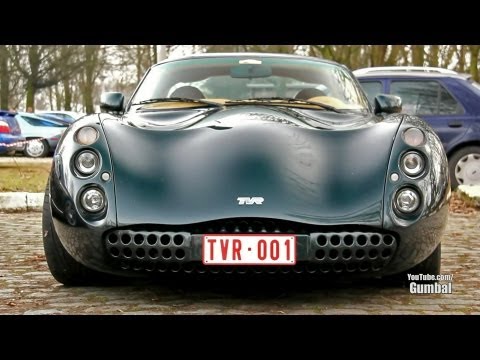
If money was no object I’d be opting for one of the modern TVR’s – a Tuscan or a Cerbera. The latter is swooping and elegant but brutal, while the former is totally uncompromising and looks as insane as it sounds.
—
Or if you want to go for true TVR exotica, there’s the Sagaris. I’m not sure there are words in the English language for this.
—
If I were to bring a TVR into Australia, however, I’d be restricted to a pre-1989 vehicle thanks to our rather ridiculous importation rules. That means either a 1980’s wedge model or something older and swoopier.
My personal preference would be for one of TVR’s M-series models: the 3000M.
TVR’s M-Series cars were built in the 1970’s using a fibreglass body on a purpose-designed chassis. Weight was low, handling was nimble and power was more-than-adequate according to the standards of the day. There was a 1600M using a Ford ‘Kent’ engine and a 2500M using a Triumph straight-six engine. Then there was the 3000M, using the Ford ‘Essex’ V6 engine.
Even though the car only had around 140hp, the 0-100km/h sprint finished in less than 8 seconds thanks to its extremely low weight.
The 3000M is not particularly fast by modern standards and I’m sure it would be far from comfortable to drive. There’s a good chance it’s not very economical or reliable either (not that economy’s a priority with a car like this, anyway, but…). The TVR chassis is so prone to rusting that you can buy replacements ready-made. If you want to see the process for replacing a TVR chassis, Wheeler Dealers did it earlier this year. The video goes for around 45 minutes.
But…. despite all that, the TVR M-series cars, like all TVR’s, have presence. My guess is that you’ll rarely hear an exhaust note so intoxicating and you’ll never see another car like yours staring at you from the other side of an intersection. Get a good one and I have a funny feeling that a TVR like this will quite likely be the most engaging car you ever own.
For sale
A TVR 3000M can sell for as little as 4,000GBP in England. I’ve seen them for even less than that. Of course, you are taking your chances with any TVR so buying the cheapest one you can find means you’re really throwing caution to the wind.
There are only three 3000M’s for sale on my favourite British classifieds site and two of those are left-hand-drive, so let’s check out the best of them.
This car is available in Germany for a somewhat more hefty €22,900 but take a look at the photos and I think you’ll agree it presents as a nicely finished car. The colour scheme is classic British and a new Essex engine was fitted just last year. Work was done to tidy up the gearbox and brakes at the same time.
Nice! Click to enlarge.
And a little 3000M sound, albeit with a slightly modified car…..
I’m very pleased to (finally) share some photos of my new pride and joy – my 1995 Porsche 968 CS. I picked this car up last Tuesday in Melbourne at the end of our road trip up the east coast of Australia.
The purchase story’s a bit complicated. I went to the mainland with the idea of returning with a Porsche 944. I got to Melbourne early and drove two 944’s prior to Mrs Swade coming over for the road trip – a 944 S2 and a 944 Turbo.
The first car I drove was the S2 and I was extremely impressed. The S2 has a 3.0 litre 16-valve engine with heaps of bottom-end torque. The owner had also fitted Porsches revered ‘M030’ suspension and a limited slip differential. Consequently, the car handled like it was on rails. It was incredibly stable at speed, very comfortable and easy to drive.
The Turbo was unmodified but with optioned-up sports seats that hug you like a long-lost grandmother. The car presented a major contrast to the S2, however. The clutch was much heavier and there was a lot of turbo lag and the 8-valve engine was relatively lifeless until the turbo kicked in. When it did, however, the car was very impressive.
I was much more comfortable with the S2 and began negotiations with the owner at the beginning of our road trip. We eventually agreed on a price and I drove Simon’s Saab 900i up the east coast happy in the knowledge that there would be a nice 944 S2 waiting for me when I got back.
I didn’t happen that way, however.
I picked up a couple of problems – cosmetic, not mechanical – on my final test drive and while they might have been fixable, I wasn’t in the mood to wait around to see how much it would cost. I could have negotiated further with the seller but I’d already held him up 2 weeks and promised that I wouldn’t go below the price I’d already offered him. It was time to walk away. I was heartbroken to leave this car behind because it drove so well (seriously, very very good) but given that this would be my first foray into Porsche ownership, I didn’t want anything hanging over me that I was unsure about.
Backing out of that deal left me with 24 hours to find another car. I had a booking on the ferry for the next day and no car to bring home. What follows is quite possibly a textbook example of how NOT to buy a car like a Porsche 968.
Put simple – I bought the car on gut feel.
The owner was a retired gent and this was his ‘other’ Porsche. His regular P-car was a 911 Turbo (996) and this car had been specifically set up for club activities (sprints). And it’s been set up very, very well, with only the best components used and no expense spared. There’s one invoice in the history file that scared the daylights out of me: a low oil pressure warning that ended up with what was essentially a major engine rebuild at a cost of $15,000. It’s scary to think that might happen to me, but at the same time it’s comforting to know it was all rebuilt just a few years ago.
I don’t want to get all Zen on you, but sometimes you know from talking to an owner, from reading a history file and seeing how they’ve set up the car, from feeling how the car drives. Sometimes the build says enough about the builder’s technique to show that they know what they’re doing. I could feel that in this car as soon as we took it around a sweeper.
About the 968 ClubSport
The 968 was the final version of Porsche’s front-engined water-cooled experiment that began with the 924 back in the late 1970’s. Porsche were going to call it the 944 S3 but so much of the car was new (around 80%, they say) that they gave it a new name.
The 968 saw the 3.0 litre engine from the S2 dressed up with variable valve timing (Variocam) to push it to 240hp. Coupled with a new six speed manual gearbox the 968 was capable of both 0-100 in around 6 seconds AND 30mpg in the US measurement. The car retained the 944’s 50-50 weight distribution so it’s extremely well balanced from the get-go. Add in some fancy shocks, tyres and other gubbins and the 968 can stick to the road like poo on a blanket.
The ClubSport model was a reflection of the times. Porsche, as was so often the case in the 80s and the 90s, was in financial trouble. They stripped out a lot of the creature comforts in order to offer a cheaper entry level model. Of course, taking out the rear seats and a lot of electronics means there’s a lot less wire, fewer electric motors and other bits. The end result was an even lighter version of what was already an impressive performer. The 968 ClubSport cost less than the fully equipped version of the car and performed better – instant cult classic!!
The 968 ClubSport came with no rear seat, the front seats were recaro shells with the fibreglass backs painted the same color as the car, no air conditioning, no central locking, no power mirrors, no power windows, only 2 speakers for its basic stereo, a manual tailgate release and a smaller battery and alternator (unless a/c was fitted as an option).
The end result was a 50kg weight reduction compared to the regular 968, or 100kg when compared to the 968 Sport sold in the UK, an optioned up package available at the time.
About *my* 968 ClubSport
Whilst all of those creature comforts were removed to create the ClubSport model, they were all still available as options. A lot of CS buyers optioned their cars up and many of the cars you see on the market today have ‘comfort seats’, a rear seat, air conditioning and other bits.
I’m pleased that my CS is pretty much how Porsche intended it to be. It’s only concessions to comfort are air conditioning and an aftermarket stereo (with a faux-woodgrain fascia and a 12-stack CD player, neither of which strike me as very sporting and both of which will meet a dumpster in due course).
Furthermore, my CS has the all-important Option 220 fitted as standard – the limited slip diff – and the previous owner shelled out around $1800 plus labour to fit the yellow Koni coilover dampers that were standard on the M030 suspension option. The car sits on Porsche Cup II alloy wheels shod with Yokohama road/track tyres that are very grippy but very noisy, too. Uncomfortably noisy, in fact. I’ll be getting some more suitable tyres later this week and will keep the Yokahamas aside for club events (it’s a waste to use them on the road, anyway).
The feature items in the cabin are, of course, the half-rollcage fitted by the previous owner and the Recaro A8 racing seats with harness on the driver’s seat. Note: these aren’t the original Recaros fitted by Porsche to the CS. They’re aftermarket Recaro seats purchased by the previous owner. The originals as fitted by Porsche are very hard to get and sell for around $4000 a pair!!
The seats have a pattern on the upholstery that brings to mind a 1990’s era Hyundai but if you can get past the looks, they’re very comfortable and incredibly supportive. I haven’t tried the harness yet (regular seatbelts are still in place on both sides). The other interior feature is the steering wheel; a think leather-clad wheel special to the CS that is the most comfortable wheel I’ve ever driven with. It oozes quality.
Actually, the whole car oozes quality. I love some of the little touches like the chrome surround for the door lock. Porsche were noted for their build quality during this era and the 968 is no exception. My car feels as tight as a drum and solid as a rock. The exterior still looks factory fresh, even after 19 years (built Sep 94). All interior surfaces are covered with quality materials and the doors, buttons, stalks and shifter operate with a level of precision and intent that I haven’t experienced in one of my own cars before. The sole exception is the driver’s window crank, which feels wobbly.
Owning it
It’ll likely be a loooooong time before I’ve even come close to the limits of what this car is capable of. Right now I can tell you it’s fast and it’s enormous fun to drive. It makes you feel good just walking up to it and as a driver, you feel confident as soon as you sit behind the wheel. This car is designed and built to be driven.
Right now, what I feel most is a small sense of foreboding at the potential service costs that lie ahead and a huge sense of responsibility towards this car.
As mentioned at the top of this story, I never intended to buy a 968 ClubSport. When the 944 S2 fell through, I invoked the “buy the best” maxim and went straight for the best front-engined 4-cylinder Porsche the company ever made. I blew my budget out of the water in the process, but right now I couldn’t be happier. Ask me about that again in 12 months when I’m still paying money into our mortgage to pay this off, but as my sister is so fond of telling me – you only live once.
My ambitions for this car:
Enjoy absolutely everything it has to offer.
Be as worthy an owner as the guy I bought it from. Hopefully one day in the distant future some lucky person will feel as good about this car and the person they bought it from as I do.
In the meantime, there’s a journey ahead. I’m not sure if this is the continuation of an ongoing automotive journey or an all-new automotive journey. All I know is I’m enjoying the ride so far.
The 968 ClubSport is an outstanding car and I feel pretty lucky to have this opportunity to own one.
Advance notice – I should advise that I bought a Porsche a few days ago. I’m extremely happy and somewhat frustrated. Happy, because the car is absolutely epic. Frustrated because right now I can’t get it down my driveway. I’ll explain in another post.
I point this out because some people know about my purchase and they’ll see this first post in a long time and think “Oh no, he’s going all Porsche now.” Well, no I’m not.
What’s prompted this post is that I’ve just seen the new photos of the Porsche Macan online and I have to say…… I like it.
Saab fans will probably want to stab me in the throat for saying this, but the first thought I had when seeing the Macan was the Saab 9X concept. I’m not saying the Macan looks like the 9X, but the proportions and the intention of the design reminds me of the Saab 9X: a more sporting and car-like utility vehicle. Saabophiles will know that Saab’s former design chief, Michael Mauer, has been at Porsche for around a decade now, so maybe the resemblance is not merely imagined.
Autocar went for a ride in a Macan with a Porsche test team and they came away quite impressed (note: it was a ride and not a drive). The Mecan Turbo they got a ride in had a twin-turbo version of Porsche’s 3.6 litre boxer engine making just short of 400hp. There’s also talk of a V6 petrol and an unspecified turbo-diesel. There’s even talk of a 4-cylinder turbo version, which Autocar notes would be the first Porsche with a 4-cylinder since the 968 (which, incidentally, just happens to be the car I bought a few days ago).
A word from Autocar:
What strikes me most about its on-road characteristics, once we leave the wide boulevards of Los Angeles behind, is its sheer agility. The Macan corners with all the eagerness of a well sorted sporting estate, displaying sharp turn-in, remarkably little body roll and an ability to accept lateral forces without any discernible understeer, even at the limit. There appears to be abundant levels of mid-corner grip, and the four-wheel drive system ensures that there’s always loads of traction and, in combination with the Turbo’s deep reserves of torque, terrific drive out of low-speed corners.
There seems to be lots of Volkswagen Group links here. The basics of the car seem to be derived from the Audi Q5, though with plenty of Porsche-specific mechanicals to make it distinct. The V6 engine will be from the Q5, too, and you can bet your underpants that any turbocharged 2-litre will have seen service in a hot Golf in a previous life.
People, especially Porsche people, love to hate on Porsches that aren’t 911’s. It’s perfectly normal and very close to being understandable – the 911 is one hell of an icon. The people who own and love their non-911 Porsches couldn’t give a rat’s tossbag about it, however, and I’m sure there will be plenty of people putting their hands up for some Porsche-hate in the form of Macan ownership over the next few years.
The Macan is due to debut at the LA Auto Show next month, at which time the full specs and interior shots will become available.
I’m driving a black 1993 Saab 900 up the east coast of Australia right now, so sitting here and watching this video gave me some special pleasure.
This is Petrolicious’ tribute to a very special Saab, owned by a very special guy. All concerned should be credited for a wonderful production. If I was to nitpick, I’d ask that they spend a little longer on the exhaust note, someone so wonderfully original to the 900. But that’s just me. They’ve done a great job and the car looks sensational.
This movie has been out for a few days now and most of you will have seen it. For those who haven’t, please do enjoy.