It’s been quiet around here because there are a few things on my mind.
First, we have a federal election going on here in Australia. The poll itself will be held on September 7. I don’t want to be consumed by it, but I am. I’m doing my best to keep the election off this website, however.
You’re welcome.
Second, this week has seen the climax of the biggest scandal in Australian sports history. The conclusion has been six months in the making and thoroughly consuming all week.
And finally, I’ve got a vehicle inspection happening tomorrow. We’ve replaced Mrs Swade’s 9000. Now it’s time to replace my Alfa Romeo GTV6.
Here’s the car:
It’s a 1990 Porsche 944 S2 – cross another one off the bucket list!!
I hope the inspection goes well. In fact, after chatting with the owner a bit I’m expecting it to go well. I’ve got the best 944 mechanic in Australia looking at it so if it impresses him then I’ll feel quite comfortable with the purchase.
I’ll let you know.
——
Mod Advice (Part 1)
Back in the SU days I wrote a four-part series on modifications to the 1998-2002 Saab 9-3. The cars are very tunable but they’re also quite compromised by a chassis that’s nowhere near as sophisticated as the engine Saab put into it.
In short, you have to make sure that the bits around your engine can handle the extra oomph that Maptun/Hirsch/BSR/whoever can get out of it.
I spotted this old ad for the Porsche 944 Turbo on TTAC today and it presents the case for careful tuning quite nicely. It shows all the bits that Porsche changed when the company went from the basic NA model to the turbo model.
Click.
Bottom line: Responsible tuning isn’t just the addition of a single go-faster bit. It’s a whole-of-car affair if you want to do it right.
——
Mod Advice (part 2)
If you’re taking your modified car to a huge gathering of like-minded car enthusiasts, make sure the car’s legal.
Queensland police have been criticised for deliberately targeting one of the largest ever car enthusiast events to be held in the state.
…. The promoters had positioned the event as a peaceful day out, with the specific instructions of “No Skids, No stupidity. Don’t give the cops a reason to turn up!”
Regardless of the exemplary behaviour of the attendees, up to 30 Queensland police officers and a special traffic task force blocked the entrance and exit to the event, which was held on private property, specifically to target modified vehicles.
It IS poor form on the part of the police, who should want to build bridges and relationships with elements of the community. Shooting these metaphorical fish in a barrel isn’t really going to help.
But it’s also poor form to drive your car in what might be an unsafe condition. Do your mods carefully and make sure the car’s legal.
All parties (police and individual owners) need to look at doing things better, I’d say.
——
Old man becomes king of the kids
The reviews are coming in and it’s emerging that what’s previously been regarded as a bit of an old man’s brand – Mercedes Benz – might just be taking over a market segment considered the reserve of the young and upwardly mobile – the hot hatch market.
After two days in the saddle (and some scorching track time), this I declare: Mercedes Benz remarkable A 45 AMG is the best high-performance hatch ever made, ever offered for sale.
The best ever… simple as that.
And then there’s this from Wheels Magazine (Australia’s biggest motor mag), who are still on their road test right now. This via Facebook about an hour ago:
Road loop today in the A45 AMG and it’s seriously epic. F@$king epic, even. We already knew it was fast, but it’s the A45’s hungry front-end and superb power down that make you grin like a loon. It’s an easy and predictable car to drive hard, but it’s also still exciting. Every motoring hack on the launch can’t stop raving about it. 2013 is proving a great year for performance cars!
The guys at Renault et al. better get their thinking caps on. I’m sure the result will be worth the wait.
Here’s some video from Autocar in the UK, just in case you haven’t got across this new AMG model yet. It looks like a barn-burner!
—
Thanks to Turbin for the link.
——
Have a good week. Fantasy Friday returns tomorrow.
Welcome to the first instalment of Fantasy Friday, a momentary brainstorm idea that may or may not be continued in the future.
I spend a LOT of time on various car-selling websites so I thought I’d pick a car from time-to-time to share on here. Any car shown on Fantasy Friday will be a car that’s available for sale at the time of publication (so hopefully a friend can buy it and I can go for a drive!!).
There’s no description on this listing as yet, but the photos say enough to suggest that this Dino presents in very good order. Shannons will put a mechanical report on their website closer to the auction date.
There’s no price guide at this point, either. Shannons have sold a few of these cars over the years, however, with most of them going in the high 100,000’s. The most expensive one sold for $220,000 back in 2007.
That was a GT and therefore, a hardtop. This one’s a GTS, meaning it’s a targa top with a removable roof. This is also the first GTS they’ve listed for sale, from what I can tell. The price will be interesting to see.
——
Here’s some video to get your aural juices flowing. That V6 engine sure sounds sweet.
The video, which was made by the owner of the car, isn’t the greatest quality but it’s got a great car-guy story behind it and gives you a good feel for riding in the car:
On the plane back from Europe in 2008 I happened to meet a French enthusiast who loved Dinos but didn’t have one. I invited him to go for a ride while he was in Los Angeles and his comments about the car are worth hearing.
——
Because I’m a lazy arse and it’s late on a Friday night, here’s a summary about the 246 Dino from the horse’s mouth – Ferrari’s own website….
At about the time that the Dino 206 GT gave way to its successor the 246 GT during 1969, Enzo Ferrari was reaching an agreement with Gianni Agnelli of Fiat to take over the production car side of the Ferrari business. At this time Enzo Ferrari was already over 70 years of age, and apart from securing the long-term future of the production car business, it freed him from the day to day responsibilities of it, and gave him more time to devote to his first love, the racing department.
The Dino 246 GT made its official debut at the Turin Show in November 1969, although the production run had already commenced. A total of 81 examples were completed by the end of the year. Visually the 246 GT was almost identical to the 206 GT that it succeeded, apart from the fuel filler cap being under a flush fitting flap on the left sail panel. In reality there were more differences than initially met the eye. Apart from the increase in engine capacity from 2 litres to 2.4 litres, the engine block material was changed from aluminium to cast iron. Also not apparent from a casual glance was the change to the wheelbase, which was 2280mm on the 206 GT, and 2340mm on the 246 GT, with a corresponding increase in overall length. An increase in diameter of the paired twin exhaust pipes could also be noticed.
During the production period of the 246 GT from 1969 to 1974, there were no major changes to any features, although various smaller items and details did change, leading to the three series of cars referred to as “L”, “M” and “E”. This is apart from the different market versions, and the targa-roof 246 GTS model.
Broadly speaking, series “L” cars were produced in late 1969 and through 1970. They have road wheels with a single knock-off spinner, front quarter bumpers into the grille opening, rear licence plate lights in the quarter bumper ends, an external boot lid release button and head rests mounted on the rear bulkhead. The body material was steel with an aluminium front lid.
Series “M” cars were produced for a short period in the early part of 1971. They had five bolt fixing for the road wheels, an internal rear boot lid release catch, seat-mounted headrests, plus detail changes to the engine and gearbox, whilst the chassis received modification, resulting in an increase of 30mm in the rear track.
The Series “E” cars were produced from early 1971 to the end of production in 1974. They incorporated all the changes to the Series “M” examples, together with further modifications to the engine and gearbox. The windscreen wiper parking arrangement changed from central to right, on left-hand drive cars, whilst right-hand drive examples retained the central parking arrangement. Other visible differences were the repositioning of the door lock barrel from within the scallop to below it. The quarter bumpers finished short of the grille opening, the cooling ducts below the front quarter bumpers changed from plain rectangular openings, to formed circular inlets, and the rear number plate light became a chrome-plated rectangular unit mounted on the rear edge of the boot lid.
A USA market version was introduced at the end of 1971, which can be identified by the vertical instead of flush mounted indicator lights in the nose panel, and rectangular side marker lights cut into the front and rear wings. The 246 GTS model with a black finished removable roof panel was introduced in the spring of 1972 at the Geneva Show. Apart from the removable roof panel, it can be identified by the omission of the rear quarter windows, which were replaced by a plain metal sail panel with three rectangular cabin exhaust air slots. Late in the production run, wider Campagnola wheels of a different design from the standard Cromodora ones, coupled with flared wheel arches, were offered, as were “Daytona” pattern seats, which had a different, more elaborate stitch pattern with thin horizontal bars to the centre, which earned the package the epithet “Chairs and Flares”.
As noted the cars were built on a 2340mm wheelbase chassis, constructed along the same lines as the preceding 206 GT. It was modified twice during the production period, and given factory type reference numbers 607L, 607M and 607E. The Dino even-number chassis numbering sequence, which had started with the 206 GT, continued in use throughout the production run. Servo-assisted ventilated disc brakes, initially Girling on “L” series cars, and then ATE on later models, together with independent suspension of the same layout as the 206 GT were provided. The body shape was virtually identical to the 206 GT apart from the details already mentioned.
The engine was again of 65 degree configuration, with chain-driven twin overhead camshafts per bank, having a total capacity of 2418cc, with a bore and stroke of 92.5mm x 60mm, bearing factory type reference 135 CS. The cylinder block was cast iron, whilst the cylinder heads and various other castings were of a silumin alloy. The engine was transversely mounted in unit with the all-synchromesh five-speed transmission assembly, which was below and to the rear of the engine’s wet sump. It was fitted with a bank of three twin-choke Weber 40 DCN F/7 carburettors on Series “L” and “M” cars, with 40 DCN F/13 models on Series “E” cars, mounted in the centre of the vee, with a distributor and electronic ignition system, to produce a claimed power output of 195 hp.
Despite the evolution of the body style from the sports-racing Dino model, there was virtually no competition career for the Dino road series cars, apart from relatively low key private entries in some national events and rallies. The only major international race appearance was at the Le Mans 24-Hour Race in 1972, when a much modified 246 GT, chassis no. 02678, was entered by Luigi Chinetti’s North American Racing Team, driven by Gilles Doncieux/Pierre Laffeach/Yves Forestier, finishing in 17th position overall and 7th in the Index of Performance category. Between 1969 and 1974 a total of 2487 Dino 246 GT models were produced, with 1274 246 GTS examples being produced between 1972 and 1974.
Here are some of my best reads from the last few days of online automotive reading (and something from the fringe).
—
Jalopnik good
I don’t know if you’d call this list definitive, but it’s entertaining. Jalopnik compiled a list of the Ten Best Automotive Ads and there are a couple of Swedes amongst them – one each from Volvo and Saab. I’m not sure they picked the right Volvo ad (I prefer the one with the Lamborghini) but the Saab one was a favourite.
—
Not a real ad
Spotted, photographed and caption-added by my mate Turbin a few days ago.
—
Jalopnik Bad
Jalopnik’s still on my RSS feed because once or twice a week you still get a story that’s worth reading (see the ads story, above). That’s maybe two read-worthy stories out of the 300-or-so they publish every week. Jalopnik’s entry rate is frenetic nowadays, which would be great if they had useful content. But Jalopnik’s style has regressed in the last 18 months and they’re publishing a heck of a lot of trash now.
I think it was around 1995 that it dawned on me how much I hate commercial FM radio. All those slick, contrived phrases delivered by silky, confected voices. It was evident even back then that they were in a race to the bottom in terms of delivering radio content that appealed to the lowest common denominator; something that’s only got worse with the passage of time and the emergence of the 24-hour media cycle. But the worst bit was the delivery method – slick, contrived humour that sounded slimy and eventually, got annoying.
Jalopnik is the automotive equivalent of commercial FM radio.
There will be crashes and auctions. Weird fashion. Weird people. Unicorn cars. And some guy dressed head-to-toe in Ferrari attire even though he just owns a 308. We will love that guy.
“Even though he just owns a 308”
There are brands that I don’t have an interest in ever owning, but I’ve got plenty of respect for those that do. Yes, a guy willing to have his wallet hoovered and dress head-to-toe in Rosso will be eye-catching and maybe even snigger-worthy, but base that on his fashion sense, not because you think he drives a ‘lesser Ferrari’.
Any Ferrari, the 308 included (the 308 especially, if you ask me), is worthy of a car guy’s respect. For most that eventually do it, owning a Ferrari – any Ferrari – is a long-held dream. I don’t know about the situation in the USA (Jalopnik’s home ground) but here in Australia, the commitment one makes when buying even the most affordable Ferrari – which right now is the Mondial – is a massive one.
First, you have to save money like a madman and fork out more than many brand-new midsize cars just to reach that most accessible level of Ferrari ownership. The sheer fact that a 308 or a Mondial can be bought by the committed at a remotely ‘accessible’ price is something to be enjoyed while the situation exists. It’s not something to be sniggered at.
Then you’ve got to maintain it, which is not a simple or cheap affair.
What really irks me is those who sit on the sidelines with their wannabe cheersquads and take the piss out of those who commit their hobby time and hobby resources to really achieving what is for them, a dream. Sure, they’re not conquering cancer or teaching under-privileged kids how to read or anything – how many car guys or girls do? – but they’re pursuing for them what is quite likely the appreciation of a level of creativity, passion and craftsmanship that’s becoming less accessible as time goes on. Cars like these are, for many, a mechanical expression of human automotive passion.
To those who commit to caring for one of these cars, I doff my hat.
And yes, this is a little bit personal. Aside from the fashion sense, I am that guy (I’ll admit I’ve barely got any fashion sense, but enough to avoid ever spending much at a Ferrari store). I’d love to have a Ferrari one day, whether it be a Mondial or a 308/328. And incidentally, the only example of a 308 I’ve ever ridden in was owned and driven by former Saab USA chief Bob Sinclair. He’s a bloke I’d be happy to emulate.
They didn’t go onto the manicured lawns and photograph the cars all perfectly parked. They waited outside and photographed the cars doing what they were made to do – they got the cars driving.
—
Tesla goes 5-star+
I’ve thrown a few bricks at Tesla in the last 18 months or so – pun intended – but credit where credit’s due.
The Tesla Model S just got 5-stars in it’s crash test and if the scale went higher than five stars, there’s a good chance they might have reached higher, too. It’s being touted as quite possibly the best crash-test result ever achieved under the NHTSA regime in the United States.
A Tesla Model S isn’t for everyone, but for those who get one, it’s good to know they’re about as safe as a car can be right now.
Congratulations to Tesla.
—
Political Spin
And finally, for those who have made it this far……
We’re in election mode in Australia right now. Politicians are everywhere and we’re all sick to death of them. This, however, is a pleasure. And with 214,000 views on Youtube in 24 hours, you’d call it a success, too.
A cameraman for our national broadcaster also happens to be the bass player in a band. He used his Canberra-based job and connections to talk a bunch of our federal politicians in to appearing in his band’s film clip. The song is about the 24-hour nature of the political news cycle that he works in, so the pollies’ appearances were probably as cathartic as they were relevant.
The clip features the current Prime Minister (behind the newspaper) as well as the current opposition leader who’s after his job (spinning the bike wheel). There’s a bunch of other prominent Australian politicians and press reporters, too, one of whom is ironing his underpants.
Can’t imagine Obama, Cameron or Putin doing a clip like this. Well, maybe Putin.
The automotive internet’s a funny place sometimes (this site included). One site says something and everyone seems to jump on board, regurgitating the information with their own small changes/additions with few people pausing to ask “Is this really possible?”
Saab is gearing up to start production of the 9-3 again in September, two years after the last example rolled off the assembly line at the company’s Trollhättan factory, Aftonbladet reports
New Saabs? Next month!!! Sounds great!
Then there’s the next sentence, which seems to completely contradict the first one, (though it didn’t stop the ‘production’ headline).
Saab’s new owner, National Electric Vehicle Sweden AB (NEVS), a Chinese-Japanese consortium created solely to buy Saab, says that the model’s parts supply is the bottleneck in the production process, understandable since many of Saab’s suppliers closed after it stopped production two years ago.
Thankfully, Just-Auto took a look at the claims with a more experienced eye and actually contacted NEVS to ask relevant questions (what a novel approach!). The answer they got put some meat on the bones of the second Autoblog quote, a gargantuan hurdle that Autoblog (and others) didn’t even seem to recognise:
National Electric Vehicle Sweden (NEVS) is declining to confirm reports it will start production next month of the Saab 9-3 at its Trollhattan plant.
Speculation has mounted manufacture would begin imminently at the site around one hour north of Gothenburg, but NEVS is pouring cold water on the suggestion.
“We have not started production yet – we have not contracted all suppliers we need for parts,” a NEVS spokesman told just-auto from Sweden.
“Before we have 100% of all parts, we are not able to start. We have the vast majority, but not all yet. We have access to the plant of course and we produce spare parts for Saab Parts, but we have not started our own production yet.”
It’s no surprised that Saab enthusiasts are quite keen to see any news of a re-start of production. I’m sure the news floating around of an imminent re-start got some people excited.
I’d urge patience.
Here’s how things work in the car business, generally speaking. You have the following options:
A quality car that’s been thoroughly tested for consumer use.
A car featuring a new engine and a host of new parts.
A car that’s released to market relatively quickly.
Your job is to pick which two you’d like, because you can only have two out of those three.
#2 is compulsory when it comes to NEVS’s plans to reproduce the old Saab 9-3 in non-electric form. It has to be one of your two choices because GM aren’t going to deal with NEVS to supply either engines or parts. That means NEVS has to find a new engine to go into the car (preferably turbocharged) and they have to find companies that’ll produce parts that GM used to supply.
Given that a new engine and a whole bunch of new parts have to go into the car, your choice is whether you test it thoroughly before release, or you release it quickly without proper testing (at least 12 months worth). Choose the latter if you’ve got a lot of money you don’t mind losing.
Now, if NEVS are saying (as per the Just Auto quote) that they still haven’t even got the full compliment of parts suppliers sorted yet, then Saab fans are in for a considerable wait.
If that statement’s a real reflection of where NEVS are at then I’d be surprised – cautiously but pleasantly surprised – if NEVS make a production car to be offered for sale to the public before this time next year.
NEVS have good resources at their disposal in terms of finance and facilities. They’re slowly going build up the workforce they need to make use of those facilities. But as I’ve said a million times before, there are no fingersnap solutions in the car business. Things take time. If NEVS have to put a new outsourced engine and a whole bunch of new parts into their re-birthed Saab 9-3, that’s going to take a bucketload of testing and development before it can be sold to the public. Technology has sped that process up, but it still takes time.
NEVS can do this, but Saab fans are going to have to be patient.
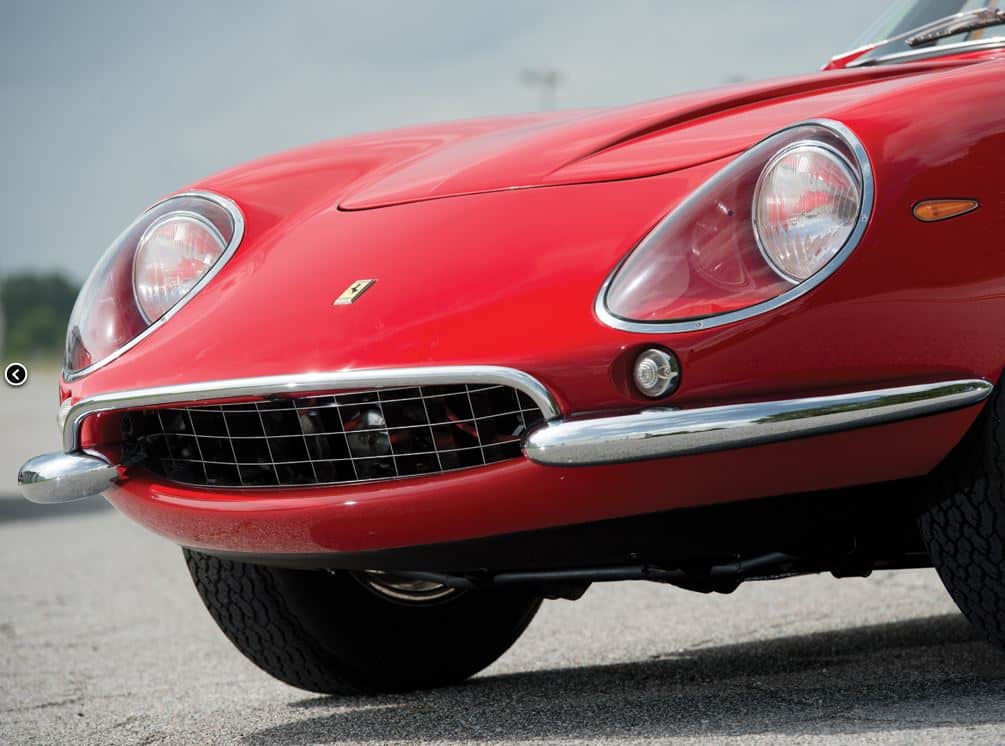
As nice as it is, this is not the most beautiful Ferrari ever bought and sold at auction.
Right now, however, it IS the most expensive Ferrari ever sold at auction.
This N.A.R.T Spider – the full official description has it as a 1967 Ferrari 275 GTB/4*S N.A.R.T Spider – just sold for $25 million. Add in the 10% buyer’s premium and the total forked out by the new owner is $27.5 million. If you’re into heart warming stories (and/or dismayed that someone could spend that much on a car) then you’ll be pleased to know that the whole $25 million will be donated by the selling family to charity.
I once asked former Saab owner and car collector, Victor Muller, what the most important thing was to look for when considering a vehicle for purchase. His answer was quick and unequivocal – provenance. The car has to be genuine and its history has to be supported. Anyone familiar with my machinations over the Canberra Fulvia will now understand my dismay that its reportedly remarkable low mileage and history was completely undocumented, aside from an old 1977 registration sticker on the passenger side window.
This N.A.R.T Spider was one of just 10 ever made. It has all of its matching numbers and it stayed in the same family its entire life. Every step of its life has been recorded and documented, right down to noting which original bits were temporarily removed and then reapplied during its restoration years ago. That’s provenance.
The owner was a guy named Eddie Smith. His is a rags to riches story, one of those American Dream tales of a guy pulling himself up by his own bootstraps. Born poor, he built a successful mail-order company in the 1950’s, got the car bug in the 1960’s and eventually owned a bunch of Ferraris thanks to a personal friendship with the importer. The only one he never sold was this Spider.
Eddie Smith died in 2007 and his family decided to put his beloved Spider up for auction this year, with the proceeds of the sale being donated to charity – a wonderful gesture from a blessed family.
The guys at Petrolicious did a feature on this N.A.R.T Spider a month or so ago, in the lead-up to this auction. It’s consistent with all their videos in that it’s beautiful to watch and shows the car of at its absolute best.
Take the time to watch and appreciate. This is the most expensive Ferrari to sell at auction and in this video, you might just get a glimpse as to why.
I think I’m about to add Pebble Beach to my bucket list of automotive events. It’s a list that I still have to put together, but is being modelled partially on the trip being undertaken right now by the Aussie writer of Any Given Reason – check it out.
While Pebble Beach concours features a collection of amazing older metal, the preceding Quail display features classics as well as more contemporary machinery, including some eye-dazzling showcases from manufacturers.
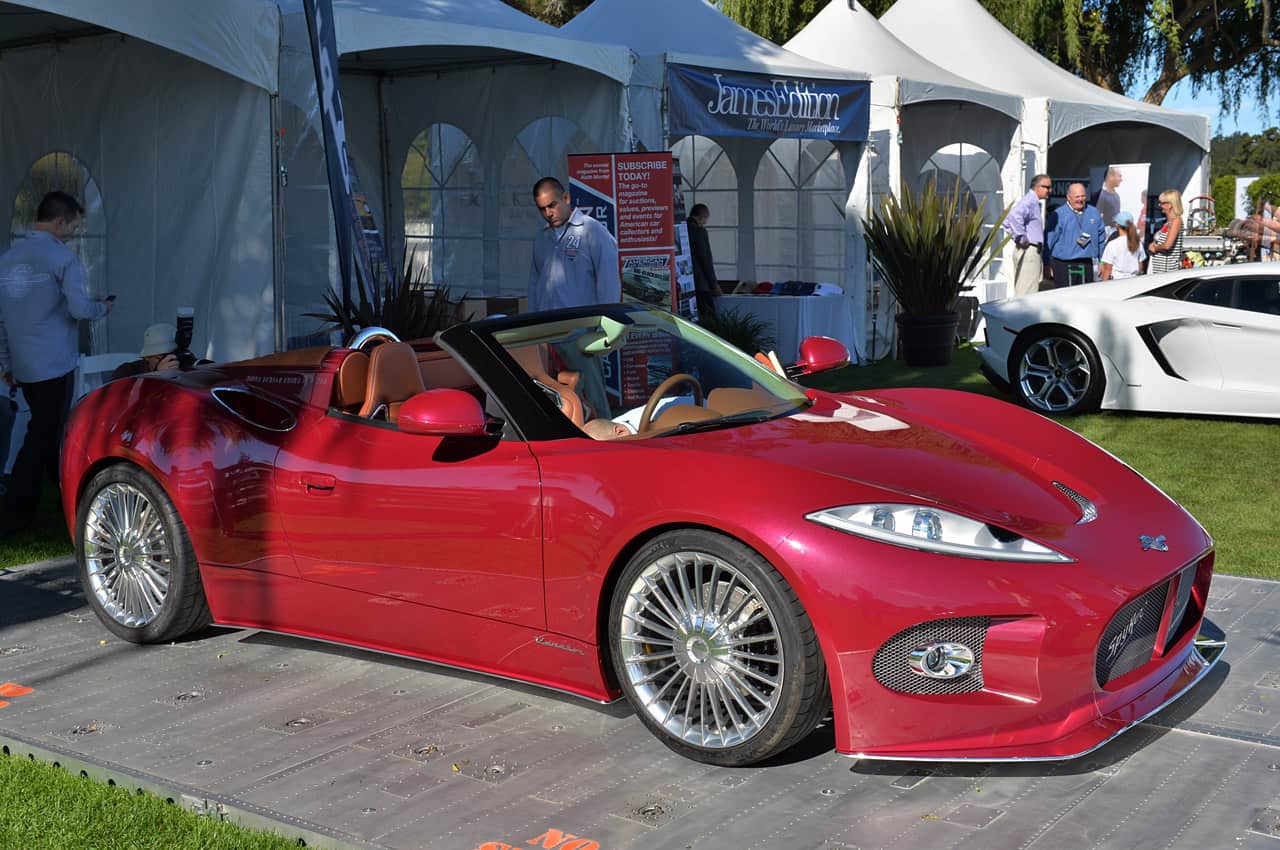
The Quail was held over the weekend. Hopefully you’ve already seen the Spyker B6 Venator Spyder, which was unveiled there earlier.
I’ve pinched a few of the Autoblog photos, reproduced below, to give you a quick taste. These are some of my favourites.
—
Jaguar XK-SS, so cool it could only have been owned by Steve McQueen.
—
If you’ve never checked out Singer Design’s Porsches, you should. This video goes for 27 minutes but will tell you all you need to know about what some consider to be the ultimate 911.
—
You can dislike BMW’s all you like, but you have admire what they’ve done with their stewardship of Rolls Royce. This is grand in every respect.
—
And while we’re talking BMW, the company steals Saab’s Lime Yellow colour for the new M4.
—
Spyker’s new B6 Venator Spyder, due for production soon. Hopefully.
—
The Lamborghini for the five-year-old in all of us – the Veneno.
—
The incomparable Bugatti Type 57 Atlantic. Simple amazing.
—
The one-of-a-kind Ferrari P4/5 commissioned by James Glickenhaus. Imagine how good it would be if he told them to go at five-fifths!
—
Any show that features the Aston Martin V8 is a fine show by me. I love this car.
—
It’s nice to see the best classic Japanese metal getting a look in. Great cars.
Spyker have just unveiled the topless version of the sensational B6 Venator that debuted earlier this year at the Geneva Motor Show. They promised the topless version back then. Today, at Pebble Beach, they delivered.
Here are the official studio images and the press release.
——
SPYKER UNVEILS B6 VENATOR SPYDER CONCEPT
Spyker N.V. (“Spyker”) today revealed the Spyder version of its new exotic sports car, the Spyker B6 Venator, at a press conference in Pebble Beach, California.
Just five months after unveiling the B6 Venator Coupe Concept to rave reviews at the 83rd International Geneva Motor Show, Spyker – creator of meticulously hand built automobiles whose beauty is equaled only by their unrivaled craftsmanship – made waves on the other side of the Atlantic.
Today the brand introduced the SPYKER B6 VENATOR SPYDER Concept, a unique alternative in the High Luxury Sports sector, via a press conference at The Quail Motorsports Gathering in Pebble Beach, California. The SPYKER B6 VENATOR SPYDER Concept is the eagerly awaited convertible execution of Spyker’s compact, 2-door mid-engine sports car that will offer the discerning driver of the highest standards a new choice, delivering a rare combination of heritage, design, performance and exclusivity.
Chief Executive Officer Victor R. Muller chose The Quail as the site for the SPYKER B6 VENATOR SPYDER Concept’s worldwide premiere because, “It is the car’s natural habitat. Car enthusiasts from around the globe descend upon exquisitely beautiful Pebble Beach for the Concours d’Elegance weekend, and The Quail Motorsports Gathering is the most exclusive event of all.” Designed by Muller, the SPYKER B6 VENATOR SPYDER Concept incorporates vintage cues of the brand’s aviation past, highly detailed design and bespoke materials into a defiantly contemporary statement that could only come from Spyker.
The company’s Latin axiom “Nulla tenaci invia est via” – “For the tenacious no road is impassable” – is tastefully featured on the exterior. The name “Venator” is Latin for “Hunter,” a nod back to Spyker’s “Hunter” fighter aircraft of the early 20th century.
Exterior highlights include:
The trademark radiator grille’s mesh is V-shaped, referencing Spyker models of the previous century. The 1903 Spyker logo harkens back to an era when Spyker built racers such as the amazing 60HP.
The headlights, equipped with LED light rails, give the car an aggressive stance.
The 3D LED rear lights are akin to the iris-type after burners of a jet engine from a modern fighter aircraft.
The brake light has been sculpted into the rear panel design to ensure smooth, flowing design lines.
Elegantly aggressive 19″ TurbofanTM wheels are shown in mirror polish finish.
The brand’s axiom “Nulla tenaci invia est via” – which translates to “For the tenacious no road is impassable” – is shown on the fairings.
Interior highlights include:
Interior surroundings crafted from the finest materials are unusually open and airy for a sports car, akin to an aeroplane cockpit. The leather is sourced from the Litano range produced by the Royal Hulshof Dutch Tanneries in Lichtenvoorde, Netherlands. Hulshof uses only West European first choice bull hides and a special tanning process that produces the beautifully rich colour palette.
The red cover on the ignition switch evokes the spirit of starting an aeroplane, as does the dashboard that lights up as part of the ‘pre-flight check.’ The dashboard is shown with a turned aluminium fascia, similar to those seen on Spykers of the 1920s.
Pressing the engine start button brings to life a powerful V6 engine that delivers 375+ bhp.
The trademark exposed gear change mechanism was inspired by early aircraft controls from Spyker’s aviation heritage.
—
Body: All carbon fibre
Chassis: All aluminium platform
Engine: details conspicuously absent – SW
Engine mount position: rear-mid
Engine orientation: transverse mounted V6
Max power: 375+ bhp
Drivetrain: details conspicuously absent – SW
Drivetrain type: RWD
Transmission: 6-spd automatic
—
Dimensions:
Overall length: 4347 mm
Width (ex mirrors): 1882 mm
Wheelbase: 2500 mm
Kerb weight: under 1400 kg
—
The SPYKER B6 VENATOR SPYDER Concept will begin production in late 2014 for key markets including Europe, the Middle East, Asia Pacific and India, followed by the US in early 2015. The introduction of the SPYKER B6 VENATOR Concept at Geneva earlier this year marked the beginning of a new era for the brand, one that will include a significant increase in production led by a management team that has never been stronger.
The SPYKER B6 VENATOR SPYDER Concept represents the next key step on that path, which is being spearheaded by Muller and his Chief Commercial Officer John Walton. Together, Muller and Walton are leading a passionate team that is supremely dedicated to creating unique and beautiful high-performance sports luxury cars.
According to Walton, “Reaction to the coupe version in Geneva was so overwhelmingly positive that we accelerated our initial plan to deliver the SPYKER B6 VENATOR SPYDER Concept. This is an exquisite drop-top that begs to be driven on the Pacific Coast Highway – yet will provide more exclusivity than any other sports car it will pass on the road.” The SPYKER B6 VENATOR SPYDER Concept will provide the authentic Spyker experience – hand-crafted rarity that is as visceral to view as it is to drive – at a more accessible price point of approximately $150,000. “The SPYKER B6 VENATOR COUPE and SPYDER Concepts are the immediate future of Spyker,” said Muller.
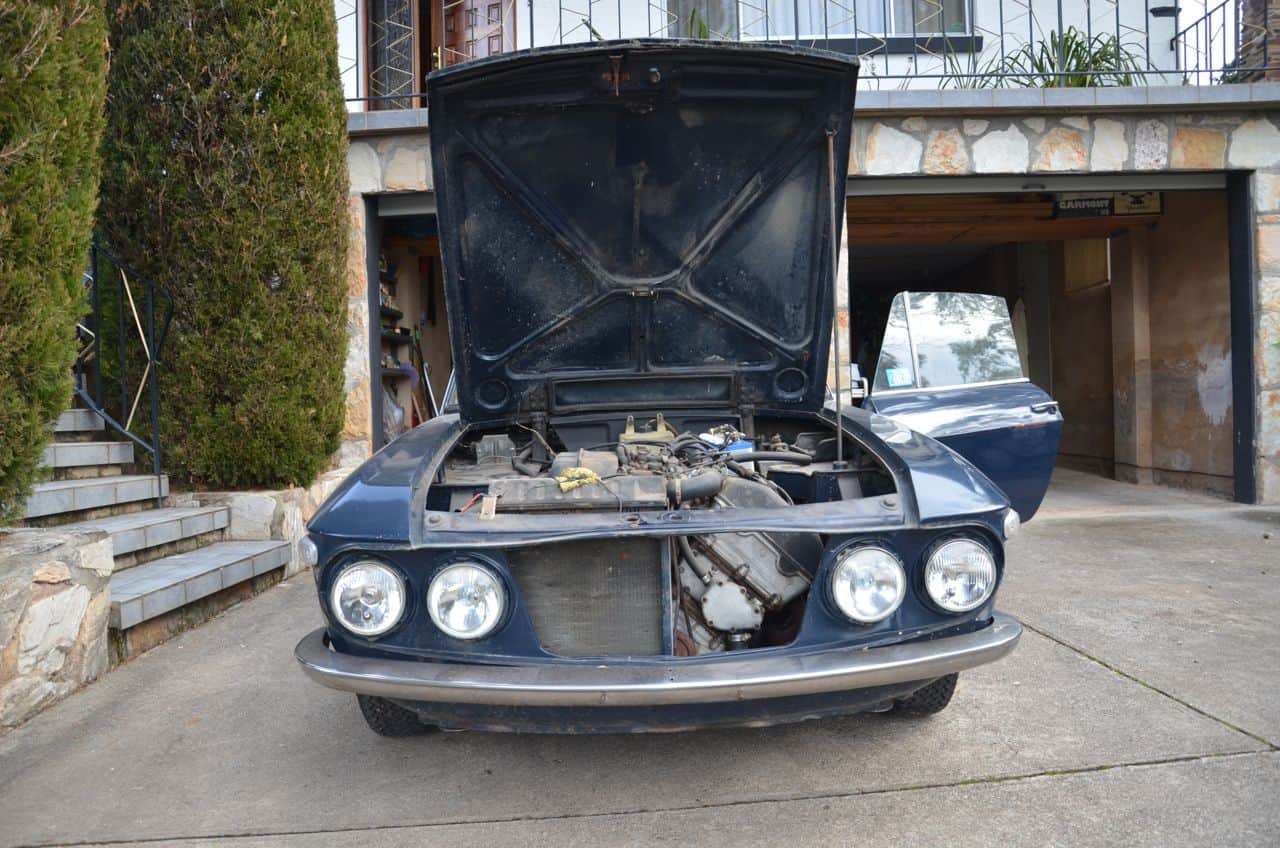
Just a quick update on my search for a good Lancia Fulvia.
The red one from northern Australia has been ruled out. I did get some feedback from the seller last night (finally) and it raised more questions than it answered. There IS a good list of spare parts that come with the car so anyone looking at it who’s willing to reconcile the irregularities that I can’t figure out from a distance could well land themselves a good car.
The blue car from Canberra is still available and the seller has received several offers, including a standing offer from me. All offers are around the same mark. I’ve said that mine’s conditional upon establishing that the car is indeed drivable.
Why?
As mentioned earlier, the car hasn’t been run for around 10 years. The seller is very, very confident that that isn’t a problem because the engine was perfect before it was stored. I still want to be sure.
And as a practical matter, the car has to be able to drive and stop as a condition of carriage with a freight company.
I don’t hold out a lot of hope for the blue Fulvia. I think some of the interested parties (and there are apparently quite a few) will have less stringent conditions than I have.
I reckon I’ll give it another week and make my own decision then. It may just be that I have to put the whole Fulvia idea aside for some time in the hope that one will become available closer to home one day.
Even I’m capable of some common sense, even if it’s only occasionally.
I’ve been asked about the Saab 9000 Aero we bought a few weeks ago. How’s it going? What’s it like? Can we see pictures?
The answer is ……. well……. complicated.
First, let me get the negatives out of the way. They are significant, annoying and even a little embarrassing. This is not the post I wanted to write about this car, but I’m going to write it as both a reminder and as a warning.
Negative #1 – The engine.
There’s no elegantly loquacious way of saying this, so I’ll just say it: Our car doesn’t have an Aero engine.
An automatic Saab 9000 Aero should have a B234L engine and ours has a B234E engine. The engine was changed at some stage and an Ecopower engine was installed. No, I didn’t know this until I had the car inspected for registration and yes, I’m quite pissed off about it. Combine this key incident with all the smaller incidents noted below and it’s fair to say that I’m a little less happy than I should be with what is actually quite an enjoyable car. Right now, it’s tainted.
Right: Something here is not as it should be.
Didn’t I notice this as I drove it home from Sydney? No.
The car does have a new turbo, a TD04, which spools up quicker. Combined with a manual boost control valve, the car does deliver better performance than a regular Ecopower 9000 (we also own a 1994 Saab 9000 CS with the standard Ecopower setup). It’s not as smooth running as I imagined an Aero should be. Not by a long shot. But I didn’t twig to the engine being a transplant.
This is not as bad as it could be, however, and that’s because our car has an automatic transmission. If we’d bought a manual 9000 Aero, I wouldn’t be writing this publicly. I’d be getting legal advice. As it is, I’ve already invested so much in the car that I’ll say my piece here and do the remedial work at as little cost as possible.
The difference between the B234L that our car should have and the B234E that we’ve got is minimal and restricted primarily to software. I can make the changes very economically and I’ve already had a chat with my mates at Maptun about doing that. It’ll be quite cheap and very, very effective. We plan to keep this car for a long time so re-sale’s not the issue but when that time comes, our car will have Aero+ performance, despite not having a genuine Aero engine.
On a matter of principle, however, I maintain my anger. I was a very up-front buyer in this transaction and I acted in good faith every step of the way. I checked out and trusted the reputation of the seller and acted in such a way that respected that reputation. I feel severely let down by the seller in that regard and have written to him with this engine issue and others (yes, there were other issues) squarely in the gun. No response so far, but we’ll see if that changes.
Learn from my mistake – even if the transaction is for a low value, as this one was, if it’s a specific model car and the type of equipment is important, take time to make sure everything is as it should be. Even if you know/trust the seller or if people you know/trust have a relationship with that seller, make sure you’re getting what you think you’re getting.
Right: The new turbo, a savings grace. The tell-tale engine number is just out of shot.
Our car will turn out OK. Better than OK. But the experience has left a slightly bitter taste so far, which is unfortunate.
Note: I’m quite sure that the seller is a decent bloke and that what we’re looking at – at least in some small part – is an oversight of disclosure rather than an attempt at genuine hoodwinkery. That’s why I’m not naming names here. I’m quite sure that the engine was replaced for no reason other than it was necessary to do so. Why would you with a B234L?
What I’m angry about is the lack of disclosure, oversight or not. An engine is at the heart of a car’s character and despite the similarities between my engine and the original engine, a buyer deserves the decency of being told what they’re getting, especially when it’s one enthusiast to another, even if they don’t know each other personally.
I’ll say it again – please learn from this and make sure you’re getting what you think you’re getting. This is an embarrassing and annoying development for me, but I’ll make it right and if someone learns from it, that’s a good outcome from a bad situation.
—
Negative #2 – The Value Maxim.
I have had a theory about used cars for a long time now. I wrote about just a few weeks ago when talking about the Lancia Fulvia. The theory goes like this:
Any given model of vehicle in good condition is worth X dollars. If you buy it for X-minus-Y dollars then you’ll usually spend Y dollars (at least) getting it up to your desired condition.
Such is the case with our 9000 Aero. I thought I could beat my own theory, but I was wrong. A good 9000 Aero in Australia is worth around $7,000 and we got this car for $3,300. But even before I picked it up in Sydney I had to get Steve at Saab Salvage to do around $1,200 worth of work to it. (Note: unlike the engine situation, I checked all this out before completing the transaction and authorised the repairs).
There were various bits not working or simply not present. Things like the electric motor on the driver’s seat, which is essential as both Mrs Swade and I will drive this car regularly and I’m around 8 inches taller than she is.
The washer bottle needed replacing. The central locking wasn’t working on one of the doors. There was a small plug leak off the distributor. One sun visor was hanging down. The A/C compressor needed replacing. The list went on…..
There are still a few items from the list that are yet to be done. The steering rack, which works perfectly but has a small leak, will need attention eventually. The front bumper also needs a little bit of cosmetic work (plastic welding and paint) but I’ll live with those for a little while.
We could have got another 6 months out of the tyres, but I figured it would be better to replace them while I was in spending mode. And I desperately wanted a functional, modern stereo, so that went in a few weekends ago.
Bottom line, we got the basics of a good car at a very good price but there’s been a lot of small things and a few bigger things to address. We’ll probably go just over X dollars by the time it’s all fixed up, but we’ll have a very well sorted Saab 9000 Aero by then – the perfect car to do our East Coast of Australia drive later in the year.
The lesson learned – Swade’s Used Car Theory ™ holds up once again. Genuine bargains are rare and any car worth having will cost you X dollars to acquire and fix.
To the good bits, then…..
—
Even decidedly mid-level modern cars have passed the best 1990’s cars in terms of performance and efficiency. They did that some time ago. The progress has been amazing. You can get a Hyundai at bargain price that’ll run rings around some of our favourite cars from 20 years ago in terms of technology, mechanical flexibility, comfort, safety and competence.
The thing I’m coming to love about the 9000 Aero, however, is that you get what is still genuine performance along with quintessential Saab styling and functionality. And despite what I wrote in preceding paragraphs of this article, you can get all that authenticity for a wonderfully affordable price.
We’ve got two front airbags (that we hope to never use), ABS, an electric sunroof, cruise control, power steering, power seats with memory, incredibly good looking seats, incredibly comfortable seats, faux woodgrain, all the radio stations in Hobart (not to be sniggered at given the radios on our recent cars), iPod/iPhone control, Bluetooth, digital climate control, massive storage space in the rear, Super Aero wheels, PLENTY of usable power and all of that wrapped in a wonderful looking, still-contemporary body.
In short, we want for nothing.
We’re very experienced with the 9000 as a model. We’ve had a 9000 of one variety or another for the last five or six years. The reason I’m so happy to buy another one is because they’ve been very reliable, they eat up highway miles like a cookie monster and they’re big enough to carry as many artist’s frames as Mrs Swade needs.
This particular 9000 is our first Aero, a model I’ve wanted to own for a long time now. I can still remember a story on Saab a few years ago wherein former Saab Designer, Bjorn Envall, said that the Saab 9000 Aero was probably the best Saab the company ever made – “the rest was compromise” (his words, not mine). That’s always going to be a subjective notion, but the 9000 has been our favoured family Saab for a long time now and as much as I like the 9-3 and 9-5 (which I like a LOT, especially in wagon form), I’ve never felt compelled to go more modern than the 9000 for our own needs.
The main differences between the Aero and our previous CS that I appreciate most are the engine (yes, even this engine) and the interior.
We’ve only had it a few weeks, but I drove it more than 1,000kms to get it home. It was a highway star, as expected, and it has proved itself very tractable around town, as well. The power isn’t huge off the line, but then that’s not the point with the 9000 (or any Saab, to be honest). The TD04 turbo is doing its job nicely and as with all 9000 Aeros, the power to accelerate when in motion is dramatic and intoxicating. It’ll only improve when I bring that engine up to spec.
I don’t want to sound superficial, but the good feelings you get as soon as you open the doors and look at those Aero seats are more than enough to justify the purchase. The car makes you feel like a king even before you sit in it. As an aside, the seats aren’t the most comfortable seats ever, but they’re very, very good.
I’ve always been a fan of the 9000’s interior layout and in the higher specification that comes with the Aero, with automatic climate control and woodgrain, it’s even better than what we were used to with our plain-Jane CS. Our steering wheel has a bit of pitting around the leather rim so I’d love to replace that with a 1/2 leather, 1/2 wood wheel from the Anniversary model. They’re getting hard to find, but it’s on my list.
The bottom line…..
Despite my experiences immediately after buying this car, our 9000 Aero has now got everything I wanted in a 9000 in terms of looks and equipment. I’ll sort out the engine and performance side very soon and I’m quite confident that this car will be providing very pleasurable family motoring long after my negative feelings have subsided.
That’s the good thing about a car like this. The character, comfort and competence built into it from the factory lasts for the life of the car. Memories and feelings, depending on the individual, are temporary.
I’ve learned my lessons. I’ll move on and enjoy.
——
Apologies for not having better photos. I’ve just got the car Tassie registered and will get some better shots soon. Promise.
Yesterday I asked you opinion on which car I should buy next. There were four options. Here are the poll results, from most popular to least popular.
52% of you think I should buy the hot looking Alfa Junior with the 2-litre transplant.
31% of you think I’m an idiot.
11% of you voted for the blue Fulvia, which needs a full restoration.
6% of you voted for the red Fulvia
——
I’d like to say I was encouraged by the vote, but it’s pretty clear I’m almost on my own with regard to appreciation for the Fulvia. And maybe I was a little hard on my description of the red one, which is probably my favoured alternative.
I’m unsure as to what will happen here.
The Alfa is almost too nice for me to buy. That won’t make sense to some, but it makes sense to me. I need something I can improve and make my own. That Alfa’s so nice it’s hard to imagine me making a positive difference to it. Plus, it’s a little more than I want to spend up-front on a car (if I can help it).
The red Fulvia seems difficult to get information about and the blue Fulvia simply needs too much work for the price that’s being asked. Plus, whilst I’m still dead keen on getting one, both Fulvia’s do break one of my own automotive maxims (to be discussed later in the week).
Thanks for your participation, even if you think I’m an idiot 🙂 . It’s nice to see that lunacy can be recognised for what it is. I don’t pretend that my automotive decisions make sense to anyone but me.