Build Your Own Guitar – Day 14

This is the entry for Day 14 of a three week intensive guitar building course I’m doing through the Australian Guitar Making School.

There’s a new button for this series on the menu at the top of this (or any) page. Simply click on the “Guitar” button. Or for now, click here.

——

We got SO much done today. It really was a big one.

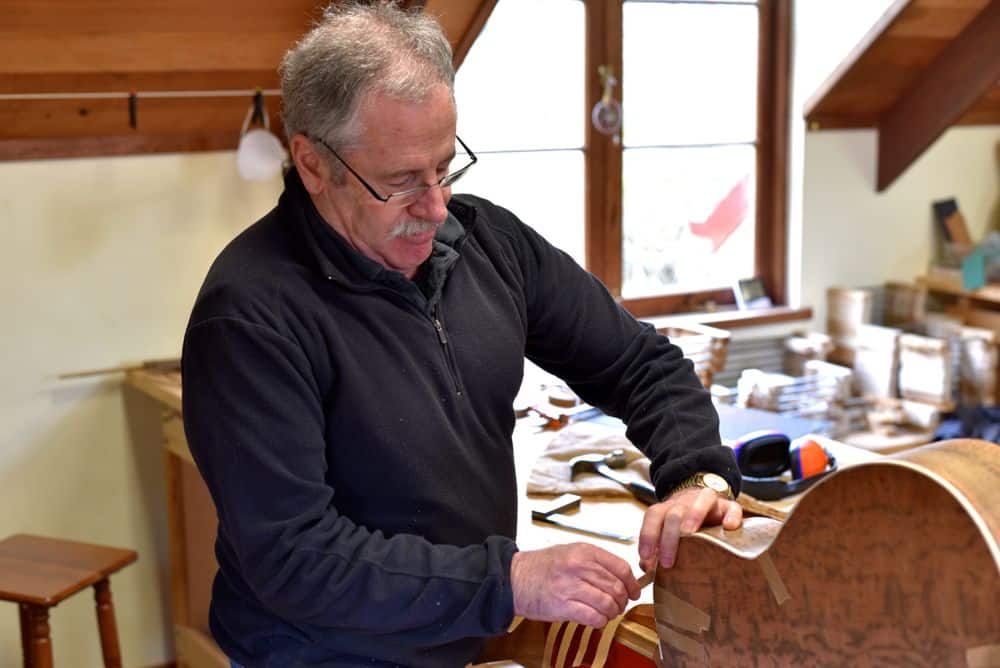
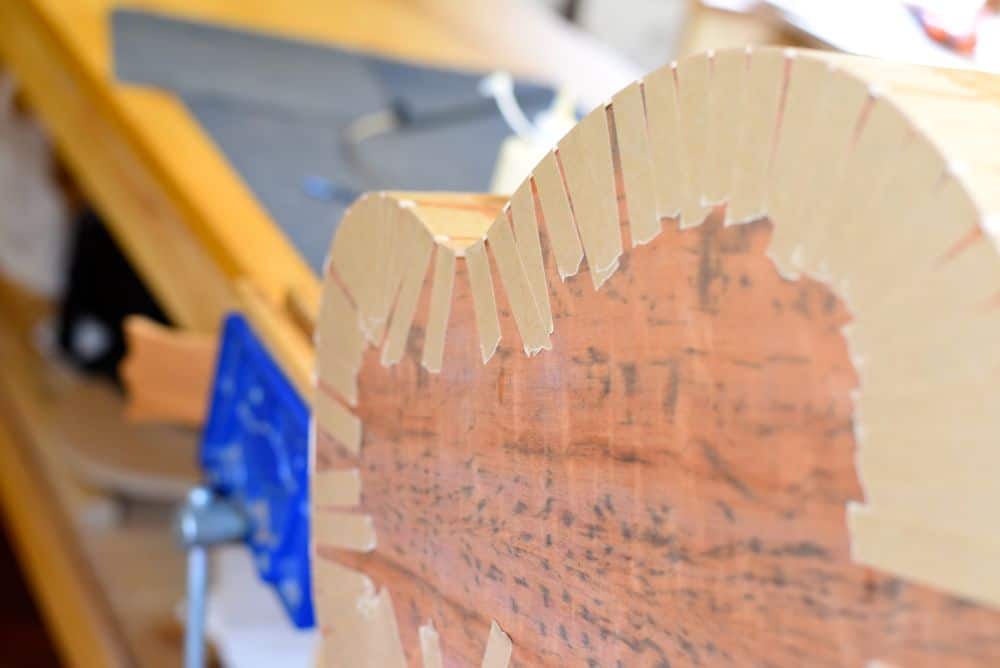
A the end of Day 13, the binding was on and the guitar was covered in tape, Which held the binding in place.
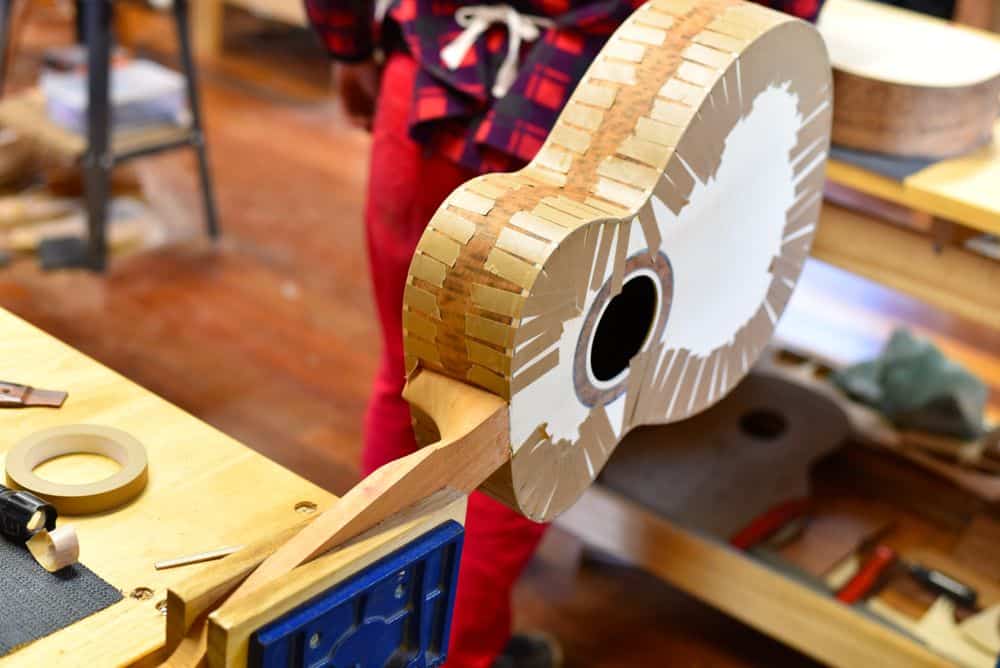
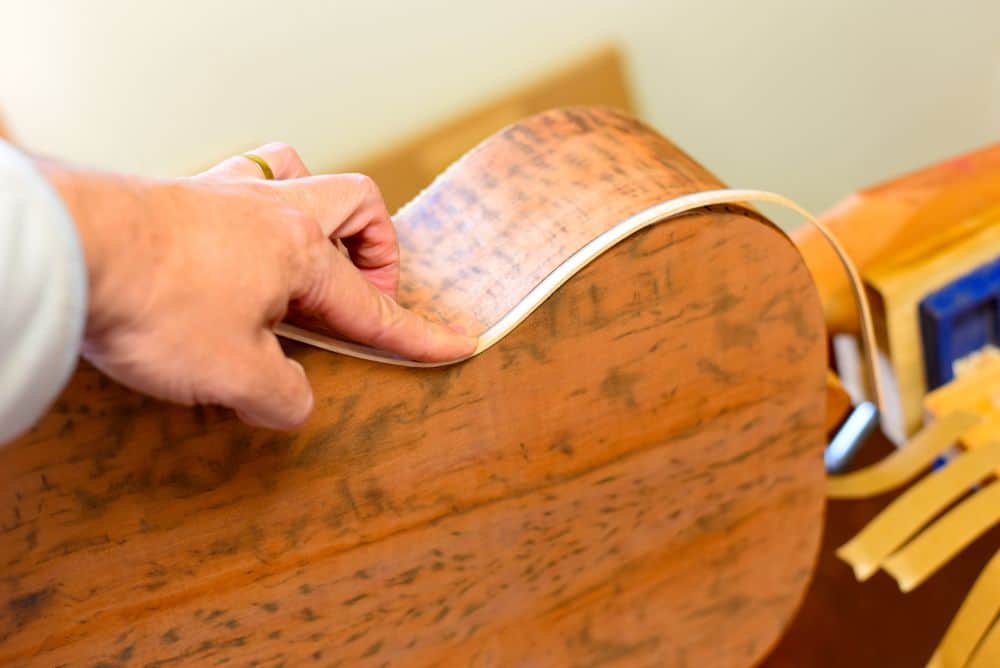
The first job today was to remove this tape but as always, there’s a special way to do that. The tape is quite sticky and the spruce is quite weak, so you have to make sure you pull off the tape with the grain rather than against it. Best to do it slowly, too.

Scraping

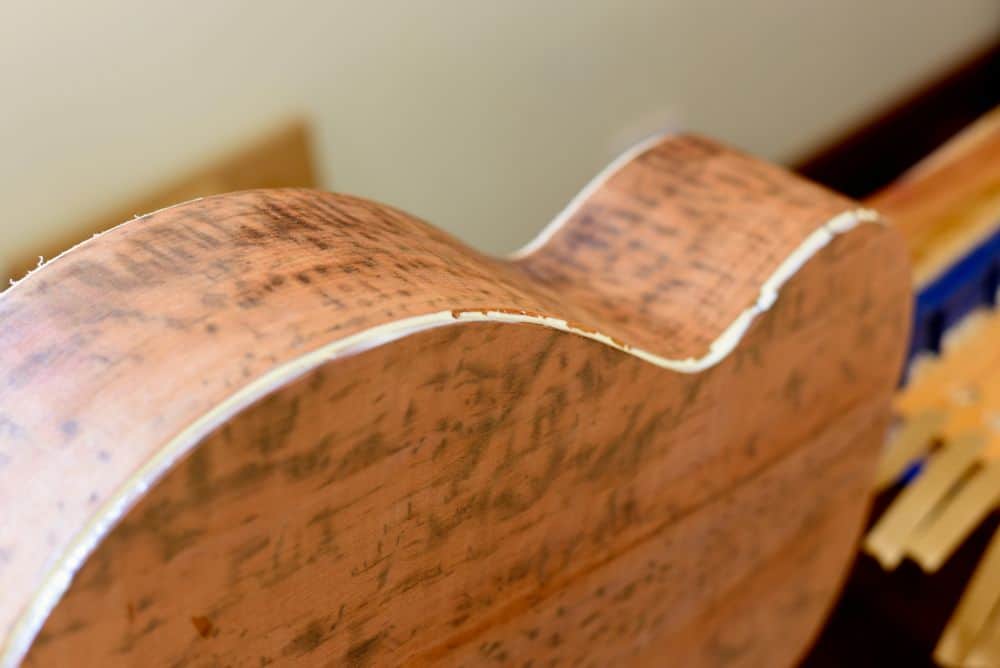
The binding sits a little proud of the front and the back edges of the guitar so in various spare moments throughout the day (waiting to be assigned a job, or waiting for some assistance), there was some scraping to be done.

Scraping involves a piece of metal with a sharp, burred edge. You scrape the metal along the bit of binding that’s poking out from the face of the instrument – whether it be the top or the back that you’re working on – and scrape off some of the excess height. Think of it as a faster, more targeted but slightly riskier form of sanding.

The technique in action…..

In the following photos you’ll see some edges, before and after being scraped. The raised edges are before scraping, of course. It’s a time consuming and laborious process, but it’s still faster than sanding on it’s own (I’ll do plenty of that tomorrow).

The Fingerboard

The next job was to prepare the fingerboard, or fretboard.

The dimensions of the fingerboard are quite specific and my first fingerboard task today involved trimming and planing the edges. The fingerboard is 46mm wide at the nut (the end furthest away from the body of the guitar) and 58mm wide at the 12th fret (where the neck joins the body). Dimensions were drawn on to my rectangular piece of timber and cut accordingly.

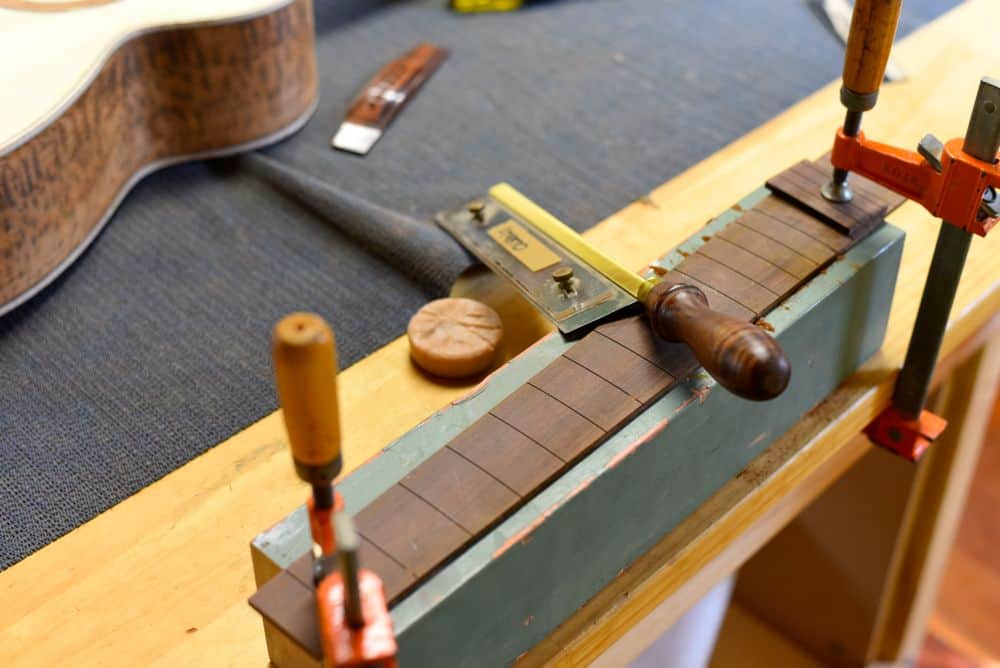
Next it was time to make the first cuts for the frets. We used a specially designed jig for this task. The saw has a bar on the top that runs against the bearings on the jig, meaning that you can only saw so deep. It keeps you sawing in a straight line, too.

The next task is to apply a radius to the fingerboard. I’m building a steel-string guitar so having a slight curve in the fingerboard makes it much more comfortable to play, especially when playing bar chords, etc.

The radius is made using sandpaper and a sanding block with a special profile. You sand from side to side for a very, very long time. Care has to be take to ensure you keep things even, with the same amount of timber taken off each side.

Inserting The Truss Rod

The truss rod sits in the neck of the guitar. It comprises two thin steel rods, threaded into a small block at each end. The rods twist against each other when under pressure, helping to maintain the strength of the neck. The rod can be tightened using a hex key via a hole inside the guitar.

Installing the truss rod involved routing a trench in the neck for the truss rod to sit in. The trench is routed to a precise depth so that the top of the truss rod sits flush with the top surface of the neck. The truss rod is not attached directly to anything. It just sits in this trench and does its thing. The fingerboard is glued over this trench later on.

Final Cuts For The Fingerboard

The first cuts were made into the fingerboard before it was profiled. Now that the radius has been applied, the cuts aren’t as deep as they were at first. Therefore, you have to cut again using another saw with a special guard on it. Some wax is applied to the blade before each cut. It’s important to get a uniform depth of cut along the whole fingerboard and you can check the depth of each cut by look at the side of the fingerboard.
A Final Flourish

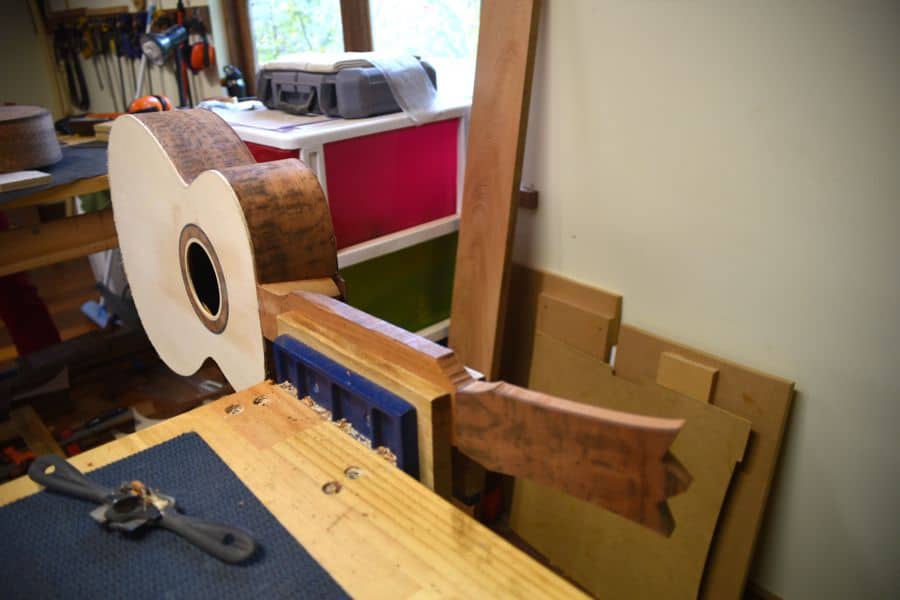
Before gluing the fingerboard on to the neck, you need to decide how you want the fingerboard to end. Some people have a straight end, or a slightly rounded end. Some people curve the end to mimic the diameter of the sound hole.

I took my inspiration from this guitar and went for an extra fret on the high strings:
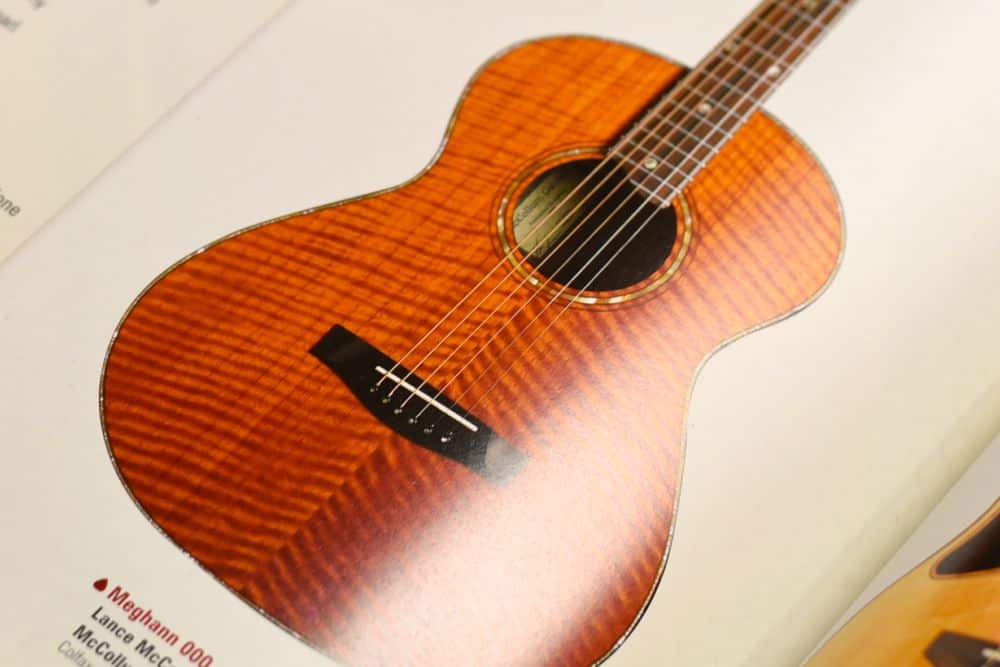
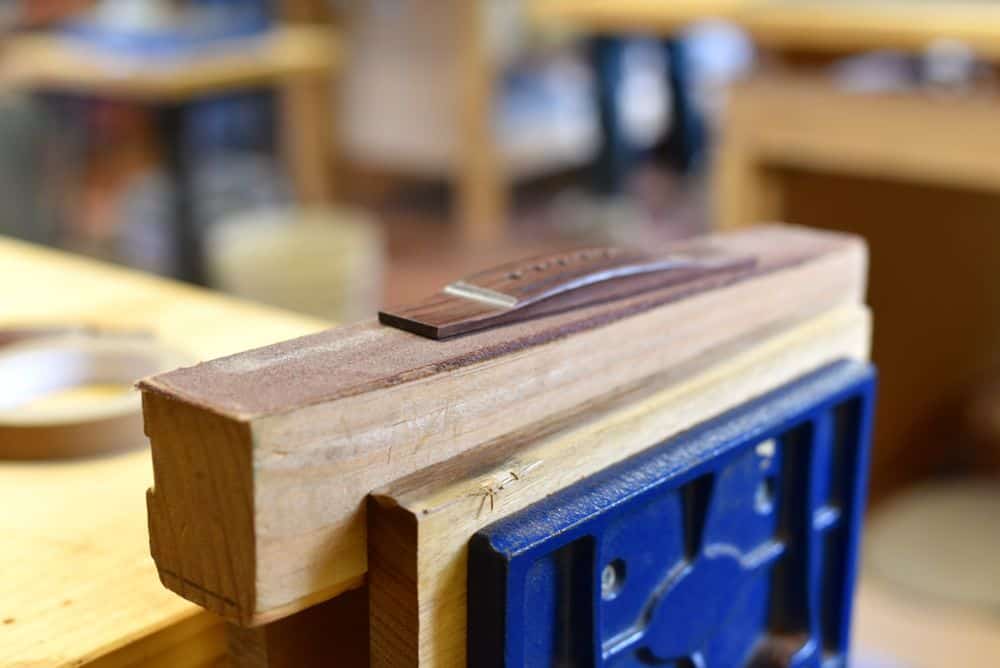
The cut is made on a bandsaw but you’ve got to have a reliable pattern to cut to. Thankfully, the bridge I’m using had a perfect edge to use as a stencil. A quick cut on the bandsaw and some sandpaper and it’s looking fantastic!

Given that my guitar isn’t a cutaway, it’s highly unlikely that this extra fret will ever be used. But it looks cool 🙂

Gluing The Fingerboard And Bridge

The bridge – which is where the string ends after the sound hole – is one of the few bits of the guitar that we’re not making from scratch. Apparently it’s a very technical process and we just don’t have that much time. Consequently, we’re using a pre-formed bridge.

In preparation for gluing the bridge, you have to apply a very slight curve to the bottom. This is done via a very slightly curved sanding jig. After that, you have to get all the oils out of the surface you’ll be be gluing by rubbing the bottom of the bridge piece with acetone for a long, long, long time.
There’s a whole lot of measurement that goes on before the fingerboard and bridge are glued on. The string length is 644mm from the nut to the bridge, plus 2mm allowance for string variation. Things are measured, checked and measured again….
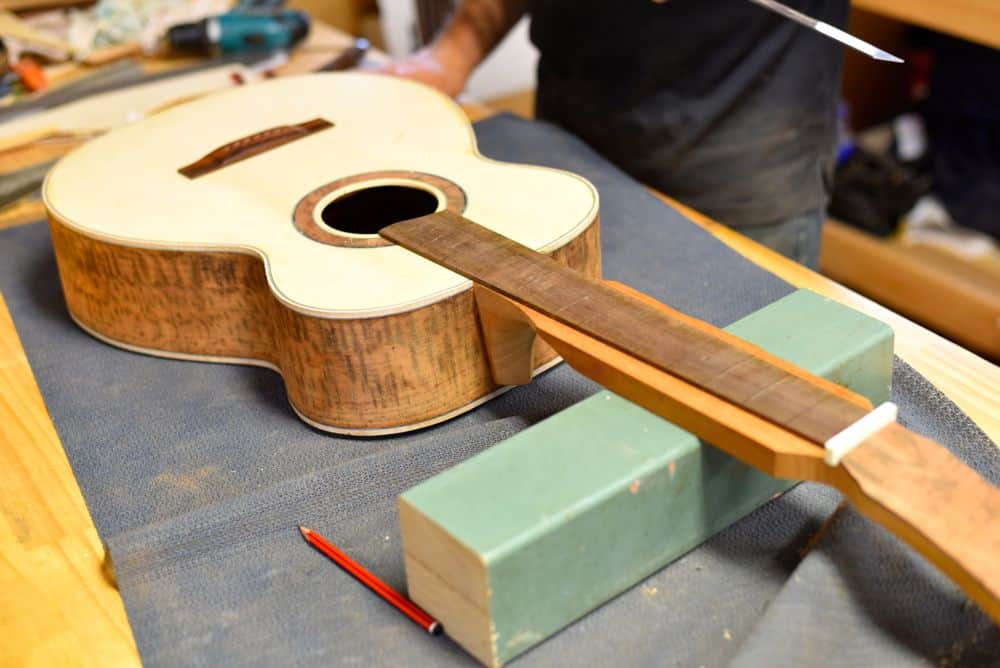
Once all the measurements are confirmed, the glue is applied to the back of the bridge and the fingerboard, and some mighty big clamping takes place.

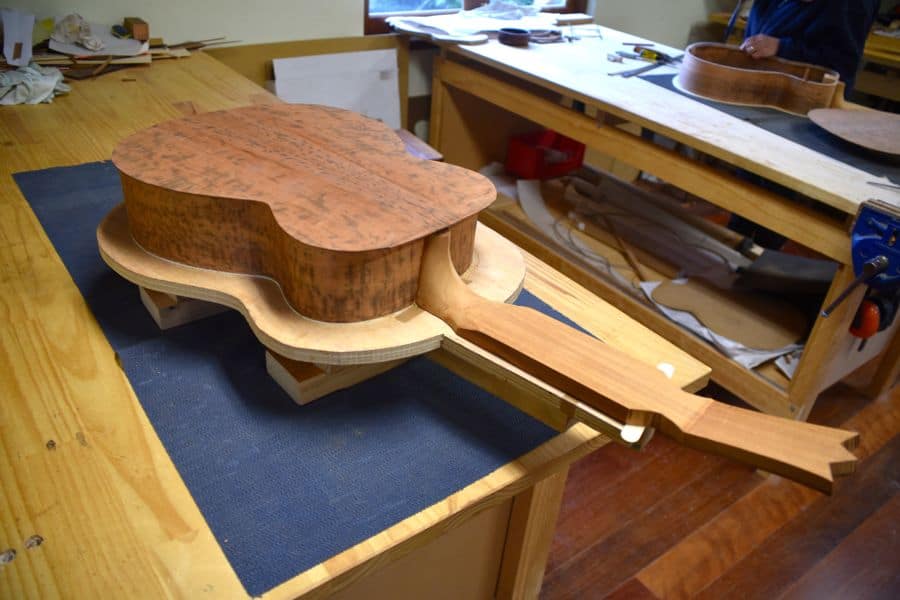
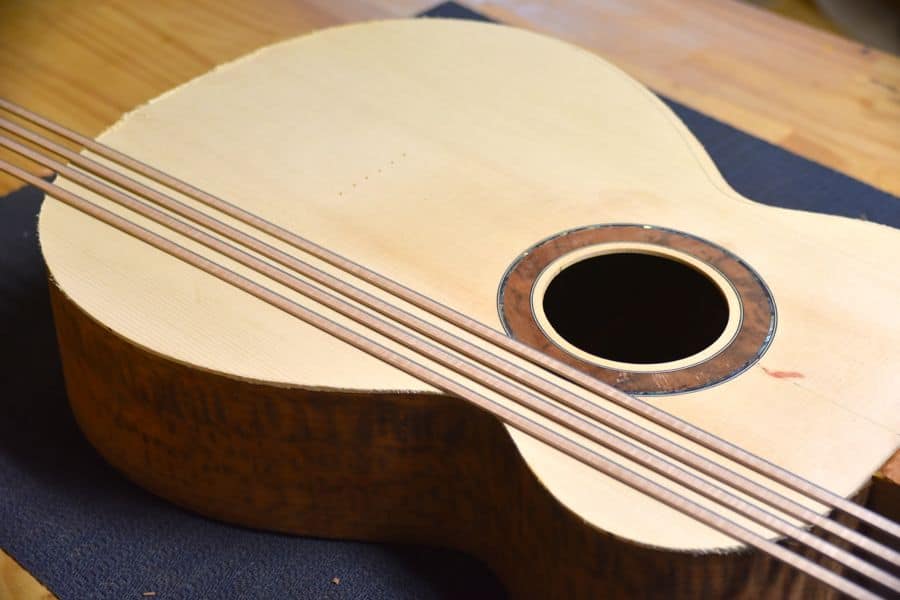
This is how things looked when I left the workshop tonight.

——

Tomorrow’s work will include either some or all of the following:

  • Insert the fretwire,
  • Finish scraping the front and the sides,
  • Sand all surfaces,
  • Drill holes for the machine heads (tuners),
  • Install machine heads,
  • Glue in the nut (made of bone),
  • Trim and then shape the neck,
  • Apply some sort of protective coating.

I think that’ll take more than a day……

Thanks for reading!

Remember, you can see all the posts related to my guitar build here, or using the “Guitar” button on the menu at the top of every page of this site.
Build Your Own Guitar – Day 13

This is the entry for Day 13 of a 3-week intensive guitar building course I’m taking through the Australian Guitar Making School.

Click to view the entry for days 10, 11 and 12.

Click to view Day 9’s entry.

Click here to view Day 8’s entry.

Click here to view Day 7’s entry.

Click here to view all of Week #1.

——

At the end of day 12, the guitar was sitting ready to receive its binding.

Binding is the thin strip of timber that forms the border between the sides of the car and the top and bottom surfaces. It looks pretty, but it also plays a role in the structural integrity of the instrument so it’s important to get it right.

Before I got to glue in the binding, though, there are a few other detail jobs that had to be done.

First I had to chisel out a triangle of timber at the tail of the guitar. I’m going to insert some patterned timber here in a few days from now (when I finally nail down the pattern!).

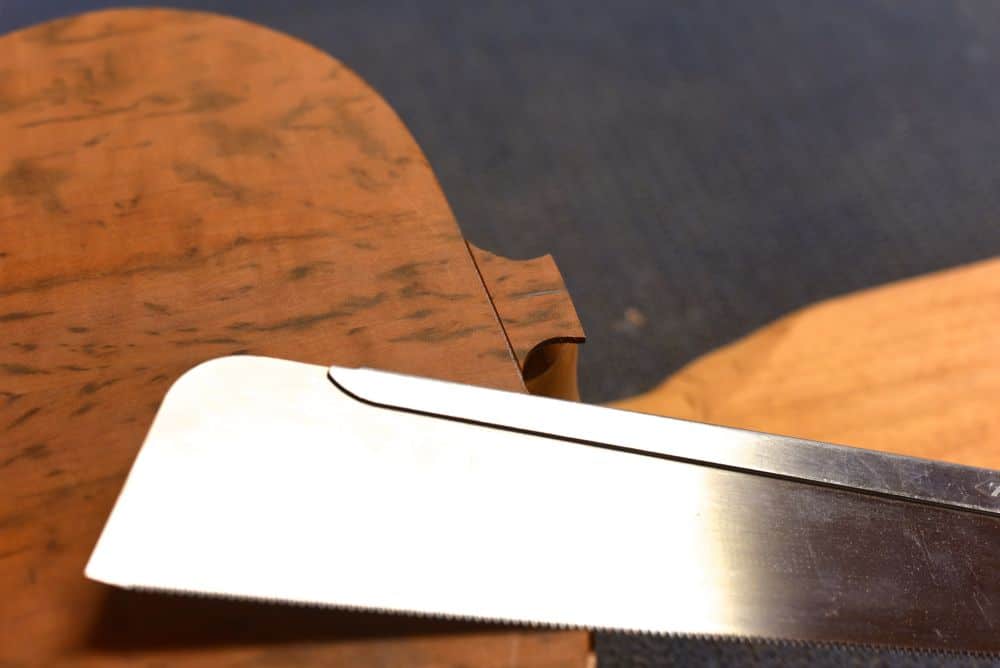
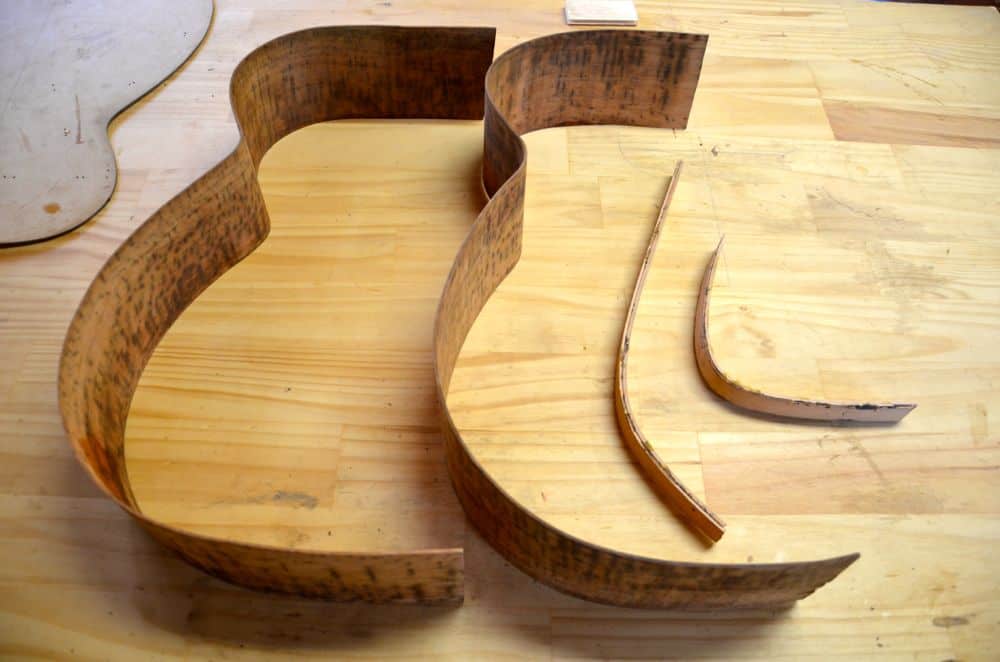
I also had to remove a leftover piece of timber on the back of the guitar, near the heel. This piece couldn’t be cleared with the router because of the heel behind it, so I had to cut it out manually with a Japanese saw and then clean up the timber in the binding channel behind it, with a chisel.

The next job in preparation for the binding is to clear a channel where the neck joins the top of the guitar, at the front. This is a precision job as the channel has to be just big enough to fit the binding and a strip of black/white/black.

Strato did a demo on one guitar and we were then let loose to do it ourselves. The job involves making progressively deep cuts in the spruce using is a scalpel, then some meticulous chisel work with a tool that’s specially customised for the job…

With those jobs done, it’s time to glue the binding into the channel routed around the edges of the guitar.

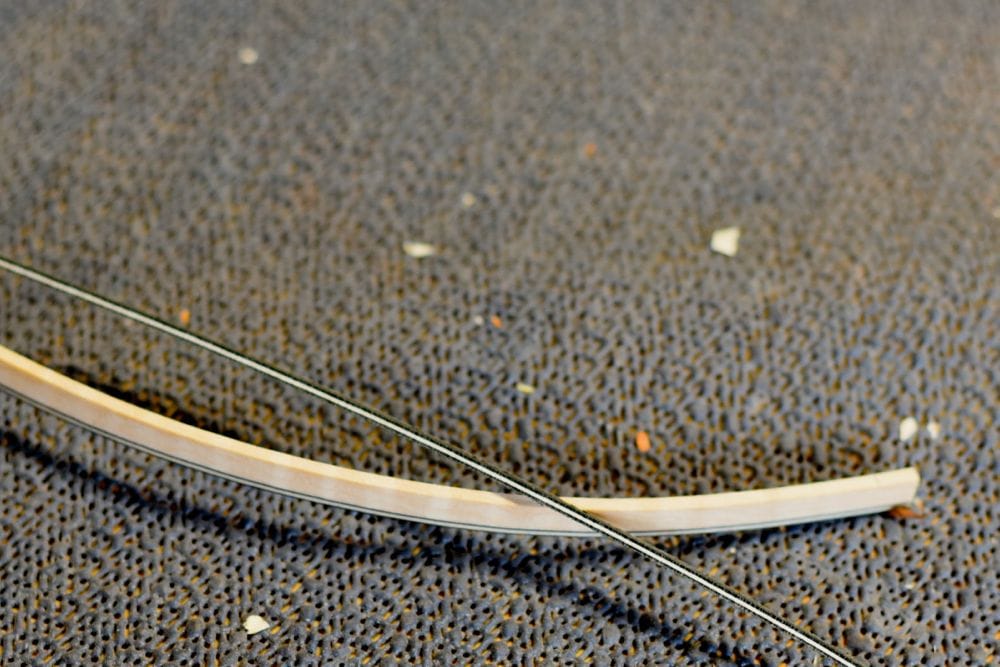
My binding is made from maple. It’s a thin strip of timber around 5mm wide by 2mm thick and it has a strip of black/white/black trim on one side to provide a nice visual effect. The light color of the maple’s going to look great as a divider between the darker tiger myrtle used on the back and sides of the guitar. The maple will blend with the light colored spruce top, so we use another strip of black/white/black to form a border around the top.

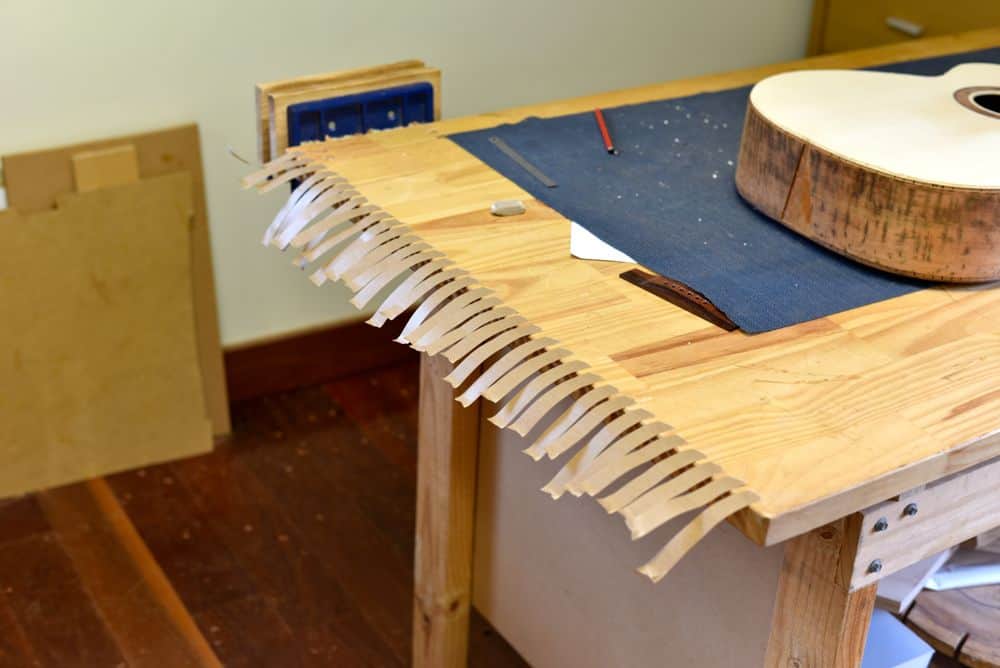
First, we need a lot of 4-inch pieces of tape…..

When I say we needed a lot of these, I mean we needed a LOT of them.

There are 4 bindings to be glued to the guitar (left/right for both front and back). The tape you see above will do about 1.5 bindings.

The rear bindings come first. The rear is simpler than the front on my guitar so it makes for good practice. With the binding measured and trimmed to size, you smear a whole lot of glue into the binding channel.

When it’s all glued up, it’s time to apply the binding and tape it down as quick as you can.

This is a pressure job. In fact, it was the most stressful job we’ve done in the last few weeks. The binding has to be positioned in exactly the right place. It has to be pressed in to the channel as hard as possible and then taped down tight. Really tight. You have to clean off excess glue as you go and all of this is being done on the clock because you have to get the binding jammed in and taped down before the glue begins to set.

Graeme from our class shows the technique…..

And here’s my guitar with the bindings on the back glued and taped in place:

Next we turn to the front of the guitar. Because the top (i.e. the front) is made from spruce, it has some ‘hairy’ bits leftover from the router. It doesn’t respond to routing as cleanly as the tiger myrtle, probably because it has a more open grain (my guess).

Those hairy bits have to be sanded down so that they don’t plug up the channel for the binding and the extra strip of black/white/black.

This is the binding and the strip of black/white/black that will be applied to the front. They both get glued in at the same time and as you can see, they’re quite thin and delicate. It’s a messy, awkward job that works much better with two people than one.

Sorry, but the process was too rushed for an action photo, but here’s the finished product. We’ll remove the tape tomorrow morning. Hopefully the close-up shots of the front will give you an idea of how the extra black/white/black forms the border and separates the spruce top from the maple binding.

That’s basically where we left things for today.

You can see from the first photo below how the binding currently sits a bit proud from the spruce top. Tomorrow we’ll remove the tape from the binding and file the excess down with a metal scraper to form a nice, clean edge along the front of the guitar.

Then we start on the fingerboard, which I measured and prepared for cutting just before going home. If we get time we might attach the bridge, too. It’s going to be another big day!

Thanks for reading.

Lancia Fulvia Update – Assessing the Rust

With the whole guitar thing going on, there hasn’t been much time to play with the Lancia Fulvia but we got a little time today. It was Classics By The Beach in the morning, followed by a little Fiat X19 time with Geoff and a friend who came over to give us the benefit of his experience with the car – thanks Ant!

After lunch, Geoff and I decided to get working on the Fulvia. I was keen to get a look under its skin to see the real extent of what we’ve got to fix and as expected, there’s plenty to do.

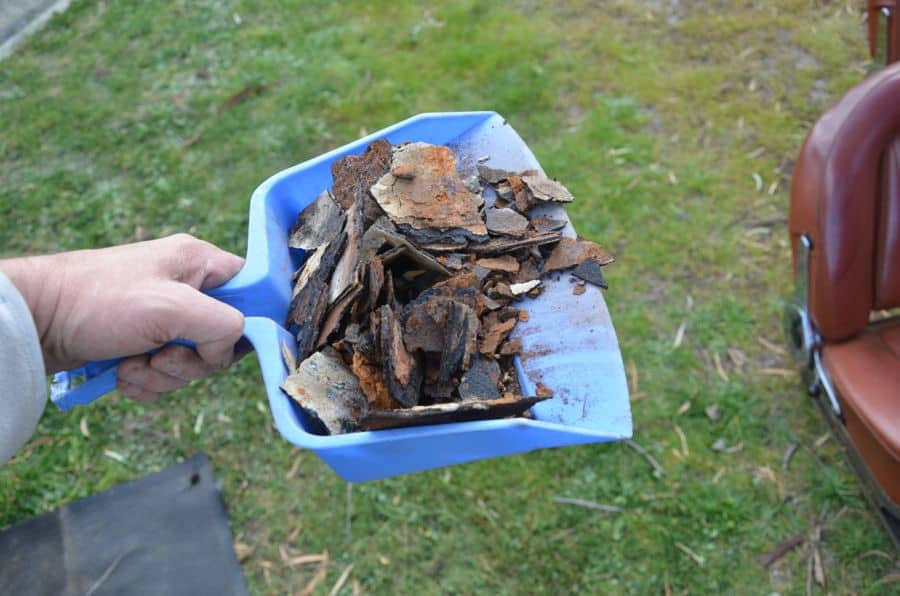
Basically, what we did today was strip out the easy bits of the interior. The seats came out, the seat belts, and then the rubber matting on the floor. The rubber matting had a fibrous underlay underneath and that was a combination of easy and hard to remove. It was easy to remove where the floor was rusted, but harder to remove where the floor was solid. It was mostly easy to remove 🙁

Bottom line: there’s plenty of rust in the floor of the car. The rust has gone right through to become small holes in some places. The rust continues on into the front footwells, too, which was a little further along than I thought would be.

Deep down, I expected this. But an inspection of the floor from underneath had me holding out some remote hope that things wouldn’t be too bad.

The good news is that the box-type framing that surrounds the floor sections seems to be pretty good. I’m still living in hope that the subframe that supports the engine is OK.

New, replacement floor sections are readily available from a various suppliers, as are the inner and outer sills. You just have to buy them and get them shipped, which is a reasonable amount of money. Now that I know how bad it is, I guess I can proceed with that order.

Here are some photos from Sunday’s “Fun With The Lancia Fulvia.”

Build Your Own Guitar – Days 10-12

This is the entry for Day 12 of a 3-week intensive guitar building course I’m taking through the Australian Guitar Making School.

Click to view Day 9’s entry.

Click here to view Day 8’s entry.

Click here to view Day 7’s entry.

Click here to view all of Week #1.

——

It’s been busy around here! I had a late night on Thursday at the workshop, a night at the movies on Friday and Saturday was…… well, it was Saturday.

So where are things at? On Thursday morning the guitar was still in pieces. It looks quite different now.

So let me take you through what happened on days 10, 11 and 12……

Day 10

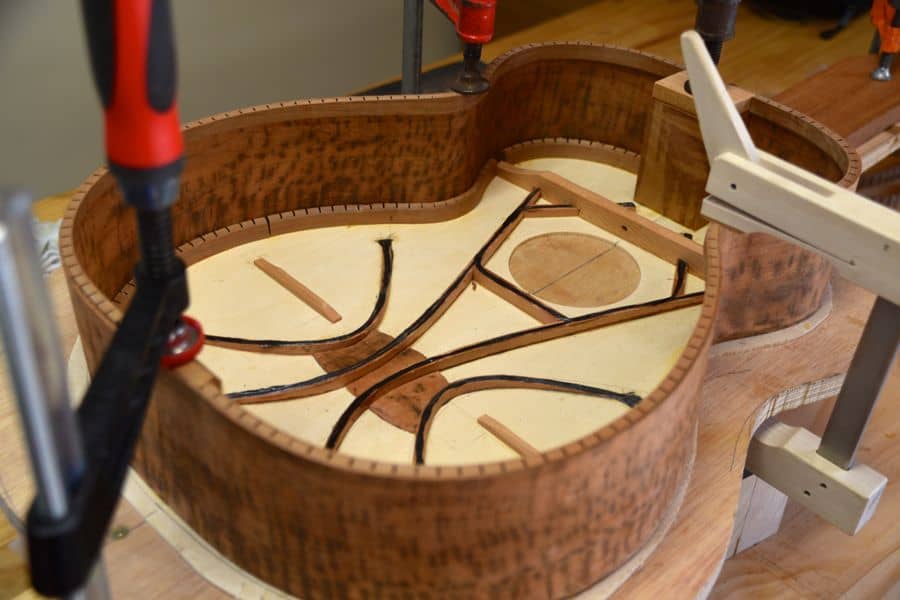
Thursday was the day we ended up attaching the top face of the guitar to the sides. There’s a lot that has to take place before that, though, so what you see here is all in preparation for that moment when the separate parts of the guitar start to become one.

First I had to finish off the falcate bracing that supports the top. As of Wednesday, I had the basics in place with carbon fibre added to the wooden braces:

Today – and much of the time we have left – is very much concerned with getting the detailed bits right.

The first job for Thursday was to make another section to go across the top of the Falcate brace, above the sound hole. This was tougher than it looks, with notches having to be carved into the top brace at odd angles to allow clearance for the existing braces.

We had to add a couple of small braces to the side of the curved falcate braces and clamp them down. They were tapered after the glue set….

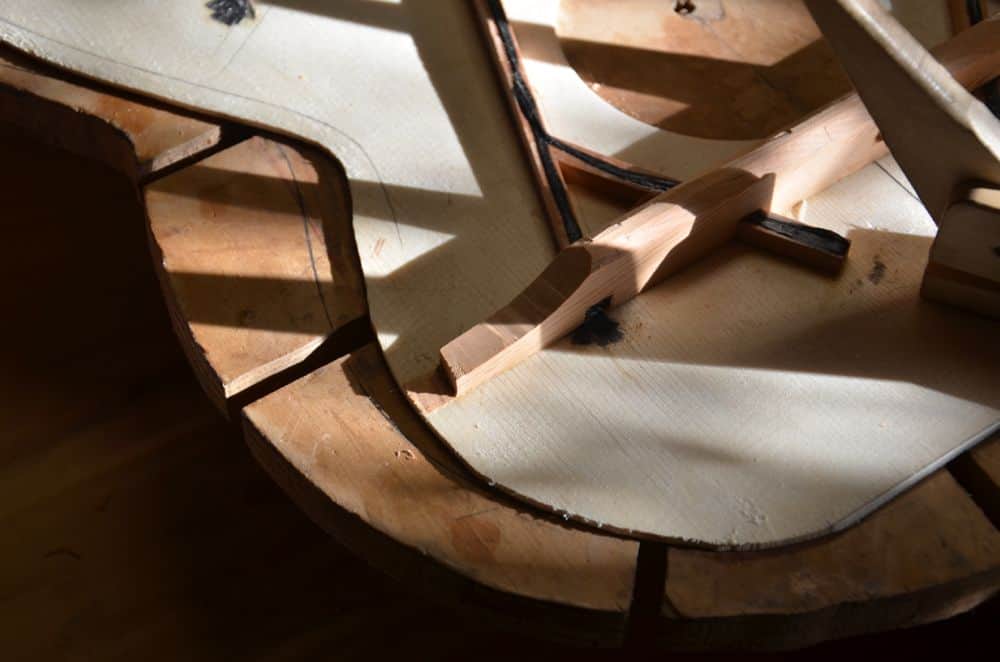
Because the sounds are going to be bouncing around inside the instrument, it’s important to blunt any sharp edges in there. We start with planing down the edges of the block, where the sides meet at the end of the instrument. The top brace on the Falcate brace is also rounded off….

The edges of the top brace are shortened so that they’ll fit within the sides when the top is attached…..

After taking a bunch of measurements and making sure everything’s in the right place, we’re ready to attach the top to the sides of the guitar.

A day earlier I made some kerfing, which is positioned and then glued at the meeting point of the sides and the top. You have to apply glue to the kerfing and then put it in place and push it hard into the joint with this stick before clamping it in place for the glue to set overnight.

The next morning, the glue has set and the top face is now attached to the sides! The instrument is starting to take shape.

——

Day 11

It’s all starting to happen a little quicker now. The front was attached yesterday and all of a sudden there’s a 3D instrument that looks like an actual guitar!

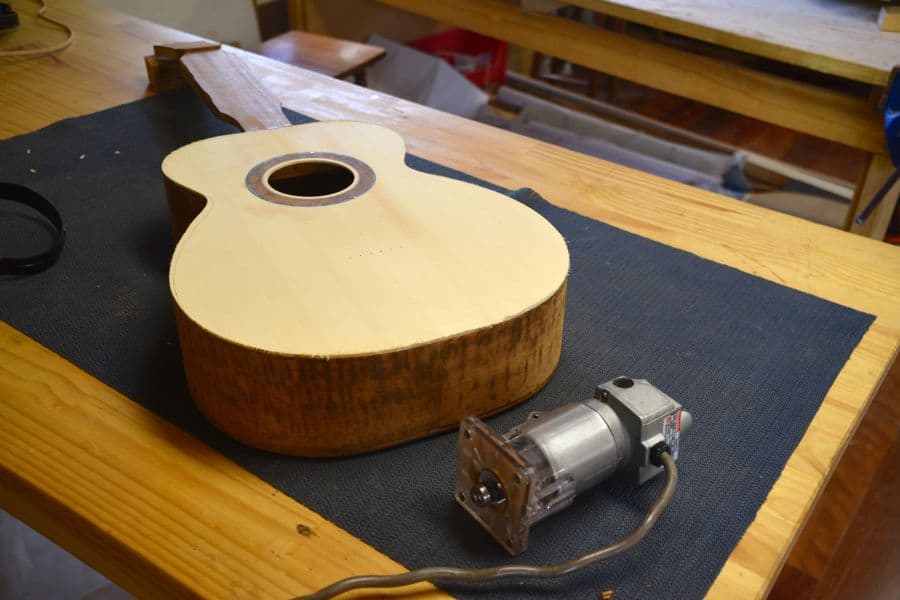
As you can see from the photos, above, the top is made to protrude from the sides when it’s attached, so we use a router to take off the excess…..

The next job is to make preparations for the back to be attached.

The sides and kerfing have to be planed to make sure the surface is smooth. I make some small braces to sit along the sides of the guitar, from top to back. These are glued and clamped in place.

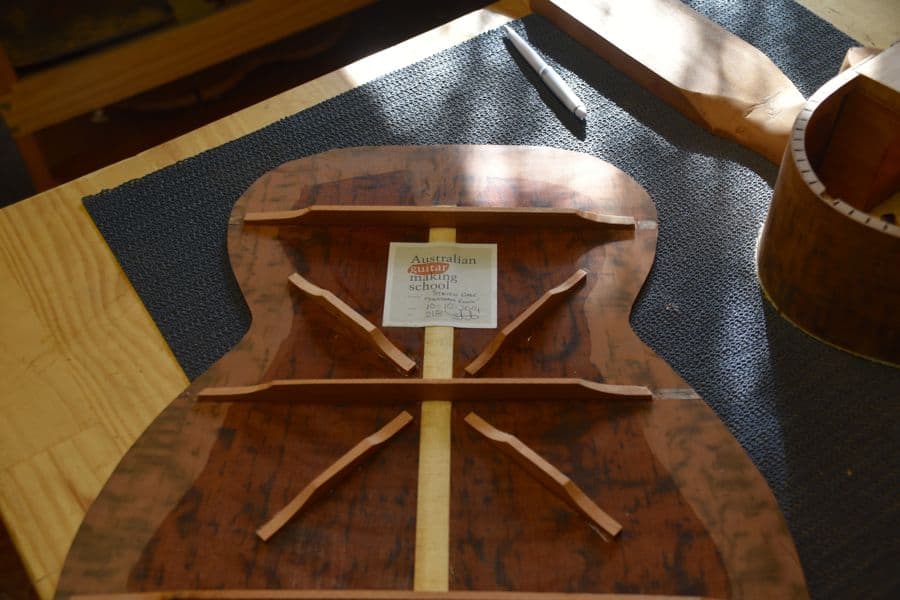
The back of the guitar has bracing similar to the top. Small notches are made in the kerfing to allow the braces to sit in the kerfing, which adds strength when the back is glued on. The braces on the back of the guitar also have to be trimmed so that they sit inside the kerfing.

Next I added a coat of shellac to all the inside surfaces, taking care to ensure that the shellac doesn’t go near the surfaces about to be glued…..

Next came a proud moment – adding the label to the back. I named the guitar, put my name on the label and the date our course will be completed.

I’ve named the guitar Stratovarius Viggen. “Stratovarius” is a twist on the famous violin maker, Anotonio Stradivari and in honour of Strato, our teacher for this course. “Viggen” is my nod to Saab and Sweden, two of the very important influences in my life in the past decade. I have a few more flourishes to come in relation to this, too.

Strato said I should sign the inside of my guitar. I asked him to sign it, too.

His response was “but you’re the one who made it”. To which I replied, “I might have made it, but you’re the one who made it good.”

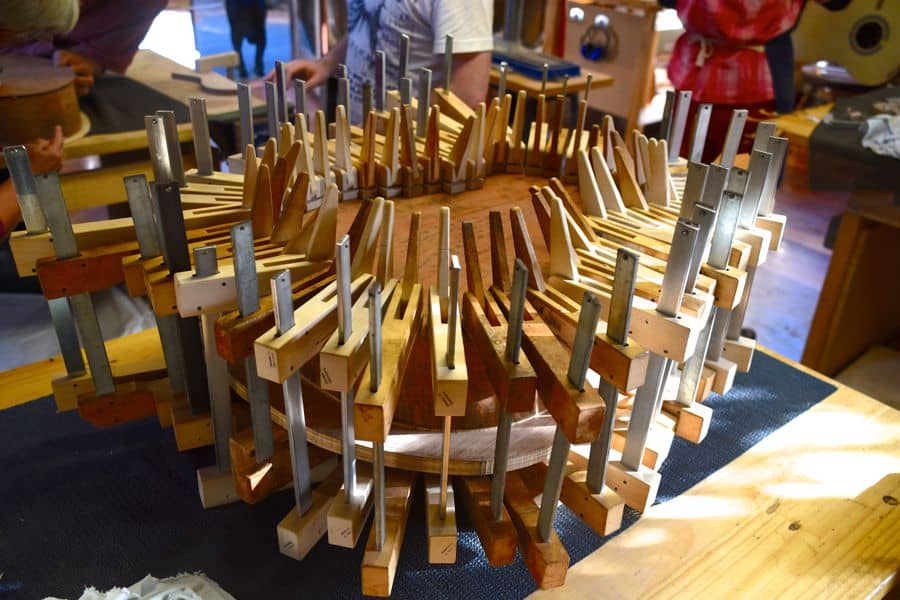
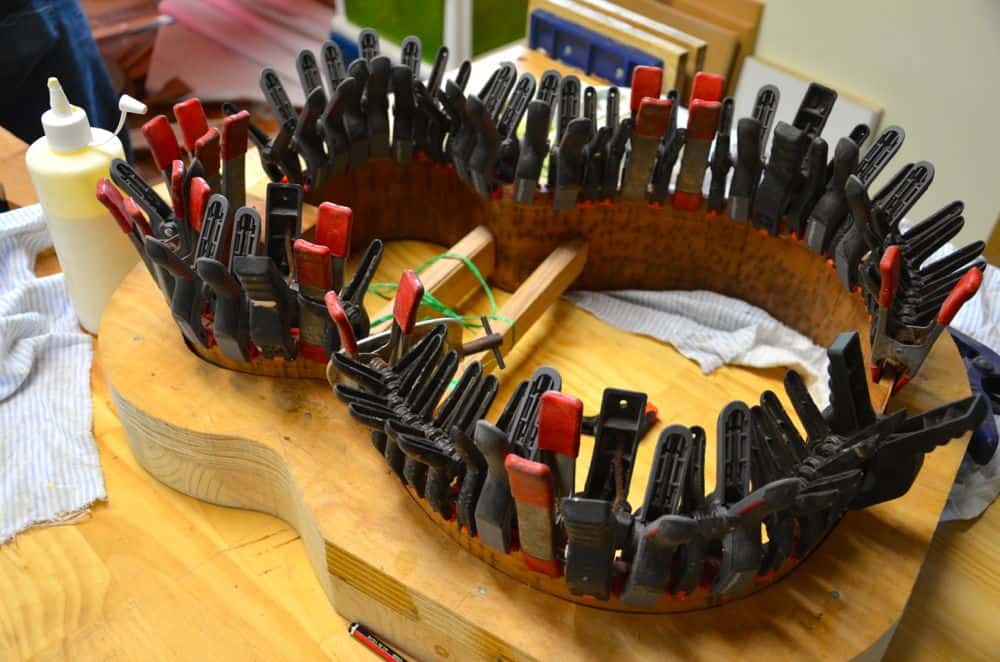
With all of that said and done, it was time to glue the back down. You add glue, and then apply a LOT of clamps……

——

Day 12

Saturday was a short day.

The first job was to apply the router to trim the excess from the back of the guitar. Here’s the excess. I don’t have a photo of the routing, unfortunately (getting slack!)

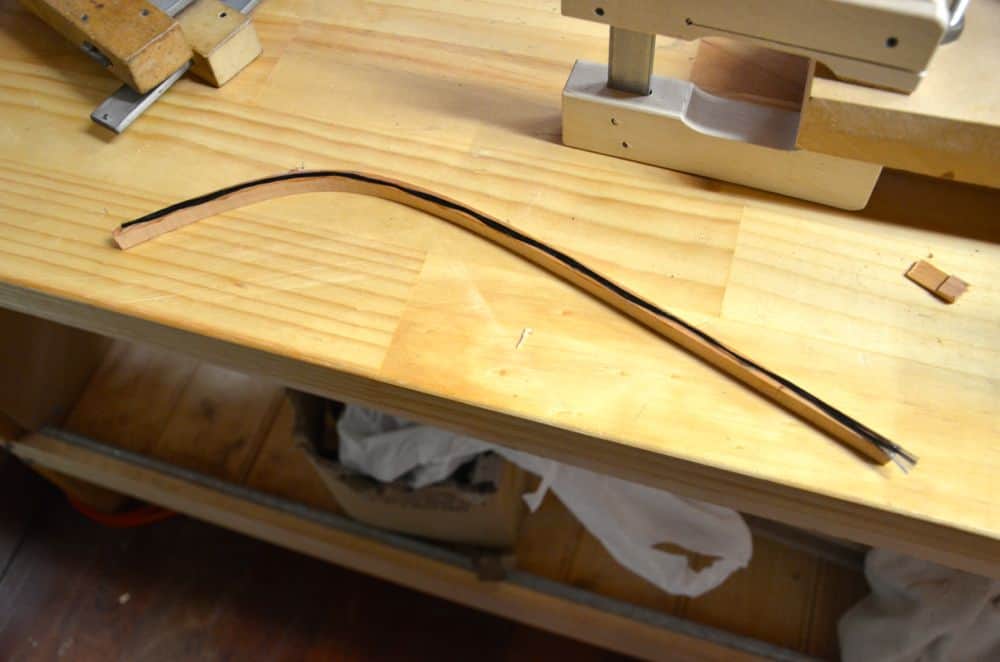
The next job involves applying the ‘binding’ to the edges. The binding is a thin strip of maple that will be glued to the top and bottom of each side of the guitar.

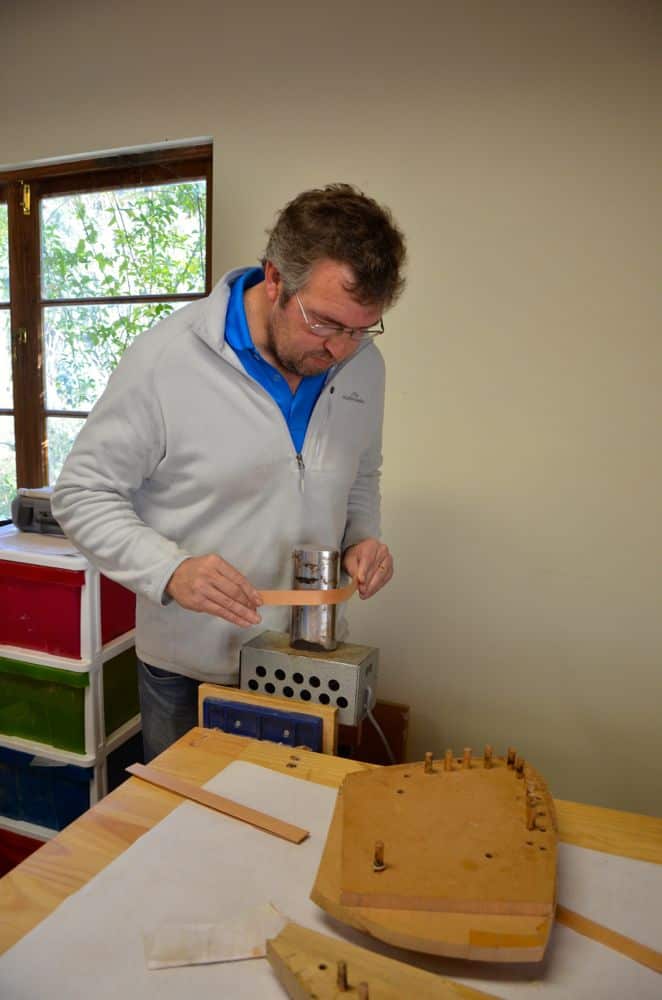
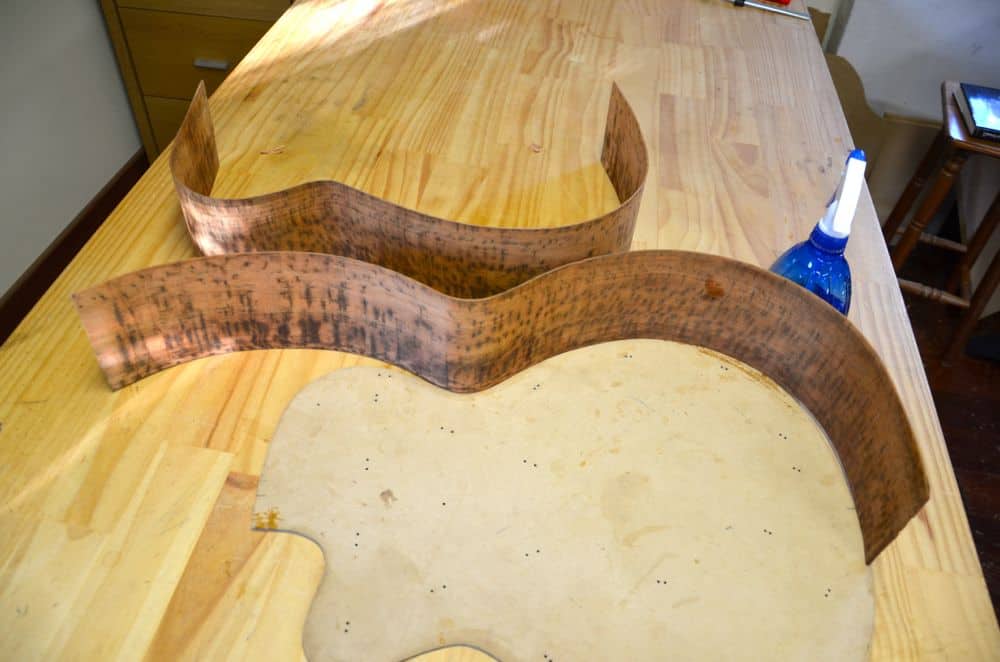
Before you can do that, though, the binding has to be heated and bent to the correct shape. As it’s so thin and small, it needs a delicate touch to avoid breakage (yes, I managed to break one!)

Next we had to use the router again to create a channel for the binding to sit in.

I didn’t get to glue the binding in on Saturday as we ran out of time.

The other job left incomplete on Saturday was some planing and sanding of the head of the guitar, which is intended as another little tribute to Sweden.

——

We still have some big jobs to do, but the margin for error is getting slimmer as all the things we do now are on the outside of instrument. They’re visible, and they will affect the sound. With the finish line clearer, the work has to better, cleaner, and more accurate.

Thanks for reading!

Result! Jim Coggs At The Pan Mass Challenge

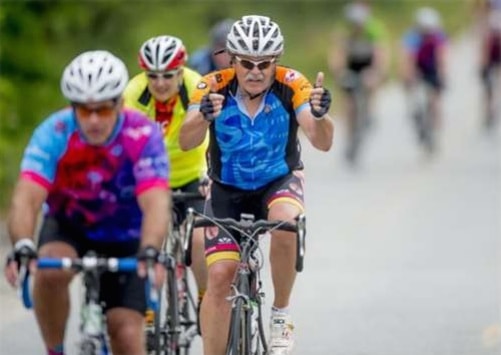
Regular visitors to this website (and Saabs United in the old days) will probably know the name of Jim Coggeshall. Jim is a big Saab fan and a multiple Saab owner.

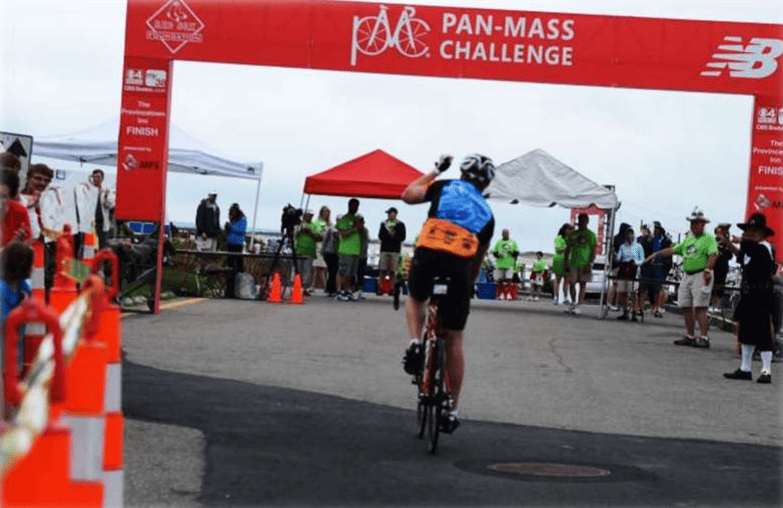
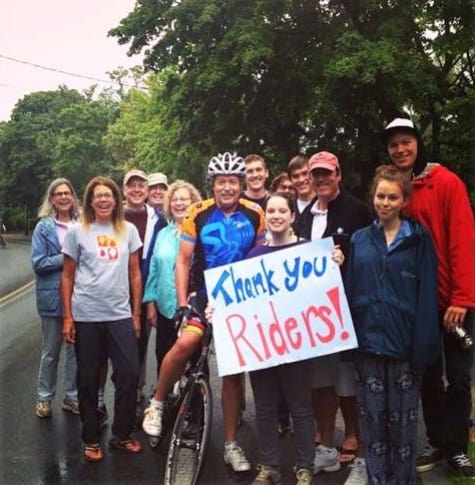
Jim is also a cancer survivor (several times over) and for the last few years I’ve been asking you to support Jim as he rides his bike in the Pan Mass Challenge to raise funds for the Dana-Farber Cancer Institute in Boston.

Well, I want to take my hat off both to Jim for doing the ride, and to you for helping him have his best fundraising year ever. I just received the following from Jim via email:

Dear Swade,

I’d like to take this opportunity to thank you for your overwhelming support in sponsoring my fourth Pan Mass Challenge bicycle ride across Massachusetts. Your generosity enabled me to contribute close to $12,000 to the lifesaving work being done at the Dana-Farber Cancer Institute in Boston. This is the highest total ever and brings my historical tally to over $35,500. In all likelihood the 5,600 cyclists will have been able to far surpass this years $40 million goal.

The Dana-Farber likely saved my life on two occasions. You have enabled them to give others the same lifesaving chance I was given. To that I express my deepest gratitude.

Coggs

I wanted to support Jim because cancer is a disease that touches all of us. It took my Dad’s life nearly 30 years ago and it recently took two great Saab friends – Nic Schellekens and Curvin O’Rielly.

I’m happy every year when Jim sends his Pan Mass Challenge email around because it gives us all an opportunity to think specifically about this terrible disease and the relentless task of not only treating the sick, but also finding a cure. And there’s no better way to think about this than through the prism of a friend who is a survivor, especially if you have friends or family who are not. Treatment IS possible and CAN work.

I’m especially happy this year to know that my friends and I have played some small part in helping another friend and cancer survivor raise funds for an institution playing a vital part in treating cancer patients.

Congratulations on another great ride, Jim. Every year and every ride is a bonus, mate!

And thanks to everyone who contributed in 2014. You really have made a difference.

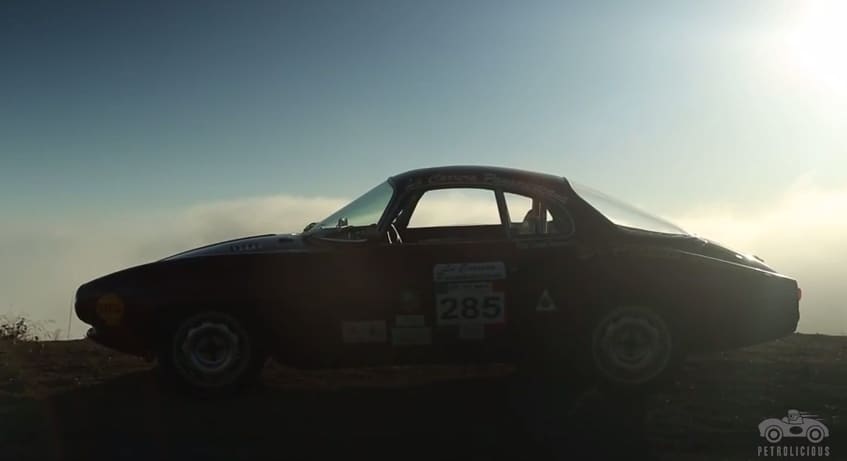
Video: Alfa Romeo Sprint Speciale Shows Everything Alfa Romeo Should Be

This might just be the best video Petrolicious has ever made.

The car is an Alfa Romeo Sprint Speciale from 1965 and it was built especially for the La Carrera Panamericana race through Mexico. There’s plenty of driving footage to see and it’s a wonder to behold. In fact, it’s so wonderful it makes you wish there was no owner’s story to tell. Just give me more driving!!

For me, this video sums up the soul of Alfa Romeo. I hope he calls in the stylists and the engineers and says “This is your brief. Do this for a modern Alfa Romeo”.

That’d be fine by me.

Put it on widescreen and turn the driving footage up loud!

Build Your Own Guitar – Day 9

This is the entry for Day 9 of a 3-week intensive guitar building course I’m taking through the Australian Guitar Making School.

Click here to view Day 8’s entry.

Click here to view Day 7’s entry.

Click here to view all of Week #1.

——

We’re Going To Be On The News!

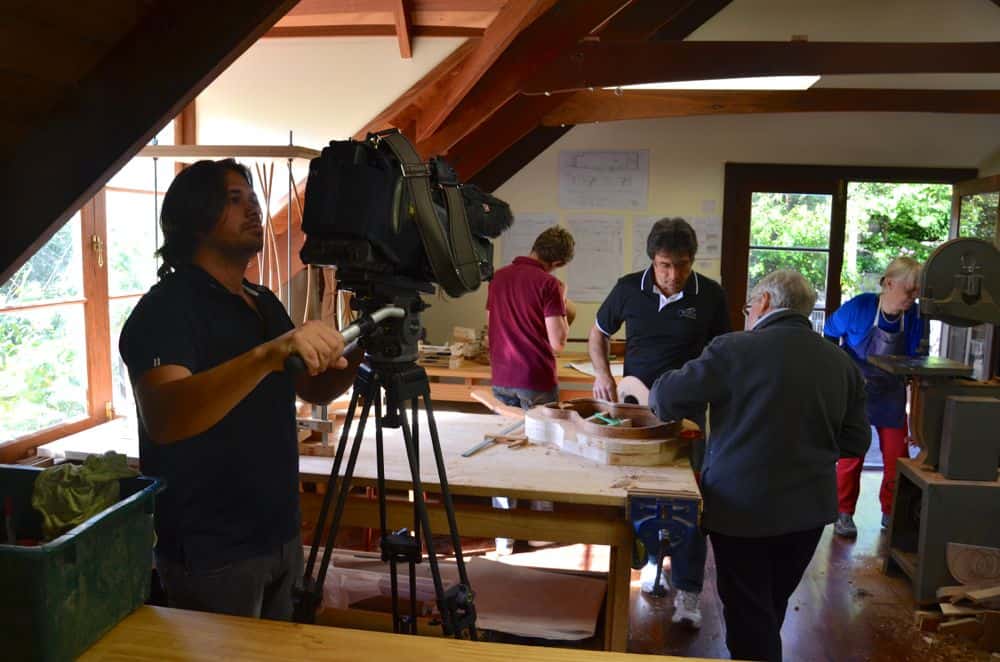
Today we were visited by a reporter and cameraman from WIN News here in Hobart. They are covering our guitar school as a ‘feel good’ feature story on Saturday night’s news bulletin.

Strato was interviewed, as were a few of the participants (no, not me, but maybe I’ll be seen working away in the background).

Our school is held in a workshop at the home of the Lewincamp family. Cary Lewincamp is a prominent professional guitarist living in Hobart. Click that link if you’d like to hear some outstanding seven-string guitar playing from an absolute master.

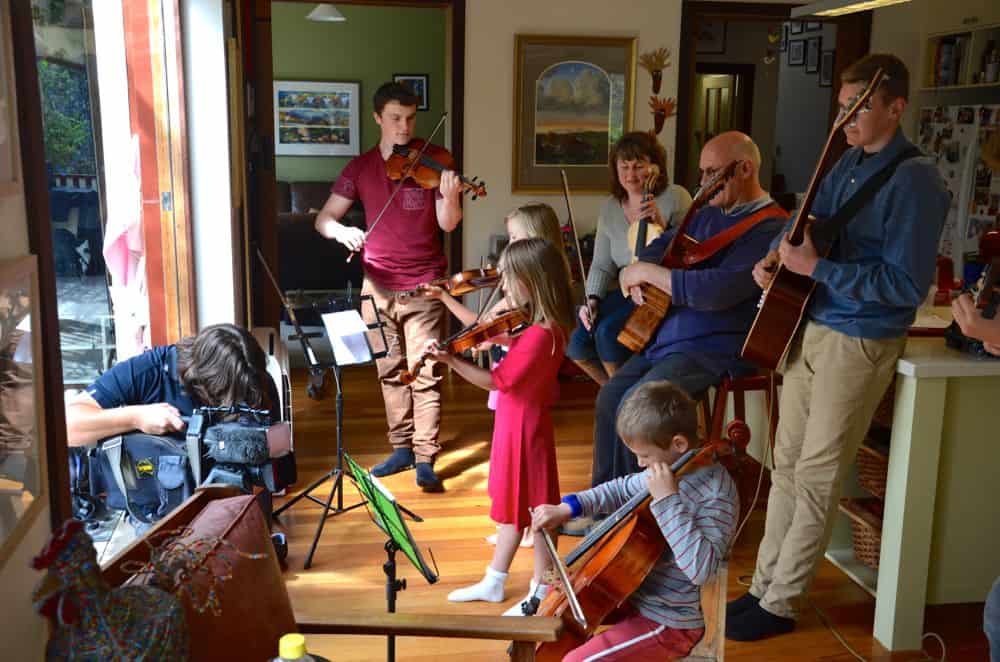
There are six Lewincamp kids still living at home and the whole family got out their instruments for a small performance for the news team, which will feature in the story. The family includes six-year-old triplets, by the way, who have just started to play. Yes, it was a cuteness overload, which was only heightened when Lewis (the family dog) walked through the performance 🙂

The welcoming atmosphere in this loving home is just amazing and we’re very, very lucky to be building our instruments in such a wonderful setting. It’s made the whole experience that much more special.

And speaking of building instruments…..

——

Back To Work!

I started today with “death by 430-odd cuts”.

That’s how many small cuts I had to make in four timber strips to make my own ‘kerfing’. This is a structural support that is glued in to the top and bottom of the sides of the instrument, where the top and back will meet the sides. The cuts are made in order to allow the timber strip to be heat-shaped to conform to the body.

Once the kerfing is shaped to fit the body, it’s glued in place and clamped to allow the glue to set. Once set, the kerfing is planed until it’s level with the sides of the guitar.

Falcate Bracing – continued…

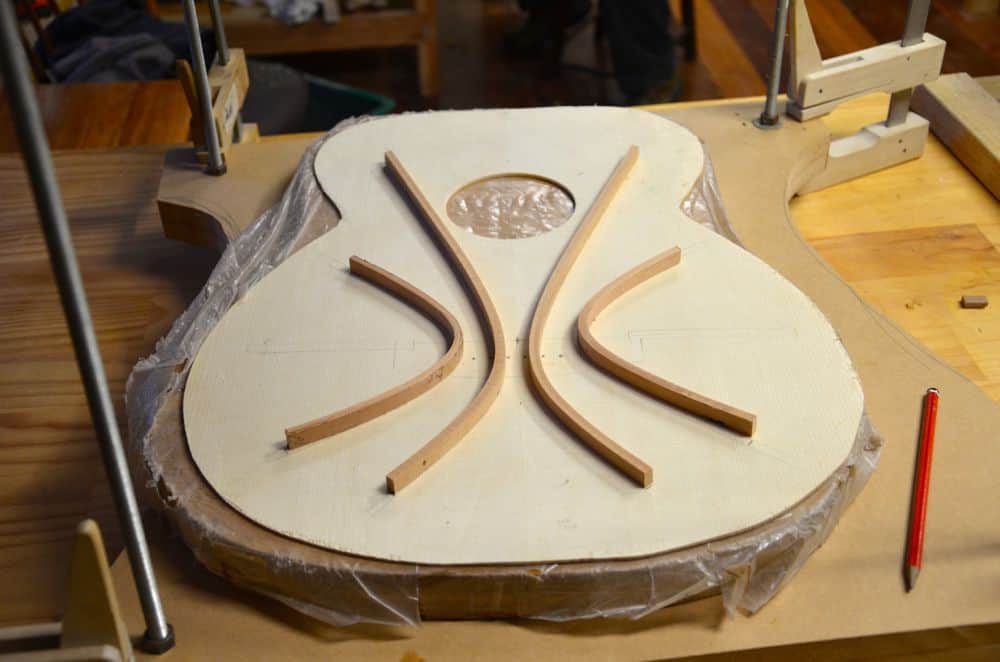
The other job for today was (almost) finishing the falcate bracing system on the top face of the guitar. When I finished yesterday, the four basic braces were in place….

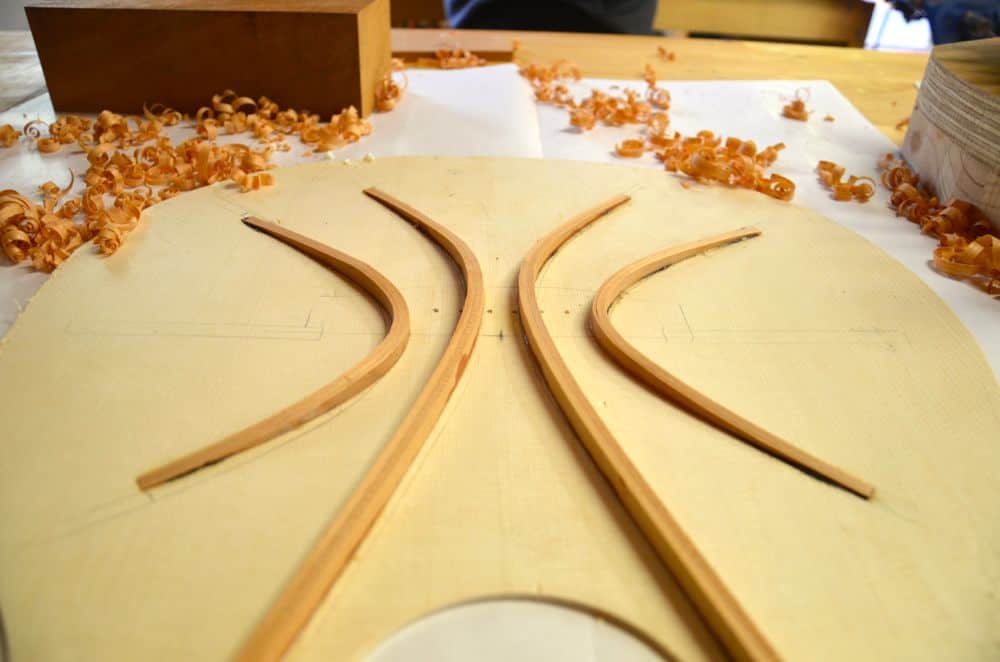
So today I started by tapering these four braces with a block plane. The difference is quite artistic, I think:

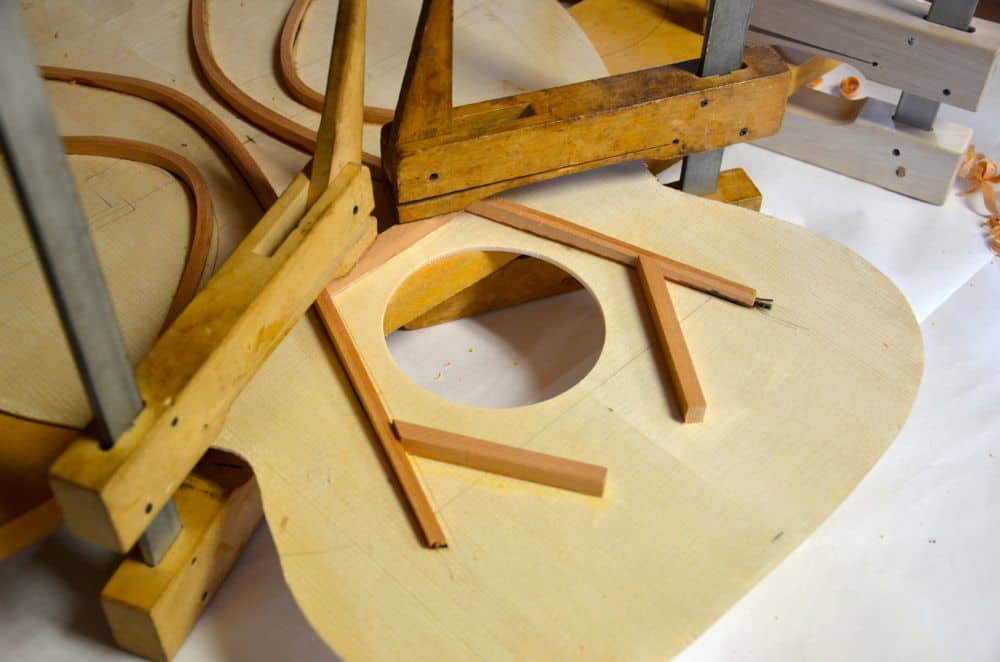
I also made/glued a few smaller braces for the top section:

The braces, which are on the ‘inside’ of the guitar, cross over where the bridge will be on the front of the top face. The bridge is where the playable section of the guitar string ends before the string passes inside the guitar. A lot of stress is placed on the holes that the string passes through, so I had to make some timber reinforcements that sit between the braces. These were made by making templates out of tracing paper and then tracing and cutting the pattern on some scraps of tiger myrtle.

It doesn’t look like much, but it took a while to get right.

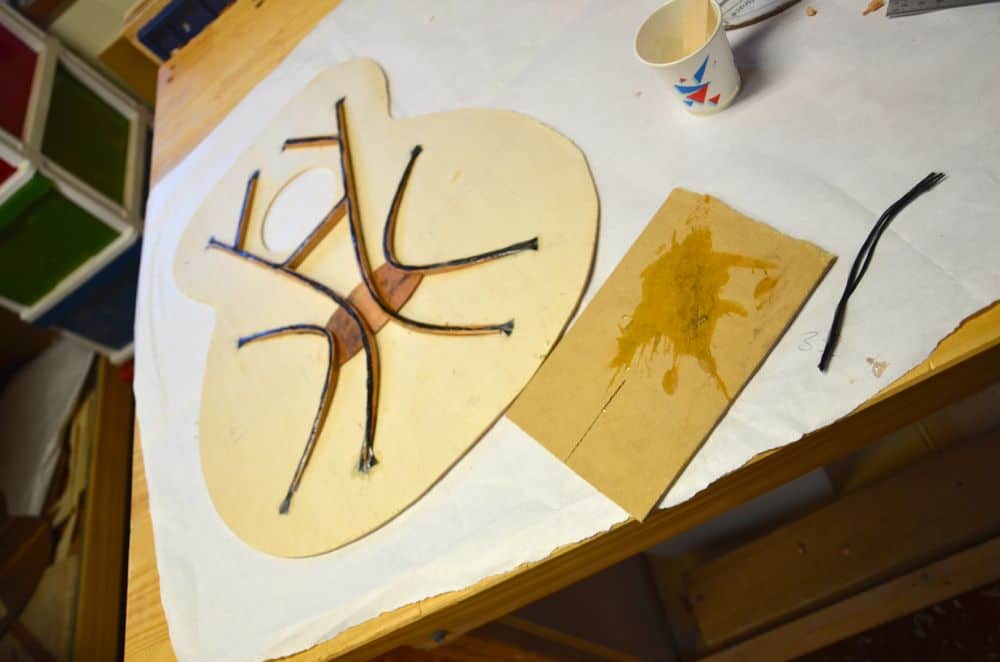
The final bit of fun for the day was adding carbon fibre to the braces. We take strands of carbon fibre, soak them in epoxy resin and lay them out along the braces, fanning them at the ends.

——

Tomorrow I have to glue those string supports in place, make my final components of the falcate brace and then………. (cue dramatic music)………. glue the top to the sides.

This is a scary proposition. All the things we’ve done so far have a certain margin for error or a capacity for my rookie mistakes to be repaired. Big stuff like gluing the top feels like one of those “no turning back” moments, where you only get one chance to do it right.

Thankfully we have Strato there to guide us.

Thanks for visiting!!

Build Your Own Guitar – Day 8

This is the entry for Day 8 of a 3-week intensive guitar building course I’m taking through the Australian Guitar Making School.

Click here to view Day 7’s entry.

Click here to view all of Week #1.

——

Today was a day of little things and big things. We had a bunch of little things to finish off in preparation for a couple of big things. The end result – I now have something that actually resembles a musical instrument instead of an assortment of wooden pieces. Exciting!

I finished up yesterday with one of my sides properly bent and the other 75% of the way there. That got finished up early this morning:

So with the sides done, the neck and head in basic form and the top/bottom in basic form, it’s actually possible to see an instrument taking shape!

There were a few things to do before we could start putting things together, however.

The sides are clamped into this mould, which helps to keep their shape while you get around to a few other jobs.

It would help at this point to explain one of the end goals for the day – to attach the sides of the guitar to the neck of the guitar. Before that happens, a little work has to be done to both the sides and to the neck.

While the sides are clamped into the mould, above, I got to work on preparing the neck. The top face of the guitar will sit on a block at the end of the neck so the first job was to chisel a step in the block so that the top face of the guitar would sit flush with the mahogany of neck (which, you should note, is yet to get its Gidgee top). Taking a step out of the block enables the top face to sit level. First you chisel, then you plane. Eventually you’ll take out a section of timber equivalent in height to the thickness of the top face panel.

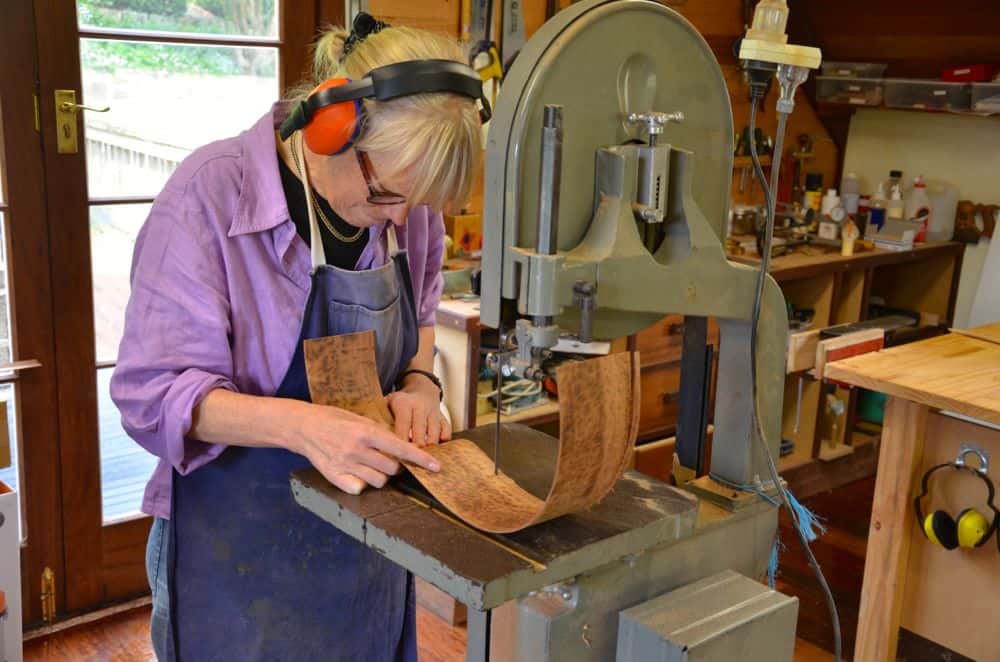
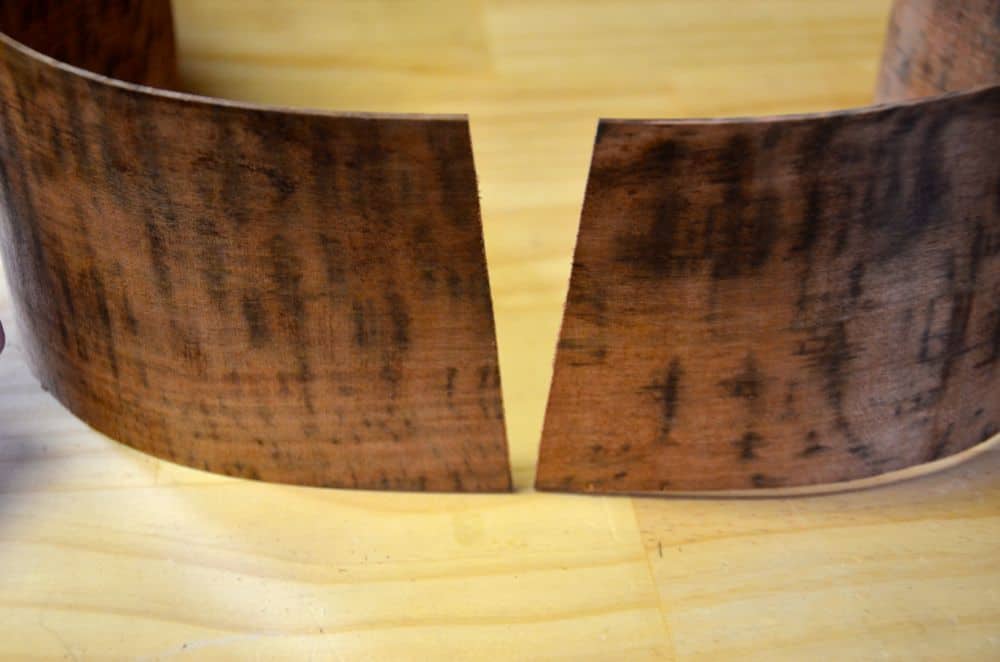
Next you have to taper the sides after removing them from the mould. A guitar body is generally fatter at one end than the other, so it requires a little bit of trimming – or ‘tapering’ – on the bandsaw.

This is a nerve-wracking process to say the least. When using a bandsaw, the optimum method involves the piece you’re cutting being placed flat on the base plate. With guitar sides, however, that’s not always possible and the potential for cracking when the wood has no direct support underneath (i.e. when cutting the waist) is real and ever-present.

Thankfully, no sides died in the making of this class’ guitars.

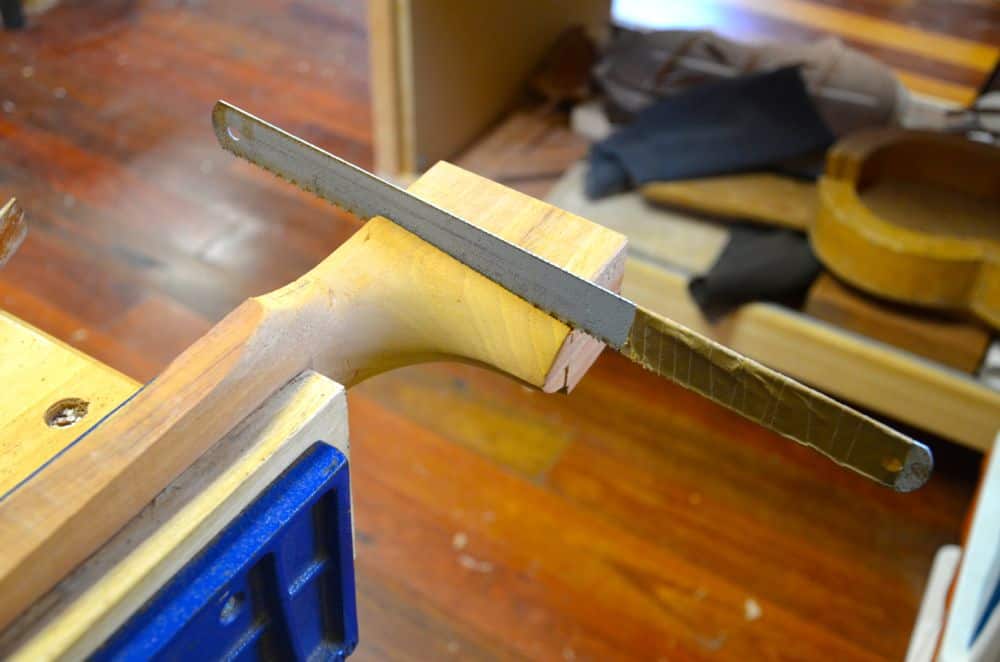
The sides fit into a slot at the base of the neck, just behind the block that I chiselled earlier. We made the first cuts for this slot last week but today those cuts had to be widened so that they would accept the sides, which are around 2mm thick. This is done with what can best be described as a fat hack saw blade with a masking tape handle. Simple, but effective 🙂

Those cuts are made on an angle so next you have to take some timber off the end of the sides to match the angle.

Next, a test fitting to make sure the sides slot in OK. This was actually a pretty thrilling moment because you’re joining two things you’ve been working on for days and things are beginning to take shape in a physical way.

After the test fitting, it’s time to do it for real. Glue is pressed into the grooves and the sides are pressed in, then clamped. I also made an end block that sits at the bottom of the instrument and this was glued in at the same time. The extra bits of wood and the plane are just providing some extra weight to keep everything flat against the table while the glue sets.

Yesterday I formed some braces to be used on the top face of the guitar. The other little/big job for today was to finish those braces then attach them to the panel with some glue and carbon fibre.

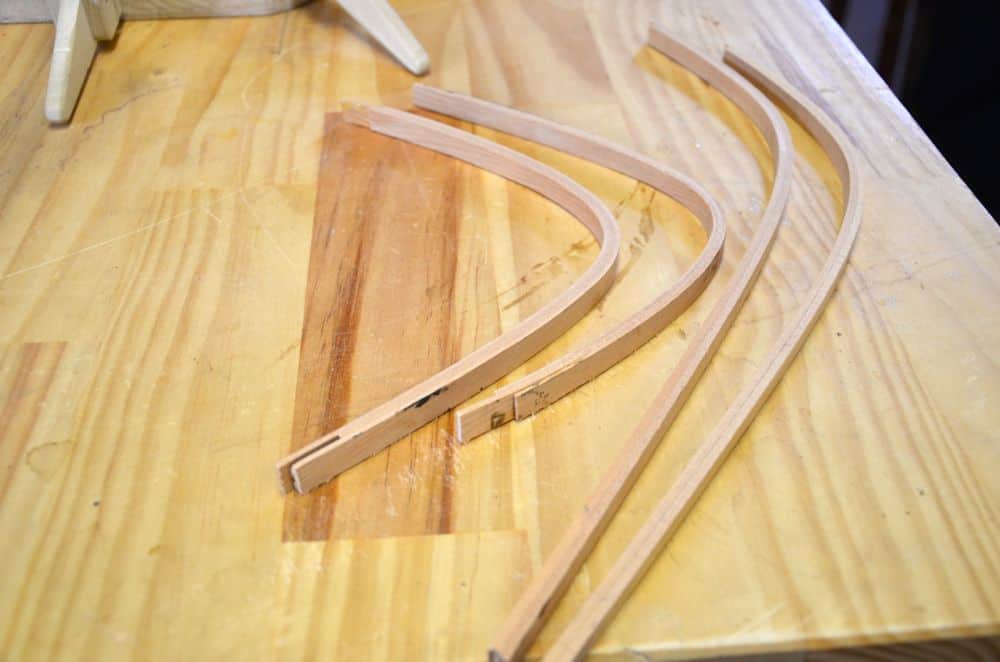
Here are the raw formed braces after removing them from the mould…..

We need four braces, however, so these are cut along their length with the bandsaw to provide extra braces of a matching shape. Edges are smoothed using a plane.

Those of you familiar with guitar bracing might find these to be of an odd shape. Traditional guitar bracing uses variations on what is called an X-pattern. At right is an example of this, as used by Martin guitars, for instance.

We are using a relatively new form of guitar bracing called the Falcate bracing system, which was developed by a couple of Australians a few years ago and is now favourably reviewed and accepted right around the world.

I’ll let the bloke who co-invented it describe the system:

I designed my Falcate bracing system to escape the limitations of more conventional bracing practices. The system is configured to withstand the high twisting forces exerted by the strings over the saddle onto the guitar’s top (tending to rotate the saddle downwards and towards the sound hole) whilst still allowing the top great scope for vibration. There are two major benefits: the stiffness distribution makes for a more even sound across all notes (i.e. there is no “designed in” bias towards a particular frequency response) and there is increased monopole mobility (responsiveness and volume) without compromising longevity, because the strength and stiffness (and consequentially the mass) is where is it needed and not elsewhere, making for an efficient design.

So that’s what we’re doing. Got it? Good.

With my falcate braces cut and planed, it’s time to glue them to the top face. First, here’s what the basic system will look like when it’s laid out. There are more braces to come after this, but these four curved braces are the basics of the Falcate system:

To glue them on, we used an epoxy resin with a length of carbon fibre applied to the resin before laying it on the rear side of the top face…..

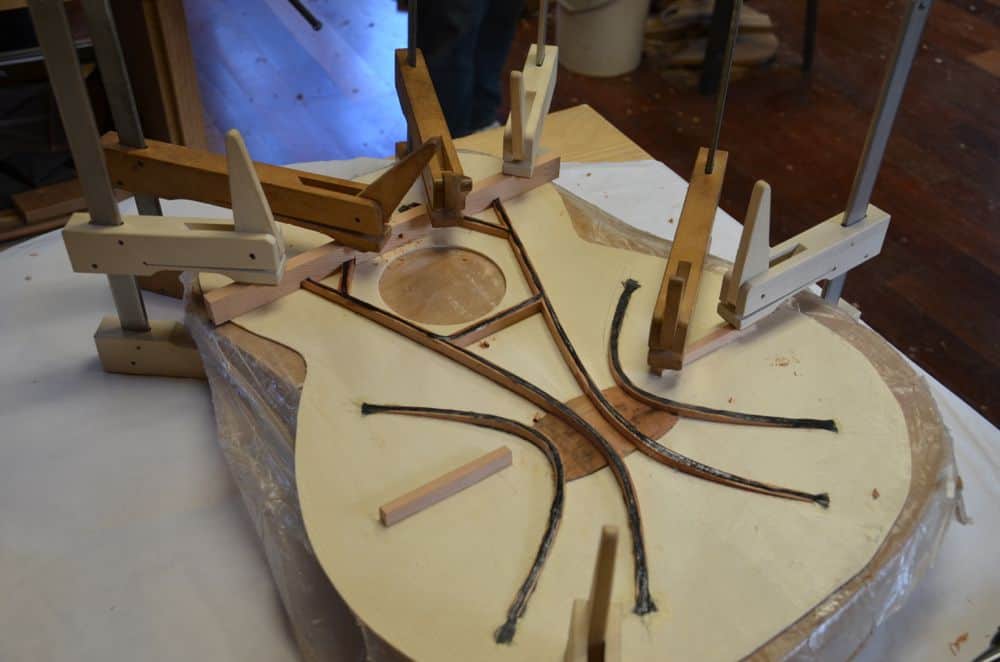
When all four braces are glued to the timber, it’s time to apply a bit of pressure to ensure they stay in place. This is done with a rig using a combination of traditional clamps as well as these tensioned rods, which apply pressure to specific points.

And that was it for me, for today. It was a long day but a lot was achieved.

Tomorrow we’ll pull this rig apart and continue the job of putting all these parts together.

If you want to build your own guitar – take the plunge. It gets better and more rewarding every day.

Thanks for visiting!

Build Your Own Guitar – Day 7

Click here to read the review of Build Your Own Guitar – Week 1.

Given that we’re covering quite a lot each day, I’m going to try and update this diary on a daily basis. The information is fresher that way and it means less photo handling at the end of the week.

Monday was all about two things – bracing and shaping.

Bracing

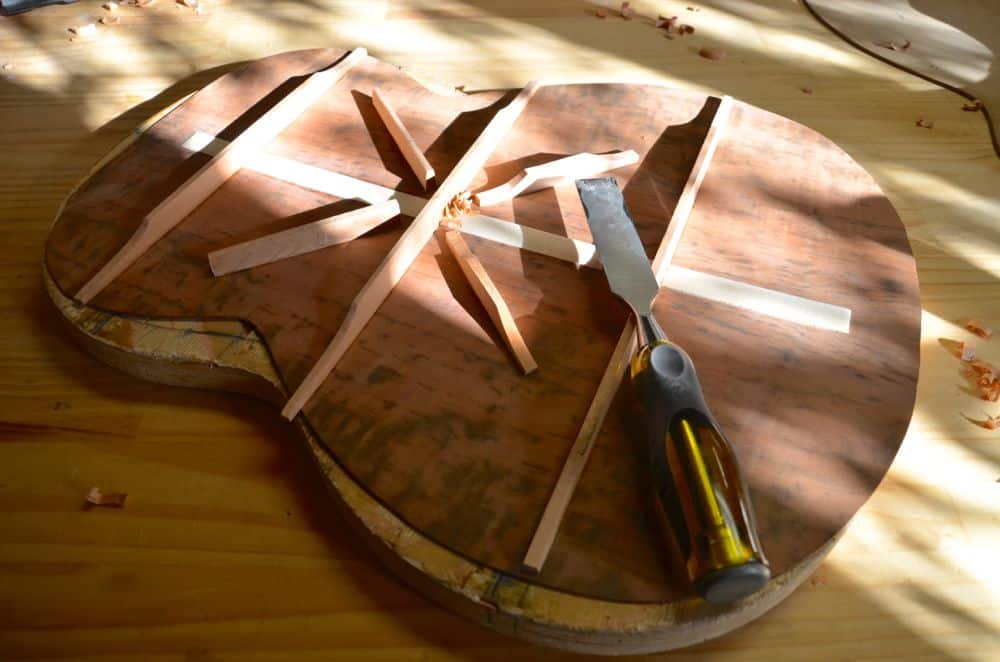
We stuck some horizontal bracing along the back of the guitar last week. One of the little jobs completed on Monday was shaping the shoulders of these braces. Done with a chisel.

We also inserted some diagonal braces and shaped those, too. Here’s the back with me halfway through shaping the braces.

That’s the bracing on the back of the guitar. There’s bracing on the front of the guitar, too. Our guitars are using a relatively modern form of bracing, known as Falcate bracing system. I’ll talk more about that later.

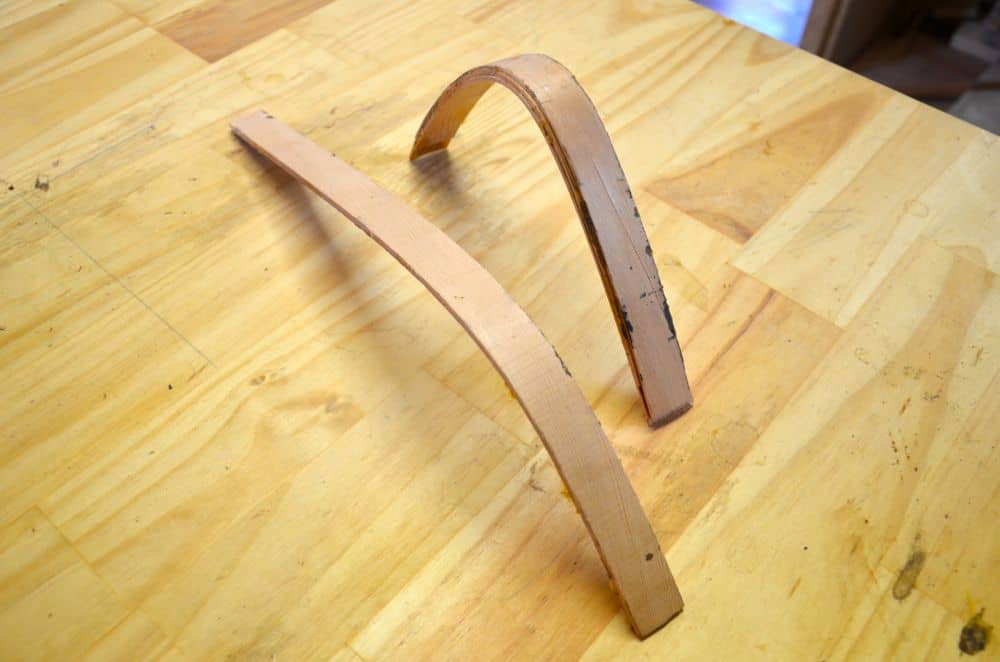
On Monday we made the braces, which involved several thin lengths of timber and a shaping iron, which is used to bend the timber.

We made two of these braces and then glued them together and bound them to a pre-formed mould to ensure they set at the right angle. They’re bound using giant rubber bands.

These moulds will make two braces – one on a mild angle and another a lot tighter. When they set we’ll cut them in half and have four braces. See how they’re applied to the top of the guitar in another section below.

Shaping

You can see me using a shaping iron in one of the photos above. The shaping iron heats to 180 degrees and the heat, combined with sprayed-on water and a little pressure, helps to slowly bend the wood. It’s a wonderful, almost addictive process. The steam coming off the wood smells amazing!

We shaped some of the internal bracing on Monday but the lion’s share of the day was spent shaping the sides of the guitar.

That kink in the waist of the guitar is a real tough one and it takes quite a bit of time to get all the angles right.

I ended the day with one side complete and the other 80% of the way there. That’s my first job for tomorrow morning.

Thanks for reading.

More to come tomorrow!

——

A footnote:

This course in Tasmania is a once-a-year affair and word’s getting around as to how good it is. Today we learned that next year’s course is already fully booked, a full year in advance. Sadly, I’m not able to do it again next year, much as I’d love to.

I’ve told Strato to save a place for me in 2016, though. 🙂

Jay Leno And The Lancia Fulvia Sport (Zagato)

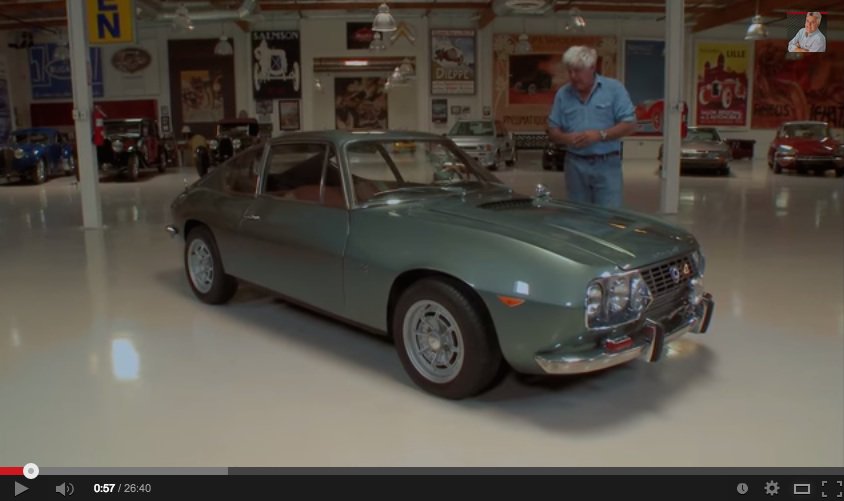
Jay Leno gets all sorts of cool stuff coming through his garage. Most of it he owns, but occasionally he brings in someone else’s car to show it off. Such is the case with this Lancia Fulvia Sport.

The video is around 25 minutes long and provides a great overview to the Fulvia, albeit with the alternate Zagato body.

For those unfamiliar, this is basically the same as my Fulvia, but Lancia had Zagato build some bodies for them until 1972. This is one of those cars. Mine is the regular coupe made by Lancia itself (they made a sedan called the Berlina, too, but that’s another story).

Anyway, the main difference is in the body styling. Underneath, it’s basically the same car.

Enjoy.

Exit mobile version