Name this car? Named!!

Earlier today I posted a picture of a car with the grille blacked out so that people couldn’t tell what manufacturer it was. Your job was to guess the manufacturer. That was earlier in the day. Now, from PT in comments:

OK Swade, c’mon now. Time to put those of us interested enough to care but not enough to Google out of our misery….What is it?

Between the guesses here and on Facebook you had most of the major companies covered, with the exception of Ford and Toyota. There were nominations for GM, Hyundai, Kia (quite popular), Peugeot, Jaguar, Audi, Lexus, Chery, Geely, Honda and Chrysler.

A few of you made the correct guess – Subaru.

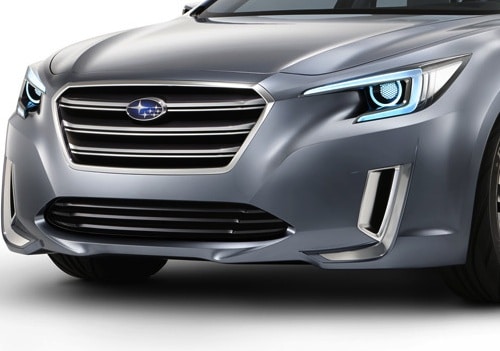
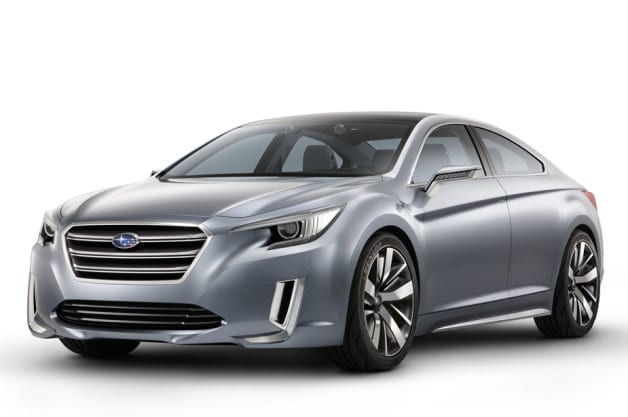
I fibbed a little when I said it was due for release quite soon. It’s actually a concept called the 2015 Subaru Legacy Concept and will show for the first time at the LA Auto Show, which starts this Friday. Subaru say – and recent trends with ‘concepts’ back this up – that the car speaks to the new design language that the brand’s models will have in the near future.

As someone pointed out in comments, the breadth of guesses pretty much proves the point I was trying to make: cars are getting more and more generic in their design. The shape of mainstream brand cars is very similar with just the ‘face’ they draw on that shape providing the difference.

For most carmakers, the days of the distinctive silhouette are pretty much over.

——

Can you name this car?

Car designs are getting more and more generic. That’s only partly the fault of the car companies. Safety and design rules place some restrictions on what can be done with car design these days.

You may have noticed car companies designing their cars with very flat fronts on them, for example. That’s courtesy of the pedestrian safety requirements, which have received heightened importance in crash testing over recent years. You want to go to market with a good crash test result? That doesn’t just mean protecting the vehicle’s occupants anymore. It means protecting those on the street, too.

And that influences what shape your car must be.

A vehicle’s silhouette used to be considered important in a time when you could identify what sort of car you were looking at when it was 100 meters away. People used to like that because their car was distinctive – it was a shape that they engaged with. You can’t mistake a classic Saab 900 from that distance, for example, or a Porsche 911.

Today, various rules and goals (e.g. aerodynamics) dictate what a car should be and vehicle design is becoming increasingly generic as a result. It’s like they’re all chasing the same magic formula, leading every company’s vehicles to adopt the same basic exterior shape. It’s the face they draw on the shape that’s different from company to company.

I saw this image online a few days ago. This car is a new release and will be shown at a motor show in the near future. The question is: can you identify which manufacturer makes this car?

Don’t go googling or checking the recent automotive headlines. Just have a look and see if you can pick who makes it.

I’ve deliberately blacked out the front grille, for the purposes of this post.

——

It shouldn’t be that hard to find, or guess.

The point of the post, however, is that in 2013 the vehicle in that photo could be made by any one of ten different companies and no-one would be surprised.

Motor vehicles have come a long, long way over the last four or five decades. The advances in technology have improved all areas of car making – from manufacturing to safety, amenity to capability, reliability to fuel economy.

I’m just not sure that aesthetic design has been one of those areas where it’s been all forward progress, that’s all.

——

Fantasy Friday – Pontiac Mera

This car popped up on a random Facebook feed earlier today – thanks Joop! – and I just had to know more. It’s so cheesy and so GM (although not officially) that I couldn’t resist elevating it to Fantasy Friday status.

Is there any mid-engined supercar from the 1980’s that hasn’t been used as the basis for a kit-car and hung on the shoulders of a Pontiac Fiero? My wife’s cousin has a Fieroghini, for example. I have to admit, they’re fun to see on the road and they’re even fun to drive, but I’m not sure I’d want to own one.

The Mera is perhaps the best execution of a Fiero remodel that I’ve seen. Whilst GM never officially sanctioned it, the remodel was so good it was actually offered as a dealer option by a number of Pontiac dealers back in the late 1980’s.

The Mera was built in 1987/88 by a company called Corporate Concepts based in Capec, Michigan. Only new Fieros were used for the cars. They were never sold as an aftermarket kit but original Meras have been used as the basis for some new fibreglass moulds so there may be a couple more around than what were originally built.

Sadly – depending on how you look at it – Ferrari heard about the Mera and put a quick stop to it. Only 247 Meras were ever built.

From the few that I can see for sale at the moment (after a whole 2 minutes of searching) they still hold some value – for late 1980’s Fiero, anyway.

So if you’re after a car that costs five figures and offers so much promise from a distance but will be profoundly disappointing once you get in it what is possibly the best execution of a Fiero kit car, the Mera might be a dream come true. At the very least it’ll be a good conversation starter.

The silver Mera in these photos is currently for sale in Troy, Michigan, for just under $16,000.

The red Mera is all Ferraried up with badges and wheels, etc, and is for sale in Tinley Park Illinois for a fiver under $18,000.

——

——

On Saabs and Production

I’ve been meaning to write this for three or four days but never got around to it. Today’s news that NEVS have tied up the last of their suppliers makes it more poignant than ever, though, so here we go.

What I’d like to do is tie last week’s Saab news in with and earlier report as well as some whispers that have come through from Trollhattan.

Now, I should mention at the outset that this is not your normal Djup Strupery. In fact, it’s not Djup Strupery at all. The bits and pieces that I’ve heard are from people in the area and not directly involved with Saab/NEVS. It’s stuff they’ve heard around town, quite possibly from contacts who are involved with Saab/NEVS but that’s not known to me. Therefore, I don’t know the original sources but I do know the people who have mentioned it to me and they’re people that I trust.

I hope that all makes sense. Bottom line: the minor bits I’ll add to the narrative here are unconfirmed but fit the story quite well.

To our contextual sources for this story, then, the patches that will make up this Sino-Scandinavian quilt.

First, there’s my post from last week, suggesting that NEVS are about to run vehicles down the production line that will be test vehicles at first, before any vehicles are made for sale.

Second, there’s an article from Autocar, written by Hilton Holloway, that also talks about Saab’s manufacturing plans. The article was written way back in September, but rings true. Holloway, by the way, has a mind like a steel trap and is very good at what he does. You can take note of anything he writes because he is very well connected. My thanks to Terry9000K for linking to it in comments.

Third, there’s SU’s report from today saying that suppliers are in order as well as recent reports in the local paper about NEVS hiring more production workers.

Finally, there are the few very small whispers I’ve heard here and there since writing my last Saab article.

Let’s start with the first section of Holloway’s report in Autocar, which is the relevant part of his report for the purposes of this story.

The first new Saabs have been built since the Trollhättan production line ground to a halt in June 2011.

Two 9-3 saloons left the line around 15 months after the assets of Saab and the Swedish Trollhättan factory were acquired by the newly created – and Chinese-backed – National Electric Vehicle Sweden.

Although this 9-3 pre-production car is powered by the same 2.0-litre turbocharged petrol engines used in the pre-collapse series production cars, this is just a stop-gap operation.

Let’s stop there, briefly.

Yes, the 9-3s have 2-litre turbo petrol engines in them. In fact, from what I hear, at least the first couple of thousand new 9-3s will have turbocharged 2.litre engines as used in the Saab 9-3 before bankruptcy.

From what I’ve heard, NEVS bought around 2,000 of these engines from the bankruptcy estate so they’re what’s going in the car to start with.

The ramp-up to production is going to be pretty slow so those engines should last a little while. There shouldn’t be any real hassles with GM, either, as it’s old technology bought from the Saab estate, not sourced from GM.

Of course, NEVS are going to have to insert an engine of their own sooner or later. Nobody knows where that’s going to come from but I’ve seen the same hopeful comments saying “BMW”. I have two words – not likely. The 1.6 engines that Saab were going to buy from BMW were super expensive. They would have been suitable for a new, premium release like the Phoenix Saab 9-3 that Saab were going to build, but they’re far too costly for a re-hashed Epsilon-based Saab 9-3 that’s going to be very close to being a teenager before it’s even built.

Back to Holloway….

According to senior sources at Trollhättan, NEVS will build a batch of petrol-powered 9-3s in order to de-bug the production and build process, before the company switches to building the promised all-electric version of the 9-3. The initial 9-3 production run has been pre-sold to three Chinese government agencies.

So those cars are the ones I was talking about last week – test vehicles to establish the production line and test the car.

The news that the old 2.0 litre engine is being used means a bit less testing is required, but any new parts will still need proving IMHO (well, let’s just say you wouldn’t want to buy them unproven, would you?)

The bit about selling these early cars to the Chinese gels with what I’ve heard, too. I don’t know how accurate it is, but one friend in Trolltown has actually mentioned that they’re intended for use as Taxis in China.

So what do I think this all means?

  • It’s good news that NEVS have their suppliers sorted. In fact, that’s probably the most prominent news here because nothing happens if you haven’t got reliable parts supply in place.
  • NEVS will start regular small scale production later this month. The first vehicles should be test vehicles both to validate the factory and the cars themselves.
  • The first vehicles to be built for sale will, in all likelihood, be shipped to China where they’ve been bought by the government to be used for purposes less noble than a keen Saab fan would like to see.
  • There’s still no word on what engine a more consumer-oriented Saab 9-3 from NEVS will be built with and that’s an important part of the puzzle. There’s no word on where it will be sold, or when. Holloway’s article seems to indicate that NEVS will get an electric 9-3 out (based on the old platform, I assume) by the end of 2014. My guess is that that might be the first car with the Saab name on it that someone might be able to buy outside of China.

    But that’s just a guess.

Again, I make no claims of accuracy in all this. I’m just tying up some loose ends in a bid to temper people’s expectations. I don’t think you’ll be able to buy a new Saab 9-3 Aero any time soon, people.

I’d still like to hear more of what they’re doing, though. If the story’s worth telling, then tell it.

——

Video – One Car To Do It All

I had a comment come in via email from my mate ‘Eggs’ overnight. I’ve got his OK to reproduce it here in order to kickstart this post:

I have been impressed by the number of people (including you) who have recently raved about the quality and seeming durability of Porsche cars. I kind of always assumed that the magic was in the drivetrain and suspension.

Interesting angle.

Indeed, the real magic IS in the drivetrain and suspension. That’s what delivers the driving experience that keeps you coming back again and again. But it’s the durability and quality of the car that keeps it on the road so you can come back again and again. That’s a tangible benefit, which is why Porsche owners talked about it consistently in the research I did before buying my car.

Durability

I’ve only recently bought my Porsche, but I’ve been interested in them for a few years. During those preceding years I did a lot of reading about Porsches and I can definitely echo Eggs’ comments about durability being one of the surprising attractions people talked about over and over.

One downside of Porsche ownership is that the parts can be really expensive if something goes wrong. I have a $15,000 rebuild invoice in my car’s history file to prove it.

The silver lining to that cloud is that they’re really well designed and made using quality materials. Result: with only a few exceptions (by reputation), these cars are absolutely loved by their owners and one of the key reasons, aside from the driving experience, is because they’re extremely reliable if you maintain them correctly.

The classic air-cooled boxer engine is remarkably simple, which is one of the reasons 911 purists love it so much. I used to wonder why so many Porsche owners were happy to pay for engine rebuilds. From what I can tell after speaking to a few of them, it’s not usually to repair something that’s gone wrong. Rather, it’s a form of preventative maintenance to ensure another 10 years of addictive peak performance.

I guess you could call that a pretty good testimony as to how compelling these cars can be to drive. Most other dedicated sports car companies survive along the same lines. They make a product so compelling that people will pay what can be crazy prices in order to keep it going in tip-top condition. In some cases, that’s because they have to (i.e. break down). In Porsche’s case, and I’m quite sure it’s not unique to Porsche, it’s because people genuinely want to keep their cars in superb driving order. They feel OK about paying a small fortune for maintenance because it insures against having to pay a large fortune in the event of a catastrophe.

As with any company, there are known weak spots. I don’t know all of them when it comes to Porsche but I learned about a few of them as I did my research.

The early/mid 1970’s 911 had a 2.7 engine that is not regarded as highly as others. US emissions regulations at the time meant that Porsche’s 2.4 engine was going to lose whatever small performance edge it ever had. Porsche enlarged the engine to 2.7 litres and included some internals designed to burn off build up in a way that didn’t result in the emissions coming out the tailpipe. They even gave it the slightly comical and slightly scary name: “thermal reactor”.

Anyway, those changes made the car run far hotter than an air-cooled car is comfortable with. Owners of these cars back when they were new saw a lot of engine failures and not a lot of support from Porsche, who have a reputation for not acknowledging their problems – buyer beware! Even though the 2.7s that survive today have most likely been modified to overcome the deficiency, prices on the second-hand market seem to reflect the model’s reputation.

The early Boxsters and 996-model 911s have a couple of problems that can rear their heads almost seemingly at random. I’ve seen these models for sale online with several hundred thousand kilometers on the odometer with no reported problems. I’ve also heard about others where the engine has blown for no apparent reason. There are a few known issues (porous blocks, head cracks, and others) but the biggest individual potential problem – the one that can cause these sudden failures – is the intermediate shaft bearing. The results are catastrophic if it fails so there’s good incentive to get it checked and updated/replaced. It’s not cheap, but it’s cheaper than an engine replacement.

Quality

It’s quite easy to think of Porsche and see $$$$$$, which can lead to an automatic presumption of high level quality/luxury/equipment. I’ll testify positively to ‘quality’ but advise caution when it comes to luxury and equipment on the older cars I’m familiar with.

I’ve only driven a few Porsches over the years – 944, 911 (964), 928 and my own 968. You’ll note that these are all pre-Boxster/996 model cars.

With the exception of the 928, I can’t say that any of these cars were built with luxury in mind. They’re certainly comfortable enough to drive everyday but Porsche’s emphasis in those years was very much on performance. Standard comfort items were pretty much limited to power steering/windows, stereo and air conditioning.

The suspension was set up with performance in mind and anything that could be classed as unnecessary excess weight was relegated to the options list. It’s only been in what I’d refer to as the modern era (Boxster/996 onwards) that Porsches had any real emphasis on delivering a comfortable drive as well as a spirited drive. That’s my theory only, by the way.

What they did seem to have in that pre-modern era (again, my terminology) was a commitment to quality in terms of design, engineering and materials. Porsche is one of the few companies where lines like “design and development through racing” are more than just marketing spin. Their parts were honed through racing, designed to operate in high stress environments and given Porsche’s success in endurance racing, for long periods of time. Things wear out, of course, but they’ll usually take a lot of (ab)use before they do.

I’ve been extremely impressed so far with the build quality of my car. It feels remarkably solid (especially given its age) yet I know from reading the specs that it’s very light. That’s a remarkable achievement but I guess it’s the use of low-weight, high-strength components that makes these cars cost a bit more than your average whip.

Versatility

Eggs didn’t mention this in his email, but one of the reasons people seem to love their Porsches is that they ARE versatile and durable enough to be used as everyday cars as well as being more-than-just-competitive track cars.

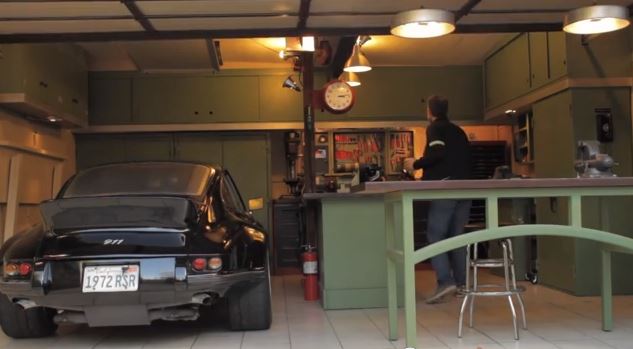
The following video was made by Petrolicious and it highlights the versatility and adaptability of the Porsche 911. This video galvanised my desire to finally take steps towards buying my first Porsche.

I really like this guy’s car, but I think I’m drawn even more by the experiences he’s had because of the car – the garage he’s built (amazing) and the skills he’s learned.

The video is 10 minutes long. I hope you take the time to watch it and understand.

——

Ken Block vs Ken Box

I think we might have just learned exactly when you should quit what was once a good thing.

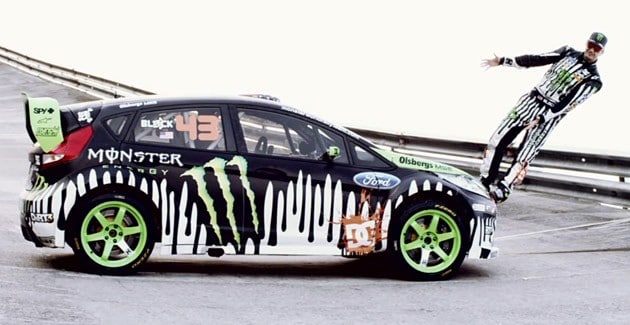
Ken Block has released his Gymkhana 6 video, continuing a five year tradition of entertaining driving, copious amounts of tyre smoke and unabashed pre-Christmas product promotion.

Here it is:

—

What do you think?

I can remember when Block’s videos were jaw-dropping and even quite funny. Personally speaking, this one felt like The Godfather III – it’s watchable, but not even close to the films that came before it.

When the TV show Happy Days was in its waning years a few decades ago, they had Fonzie on water skis jumping over a shark to create some tension and (they hoped), some interest. This is now considered the Gold Standard in doing ludicrous things in order to maintain interest.

Mr Block might want to consider doing his next Gymkhana video at a water park because Gymkhana 6 is more than just a bit tedious in comparison to episodes 1-5.

In fact, it’s not even as entertaining as a tribute/parody from a guy calling himself Ken Box, who whizzes around a warehouse in a Crazy Cart wrapped in a cardboard box.

Enjoy.

——

I know. It’s all a bit frivolous and light weight. Feel free to make your arguments that I’m jumping the shark myself by writing this post.

I’ll try and get to something more engaging soon, I promise.

——

Australia – The Mushroom Democracy

A non-automotive post.

——

It’s been 2 months now since Labor lost the federal election in Australia – and I describe it that way quite deliberately.

I am convinced that Tony Abbott and his Liberal/National coalition did not win this election because they offered attractive policies or solid personnel. Rather, Labor lost the election because of their ongoing leadership farce, their unnecessary overcommitment to an uncalled-for budget surplus, their stumbling actions on climate change and an inability to cut through and sell their economic credentials.

It should be an unambiguous sign to the Labor Party about just how screwed up they were from 2009 to 2013 that this Coalition government, led by the seemingly unelectable Tony Abbott, looked like a good option. Hell, even Clive Palmer managed to convince enough people to vote for him to get a seat in parliament (which is probably a bigger blow to Tony Abbott than it is to Labor, but electing a clown like Palmer is all the evidence you need that the electorate was desperate for change of some sort).

We’re 8 weeks on from the election and what have we got?

—

Well, the things we don’t have include a Climate Commission, a science minister, a proper commitment to long-term education funding (aka the full Gonski), plans for an international standard national broadband network, an agency to administer our foreign aid program (let alone a foreign aid program that meets the international commitment we made), a dozen different and very cost-effective expert panels to advise government in varying areas of social importance and of course, we still don’t have a budget emergency. We never did.

What we do have is a government that has decided to try and take Canberra out of the news cycle. Tony Abbott’s opposition did so much active, fever-pitch opposing between 2010 and 2013 that they ensured people would be sick to death of hearing about the government. And it worked. People did get sick of the relentless procession of politicians on their televisions and in their newspapers.

(Labor didn’t help, of course, with former Prime Minister Julia Gillard setting up a 9-month election campaign by announcing a September election date in January.)

The Coalition’s election campaign in opposition followed a small target strategy of keeping the focus on the government’s problems and personalities whilst offering little more than three-word slogans themselves. Stop The Boats. The Budget Emergency. Cut Red Tape. Jobs Jobs Jobs. Build Build Build.

The Coalition has tried to carry that small target strategy into government by closing the windows on transperancy. The Prime Minister himself has barely done one press engagement per week and any penetrating questions asked ‘on the run’ are fended off by minders as the PM moves from ribbon-cutting to his Comcar.

That’s almost understandable. Tony Abbott himself has said that people shouldn’t count on anything he says on the run; only his carefully scripted remarks should be taken as reliable (that’s video of him saying so in an interview, but I’m not sure if it was scripted or not so maybe it’s unreliable).

But even the Coalition ministry, many members of which are capable of saying sensible things without rehearsal, is not allowed to give impromptu press conferences or even interviews to local radio outlets without clearance from the PM’s office. Questions to ministers now often go unanswered.

—

One of the Coalition’s key policies was immigration and border control. Instead of real-time information on this issue of national importance – as provided by previous governments – the Coalition does one press update per week. And at that press conference, they stonewall on key questions, hiding behind the skirts of it being “a military operation”.

Here’s the phrase that journalists have hot-keyed on their laptops when reporting from Scott Morrison’s press conferences: “We don’t provide information on operational matters”. The result they’re trying to achieve, of course, is a situation where the lack of negative information means that the average Aussie punter has nothing to complain about. The hope is that there won’t be many who care enough to be bothered by the lack of information.

This is Mushroom Democracy at its finest. Keep the people in the dark and feed them the occasional bit of bullshit. Take the government out of the news cycle and hope the people forget it exists.

It worked for a few weeks, but the press gallery is starting to make the government’s relative silence an issue in itself. Laurie Oakes, Canberra’s most respected political penman, has noted it, putting government transparency right back on the agenda.

—

You have to hand it to the Coalition’s strategists. The hung parliament of 2010-13 presented it with a rare opportunity to create a genuine problem (unceasing political rancour) and offer itself as the quiet, stable, reliable solution.

The substance of that solution is only now being seen.

Where we were accustomed to the press gallery keeping our government accountable, we now get only occasional 10 minute press conferences with minimal opportunities for questions – and those are when the government is feeling generous with its time. Many events of importance such as the backdown on asylum seeker policy that occurred just yesterday, are announced only via press release.

Where we had a budget emergency under Labor with debt and deficit a twice-per-week headline, we now have a treasurer adding 8 billion to the budget deficit by giving the Reserve Bank a slush fund it never asked for and doesn’t need. And that’s on top his slugging low-income earners’ superannuation accounts while giving a free pass to those with millions in their nest eggs.

Where we once had nearly 70% of the population agreeing that climate change was an important issue, that number went down to 36% (now rising again to 40%) because the Coalition managed to get people more concerned about the short term hit to their hip pockets than about long-term ramifications of climate science (it doesn’t help that we’re a fickle bunch, dependent on events such as long term drought to get us to take notice). The Coalition pays lip service to the issue to woo the swinging voter but have a policy that’s been described as an environmental figleaf from within their own party and they’re not even sending an elected representative to the upcoming UN climate conference in Warsaw next week.

These are but a few examples. If you want more, there’s the impending closure of Australia’s car industry, the complete dismantling of AusAid and the quiet re-jigging of the National FraudBroadband Network rollout map, just to name a few.

—

The media, particularly the Murdoch press, played a huge role in the 2013 election campaign.

Now more than ever, Australia needs an independent, diligent and robust fourth estate to keep the government accountable to the people. It’s good to see they’re already making efforts to do so but it must continue.

Australians should be vigilant about the media they consume and support good quality, independent journalism from a variety of sources. I fear that a lot of the population are happy to take whatever they’re spoon fed but I hope that’s not the case.

——

Fantasy Friday – Renault-Alpine A110

Is the Alpine A110 the discerning man’s classic car bargain of the moment?

I was inspired to do this Fantasy Friday post by a photo feature on Petrolicious earlier this week. There’s a sample of it above. Click here to see the full shoot.

You might be familiar with the Alpine A110. Or maybe you haven’t heard of it. Or perhaps you’re like me and have only come across it relatively recently. I’ve only been aware of this elegant classic for a few years thanks to a friend’s interest in Renault Sport vehicles.

So what is the Alpine A110, aside from staggeringly beautiful?

The Renault-Alpine A110

Before you get to the A110, you have to start with Alpine (read it with a French accent and say Alpin).

Alpine was started by the outrageously over-accented Jean Rédélé in a town called Dieppe. Jean wanted to race French cars after the war and started with the Renault 4CV (which rumour has it was a car that played a remarkably shadowy part in the personal history of one Ferdinand Porsche).

Rédélé took factory Renaults and made them more competitive with aluminium (and eventually, fibreglass) bodies, souped up rear-mounted power plants coupled to 5-speed gearboxes of his own design.

Right: My favourite Alpine photo

He met with success early at the Mille Miglia and various rallies in his native France. His success at the Coupe des Alpes and his love for racing in the French mountains gave the company its name.

Alpine’s first car was a re-bodied 4CV called the A106, which was followed by the A108. The A108 used a Renault engine tuned by Gordini, which is interesting in tangential terms because Renault eventually bought both Alpine and Gordini and from the ashes of those two companies, started the RenaultSport brand than continues today.

The Alpine A110 featured a fibreglass body on a steel chassis. Early cars used a small 1100cc engine producing just 66hp but a Gordini-engined option soon followed with a beefier 95hp. The engine continued to grow through 1300cc up to 1600cc and a maximum output of 140hp – in a car that weighed just a little over 600kg.

Yes, you read that correctly. Just over 600kg.

I don’t know if it’s evident from the photos featured here already, but the A110 is quite small. I had the opportunity to see one in person at Targa Tasmania last year and couldn’t help but take a bunch of photos of both the A110 and it’s stable-mate, a Renault 5 Turbo. That the A110 could make the Renault 5 Turbo seem big(-ish) goes to show how much of a pocket-rocket the A110 really is.

That sort of power-weight ratio lent itself to motorsport success and Renault-Alpine won the first ever World Rally Championship with the A110 in 1973, though the car had already tasted success with the International Rally Championship in 1971 and back-to-back victories at Monte Carlo and many other rallies years before.

There are more awesome photos where that one came from at eGarage.

Here’s what you can do in an Alpine A110. The action starts 30 seconds in and take note – this is just the 1300cc model, not the bigger and more powerful 1600cc 🙂

——

For Sale

So is the Renault-Alpine A110 the collectable bargain that I mentioned at the top of this post? Well, I’m not sure you can ever call something that can cost around £80,000 a bargain, but when you consider that you won’t even be allowed to look at a Lancia Stratos from the same era without serious six-figure sums in your pocket, it doesn’t seem too bad.

In fact, you can buy the Renault-Alpine A110 below for a mere £44,679 but there’s a catch – it was built by FASA, a Spanish contractor that built Renaults for around 50 years up until the turn of the century. So it’s not an imitation, but it’s not the most desirable version, either.

The real deal will cost you all of that £80,000 and a little bit more, but it’ll be the authentic French-built version built at Alpine’s skunkworks in Dieppe.

The car below is currently for sale in Germany. It’s just a baby with only 32,500kms on the clock, is said to retain its original paint and has had only two owners. Notably, it’s the bigger 1600cc model so you are getting maximum bang for your buck, but there’s a LOT of money involved – £85,000.

——

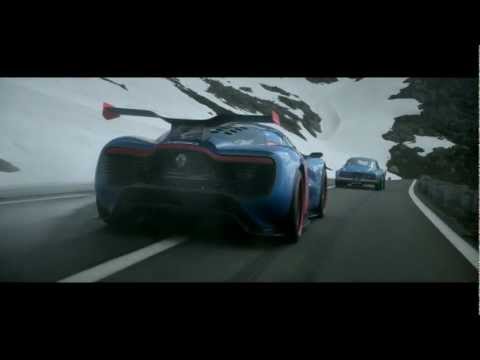
BONUS CLIP

Renault celebrated the 50th anniversary of the A110 by building the A110-50 concept car in 2012. This clip features some wonderful photoshop work to pit the old against the new. Enjoy.

——

Here’s A Photo Of One Of My Nuts.

Warning – this post may contain content about a certain brand of car beginning with P. I feel like I’ve been gushing a little too much about my latest acquisition so I’m trying not to mention it too much lest people get a bit sick of it – but HOT-DAMN, it’s good!

If there’s one thing I fell in love with straight away when it comes to my 968, it’s the grip. Much of that comes courtesy of the car’s transaxle, 50/50 weight balance and limited slip diff. But the finishing touch was the four rubber patches holding it to the road – the Yokohama tyres that, whilst road legal, are designed primarily for the track.

The downside is that they’re very, very noisy. They create a whining sound that rises in volume as you accelerate and to be honest, they made driving the car around town more laborious than it should be.

So last week I made my first post-purchase decision and had new tyres fitted. The new tyres are Goodyear Eagle F1 Asymmetric 2’s.

Here’s a photo of the new tyre next to the old one:

Result – a much more pleasant driving experience!! The Goodyears are not only a LOT quieter, they seem to absorb the disturbances in the road a lot better, too, making for a much more comfortable drive all round.

I’ve undoubtedly lost a little bit of that grip, but I tested the new rubber out on a couple of 180+ degree off-ramps the other day and I can tell you: there’s still plenty of grip there to be enjoyed 🙂

The Yokohamas are now in storage and will come out for special occasions, like the Porsche Club of Tasmania hillclimb at Baskerville race circuit in a few weeks from now. It would have been a waste to wear those Yokohamas out on regular streets, anyway.

——

A couple of things noted during the tyre change:

1) It’s nice to know I’m not the only one that has trouble with the low stance of this car.

The guys at Beaurepaires couldn’t get their hoist under it to change the tyres so they had to do it with trolley jacks instead.

2) While the wheel was off and for no good reason at all, I picked up one of the wheel nuts. Porsche’s commitment to always thinking like race-car builders was evident straight away.

The wheel nuts are made of lightweight alloy and weigh next-to-nothing. I picked up the wheel nuts from the Holden Commodore in the next bay and they must have been at least three times as heavy.

When it comes to unsprung weight, every little bit helps.

——

The next spend will be on the 120,000km service, including the timing belts and associated bits and pieces, just for my own piece of mind. After that, I’ll be hunting for a spare set of Cup I wheels so I don’t have to go back to Beaurepaires every time I want to change my tyres.

Of course, there’ll be some very pleasant driving between now and then and maybe, if it’s OK with you, some more photos and posts on the website about the expeirence.

It might even be time for a film.

—

The Ringbrothers – Emphasis On Quality

It’s natural that people tend to be comfortable with what they know if it’s functional and does what they need it to do. There’s rarely a need to explore the finest quality product available unless you’re deeply interested in that certain something.

I’d be quite happy with a watch, for example, but some people won’t settle for anything less than a Rolex or a TAG Heuer.

I used to think that companies like Ford and Toyota built generic cars, companies like BMW and Mercedes built real quality and further down the road, Ferrari and Lamborghini built real exotic quality. To a large extent, that’s mostly true.

Then I visited Koenigsegg, whose in-house capability and dedication to building the best product possible makes everyone look generic.

It’s all about what matters to you. You seek out the quality that you desire, whether it be as a potential owner of something or just as an interested party and an admirer.

It’s only in the last few years that I’ve gained a real appreciation of how hard it is to engineer something that is bespoke for a particular creation. Mass production has us all used to the idea that we can only change or customise a small part of anything we are looking to buy.

There are people who don’t work that way, however. People who don’t just build things. They create things. People who can take the familiar and make it special.

Petrolicious has a new video this week looking at a company in the USA called Ringbrothers. They make parts, mostly for American muscle cars. They also take cars that are quite generic within their niche and make them special, using the parts that they design and mill in the company’s workshop.

I know they’re just one of a large number of custom shops, but their work struck me as not only being top quality, but pretty tasteful as well (which is not something you can say of some of the more well known custom shops that end up with their own reality TV shows).

I wish Petrolicious had got a few more customer cars into this video for a larger exhibition of Ringbrothers’ work. The small sample you see in this video is enough to whet the appetite but I’d really love to see more of what they can do.

Well done, Ringbrothers. The more I see stuff like this, the more I love the idea of a car as a piece of art. This is craftsmanship.

—

Exit mobile version