Leica Virgin – Why I Bought a Leica M 240

I recently took a rare plunge and spent far more money than my talents can justify and bought the Porsche 911 of cameras. A Leica M (Type 240) rangefinder digital.

Like the 911, it’s German. It’s Iconic. It’s been used by masters to do amazing things.
A masterpiece in both design and execution. Both the 911 and the Leica M are revered by many, though unlike the 911 (which is quite rightly, rarely criticised) the Leica can be lampooned by some – typically because they’re occasionally bought by buffoons like me.

This is not a photo of my specific camera and lens, but my setup looks exactly the same.

The lens is a Leica Summicron 35mm f2 ASPH and just like the one in the photo above, mine is finished in silver. It looks a bit strange, but I’ll live with it.

I won’t go into the specific amount that I spent but let’s just assume that it was ridiculous. Because it was r-i-d-i-c-u-l-o-u-s. Both the body and lens were second-hand and they were still ridiculous (and the body was just over half the price of a new one!).

It looks even more ridiculous when you consider the following:

  • It only uses prime lenses.
  • It’s completely manual focus.
  • It’s basically useless for fast-action shooting, as far as I can tell. Continuous shooting mode is a joke and the buffer doesn’t allow you more than 2 or 3 shots in RAW before it needs a cup of tea and a good lie down.
  • It’s pretty ordinary in low light and completely useless at night without a tripod.
  • It’s minimum ISO is 200 and while it goes up to native 3200…. don’t. Just don’t. Anything above 1600 is going to have noise.
  • While mine does have video capability, it’s not great. In fact, the video on my camera was so poor that they took if off subsequent releases from the same generation of cameras, and they didn’t re-introduce it in the all-new, just-released M10

The question, then, is why?

1 – Size

SLR’s are big. Nobody really felt they were big until a new generation of mirrorless cameras from manufacturers like Sony came out. All of a sudden, SLR’s started to look a bit like dinosaurs. They’re big-bodied and the lenses can be huge.

Leicas are the original mirrorless camera. And they’re so compact, even today, that they make the Sonys of the world look big.

Here’s a (rather poor) shot of my M next to my 17-35mm f2.8 Nikon lens. Just the lens, not even the massive Nikon body.

Being so small definitely has its advantages. They say the best camera is the one you have with you. Well, this one is much easier to take everywhere.

The other thing about the Leica’s small size is that it isn’t intimidating when you’re shooting on the street. People get quite conscious of photographers walking around pointing SLRs with massive lenses at them. It’s like bringing a tank to a gunfight.

The Leica is small. It’s non-threatening. You look almost grandfatherly carrying it and people don’t respond nearly the same way if you’re pointing it in their general direction. Many don’t even notice.

I’ve been here in Europe for over 2 years now I’ve hardly travelled during that time, except for work. I’ve been to the UK a few times, but that’s all. I’ve not been to France, Italy, Spain, Germany, Portugal, Austria, the Netherlands, Belgium, Czech or any other desirable spots yet. I’m planning on changing that pretty soon.

The M will be the perfect travel camera, both because of its amazing results, and quite pointedly because of its compact size.

Yes, shooting just the 35mm focal length will limit some of the shots I can get but I think the benefits of being able to travel so light will overcome that. Those times when you simply can’t be bothered carrying around a big bag won’t even be a consideration (I have 5 lenses for the Nikon and three of them are bigger than the one above).

Shooting just 35mm will mean a different sort of travel photography but different doesn’t necessarily mean limited. It’s just different. In fact, I’m sure that my travel albums will feature shot after shot that I wouldn’t have taken if I had a full bag of zooms.

Will I miss zoom lenses from time to time? Sure. And I’m sure there’ll be times when I’ll take both systems with me. But the Leica allows me to cut loose and travel light when I want to. That’s a very liberating thing.

2 – Results (especially for size)

I’m not a pro photographer, by any means. I’m not even worthy to carry a pro’s bags.

The M 240 is, however, a pro level camera that’s capable of producing pro-quality images. And I like the fact that it can do that in such a small package.

I’ve only had the camera a week so I haven’t done much with it. I went on a walkabout photo tour of Copenhagen last weekend with some locals. We shot for about an hour and it’s fair to say that I’m over-the-moon giddy with some of the early results.

It sounds like a bunch of marketing mumbo-jumbo but there really is something about the way the Leica renders colour, the way it makes something look both soft and sharp at the same time.

Maybe I’ve just drunk too much of the Leica Kool Aid?

Here’s a sample shot to show you what I’m excited about. It’s a streetscape and a pretty ordinary one, at that.

What excited me about this shot is the sharpness from front to back.

Take a look at a close-up of this sign from the top left corner….

I love the way it seems to smooth out the colours yet retain perfect clarity.

Here’s the bar sign from the middle ground. Again, the colour rendition is gorgeous and the image is wonderfully sharp.

The sharpness peters off as you get to the end of the street, but it’s a nice fade that still includes the details you need.

I didn’t do any maximum aperture shooting to test the bokeh on this shoot, but it’s supposed to be wonderful. An earlier version of this lens was known as The King of Bokeh, for what that’s worth.

3 – Glass

The company that would eventually become known as ‘Leica’ started off making microscopes in the mid-1800’s and they built on their worldwide renown in that area for 60-70 years before pioneering the world’s first 35mm format cameras.

In other words, Leica knows good glass. They were making some of the world’s best lenses before they ever built a camera.

They make you pay for it, too. The basic 35mm f2 lens that I picked up for my M 240 cost more second-hand than my old Nikon D750 body cost brand new.

The reason it costs so much is the same reason so many people love to shoot with them – they’re exquisitely made – by hand – and yield amazing results. In fact, it’s fair to say that a lot of people buy Leica cameras simply so they can shoot with Leica glass.

There’s a lot of historical virtue in the Leica system, too. I’ve just bought a camera that was built some time around 2013 or so, and yet I can use almost any Leica M system lens dating back to the first M lenses in the mid-1950’s. And they’re all superb.

4 – Simplicity and versatility

At the top of this article, I listed all the ‘limitations’ of this camera.

  • It only uses prime lenses.
  • It’s completely manual focus.
  • It’s basically useless for fast-action shooting, as far as I can tell. Continuous shooting mode is a joke and the buffer doesn’t allow you more than 2 or 3 shots in RAW mode before it needs a lie down.
  • It’s pretty ordinary in low light and completely useless at night without a tripod.
  • It’s minimum ISO is 200 and while it goes up to native 3200, don’t. Just don’t. Anything above 1600 is going to have noise.
  • While mine does have video capability, it’s not great. In fact, the video on my camera was so poor that they took if off subsequent releases from the same generation of cameras, and they didn’t re-introduce it in the all-new, just-released M10

Many shooters will see those as limitations. A lot of Leica shooters that I’ve read and watched prefer to think of them as creative liberations.

Using another automotive analogy, think of a sports car from today vs a sports car from the 1960’s or 70’s.

Today’s version has traction control, ESC, ABS, TMPS, and all sorts of other acronyms. Today’s version is incredibly fast and allows even the most cack-handed driver to feel like he’s Lewis Hamilton in relative safety.

The car from the 1960’s provides a different type of experience. It doesn’t have all the bells and whistles. In many ways, it’s a more manual experience that relies on the driver interacting with the car.

The analogy doesn’t fit perfectly because there are some fancy electronics hidden away in the M, albeit nowhere near as many as what I’ve got on my Nikon D810.

But the analogy does work in that both experiences allow a thrill – they just do it in different ways. One relies on ultra-modern technology to assist the operator and the other is a more organic experience.

The M is very much a camera that’s designed to concentrate your attention on your exposure, focus and composition. Those are the key creative elements in photography and sometimes they’re easy to overlook in a world of 400-point autofocus systems.

Put it this way….. It’s not quite old-school. But it’s definitely not new school.

5 – Value

This will seem like an odd criterion to think about when spending a metric buttload on a camera and lens system, but it works.

The good news about Leica values is that after just a little bit of depreciation post-unboxing, they hold their value quite well. Some lenses actually go up in value.

I’m choosing to look at this as an investment in a hobby that I love, an investment that will allow me to be more free in pursuing some unburdened travel and one that will hopefully yield me some great photographic results.

And if I hit an emergency, I can always sell it and use my phone’s in-built camera.

——

Here’s a sample of images from the Copenhagen walk-around, including a couple of happy accidents on the way home. None of them are spectacular, I know, but they make me happy.

And that’s what photography is all about.

On Australia’s Vote for Same Sex Marriage – Resolving the Issues

This is the third (and final) instalment in a series on Australia’s current debate over making same-sex marriage legal.

The first instalment looked at the backstory to the issue.

The second instalment looked briefly at the Yes and No campaigns, as well as my view on the issue.

In this final instalment, I’d like to look at a few of the key issues and try to shine some light on those issues.

——

The ‘Yes’ campaign has a pretty simple platform: It’s time for same-sex couples to get the same access to marriage as heterosexuals. Australia is an egalitarian society and it’s time our marriage laws stopped discriminating against same-sex couples.

The issues that have made this such a complicated affair are pretty much all raised by the ‘No’ side of the debate. They’re the issues that I’d like to address here.

——

Same-sex couples in civil unions are treated the same as de-facto couples and the law has already been changed to give de-facto couples the same rights as married couples.

Umm, no. This is not true.

Yes, de-facto couples (couples in a relationship under the same roof but unmarried) do get many of the protections offered to married couples under the law. But not all.

The rights of a married couple are established as soon as the marriage certificate is signed. The rights of a de-facto couple are different from state to state, and they also differ depending what area of the law you’re looking at. The definition of a couple used by Centrelink is different to that used under migration law, and different again to that used under family law.

Married couples have more automatic rights with regards to IVF at the beginning of life and more rights about health decisions for their spouse at the end of life. They have less complicated proceedings available for divisions of property, and estate management. They have more rights and simpler procedures when it comes to superannuation.

Another key problem is that civil unions are administered by state law. The Marriage Act 1961 is a national law and all marriages in Australia are recognised under this law. Civil unions are established under inconsistent laws across the states and territories that actually have them (you can’t register a civil union in Western Australia or the Northern Territory at all).

If your partner is in a car accident in Sydney and ends up in hospital, a doctor will immediately know what your rights are if you can tell them you are that person’s spouse. The terms are clear. Saying “I’m their partner according to a Queensland civil union” lands you in far muddier waters.

Furthermore, while Australian marriages are recognised pretty much everywhere around the world, civil unions registered in applicable Australian states are barely recognised anywhere – a big problem if a couple moves overseas for work.

This piece at The Conversation will give you the full breakdown.

The bottom line: significantly similar rights are indeed available to both married and de-facto couples but de-facto couples have to jump through a lot more hoops to get access to them (well, the ones they actually have access to). It’s far from automatic.

I don’t necessarily see a problem with parts of that. If a couple does not want to marry, if they don’t want to declare their relationship in public and commit to one another in that way, then that’s their right. They can choose to forego the rights that marriage offers them and stay as a de-facto couple if they wish.

The problem is, a lot of same-sex couples DO want to declare their relationships in public and commit to their spouses. They’re not choosing to live together as de-factos. They want their family unit just like their hetero brethren, and it’s being denied to them purely on the basis of their sexuality.

It’s discrimination.

——

Why can’t we just amend the laws around civil unions so that same-sex couples get the same rights as married couples, but without it being called marriage?

Because that’s not marriage equality. We don’t need to create something new and different for same-sex couples. We already have something – it’s called marriage.

There is social currency in marriage. A married couple is one that has decided to declare for one another in the presence of witnesses and according to the laws of the land. They carry obligations to one another and have rights under the law.

Marriage is understood by society. People know that some marriages last and some don’t, but they know that a married couple has been serious enough about each other to tie the knot and they respect that.

Former speechwriter to Tony Abbot, Paul Ritchie:

“Allowing same-sex couples to marry is not just a matter of law. It’s also a matter of heart and soul. It reflects a universal hope: to be blessed by family and friends, and to share your life, with its trials and tribulations, laughter and joy, with the one that you love.


“The institution of marriage affirms us as people; gives standing to our most significant relationship; and changes our families for the better. It is an institution that points to a better life and helps us answer the deepest question: can I selflessly love another and find meaning and purpose in that love? This is a conservative ideal,” he writes.

What’s at question here is whether or not the respect that society gives to married couples should be given to all couples, or just heterosexual couples.

This is where a lot of Christian conservatives get their noses out of joint.

To Christians, marriage is a sacrament – “til death do us part”. It’s a human manifestation of the unbreakable bond between God and humanity.

To the courts, marriage is a legal arrangement that’s defined by statute. Like all good first-world countries, Australia has a distinct division between church and state. The definition of marriage in this instance is a matter of law, not a matter of religion.

This really is a key point that gets stuck in a lot Christian craws.

They want marriage how they see it. It’s theirs. It’s ordained by God and being married is something special that they don’t want to be confused with something so fundamentally sinful as homosexuality.

Other ‘sins’ are OK. But not this one.

It doesn’t matter that many of the people getting married are Hindus, or Muslims, or Buddhists, as long as it’s a man and woman. It doesn’t matter that many of the people getting married are shite at being married and end up divorced (multiple times), as long as it’s a man and a woman. It doesn’t matter that many of the people getting married are shite at being parents to their progeny, as long as it’s a man and a woman.

A conservative Christian sees all those situations as redeemable. They can equate their marriage with those people by saying ‘there but for the grace of God….’

But not this. Homosexuality has a special place in hell to them. Presumably one without lubricants*.

While it’s mostly unspoken, one of the things Christian conservatives hate the most is the idea that two gay people getting married might be equated with their marriage.

They want the word ‘marriage’ to themselves.

This is why you hear things such as “I’ve got nothing against gay people, but…..” and “I’m happy to see their rights protected, but……”

I’ve actually had one person propose to me that a new arrangement could be set up for same sex couples called a Homounion.

I’ve heard Christians raise concerns about gender fluidity, free speech, political correctness, paedophilia (which I consider ironic, given the nature of some priests in the Catholic church) and other issues. When it all boils down to it, though, Christian opponents to same-sex marriage simply want marriage to be the singular domain of people who bump uglies in the way it’s described in the bible.

I’ll say it again. In this debate, on this question, the word ‘marriage’ is a legal definition in a statute. It’s not the religious interpretation that people are seeking to re-frame here.

It’s a point. of. law.

As the wise man says… If you don’t like the idea of gay marriage, don’t get gay married.

——

Changing the definition from the current “between a man and a woman” will open Australia up to people marrying animals, and even stranger things such as bridges.

Yes, one Australian politician gave that as an example. Hit the link to see the story.

There is a LOT of dis-information being circulated at the moment and it’s designed to whip up fear of the unknown.

A classic example is the notion that changing the existing definition in the Marriage Act 1961 (a man and a woman) will leave the statute unclear on gender, or even completely genderless. And if the statute is genderless, then it’s just two….. things getting married – hence the reference to a person marrying a bridge.

Bollocks. Unnecessary, fearmongering bollocks.

Why assume that the wording will change from “between a man and a woman” to a genderless statement? Why not trust that our legislators can re-word it to something like “between a man and a woman, or a man and a man, or a woman and a woman.”

That wasn’t so hard to solve, was it?

——

“This is all part of a strategy for gay people to recruit and abuse children.”

This sort of rubbish is actually being bandied about. Seriously.

——

Kids deserve a mother and a father

This is something that’s a little easier to empathise with. “I grew up with a mother and a father and I liked it that way, therefore every kid should have that.” It’s easy for us to relate to (if you had both parents and the outcome was a good one).

Personally speaking, I’m not opposed to the notion that a child should have knowledge of (and preferably access to) both biological parents. I definitely don’t see that as a dealbreaker, however.

I don’t see it something that happens now, either. There are kids in broken homes all around the country that don’t see one (or more tragically, either) parent.

Having both Mum and Dad around isn’t a formula for success. Having a good family around you is a much better deal, and there are social studies to prove it. Being hetero provides no guarantee of being a solid family. In fact, I’d argue that in 2017, a family comprising same-sex parents is likely to be stronger than most, because they’ve had to fight to get there.

What kids need – what society needs – are solid families, not prescriptions as to what those families look like.

——

“Same-sex marriage is a trojan horse for…..” (killing free speech, rampant political correctness, promoting gender fluidity via the Safe Schools program, insert hobby horse of your choice here)

Rubbish.

This is the classic Strawman argument, designed to whip up fear and distract from the actual issue at hand.

Once again, the ballot has only one question on it:

If any of those side issues are a chance to be affected by changes to the Marriage Act 1961, then that’s the time for legislators to do their job and ensure there are protections in place so that people who want to get married can get married, and the reasonable rights of others aren’t infringed.

The law is there to do a job. Make sure the lawmakers get it right. That’s all part of the parliamentary process.

Also, let’s not pretend that these issues are going to go away anytime soon. The ‘No’ campaign would have you think that these are issues solely because same-sex marriage is being proposed.

Does anyone really think that if same-sex marriage is not implemented – i.e. if the ‘No’ campaign wins – that the content of the Safe Schools program will stop being an issue? Do you think Andrew Bolt will stop whinging about free speech?

These are all sideshows. They’re Strawman arguments designed specifically to get people upset and waste time. They’re issues that can, and will, continue to be discussed and legislated upon.

——

CLOSE

I’m fine with people having religious convictions about marriage and what it should be. I’m fine with people voting their conscience. I don’t necessarily agree with your convictions but I respect them and I’ve got no problem with that.

What makes me scratch my head, though, is people ignoring the REAL question and choosing to muddy the waters with dis-information and, in some cases, outright deceit.

Same-sex marriage will create more families. It’ll bring dignity and respect to a group in our society that have been figuratively and literally bashed for decades. It’ll give the people who want to access it much-needed and much-deserved rights and protections under the law. It’s not going to hurt you, or your family.

Modern WASP civilisations have got plenty of things wrong over the years. We kept slaves. We didn’t let women vote. We didn’t let indiginous people vote. We didn’t allow interracial marriage. This is just another thing that future generations will look back on and say “what was all the fuss about?”

Same-sex marriage will be legislated in Australia eventually. Be on the right side of history. Of justice.

Vote “Yes”.

——

* I should apologise to my Aunty Joan and my sister for the lubricants gag because there’s a fair chance they’ll read this. Actually, Aunty Joan will probably find it quite funny. So sorry, Sis.

Australia and Same Sex Marriage – The Campaign, and My View

This is the second in a 3-part series on the question of same-sex marriage, which is currently being ‘debated’ in Australia ahead of a non-compulsory public vote that is not binding on the government (and if you’re wondering “if it’s non-compulsory and non-binding, why have it?” – please join the massive queue forming on the left).

Part 1 of this series discussed the backstory to this issue.

Onwards and upwards, then….

The Ballot

This is the question on the postal survey form sent out to Australian voters in the last few weeks.

It’s pretty simple. Or it should be.

Advocates for same-sex marriage feared the idea of a plebiscite – a compulsory vote that’s non-binding – because it would be pre-empted by a campaign during which they’d have to justify their existence to the rest of the country.

They feared the idea of a non-compulsory postal survey even more.

Of course, the Prime Ministers (both former and current) went to great pains to talk about the need for respectful debate on the issue. The current PM will stick to that. He’s a centrist and has been outspoken on his support for same-sex marriage for some time. He’s also sitting on a razor-thin majority with hard-right conservatives holding him to the party line.

The former PM – the man who first set the plebiscite (that we’re not having) in motion – has already broadened the issue to be about free speech, religious liberty, and the stamping out of political correctness. As we all knew he would.

The ‘No’ campaign is made up primarily of two groups of people.

First, there are those who oppose the idea on religious grounds. They believe that God made Adam and Eve, not Adam and Steve. Any change to the law, which currently describes marriage as being between a man and a woman, would be contrary to God’s will. They are here to see that God’s will is adhered to. They have come up with a whole grab-bag of issues, which I’ll discuss later.

Second, there are the garden variety homophobes, who don’t think anything should be done to advance the rights of homosexuals at all. They’re not necessarily religious. They just don’t like poofters and lezos.

The remainder on the ‘No’ side is a mixed bag of people who don’t like change of any type and probably think it’s too much, too soon.

The ‘Yes’ campaign is, according to all recent surveys, the most popular and will hopefully be the side popping champagne corks on November 15. The question of same-sex marriage has enjoyed popular support for many years and most recent polls have support sitting at around 60%. The remaining 40% is divided between ‘No’ and ‘Unsure’ so there’s a reasonable chance of support being more than 60%.

The vast majority of the ‘Yes’ vote will come from city-dwellers, who are typically more progressive than their country counterparts. The ABC’s Vote Compass has a great breakdown of the support for both sides, mapped according to each electorate in the country.

——

The Yes Campaign In a Nutshell

The Yes side, in line with the question on the survey, is keeping things simple. The survey paper has one question only, and you tick either ‘Yes’ or ‘No’ as a response. The question at hand is:

Should the law be changed to allow same-sex couples to marry?

The Yes side say that this is all about marriage equality. Australia is an egalitarian society and within such a society, a couple should be able to access marriage, regardless of whether that couple is mixed-gender or same-sex.

That’s a pretty simple answer to a pretty simple question and I think it resonates with most fair-minded people. It certainly does with me.

Perhaps I should add a little more perspective here.

——

My Personal View

I grew up going to Sunday school as a child and later in my youth, attending a Pentecostal church. I was no model young Christian – very few of the young people at our church were at that time were – but I tried. We tried. We were a tight-knit group and we rose, fell and grew together. I even spent a year at a bible college, in 1991. I was a music/worship leader at both of the churches where I spent the majority of my time until age 30 and the Music Director at one of those churches.

All that’s to say that I grew up in an environment that didn’t encourage much tolerance for ‘sin’ (which is an irony, given a lot of the things I experienced and saw at the time).

We preached love and tolerance for all people but we rarely had to demonstrate any of that because, by and large, we moved in our own circle of like-minded people. If we’d have run into a gay person back then we would have 1. crapped our pants, then 2. tried to pray the gay away (hoping for either interpretation of the phrase to take effect).

I have since walked away from the church and no longer consider myself a believer. That’s a path I have walked over a long period of time, from around 2001 or so until now.

I’ve lost a few friends over that, which is sad, but it’s been for the best. I’m super-thankful for those friends that have stuck with me and I cherish the time I get with them. They’re great people of real substance.

I don’t regret my time in the church, though I’m still angry at certain people and a number of things I experienced. Overall, though, it taught me a lot and it gave me a solid moral grounding around which the rest of my life has been based.

That background, then, forms part of the prism through which I view this issue.

I’m not a gay man and I can’t say I understand the attraction that gay men or women have for one another. It’s a mystery to me.

I have had, and continue to have, gay family members, friends, and colleagues. None of them have judged me. None of them have hurt me. None of them have tried to hit on me. None of them ever tried to convert my stepkids. None of them have done anything other than live their lives, do their jobs, and enjoy themselves.

Perhaps the most poignant thing I can say about the gay people I know is that they’re basically unremarkable in many ways. They have issues that they’re passionate about, hobbies that they indulge in, they’re sports fans, political wonks, artists, creators, and from every observance I’ve made, they’re extremely productive. They’re…. people.

None of my gay family or friends have ever infringed upon my life in any way. In fact, many of them have shown me more acceptance than maybe I deserved, and definitely more than some of the so-called friends from my churchy past.

Who am I, then, to deny these most ordinary of people the right to marry?

In fact, it’s not even a question.

If two people are in love with one another and want to get married, they should. If we are to pose restrictions on that, let’s keep it to age and (maybe) crack addiction.

——

This issue is being debated very passionately in Australia right now. You’ve got my perspective, above, but that’s just me and my thoughts. There is a whole range of issues being thrown about.

In the next (and final) instalment in this series, I’m going to take a look at the major issues being talked about and how those issues are, in many cases, being manipulated and how the facts relating to those issues are, in my considered opinion, nothing to be scared about.

On Australia’s Vote for Same-Sex Marriage – Backstory

My home country is fighting with itself right now. The issue? Same-sex marriage.

Rather than do what they were elected to do (legislate), the Australian federal government, which has the sole legal jurisdiction over the definition of marriage, decided to outsource its job to the people. They’re holding a nationwide, non-compulsory vote on whether or not the definition of marriage within the Marriage Act 1961 should be changed to allow for same-sex marriage.

Ballots have been mailed to citizens around the country and the Yesses and Nos will be tallied as of November 7. The results will be announced on November 15.

——

Backstory

The issue of same-sex marriage has been on the agenda in Australia for a while.

A public poll held in 2004 showed that only 38% of respondents were in favour of same-sex marriage, with 44% against and 18% undecided. Just three years later, those results shifted to see 57% supporting same-sex marriage, with just 37% opposed and 6% undecided. Same-sex marriage, or Marriage Equality as the campaign is currently called, has enjoyed majority support in Australia ever since. Most recent polls show support over 60% with opposition resting between 20% and 30% and the remainder undecided.

What happened in 2004, you ask?

The Prime Minister of the day (and shit cricketer) John Howard, advocated changes to the Marriage Act 1961 that included a definition of marriage as being exclusively between a man and a woman. Same-sex marriage wasn’t at the front of many people’s minds before then, but it certainly was after.

The Marriage Amendment Act 2004 was prompted by a couple of Australian men who got married in Canada, where it was legal, and came back to Australia seeking to have their marriage recognised in Australia. The more specific definition – between a man and a woman – was therefore inserted to prevent any further attempts to have overseas same-sex marriages recognised under Australian law.

While The Marriage Amendment Act 2004 passed through parliament with bi-partisan support, it did not go through unnoticed. In many ways, the passage of this act was the tipping point for discussion on the issue and the birthing suite of the Marriage Equality movement we see today.

Those who had ‘opposed’ same-sex marriage up until 2004, simply because they’d never really thought about it, began to ask why? Or perhaps more poignantly, why not? The debate around same-sex marriage has been gathering steam ever since.

Former PM Kevid Rudd was opposed to it in 2007.

His replacement, Julia Gillard, was also opposed to changing the definition in the Marriage Act 1961, but the Labor Party she led allowed its MPs a conscience vote on the issue when it came to parliament in 2012. Gillard later stated she’d changed her personal stance on the issue, saying she supported same-sex marriage.

Kevin Rudd returned to the Labor leadership in 2013 and also announced a changed position, following a period of personal reflection and discussions with gay colleagues. Rudd vowed to introduce legislation if the Labor government was returned in the 2013 federal election. Labor was defeated in that election, bringing the Liberal/National (conservative) coalition into government.

The Prime Minister who won that election, Tony Abbott (a monumental prick for reasons that go far beyond this issue), is firmly against same-sex marriage. He declined the idea of having a vote in parliament on the issue while he was PM, promising instead that the government would hold a plebiscite (remember that word) during its subsequent term in office. He never got to keep that promise, however, as his own party voted him out of the leadership in 2015.

His successor, Malcolm Turnbull reaffirmed this pledge to the conservative base at the subsequent election. Turnbull is a progressive conservative in favour of same-sex marriage. While he currently leads the party, he has a razor-thin parliamentary majority of just 1 seat and is consequently hostage to the far right of his party. He probably wouldn’t have won the leadership if he’d changed the party’s policy on this issue.

That’s how we got here. But where is here, exactly? And what does it mean?

——

The Plebiscite (that Australia is not having)

It’s important to note that it was a plebiscite that was initially proposed by Abbott, because that’s different to what is going on right now.

A plebiscite is a compulsory vote on an issue. The outcome of the vote is not binding on the government, but reasonable people would hope that the government would respect the will of the people.

Tony Abbott offered the plebiscite as means of acknowledging the reality of the issue in the minds of the public. He also offered it because it let him put the issue on the backburner so he could go about being a bastard in other ways (his disaster budget of 2014 being chief amongst them).

The offer was and should be regarded as cynical. Abbott is a skilled campaigner on wedge issues, having dragged the Monarchist movement over the line during the Republic referendum in 1999. His M.O is to create fear and doubt over issues of substantial change, believing that in the presence of fear and doubt, most people will stick with the status quo rather than opt for change. Despite popular support for a Republic in principle, the ‘No’ vote won the referendum.

It worked then, so why not now?

Abbott proposed the plebiscite because he knew that it would be both non-binding and divisive. Outsourcing the vote to the people means that the people would fight amongst themselves, a perfect scenario for the type of anxiety that feeds his blackened soul.

You can’t just hold a plebiscite whenever you feel like it. It requires legislation. When the enabling legislation for the plebiscite was voted down in parliament for the second time, the government opted for a postal survey, which is what we’ve got now.

A postal survey is an even worse option than a plebiscite.

Once again, I hear you asking Why?

The postal survey is exactly what the name suggests. Ballots are posted out to everyone on the electoral roll. Voters then mark their preference on the ballot paper and send it back. Simple, right?

No.

There have already been stories of ballots being taken out of mailboxes, or being blown about neighborhoods by the wind. And those happenings are just the beginning as to why this was a seriously bad idea.

Perhaps the main reason this is a terrible idea lies in the fact that unlike a plebiscite, voting in the postal survey is non-compulsory. As well as being non-binding. That’s why people have been seen offering ballots for sale online. They don’t have to fill them out, so why not make some money??

The Australian government, led by the supposedly fiscally responsible Conservatives, is spending $122 million Australian taxpayer dollars on a survey that will sow bitterness, is not compulsory for voters to respond to, and does not bind anyone in the government with respect to its outcome.

I mentioned sowing bitterness in that last sentence. That is perhaps the saddest outcome of this government’s mistake. It’s one of the reasons Tony Abbott chose the plebiscite option instead of having the cohunas to face legislation in parliament.

The plebiscite-cum-survey was always going to be prefaced by a period of VERY public debate on the issue before votes were due. Despite pleas for decency from all sides (some of which could be rightly viewed with a liberal dose of cynicism), that debate was always going to be vicious. It was always going to be framed in such a way by those opposed to change so as to create maximum anxiety amongst those who are undecided.

And so it has been.

In my next post on this topic, I’ll address some of the ‘issues’ that have been raised and the way they’re being used to distract from what is a pretty simple question:

The 2017 Automotive Bucket List (Part 2)

After publishing what has turned out to be Part 1 of the 2017 Automotive Bucket List, last week, a few people pointed me towards cars that made me extend my thinking a little. The first two are both cars that I’ve thought about in the past and by rights, they should form part of my thinking today, too.

To recap last week’s potential purchases:

  • Mini Cooper S JCW
  • Jaguar XKR
  • Maserati GranTourismo
  • Porsche 911 (996)
  • Alfa Romeo 156 GTA
  • Morgan 3-Wheeler

The Mini and the 911 are the clubhouse leaders as we turn for the back nine (of which there won’t be nine, but hopefully you get what I mean!).

To the continuation, then…..

Ford Focus RS

The juvenile delinquent option. Almost irresistible on a certain level. And downright stupid on another.

The car I’d be looking at is the second generation Focus RS. Most examples sell for under 200,000 SEK here in Sweden but there are a few that creep over. All examples sold in Sweden were 2010 models. Most of them are white but there are a couple of green ones, for those feeling a little more lairy.

The Ford Focus RS uses a 2.5 litre, inline 5 cylinder engine sourced from Volvo that produces 300-odd horsepower. It’s a popular tuner model, too, with typical outputs of over 400hp. All of that power is sent to the front wheels, via a Quaife LSD. It’ll do 0-100 in about 6 seconds, so it’s proper fast. It’s got 4 seats and the rears even fold down to give you cargo space.

It’s a little practical and quite mad. It was a massive success for Ford and the new model’s going gangbusters, too.

I’ve driven a couple of regular Focuses (Focii??) and while they’re quite pedestrian under the hood, the chassis is really well sorted. Even the garden variety version was fun to drive when pushed around the winding roads in Tasmania’s north (my thanks to the Tasmanian taxpayers for the Focus in our car pool at Mt Nelson campus a few years ago).

I can only imagine how much fun an RS model must be.

The downsides….

I’m 47 now. Shouldn’t I be acting my age? This is a Ford Focus RS in green. It looks like it was built for a 7-year-old, not a 47-year-old.

Secondly, I’m not sure if I could handle the rather plain interior. Yes, it’s got really nice Recaro seats but have a look at that dashboard. This is why you pay bargain-basement prices for top-floor performance with the RS. It understandable. I’m just not sure I want to live with it.

And finally….. I’m just not sure I could cough up that much money for a Ford.

——

Volkswagen Karmann Ghia

At the other end of both the elegance and performance spectra is the beautiful Volkswagen Karmann Ghia (Type 14).

Every car company, no matter how ordinary or boxy it’s general design history, has at least one eye-catcher somewhere in its history. Volvo has the P1800, BMW has the 507, Mercedes has the 300SL.

Volkswagen’s history isn’t dull, by any means, but the Karmann Ghia is – for my money – the definitive standout.

The bodywork by Karmann is gorgeous but the engine by Volkswagen leaves a little to be desired. Maximum output from the factory is only around 50hp. Thankfully, plenty of owners have upgraded their engines to get a little more poke out of them. Yes, I know this is a cruiser and not a racer, but still….

Examples start under €10K for a fixer-upper and you can get decent runners for €15-20K. The sky’s the limit from there. Both the white model, above, and the green one, below, are for sale for around €20K.

The downside – apart from the sluggish performance, the Karmann would definitely be restricted to summer duties (as would the Morgan in Part 1).

But oh, what a beautiful summer it would be!

——

Porsche Cayman S

The Coxster!

I’d be restricted to early year S models but the Cayman S has long been on my mind.

The S model produces 295hp and with its mid-engined setup, is a beautifully balanced car. It’s widely believed that Porsche restrict output on the Cayman to ensure that it doesn’t out-perform the 911, which it *could* do if equipped with similar output because of it’s inherently better balance.

The styling of the Coxster can be polarising due to that dip at the back, but I love it.

It’d cost a little more than I want to spend (ideally) but prices are pretty stable and your money is buying you both Porsche quality and Porsche performance.

Downside – would I get bored? I’ve had a good performance Porsche once before and it was so solid and capable that it bored me to tears. I like a car that needs to be loved a little, wrestled with. I’m not sure about the Cayman.

Downside 2 – finding one in a colour other than silver or black can be a challenge. In fact, if you look at Autoscout24 for Caymans under €25,000, ALL of them are silver, grey or black. Hmmmm.

——

Saab 9-7x

OK, I’m kidding. Even I can’t manage to put up a facade for this one. BUT….

There are a number of them available in Europe for amounts into the early 20,000’s. The top-price goes to an Aero in the Netherlands with the big 400hp Corvette engine under the hood.

I’ve actually driven a 9-7x in Detroit back in 2010 and the ride was pretty comfortable. It’s got plenty of space, and……

No, Steven!!

This one’s a 4.2 litre 6-cylinder version (291hp) with some custom paintwork and it’s selling for just €6,500.

Hmmmm. No. Still.

The 2017 Automotive Bucket List

Life has been a little bit unconventional since I last published an automotive bucket list back in 2014:

I’ve taken a new job, which I absolutely love, but it’s a job that came with a 30% pay cut compared to my old job. I’ve moved half way around the world. I’ve formally separated from my wife and the relative financial security that that relationship allowed. I’ve bought an apartment here in Angelholm, which means I’m not only tied to a mortgage again, but I’m down to one parking space, too.

Given those changed circumstances, one can hopefully understand why automotive dreams have been a little bit lower on my list of priorities over the last few years.

I’m still a car guy, though, and there are still cars I’d like to own before I pop my clogs (or… before the ownership of gasoline powered cars is banned completely, whichever comes first). Therefore, another automotive bucket list is very much in order.

As is tradition, I will first list the cars on my last bucket list, so we can track how it’s changed. The 2014 bucket list comprised the following:

  • Jaguar XJ6 with V8 conversion
  • Alfa Romeo Sprint with 16V conversion
  • Saab 9-5 Aero SportCombi
  • Lancia Fulvia 1.3S
  • RenaultSport Megane
  • Alpine A110
  • Saab Sonett III

Can we tick anything off that list? Why yes, we can!

I didn’t get a Jaguar XJ6 with a V8 conversion, but….. I did manage to get something a whole lot better. In May 2016, I bought a 1995 Jaguar XJR with a supercharged straight-6 and all the usual Jaguar appointments (except cruise control!! Who specs one of these cars without cruise control???!).

I didn’t get a Saab 9-5 Aero SportCombi, but….. I did buy a 2003 Saab 9-5 Vector SportCombi. That feels close enough to me. I’ve still got it, actually. It’s very comfortable and very practical, but I’m getting a tad bored with it. Change may (or may not) be in the wind.

I managed to tick the RenaultSport Megane off my list, too. I bought one soon after I moved to Sweden, in 2015. I’d been after an RS Megane for a few years before I actually bought one and when it comes to driving, the car didn’t disappoint. It’s a little road rocket and the performance is still impressive, even today. What was disappointing, though, was the interior. It felt too cheap and tacky, even with full leather Recaros.

I’m going to remove the Alfa Sprint from the list, for two very good reasons. 1) Sprints cost way more than I think they’re worth here in Europe. And 2) the idea of doing a conversion just won’t work in my current circumstances. It’d still be a great car to own, but it’s not for me at this time.

The Alpine A110 is also removed due to cost and impracticality. I’m surprised that it hasn’t ridden on the coattails of the Porsche 911 and doubled in price over the last three years. The upper end has risen a little in that time, but you can still get what looks like a good one for around €60,000 here in Europe. That’s still a lot more than I’ve got to spend, however, especially on an indulgence.

I can’t bring myself to remove the Lancia Fulvia or the Saab Sonett from the list but I won’t write them up again here, today.

(drumroll……)

The 2017 Automotive Bucket List

As alluded to earlier, the circumstances under which I write this list have changed since its last incarnation. In 2014, I was still in Hobart with a job paying around $100K a year and the house all-but paid off. The world was my automotive oyster. Those circumstances have changed in every way. I have a mortgage once again, and I’m earning less than I was before.

The dim ray of light on the horizon is that I should come into some cash soon, when the house settlement is completed. There’s no real incentive to pay off the flat here in Sweden (interest rates are near zero and interest is tax deductible anyway) so this presents an opportunity to indulge my car habit – just a little.

The criteria are as follows:

  • The theoretical budget is somewhere between €25,000 and €30,000. That’s an upper limit. A lot of the cars I’m considering are way less than that.
  • The car would be used as both a summer and winter car. Storing a car here can be an expensive pain in the butt, so unless it presents an exceptional case that justifies winter storage, it’ll need to be a daily driver.
  • The car should be compelling in at least one area, whether it be styling, interior, handling, historical importance, or that most important of all attributes – character.

To the list, then…..

Mini Cooper S – John Cooper Works

I had a chance to drive a JCW Mini recently. It wasn’t the one I’m thinking of buying. It was a series 2 Mini (R56) wheras the one I’m thinking picking up is the earlier R53 model from 2001-2006.

The R56 was super impressive in its finish and the way it drove. It’s proper-quick for a small car and it handles beautifully. The only critique I can offer is that it’s too……. German. Like my Porsche 968 CS from a few years ago, the R56 JCW Mini is so technically capable that I found myself a little uninspired by its competence.

I like to wrestle with a car. The Germans are fantastic at designing/building great machines, but they tend to leave me wanting in terms of the man/machine connection. A car has to have some personality and humility about it if it’s going to be engaging – and a Mini should always be engaging.

An aside – I drove a 2017 Mini Countryman a few months ago and it was more sterile than a heart surgeon’s operating theatre. Avoid. /aside.

Last year, I took a brief test drive in an R53 Mini Cooper S from the early 2000’s. I think it was a 2005 model. It had 160hp and razor sharp steering. It was a lot of fun. Almost perfect, in fact. I didn’t buy that car because the seller was very dodgy and the car had a big scratch down the side. It was a nice first dab of the toe into the Mini world, but I have to admit that a little more power would be welcome.

That’s where the John Cooper Works option comes in. Mini sold the Cooper S at that time with a JCW option that offered various bits and pieces, most important among them a power upgrade to 199hp. That R53 chassis with 40 extra horses sounds like more fun than a sack full of puppies. A proper little go-kart.

The other thing I like about the R53 model is that it came with a standard, old school DIN radio. From about 2005-onwards there’s this zombie period when car companies used integrated radios that tried to look pretty but are now just hard to use and even harder to replace. Give me a proper Bluetooth audio experience or an old school DIN radio that I can replace with a head unit of my choice, please.

So, a JCW is firmly on the radar and if I’m honest, it’s the car from this list that I’ll most likely buy in the near term.

——

Jaguar XKR

Jaguar first made the XKR in the late 1990’s. That car looks like a giant rubbish bubble as a coupe, but it’s extremely elegant as a convertible. It’s a strange thing. Night and day.

Please excuse the terrible photos….

That’s NOT the XKR I’m thinking of, however.

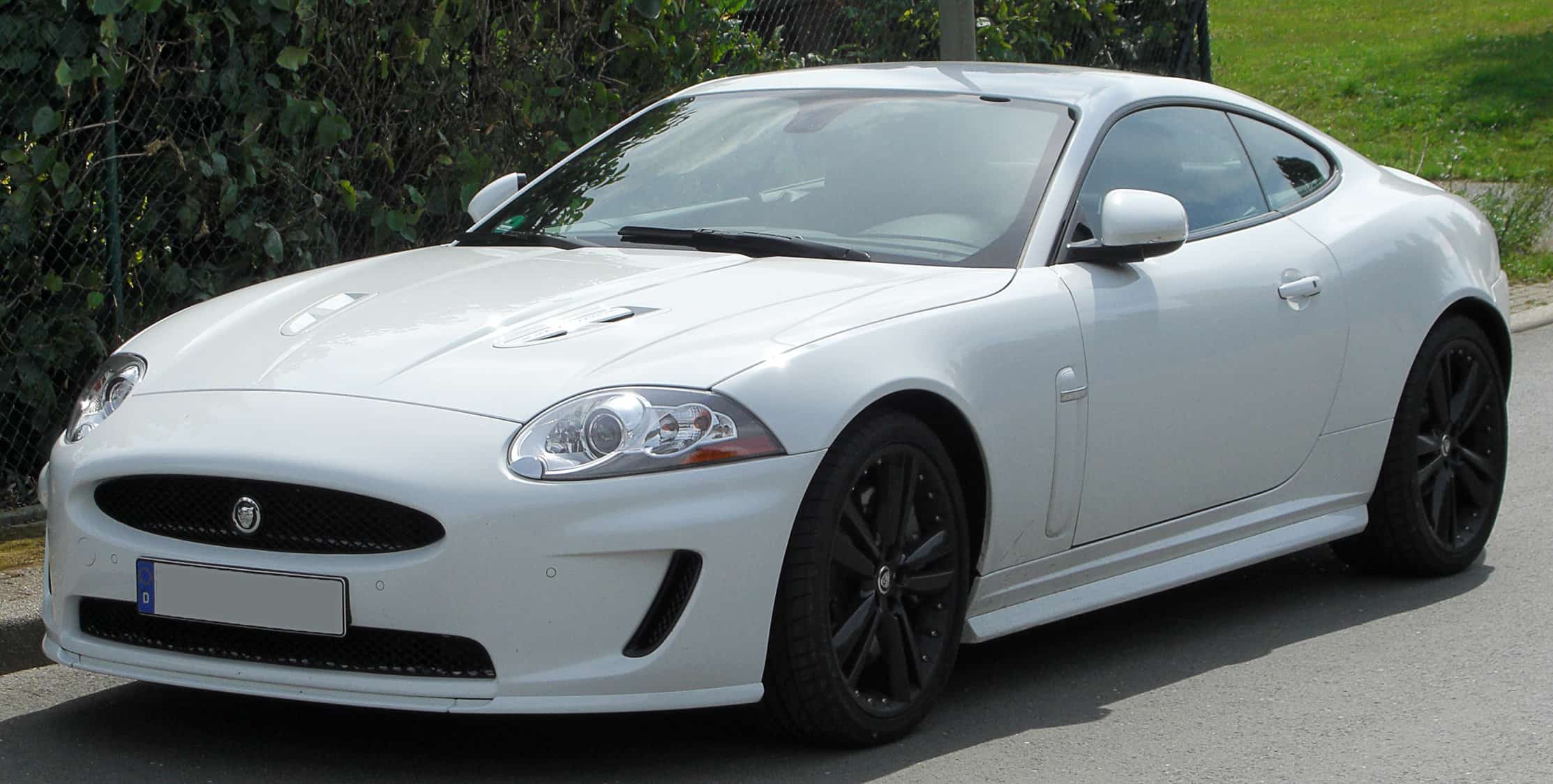
The XKR I’d like to consider is the more recent model, the predecessor to the current sporty Jaguar coupe – the F Type. This is the XKR sold from 2006 to 2014, which looks like this….

The early versions of this car (i.e. the one I could (maybe) afford) have a supercharged V8 of some 4.2 litres that produces nearly 420hp. They’re quick, they’re exceptionally good looking and they’re very comfortable.

I’ve enjoyed one Jaguar experience. I’d like to enjoy another. The XJR saloon was a wonderful car but I did feel like I’d retired prematurely. This muscly coupe is a bit more my style.

XKRs for sale in Sweden are beyond my price range at the moment BUT there are XKRs for sale in Germany at the mid-20K € mark. It’s a contender.

——

Maserati GranTourismo

OK, this one is out of my price range. But just look at it!!

The car above is currently for sale in Germany for €45,000 and that’s waaaaaaay more than I’ve ever spent on a car. Especially on a car that will continue to depreciate. It’s completely foolish to even contemplate, but also uttely compelling.

The Maserati GranTourismo, like the XKR, is a muscle-bound coupe packing a 405hp V8 and an exhaust note that’ll make you giggle all the way home.

As the name suggests, it’s a GT car. A long-distance tripper. That’s something I’d love to make use of while I’m living here in Europe. There are thousands of roads that I’d love to explore here. The Maserati has just the right blend of style, comfort and power to make those road trips even more memorable.

It’s on this list because it’s a bucket list. A goal. Hopefully, they’ll come down in price a little more and I can aim for one in a few years.

——

Porsche 911

The one that got away…..

Back in 2014, I bought a Porsche 968 ClubSport. It was an amazing car and it was the most expensive car I’d ever bought, at A$30,000. If I’d stretched another $10K, I could have bought a really nice air-cooled 911. And of course, air-cooled 911’s that cost $40K in Australia in 2014 are now selling for $90K or more.

Que sera sera.

You can still get into a 911 for under €30,000, however. It’s the ugly duckling of the family: the 996.

The 996 is not the best looking 911 in history. In fact, it’s probably the worst looking 911 in history. But it’s still not a BAD looking car.

This is a 996….

That car is bog-standard, in boring silver and with the horrible runny-egg headlamps.

This is also a 996….

It’s a Carrera 4S with 320hp. And it’s much nicer to look at, wouldn’t you agree?

I can almost hear my mate Mats having a coronary over this because I haven’t mentioned the IMS bearing yet. YES, there are things you have to be wary of with the 996, but there are PLENTY of them for sale in Germany under the 30K mark and many of them claim to have had the IMS bearing upgraded. It’s a matter of checking them out.

There are a lot of things to consider with the 996. The IMS bearing is the just the beginning. It’s not got the nicest interior, for example, and I place a lot of importance on the interior of a car.

But it’s still a 911. And that means something in terms of driver enjoyment and satisfaction.

No, I’m not a big fan of German cars. Not at all. But I’d make an exception for a 911.

——

Alfa Romeo 156 GTA Wagon

There HAS to be an Alfa on this list somewhere, right? The world would be out of balance, otherwise.

The Alfa 156 GTA is a hairy-chested beast of a car. It has that beautiful Busso V6 in its final iteration, making 250hp and still sounding as amazing as they day Guiseppe Busso first fired it up.

I’ve driven a 156 GTA sedan in Australia and it was extremely comfortable and agile for a front-wheel-drive performance sedan. It had exactly the right mix of beauty and fun. And it’s an Alfa. I’ve got a massive soft spot for Alfas, as many of you will know.

Why the wagon? Why not?

——

Morgan 3-Wheeler

I will definitely own a JCW Mini at some stage. That’s one of two cars on this list that I will definitely buy at some point in the future.

The other is the Morgan 3-Wheeler.

If you wanted to pick a car from this list that won’t lose value, you’d pick the Morgan. They’re also totally impractical and therefore hard to sell, but they DO hold their value.

The Morgan 3-wheeler is, in legal terms, a motorcycle. And it’s about as close to a real motorcycle as I will ever get. It has two skinny tyres on the front and one proper-sized tyre on the back. It’s powered by an 82hp V2 air-cooled engine made by S&S Motors in Wisconsin.
It’s completely impractical, but it’s also simple, elegant, and at just 550kg, extremely light. That’s a recipe for FUN and if you check out all the videos online, that’s exactly where the 3-Wheeler excels.

I will have one, one day.

Enjoy the video.

——

Please Support Jim’s Ride for a Cancer Cure

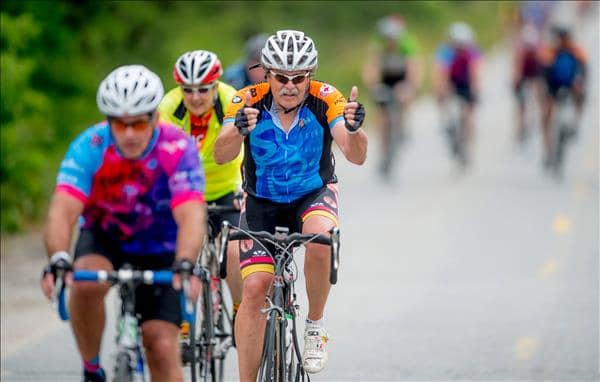
It’s that time of year when I ask you – once again – to support the endeavours of our mutual friend Jim Coggeshall as he participates in the Pan Mass Challenge to raise money for the Dana Farber Cancer Institute.

This is Jim’s seventh tour in the Pan Mass challenge and my guess is that we’ve been supporting him for at least 6, or maybe all 7 of those rides.

Jim is a cycling fanatic, an owner of 4 fine Saabs (and a very nice MG), a connoisseur of fine music and just a general all-round great guy. I first met Jim in 2010 when he was just a rookie cancer survivor (see next paragraph). I had the pleasure of spending a few days at his home last year and it was great to spend some more time with him AND get a drive of his gorgeous Saab Sonett.

CLICK HERE TO DONATE

Jim is a four-time cancer survivor, thanks in no small part to the outstanding research and clinicians at the Dana Farber Cancer Institute. He’s not just a fundraiser for cancer research – he’s a walking advertisement for it.

Jim will most likely top the ,000 mark this year, for funds raised over his seven rides. On top of that, he’s personally donated around $8,000 of his own heard-earned to support other riders.

I support Jim’s ride every year because he’s a great mate, and this is a great cause. Everybody is touched by cancer in one way or another and the Dana Farber Cancer Institute is doing great work developing treatment regimes that eventually find their way to your local hospitals. This is a donation to one place that can have a lasting effect around the globe.

From Jim:

I’m asking again for support as I join over 5,500 other cyclists as we attempt to meet a goal of raising over $48 million in one August weekend by riding across the state of Massachusetts. In the history of the event the PMC cyclists and their sponsors have been able to contribute over half a billion dollars to fund cancer research at the Dana-Farber.

If you’re reading this in the USA, you should know that your donation is tax-deductible and eligible for most company donation-matching programs. If you’re not in the USA, please donate anyway and enjoy the good karma.

CLICK HERE TO DONATE

As always, I’m not asking you to donate without having done so myself. I’ve just tipped $200 into Jim’s hat. The readers of SaabsUnited and Swadeology have donated multiple thousands of dollars over the stretch and I hope you’ll step up to the plate again this year.

——

By way of catch-up……

Long time, no write. Well, the last post was just 6 weeks ago but it feels like a looooong time ago. A brief look tells me this is just my fifth entry for 2017. Not even one a month. Bad Steven.

I’d write more, but I guess real life has taken over from internet life for a while, which is not a bad thing in 2017.

And besides, one of my main (publishing-related) interests is watching the demise of the sitting US president and nothing I put on ‘paper’ here would be as entertaining or as effective in bringing down the pussy-grabber-in-chief as the man himself (and yes, I fully realise the sadness inherent in that statement). America is being presided over by an idiot, the small-c captain of a Ship of Fools.

I hope you’re all well, and that you’re ticking some interesting cars off your personal automotive to-do lists.

I recently sold my Jaguar XJR – did I tell you about that one?

It was a 1995 model, with a 4-litre super-smooth, supercharged engine producing 320hp. It was red with a tan leather interior and I felt like a distinguished gentleman every time I got behind the wheel. It was everything I hoped my first Jaguar would be.

Why did I sell it? Basically, I needed the money more than I needed the car. I still have my 2003 Saab 9-5 SportCombi and being a two-car-guy with only one parking spot is a pain in the patoot.

The Jaguar is gone but another will take its place, eventually. I’ve been keeping an eye on the prices of the Jaguar XKR from around 2010. One of those would do nicely. The sexiest car in the world for me right now is the Maserati GranTourismo but they still exist only in la-la-land for a man of my modest means. Que sera sera.

My other automotive interest at the moment is the utterly charming Morgan 3-wheeler. It looks like it’d be a blast to drive and it’s so impractical that it’d make a perfect addition to the Swade garage. All in good time.

Present day bottom line – It’s fair to say that my automotive world is fairly plain right now (if you don’t count the Koenigseggs I see at the office every day). The Saab is reliable and comfortable – it’s actually more comfortable than the Jaguar was, I’m surprised to admit – and it’s worth so little in financial terms that it makes no sense to sell it at this point in time. Maybe next year, if the yearning for something zippy gets strong enough.

Until next time, please donate to Jim’ ride.

This has been fun. I hope to get back to a more regular posting schedule in the near future.

Saab Festival 2017

Everyone’s Saab Festival is different. Some people go for the cars. Some people go to dream. Some people go for their once-in-a-lifetime pilgrimage to Trollhattan. Some people go just to catch up with their mates.

I last went to the Saab Festival in 2015 and I don’t think I wrote anything here about it. I was winding down from my previous job and about to start a new job at Koenigsegg and I just wanted to be there and enjoy the moment. It was great.

At previous Saab Festivals, I’ve worked feverishly to get all the news and pictures from the event into your news feed as quickly as possible. Those Festivals were exhausting.

This year, it’s a combination. I spent quite a bit of time chatting to old friends and colleagues from Saab. I also spent a lot of time at Saturday’s car show, admiring the cars on display and dreaming of ticking a few cars off my list.

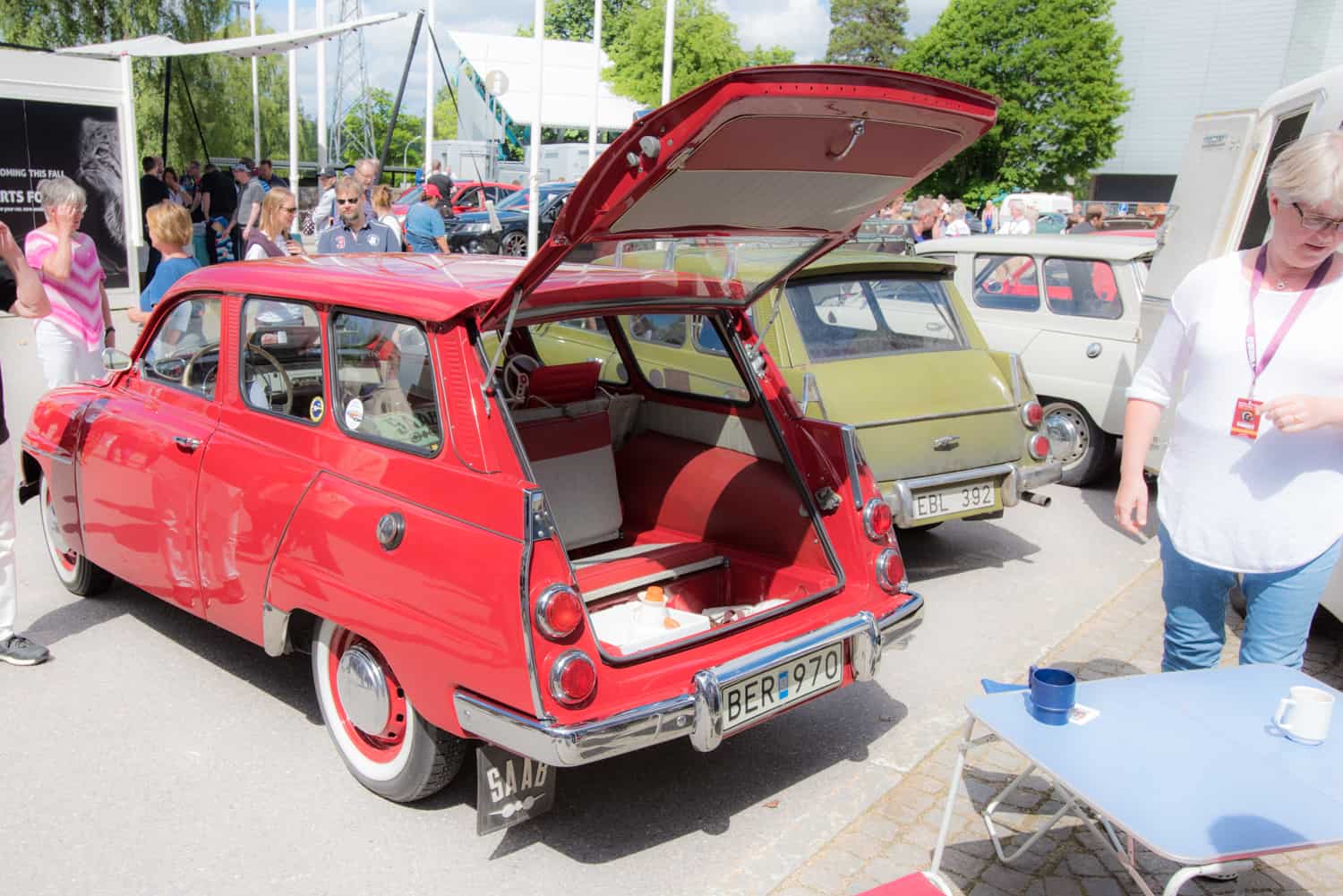
These are those cars. I didn’t photograph everything this year. I mainly spent time around the cars I’d really like to own examples of, one day. Those are the V4’s and the 99’s. You won’t see much else in the gallery below, so if you’re looking for 9-3’s or 900’s, today’s not your lucky day.

The Cars

As mentioned, it’s mostly about V4s and 99s this year. I feel like I’m closer to getting a V4 (in fact, in the month leading up to the Festival, I came very close to buying a Saab 95 that’s been converted into a ute). It’s just a matter of when. It would have to be my 2nd or 3rd car, though, and right now, I only have one car space. All in good time.

Being around the V4’s just makes you feel good. I think it’s a lot to do with colour. The 9-3 area of the exhibition was a monochromatic sea of black/grey/silver. But have a look at the V4/2-stroke area:

Doesn’t that make you smile?

The beauty of these cars is that you can do nearly anything with them. You can paint them whatever colour you like. You can put the craziest stickers or decals on them. Whatever you do, people still love them.

A few notables from the wider display, then…..

This Saab 99 Turbo caught my eye straight away. It’s a 2-door in Marble White, the same colour as my first Saab 99 Turbo from all those years ago. Of course, it also had the green velour interior, too. Delicious!

——

This Saab 9-5 SportCombi was interesting. Not only is it one of only a handful of NG 9-5 SportCombis in existence, it also started out life as a sedan!

The info I received is that the owner (who also has a uniquely modified 9-5 sedan badged as 9-5x) did the work himself, using a combination of the original 9-5 sedan trunk lid and the rear door from an Opel Insignia wagon. The workmanship was first class – a very impressive result.

——

While the over-all numbers present were very impressive – the Saab Spirit is well and truly alive! – there were not many Sonetts on show this year. I hope that changes in the future.

——

This Saab 96 was probably my favourite car from the weekend. The photo isn’t a 100% accurate reproduction of the colour. It was a tiny bit more blue than what you can see here. The whole car was very elegant. I’m not always a fan of modern wheels on old cars but again, these modern wheels are simple enough to enhance the car and improve the stance without screaming “look at me!”

Very nicely done, sir.

Enjoy the full gallery, below. Click to enlarge.

——

The Details

This is pretty much what the Saab Festival should be about, right? You get your car out, open it up and invite the world in for a nice cup of tea 🙂

I see images like that and I can’t help but smile. Part of that is the beautiful spirit present and part of it is the old classic V4 and the pictures you can paint with a car of such significant character.

As I wandered around the display on Saturday, I was taken in by the ways people lent their own personal touch to their cars. The stickers on the windows, the decals on the body, the props on the parcel shelf. They all added something human to what is already a very animated, ‘alive’ type of car.

Please feel free to indulge with me as we look over some of the details on show…..

——

What was the last thing to go through this fly’s mind before he hit the Sonett badge? 😛

The 10 Best Prince Songs You’ve (Probably) Never Heard

This week marks the first anniversary of Prince’s death.

He was the greatest musician of my lifetime, definitely one of the most prolific songwriters of my lifetime and arguably one of the best. He was, unarguably, the greatest showman.

It still saddens me to know that he’s gone, that he passed alone like a junkie in an elevator, albeit an elevator at his home studio, Paisley Park. And of course, it saddens me that there’ll be no more new music written and no more shows.

But this isn’t a time for sadness. A life like Prince’s should be shared and celebrated, which is what I’d like to do here.

Prince would often punctuate his shows with medleys from his catalogue – an intro from this, a verse from that – stopping mid-song and saying (with his trademark mischevious smile) “I got too many hits”.

This post isn’t about the hits, though . This post is about those songs that never got played on the radio; songs that reach out to you because of a riff, a lyric, a memory or an attitude. These are some of my favourite Prince songs of all time. If you know them, kudos. If you don’t, you might just be in for a treat.

I’ve put the mp3’s into this article. Hopefully, the files all work OK.

Note to the sensitive: Prince was known for being, shall we say…. suggestive. You have been warned.

——

Prettyman

This is the final (hidden) track on Prince’s final album of the 1990’s – Rave Un2 The Joy Fantastic.

The whole song is a shining example of Prince’s trademark humour “They all hate me cause I’m beautiful” before moving into a super-funky, James Brown-esque jam. Prince provided all the vocals and 90% of the instruments, with just a drummer and saxophonist Maceo Parker adding parts to the song.

Play it with a smile.

“When it comes to perfume, if it’s on the shelf – I get it down, if there ain’t nobody around, I….. I smell myself”

https://swadeology.com/wp-content/uploads/2017/04/Prettyman.mp3?_=1

——

Joy in Repetition

Graffiti Bridge was the worst movie Prince made. Actually, it was one of the worst films anyone ever made.

But it has a great soundtrack.

Joy in Repetition features a narrative, both spoken and sung, that builds and builds before a magnificently loose and dirty guitar solo over some grinding backing vocals. This song is a favourite of mine, aside from the building drama, because it’s a great example of both Prince’s creamy vocal arrangements, as well his rather amazing guitar chops.

This one’s great in the dark.

“These two words, a little bit behind the beat, I mean just enough to turn you on”

https://swadeology.com/wp-content/uploads/2017/04/Joy-In-Repetition.mp3?_=2

——

The Exodus Has Begun

Not your typical Prince track…..

This is the final song on an album by Prince’s band, the NPG. The album is called Exodus. Prince isn’t credited by name on the album but, naturally, he’s all over it.

You’ll hate this song on first listen. You’ll just think it’s weird with its modulated vocals and odd rhythms. Feel free to go over it a couple of times, though, and let it stick.

This is a protest song about artists’ rights, recorded under The NPG name with Prince going un-credited and on his own label, NPG Records. Prince’s contribution to the album is officially credited under the name Tora Tora. Whatever. Eccentric is as eccentric does.

This was recorded and released at the beginning of his dispute with Warner Brothers (the label with the rights to release music under his own name at that time). Prince subsequently quick-released four albums in two years with Warner Brothers in an attempt to get out of his contract quicker.

“Long live the new power! Generation after generation, soul will never die”

https://swadeology.com/wp-content/uploads/2017/04/The-Exodus-Has-Begun.mp3?_=3

——

Time

Proof that Prince’s songwriting kung-fu was still potent well into his 50’s, Time is a beautiful duet with Cameroonian singer-songwriter Andy Allo.

It’s nearly 7 minutes long and sounds best on a sofa with the curtains drawn.

“I think it’s ’bout time, that I got time, alone with you”

https://swadeology.com/wp-content/uploads/2017/04/TIME.mp3?_=4

——

Violet The Organ Grinder

Violet is a song on its own and a remix all the same time. It uses the unmistakable drum track and chord structure from Gett Off but applies an all-new vocal full of cheeky double entendre.

Dance like nobody’s watching. And laugh.

“I am Violet, the organ grinder, and I grind all the live-long day”

https://swadeology.com/wp-content/uploads/2017/04/Violet-the-Organ-Grinder.mp3?_=5

——

Baby Love

This is an outlier on this list in that it isn’t Prince singing and it isn’t even a Prince song. It’s a live recording from a Prince concert, however, with lead vocals performed by one of Prince’s support singers, Shelby Johnson.

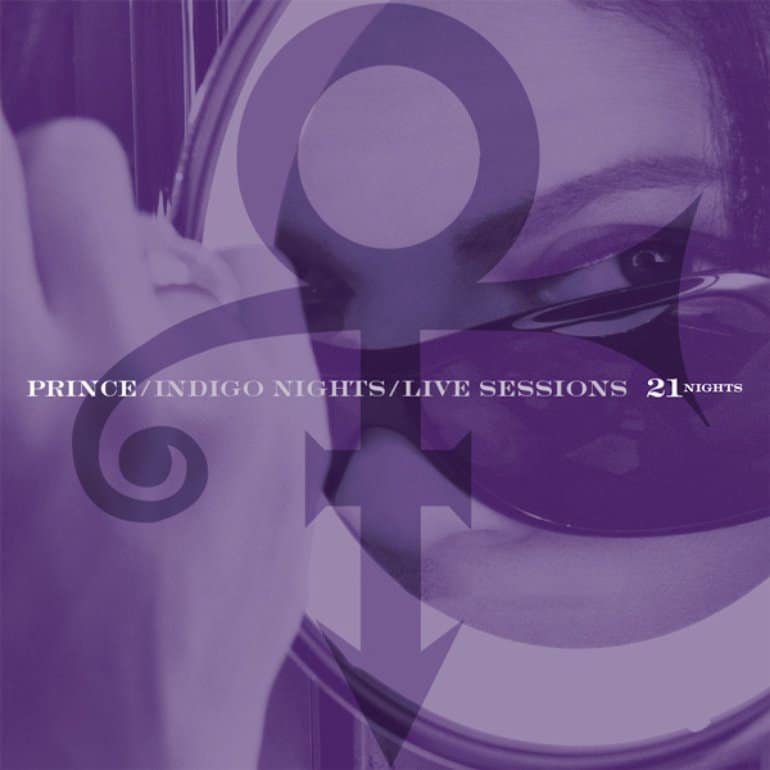
This recording was captured on his Indigo Nights album, a special live release that came as an accompaniment to a book called 21 Nights. The recordings were taken from two of Prince’s after-shows in London.

Note: Prince and his band performed Love Is A Losing Game with Amy Winehouse at the same show that this recording is taken from.

Baby Love was originally recorded by a funk rock band called Mother’s Finest. Dance to it in your kitchen and get goosebumps when Shelby J reaches for it in the last verse.

“Sing it, mother!”

https://swadeology.com/wp-content/uploads/2017/04/1-13-Baby-Love.mp3?_=6

——

Chelsea Rodgers

Prince cut his teeth on early records doing catchy disco-funk songs like DMSR and I Wanna Be Your Lover.

Released in 2007, Chelsea Rodgers goes back to that early feel but adds a lot more sound. It’s a duet with Shelby J sharing the lead vocals.

This is a great morning motivator. Play it loud.

“Chelsea Rodgers was a model, but she really rock n rolled”

https://swadeology.com/wp-content/uploads/2017/04/Chelsea-Rodgers.mp3?_=7

——

Get on the Boat

Prince had a bit of a spiritual revival in his later years. He was a Jehova’s Witness and while he didn’t completely remove the relationship overtones from his songwriting, he did try to sanitise his work a little. He stopped performing fan favourites such as Gett Off and Darling Nikki in live shows, for example. Our loss.

Get On The Boat is a funk-spiritual dance song. It’s all energy, driven by a great drum track and some wicked horns. It also features his long-time collaborator, Shiela E, on percussion.

The song was released on an album that was seen by many as his return to commercial form, 2006’s “3121”.

“Everything in the darkness must come out into the light”

https://swadeology.com/wp-content/uploads/2017/04/Get-On-The-Boat.mp3?_=8

——

P-Control

The P stands for Pussy, the central character of the song. Pussy Control is her name and her nature.

Those who have just a passing knowledge of Prince’s catalogue might think him to be an exploiter of women. Nothing could be further from the truth. Yes, Prince was openly sexual in his art and wrote plenty of suggestive songs but he exalted women, celebrated them, and always portrayed them as empowered people.

Prince demanded the best from his bands and from Wendy and Lisa in The Revolution to the all-female 3rd Eye Girl that he recorded some of his final works with, Prince consistently relied on his female co-creators in the making of his art. His albums and production credits include work with Sheila E, Vanity 6, Sheena Easton, Rosie Gains, Sheryl Crow, Shelby J and many more. He wrote hit songs for Martika, Chaka Khan, The Bangles and Sinead O’Connor.

Call it the conviction of a shorter-than-most black man from America, full of confidence in his belief that everyone should make good music, regardless of colour, size or gender.

P Control is a song about Prince’s type of woman – educated, powerful and in control. It’s cheeky, funky and damn good.

“You need a brother that respects your name, now say it – Pussy Control”

https://swadeology.com/wp-content/uploads/2017/04/3-08-P.-Contro.mp3?_=9

——

The Sacrifice of Victor

The Love Symbol album is my favourite Prince album. I couldn’t construct this list (or any other Prince list) and not include something from it.

The Sacrifice of Victor is a cryptic tale about Prince’s life and the heady times he grew up in. Victor is the name of the central character in the song, but it’s more of an outcome than an actual name. He’s been challenged by life and circumstance, he’s sacrificed and he’s come through everything as a victor. Joy is around the corner.

For those who don’t want to engage in the lyrical content, it’s also one hell of a funky jam that builds and builds and builds.

“When I reach my destination my name will be Victor”

https://swadeology.com/wp-content/uploads/2017/04/18-The-Sacrifice-Of-Victor.mp3?_=10

——

Bonus Track – The Morning Papers

They could contemplate the entire universe or just one star

https://swadeology.com/wp-content/uploads/2017/04/04-The-Morning-Papers.mp3?_=11

——

A Short Study In Fake News

‘Post-truth’ was the Oxford Dictionary’s word of the year in 2016.

If that (now) dubious honour doesn’t go to ‘Fake-news’ in 2017 – hyphenated for eligibility purposes only – then nobility and integrity must be counted as things of the past at the Oxford. No one phrase has embedded itself in political discussion quite like it this year.

Fake News – now capitalised for effect – is now commonly recognised as “anything that Donald Trump doesn’t agree with”. But there was a time, quite recently, when Fake News actually meant something more than that.

Fake News, at the outset, was a news story that looked like it could be true, but wasn’t. It bore some resemblance to ‘a’ truth if you squinted hard enough while reading it, but it smelt a little bit funny and eventually, was proven to be untrue.

It’s the typical strawman diversion of the past, but taken to Troll Level 10.

How was it done?

Example 1 – Play with inconsistencies

The Sandy Hook school shooting.

The Fake News spin says (among many things) that Adam Lanza could not have used an AR-15 Bushmaster rifle in the incident because initial reports claim that that particular weapon was found in his car.

Yes, initial reports may have claimed that. But those initial reports were later corrected. The police themselves issued a correcting statement as reported by NBC in Connecticut:

Police released a news release on Tuesday, saying they provided details in news conferences but wanted to eliminate any confusion or misinformation.

Police said they found a Bushmaster .223 caliber model XM15-E2S rifle with high capacity 30 round clips, a Glock 10-mm handgun and a Sig-Sauer P226 9mm handgun inside the school.

Police also searched Lanza’s car, which was in [the] parking lot, and found an Izhmash Canta-12 12-gauge shotgun.

Initial reporting around a tragedy like Sandy Hook is always sketchy at best. The news cycle is a savage, hungry beast, and sadly, even among established and credible outlets, the primary competitive motivator is to be First, not to be the most accurate. Details are sometimes reported before they’re confirmed and have to be corrected later. It’s sad, but true.

Such reportage has consequences.

Conspiracy theorists have built websites and made movies about how there are inconsistencies in reportage around what happened at Sandy Hook. They claim these inconsistencies are proof that the attack never happened. The ‘best’ of these conspiracy theorists actually make a living off this stuff.

There are a dozen or more claimed inconsistencies like the one quoted above. All of those holes in the reporting have since been cleared up but the corrections go unnoticed and those holes in the narrative give Sandy Hook sceptics the ammunition they need (pardon the pun) to run their mouths off and spout their conspiracies.

Why do they do it?

They’ve usually got a vested interest in doing so. They might be gun nuts looking to promote/protect the second amendment. They might be anti-government extreme right-wingers looking to throw mud at government involvement in anything. They might simply be looking to get the attention of weak minded individuals so they can sell them stuff (hello, Alex Jones).

The bottom line – Fake News is a conspiracy theorist’s wet dream. It’s a scenario where you get to take a true story and inject just enough doubt – credible or otherwise – so you can twist it to your own ends.

Example 2 – Shake and Twist. Believe Me.

“Donna Brazile Admits to Sharing Debate Questions With Clinton Camp, Blames Russia”

That’s the top headline at Fake News specialists, Breitbart News, as I write this article. Here’s the screenshot to prove it.

Again, you take an element of truth and spin it the way you want it to go.

The source article referred to in the Breitbart story is an Op Ed written by Brazile for Time Magazine (note: Fake News purveyors rarely do any actual journalism. They mostly spin articles produced by actual news and opinion outlets (which they typically later brand as mainstream, out of touch, or most amusingly, fake))

Breitbart’s headline makes it sound as if Brazile is admitting passing possible town hall topics on to the Clinton camp for the first time. She’s not. She did that when she stepped down from CNN. Breitbart’s headline makes is sound like she’s blaming the Russians for her own wrongdoing. She’s not.

If you actually read the Time story, you’ll read Brazile breaking down the Russian hack and the effect it had on the DNC. Her wrongdoing, which she freely admits to and regrets, is part of what was exposed by the Russian DNC hack but the Time story is about much more than that.

That’s Fake News as done by the specialists. Shake, twist, and count on people to accept what you say without checking further.

Breitbart’s inclusion of a link to the source makes everything seem more credible, but in truth they’re counting on readers to accept that level of seeming credibility and not bother to click on that link and weigh the story for themselves.

Example 3 – Duck, roll, shimmy, blame everyone else just like Bart Simpson used to do.

You knew this was coming, didn’t you? Yes, it’s our favourite Fake News disseminator, Donald ‘Joffrey’ Trump. This is an example of Fake News being constructed right before our eyes.

The Real News story is that Donald Trump used Twitter to claim that his predecessor, Barack Obama, ordered some wire-tapping on Trump Tower a month before the election in 2016.

Here are the tweets, straight from his personal Twitter account:

Those tweets represent one hell of a public accusation. Such action by a sitting president would be a federal crime so it’s not something you should go bandying about, willy nilly.

That’s the Real News story here.

The Fake News story is the narrative that’s now being used by the Trump administration to explain these tweets.

In an interview with Tucker Carlson through the week, Trump cited an article in the New York Times – yes, they are credible when it suits his needs and ‘failing’ the rest of the time. The article in question was on the front page on January 20 – Inauguration Day – and had a headline in the print edition that said Wiretapped Data Used in Inquiry of Trump Aides. The headline was changed for the online edition.

That’s source 1, as quoted by Trump and others.

Source 2 was a brief interview given by a former judge, now talking-head on Fox News, Andrew Napolitano. Here it is.

The problem with Source 1 is that the story doesn’t support the charge. The headline might suit Trump’s narrative if you have a vivid imagination and you squint hard enough when reading it. But the story doesn’t support his assertions. At all.

The story does cover the use of surveillance to investigate associates of the now-president. But where Trump alleges that Trump Tower was definitely wiretapped with orders coming direct from President Obama, the story says nothing of the sort. In fact, the story says nothing about Trump Tower being under specific surveillance, let alone any orders for such surveillance coming from the White House.

Such things matter when you’re publicly accusing a former president of a specific federal crime.

The problem with Source 2 – When President Trump was pressed on the wiretap issue by a German reporter in his press conference with Angela Merkel, he told the reporter that he should “go talk to Fox”, presumably because that’s the other source where Trump’s theory-presented-as-fact came from.

As it turns out, however, the ‘judge’ on Fox had no evidence to support this theory-presented-as-fact and Fox has since disavowed his statement, live on air. The key quote is at 1:20 in the video below.

Source 2 has bigger problems associated with it, too, namely the accusation that President Obama strong-armed an ally (the Brits) to conduct this surveillance on his behalf. Britain’s GCHQ has since commented and the agency was unequivocal in its denial.

And as if sources 1 and 2 being discredited aren’t enough, a statement from the chair and vice-chair of the government’s own Senate Intelligence Committee said:

Based on the information available to us, we see no indications that Trump Tower was the subject of surveillance by any element of the United States government either before or after Election Day 2016

Speaker Paul Ryan has also said no such wiretap existed.

The real news: President Trump accuses former president of federal crime without evidence.

The fake news (now being spread by the guy in the Oval Office): Obama wiretapped Trump Tower.

Words matter.

The president’s words matter a lot.

I want to finish by making a really important distinction:

Fake News and incorrect reporting are two very different things.

As you’ve seen here, Fake News is the deliberate twisting of a story beyond its factual base to serve one’s own ends. It’s misinformation with just enough credibility to sway non-thinking readers to believe it.

Incorrect reporting, on the other hand, is a reporter making a mistake. You can tell when incorrect reporting happens because credible organisations will retract or correct the report.

Example ….

There was an incorrect news report in January claiming that Donald Trump had removed a bust of Martin Luther King from the Oval Office. The news report came from a reporter for Time Magazine. The reporter realised his mistake shortly after it happened and corrected the record via emails, tweets and in-person. Time Magazine even printed an editorial about how it all happened.

That’s a reporter making a mistake and then correcting the record. It is not Fake News.

As shown in the Sandy Hook example at the beginning of this article, the pressure on news organisations to be first is now a financial imperative. It shouldn’t be that way with news, but it is. Such is life in a capitalist society.

That pressure to be first means that mistakes are made. Those mistakes can be siezed upon by these peddlers of Fake News to build inconsistent stories, or stories that are later twisted to suit a particular motive.

Reputable news organisations will work to correct any inconsistencies and note those corrections as footnotes to their articles.

We rely on an independent media now, more than ever. Some understanding and maybe even a little forgiveness is going to be required, as is a lot of financial support. I’ve said it more than once in the last year, but please go out and buy a subscription to your preferred reputable news outlet. I don’t care if it’s left or right leaning in its editorial slant, as long as it gives you fair, fact-based coverage.

Support your local media.

Exit mobile version