Volvo V40 plays familiar, catchy tune

The latest in my series of “Alt-Saab” entries belongs to the new Volvo V40.

The car is launching in Australia right now and pricing starts from a pretty competitive (and sub-Saab 9-3) price of ,990 plus ORC.

For that, you get a reasonably breathless 84kW (113hp) four-cylinder turbo BUT…. it’s a diesel, so it’s got great mileage and importantly, 270Nm of pulling power to make driving it a lot more pleasurable than the power rating would suggest. There’s also a five-cylinder diesel for $5K more, as well as two petrol engines: a 132kW 2.0 turbo four and the range-topping 2.5 litre five-cylinder R-Design, with 187kW (250hp) for ,000.

Those engines sit under the hood of a car with nice styling, decent equipment levels and as always, great ergonomics and safety. And speaking of the V40 hood, it’s the first in the world to be equipped with a pedestrian airbag!

Cue Dudley Moore: Volvo – built to protect Volvo drivers from other Volvo drivers 🙂

——

The V40 appears to be a bit smaller than most Saab fans would like. It’s got the all-important rear hatch/door but you’ll need the folding rear seats for bigger items as there doesn’t look to be too much room behind them.

The equipment list is long and only gets longer the more you go up the model tree. Both generic and Volvo-centric terminology abounds depending on which one you choose:

Stop-start technology and regenerative braking.
Electrical Power Assist Steering (links with other safety aids)
Lane Keeping Aid
Park Assist Pilot
Upgraded stability and traction control
Blind Spot Information System (new, using radar)
Pedestrian Detection System
Pedestrian Airbag
Driver Alert System (incl Lane Keeping Aid, Road Side Information and Active High Beam)
Active Bending Lights

…..and all of that’s leaving out the interior trimmings and gadgets like ambient lighting, eight-speaker stereo, standard 5-inch TFT screen (upgrade to 7-inch available), LED DRL’s, parking sensors and automatic wipers.

Go further up the tree for leather, electric seats, reversing camera, etc.

——

The V40 has smart styling, a well designed interior, good engine options (esp in diesel markets) and I’ll look forward to actual road tests here in Australia to read how it drives. If it’s anything like recent Volvos I’ve driven then it’ll be stable and well sorted, if not thoroughly engaging.

Given that, the question remains for current/former Saab owners – would it make your list?

—

The Qoros Logo Looks Like A Thought Bubble

I don’t know if this is a good thing or a bad thing. At this point it’s just a thing.

But it’s a thing that’s hitting me every time I see it – the Qoros logo looks like a thought bubble. Actually, it’s more like a quote from a science-fiction comic book.

Qoros is a Chinese car company launching specifically with an eye outside Chinese markets. Qoros’ parent company is Chery, a company that makes cars for China as well as selling in a few markets overseas. Qoros is significant in terms of Chinese-owned car companies because while they’ll also sell in China, it’s the first Chinese car company I’ve noticed being launched specifically with Western markets as their focus.

The Qoros name should be familiar to regular readers here because I’ve mentioned it several times before. A few weeks ago on February 5, I mentioned the fact that Qoros will quite possibly be the first car company to launch a vehicle using eAAM’s electric drive system, the one that Saab was supposed to use in the Phoenix-based 9-3 replacement. RedJ has done a nice article on that on SaabsUnited today. Qoros’ press release for Geneva doesn’t use the name eAAM anywhere, however the system described follows the same principles and Qoros representatives mentioned to members of the English press that it was the same system at a recent media event.

The vehicle linked to the eAAM system is the Qoros 3 Cross Hybrid Concept (see photo in gallery, below). For Geneva, it’s a concept car only. There’s no launch date mentioned but Qoros do hope to launch a new vehicle every six months after the basic Qoros 3 Sedan launch later this year.

(As an aside…….. Qoros’ possible use of eAAM’s technology makes their cars very interesting. It’s potentially a genuine innovation worthy of piquing the interest of a Saab fan. Whether Qoros can become a new Saab is a question worth some consideration, but it’s going to take a lot more than just some fancy partial electric drive system to do that. It’s a foot in the door, nonetheless.)

The other reason I’ve mentioned Qoros a few times is because there are quite a few former Saab people working in Qoros’ PR department.

Who knows? There might be Saab people in other parts of Qoros, too.

Given that I’m connected with a few people from Qoros on Facebook, I see Qoros press releases when they come out and I get to see their vehicles, and the Qoros badge, several times a week. The thought bubble thing has nagged at me since I first saw it, hence this post today.

That it’s memorable and modern is a good thing. Hyundai’s stylised ‘H’ logo drives me bonkers. But does the talking Q potentially trivialise what’s supposed to be a serious tilt at the European market? Can they capitalise on this to benefit the company? Maybe I’m just trivialising it because it sticks in my brain and I’m a trivial bastard sometimes?

I think they can us it for good, however. As always, it’ll depend on the product. If they can prove to be an innovative company and introduce other technologies that make owning their cars a better experience, the unstated implication of a thinking/talking about it could well be a good thing.

At the moment, it remains purely as just a thing. We’ll have to wait and see if Qoros can make it a thing worth talking about.

——

Below….. the Qoros 3 Sedan (prduction car for launch late in 2013), the Qoros 3 Cross Hybrid Concept and the Qoros 3 Estate Concept.

—

NYT v Tesla – Everybody Loses

Warning! 3,400 words here. Grab a cuppa and rest your bones.

It’s been NYT v Tesla all week in the automotive press and everyone’s been sharing their opinion. I’m not going to elaborate much more on this from my own personal point of view except to say that when Tesla owner Elon Musk made it personal, it was a PR mistake on his part.

Question observations, by all means, and let the facts speak for themselves.

Question the professional and personal integrity of an experienced senior journalist at a long-established masthead? That’s a whole new ballgame.

There are different types of people interested in EV’s. There are those who are curious, even up to the point of considering a purchase some time in the future. Then there are those who are 100% sold already, usually newly fervent to the point of being cultish. Those in the latter category, who prostrate themselves at the altar of EV sweetness and light (especially those who mock to the point of segregation when people do not have the same blind faith) more than just admire Musk’s passion and his willingness to defend his company. To the rest of the motoring world, however – including the motoring press – he simply looks like a bit of a tool.

I’m not going to go through the claims and counter-claims of the last 5 days with a fine toothed comb here. Those who have covered this story have done so with more thoroughness and timeliness that I could. Here’s a list of links and quote from the best articles I’ve seen through the week, however.

Read them all, if you’re inclined, and draw your own conclusions.

——

The whole shebang started here, with the New York Times account by John M Broder of his ill-fated trip in very poor weather, testing out Tesla’s SuperCharger charging network on the east coast of the US. He was driving a Tesla Model S specced at around US$100K with the big 85kWh battery that Tesla claims has a 300 mile range. The EPA rates it at 265 miles. The distance between charging stations was 200 miles but day 2 of the trip, the return leg, saw him on the back of a flatbed truck.

Elon Musk initially fired his first thoughts on Twitter, claiming that the test was a fake, followed by some elaboration on US television. This led to some more explanations from Broder via the NYT.

When I first charged the car, which was equipped with the highest-capacity battery available, of 85 kilowatt-hours, at the Tesla Supercharger station in Newark, Del., I left it connected to the cable for 49 minutes until the dash display read “Charging Complete.” The battery meter read 90 percent full, with a range of 242 miles.

In that CNBC audio, you’ll hear Elon Musk tell them that Broder was told he had to have the battery fully charged. Broder’s recall is different and quite explicit:

I was not directed by anyone at Tesla at any time to then switch to the Max Range setting and wait to top off the battery. If I had, I might have picked up an additional 25 or so miles of range, but that would have taken as long as 30 additional minutes.

The other thing about topping it off above 90% is that it actually shortens battery life. Tesla claim that the Model S is an EV without the compromises, that you can do long trips in it. Anyone spending $100K on the biggest-battery version, however, isn’t going to deliberately shorten their vehicle’s life too often, especially when your destination is well within the projected range of the vehicle. This is the difference between real-world testing (to drive it like a normal person would) and fairyland Beta testing with a bunch of stated rules and hard parameters.

The next big step in this saga came when Elon Musk published his promised blog post on Tesla’s website, including datalogs from the car in question.

Musk’s article certainly prompted some questions and it’s only right that Broder be asked to elaborate on issues like these:

Cruise control was never set to 54 mph as claimed in the article, nor did he limp along at 45 mph.

At the point in time that he claims to have turned the temperature down, he in fact turned the temperature up to 74 F.

As the State of Charge log shows, the Model S battery never ran out of energy at any time, including when Broder called the flatbed truck.

That last one’s particularly damning and musk follows it up with this:

When the facts didn’t suit his opinion, he simply changed the facts.

That’s a massive allegation to lay at the feet of an experienced senior journalist and it’s allegations like that that have most likely prompted other members of the motoring press to look a bit harder at Musk’s counter-claims and charts.

Here’s a selection and a few relevant bits:

The Atlantic Wire examines Musk’s key claims including speed, cabin heating, and wandering around the charging station to get the car to conk out, amongst others. Their conclusion:

Not all of Musk’s data is entirely convincing and the parts that are don’t point to a malicious plot. In the end, it looks like Broder made some compromises to get from the Newark charging station to the Milford one, in both speed and temperature. Broder may not have used Musk’s car the way Musk would like, but Musk is, for now, overhyping his case for a breach of journalism ethics.

Wired ask an obvious question, one that’s been mirrored in Car and Driver as well. No-one wants to ask it directly (perhaps the journos have more respect for Musk’s integrity than he has for theirs) but the question is out there – Could Tesla’s logs be questionable?

To begin with, there’s one massive chunk of the data missing from the puzzle: GPS. According to a Tesla spokeswoman, the automaker didn’t have GPS data turned on in the car, which makes Tesla’s claims that Broder drove around in circle in a Supercharger parking lot dubious, at best.

You might be surprised (or not) but some of the best coverage on this whole NYT v Tesla story has come from Jalopnik. They tracked down the towing company and managed to refute Tesla’s claim that “the Model S battery never ran out of energy at any time, including when Broder called the flatbed truck.”

I just spoke with Donna Rogers at Rogers Automotive & Towing in Milford, Conn., the company that was called out to tow the Model S when it ran out of juice.

She says that their records indicate the car’s battery pack was completely drained. Additionally, she says her tow truck driver was on the phone with a Tesla employee in California, and they were trying to figure out how to get the car onto the flatbed without moving it because it was so dead.

That should be the simplest of all things to figure out – was it dead or not? Could they move it or not? Musk’s claim that there was some charge left in some area means diddly-squat when you’re stuck in freezing temperatures on the edge of the highway in a car that won’t move.

Wired, again, on the cabin temperature claims:

Tesla also suggests that Broder didn’t turn down the interior temperature during the trip, but the chart it released last night shows a dip in the climate control temp from 225 to 300 miles. It might not have been exactly when Broder claimed, but he did it nonetheless.

And they’re right – the chart Tesla themselves provided shows two rather large drops in cabin temperature through the trip.

The Tesla blog also claimed that Broder was a journalist given to disdain towards electric vehicles, that he was prejudiced against them and some of his previous articles prove this. The Washington Post took a look at that claim and it disagrees.

The author of the rant against Broder, Musk, argues that in allowing Broder to test-drive the Model S, the company “let down the cause of electric vehicles.” Those words are a missionary’s, an advocate’s, and they’re evidence of a mind-set that interprets inconvenient facts as “disdain” or bias or worse.

Musk is an enthusiastic advocate for his company and that’s admirable, but fanboy partisanship is for blogs (I should know) not for CEO’s, a point that Engadget also tries to make.

Musk has stepped far beyond simple fact-checker and seems to wade into the realm of moral and ethical judge. It’s in this that he loses the hearts and minds of many — and provides us with an important lesson: When correcting others, present the facts and then step away. Let the discussion brew on its own.

Of course, Musk’s post on the Tesla blog prompted Broder to publish a response at the New York Times, looking at each of Musk’s claims in detail. For some of them, there is simply no explanation. Tesla’s logs don’t show excessive prolonged speeding but they show Broder drove a bit faster than he claimed in the story (though it has to be noted, these are not unreasonable speeds by any means whatsoever – it’s meant to be a real life test, remember).

Broder’s response is essential reading because it’s the final post that addresses specifically the allegations made by Musk. Here’s a rather long excerpt where Broder answers Musk, point by point. This is too important to shorten, so settle in (as if this article wasn’t long enough already)

• “As the State of Charge log shows, the Model S battery never ran out of energy at any time, including when Broder called the flatbed truck.”

The car’s display screen said the car was shutting down, and it did. The car did not have enough power to move, or even enough to release the electrically operated parking brake. The tow truck driver was on the phone with Tesla’s New York service manager, Adam Williams, for 15 or 20 minutes as he was trying to move the car onto a flatbed truck.

• “The final leg of his trip was 61 miles and yet he disconnected the charge cable when the range display stated 32 miles. He did so expressly against the advice of Tesla personnel and in obvious violation of common sense.”

The Tesla personnel whom I consulted over the phone – Ms. Ra and Mr. Merendino – told me to leave it connected for an hour, and after that the lost range would be restored. I did not ignore their advice.

• “In his article, Broder claims that ‘the car fell short of its projected range on the final leg.’ Then he bizarrely states that the screen showed ‘Est. remaining range: 32 miles’ and the car traveled ‘51 miles’ contradicting his own statement (see images below). The car actually did an admirable job exceeding its projected range. Had he not insisted on doing a nonstop 61-mile trip while staring at a screen that estimated half that range, all would have been well. He constructed a no-win scenario for any vehicle, electric or gasoline.”

The phrase “the car fell short of its projected range” appeared in a caption with an accompanying map; it was not in the article. What that referred to (and admittedly could have been more precise) was that the car fell short of the projected range, 90 miles, that it showed when I parked it overnight at a hotel in Groton, Conn.

Tesla is correct that the car did exceed the projected range of 32 miles when I left Norwich, as I was driving slowly, and it gave me hope that the Tesla employee I’d consulted was correct that the mileage lost overnight was being restored. It wasn’t enough, however, to get to Milford.

• “On that leg, he drove right past a public charge station while the car repeatedly warned him that it was very low on range.”

If there was a public charging station nearby, no one made me aware of it. The Tesla person with whom I was in contact located on the Internet a public charging station in East Haven, Conn., and that is the one I was trying to reach when the car stalled in Branford, about five miles shy of East Haven.

• “Cruise control was never set to 54 m.p.h. as claimed in the article, nor did he limp along at 45 m.p.h. Broder in fact drove at speeds from 65 m.p.h. to 81 m.p.h. for a majority of the trip, and at an average cabin temperature setting of 72 F.”

I drove normally (at the speed limit or with prevailing traffic) when I thought it was prudent to do so. I do recall setting the cruise control to about 54 m.p.h., as I wrote. The log shows the car traveling about 60 m.p.h. for a nearly 100-mile stretch on the New Jersey Turnpike. I cannot account for the discrepancy, nor for a later stretch in Connecticut where I recall driving about 45 m.p.h., but it may be the result of the car being delivered with 19-inch wheels and all-season tires, not the specified 21-inch wheels and summer tires. That just might have affected the recorded speed, range, rate of battery depletion or any number of other parameters. Tesla’s data suggests I was doing slightly more than 50 over a stretch where the speed limit was 65. The traffic was heavy in that part of Connecticut, so cruise control was not usable, and I tried to keep the speed at 50 or below without impeding traffic.

Certainly, and as Tesla’s logs clearly show, much of my driving was at or well below the 65 m.p.h. speed limit, with only a single momentary spike above 80. Most drivers are aware that cars can speed up, even sometimes when cruise control is engaged, on downhill stretches.

• “At the point in time that he claims to have turned the temperature down, he in fact turned the temperature up to 74 F.”

I raised and lowered the cabin heat in an effort to strike a balance between saving energy and staying somewhat comfortable. (It was 30 degrees outside when I began the trip, and the temperature plunged that night to 10 degrees.) Tesla jumped to the conclusion that I claimed to have lowered the cabin temperature “at 182 miles,” but I never wrote that. The data clearly indicates that I sharply lowered the temperature setting – twice – a little over 200 miles into the trip. After the battery was charged I tried to warm the cabin.

• “The charge time on his second stop was 47 minutes, going from —5 miles (reserve power) to 209 miles of Ideal or 185 miles of E.P.A. Rated Range, not 58 minutes as stated in the graphic attached to his article. Had Broder not deliberately turned off the Supercharger at 47 mins and actually spent 58 mins Supercharging, it would have been virtually impossible to run out of energy for the remainder of his stated journey.”

According to my notes, I plugged into the Milford Supercharger at 5:45 p.m. and disconnected at 6:43 p.m. The range reading was 185 miles.

• “For his first recharge, he charged the car to 90%. During the second Supercharge, despite almost running out of energy on the prior leg, he deliberately stopped charging at 72%. On the third leg, where he claimed the car ran out of energy, he stopped charging at 28%. Despite narrowly making each leg, he charged less and less each time. Why would anyone do that?”

I stopped at 72 percent because I had replenished more than enough energy for the miles I intended to drive the next day before fully recharging on my way back to New York. In Norwich, I charged for an hour on the lower-power charger, expressly on the instructions of Tesla personnel, to get enough range to reach the Supercharger station in Milford.

• “The above helps explain a unique peculiarity at the end of the second leg of Broder’s trip. When he first reached our Milford, Conn., Supercharger, having driven the car hard and after taking an unplanned detour through downtown Manhattan to give his brother a ride, the display said “0 miles remaining.” Instead of plugging in the car, he drove in circles for over half a mile in a tiny, 100-space parking lot. When the Model S valiantly refused to die, he eventually plugged it in. On the later legs, it is clear Broder was determined not to be foiled again.”

I drove around the Milford service plaza in the dark looking for the Supercharger, which is not prominently marked. I was not trying to drain the battery. (It was already on reserve power.) As soon as I found the Supercharger, I plugged the car in.

The stop in Manhattan was planned from the beginning and known to Tesla personnel all along. According to Google Maps, taking the Lincoln Tunnel into Manhattan (instead of crossing at the George Washington Bridge) and driving up the West Side Highway added only two miles to the overall distance from Newark, Del., to Milford, Conn.

Neither I nor the Model S ever visited “downtown Manhattan.”

——

Phew!

The end result here is unsatisfactory for everyone concerned, but it is what it is.

Engadget tells two truths in their article:

(A trip like Broder’s) requires a lot more (preparation) work up-front, work that is just fine by me. I’m okay with such investments if it means covering 165 miles in a 416-horsepower luxury car for just 10 bucks’ worth of electricity.

That’s the lure of a ride like this in a car like the Model S. Having your cake and eating it, too.

There’s always a penalty, however, because if there’s one thing I’ve learned having written about cars for the last eight years and having met many different types of car owners in that time, it’s that car companies HAVE to design their cars for unprepared people. Why? Because the vast majority of their customers treat their cars as they treat household appliances. They get in and go.

From another piece at Wired:

Tesla positions the Model S as the first “no compromise EV” able (with the Supercharger network) to take the proverbial “Vegas on a moment’s notice” road trip. Yet after pitching the trip idea to Broder in the first place, Tesla’s own staff needed to issue carefully detailed instructions and make follow-up contact along the way to ensure he got to his destination. In doing so, they busted their own road trip myth before Broder ever left the driveway.

As Slate also note, Broder didn’t just have instructions beforehand…..

Perhaps the most convincing statistic in Broder’s rebuttal is the number of times he called Tesla personnel throughout the trip to ask for help getting the car to its destination: “about a dozen,” he says. That’s hardly what you’d expect from a man “determined” to get the car to die so he could embarrass Musk and co.

The Tesla Model S is a marvel of 21st century engineering. It’s the best electric vehicle available on the market today and it’s forging a path that MIGHT allow electric vehicles to be successful in the future.

In my original article on this story, the headline stated that the NYT test showed the Model S’s flaw. I stand by that 100%.

Whatever Broder did on that test, I don’t believe any of it whatsoever was malicious or designed to make the car fail. I believe he consulted with Tesla’s people along the way. Whether it was flawed advice, flawed technique or just plain lousy weather conditions, the Tesla ended up as a brick.

Slate, again:

The bottom line is this: For a variety of reasons, including user error, the Model S and its brand-new Supercharger network didn’t live up to expectations on one man’s road trip. That doesn’t make Broder a liar, and it doesn’t make the Model S a failure.

And Engadget, again:

The point of that article, it seems, boils down to this: In 2013 you can’t just go on a whimsical joyride to wherever you want in an EV.

…..and that’s the flaw. Whether that flaw is suitably sorted in the next 3, 5 or 10 years is something we’ll have to wait and see on. At the moment, though, it’s an unmistakable flaw and those who deride people for pointing it out do everyone, including themselves, a disservice.

——

One final postscript:

CNN journalists have just completed what is basically the same route. They had better weather conditions but ultimately made the trip with no issues (and no flatbed trucks).

Read their account at that link. It’s very encouraging for Tesla and for people interested in EV’s, no doubt.

It’s good that they proved the tech without a hitch (even if they had some anxiety along the way).

One has to point out, however, the other drawback of EV’s – even those that can use a SuperCharger network. What is usually an 8-hour drive took them 13 hours to complete. Even if you do it for just $10 of electricity, that’s a lot of time sitting around waiting.

—

Saab owners changing brands?

It’s been almost 14 months since Saab Automobile AB went into bankruptcy prior to being sold by the receivers to NEVS.

14 months is a long time. Thousands of leases would have become due around the world and other potential buyers would have shopped the brand in that time if it were still around.

I’m interested to see if Saab owners are changing brands and if so, to what…..

Have you picked up a new Saab since the bankruptcy at a bargain price?

Has the situation with Saab Parts influenced your thinking on picking up such a vehicle, either new or second hand?

Have you gone vintage and picked up a collectable Saab to commemorate your relationship with the company?

Are you waiting and saving for a Saab internal combustion vehicle from NEVS?

Are you waiting and saving for a Saab electric vehicle from NEVS?

Have you departed completely and shopped elsewhere and if so, what’s caught your eye?

——

If I’m asking this of others, I guess I better answer it myself.

Since leaving my employment with Saab in late 2011 I’ve bought an Alfa Romeo and a Subaru. I guess that speaks for itself. I maintain a keen interest with what’s going on with the brand and the community but I’ve owned nearly all the modern Saabs that I’m keen on owning, with the possible exception of a Turbo X SportCombi and a 9-5 Aero Wagon. We’ll likely look at picking up the latter when our 9000 CS dies one day, depending on the parts situation.

Speaking of which, I know the guys at Saab parts are working extremely hard. They’ve taken steps to reach out to customers in Saab’s major markets and that’s a good sign. I still hear stories about people having difficulties in some places, with some parts. I does cause me concern in terms of being a potential owner of a newer Saab, but I think there’s a long life ahead of these cars and if properly cared for, they should provide driving enjoyment for many, many years.

If I get a vintage Saab in the next decade or longer, it’ll be a Sonett III. It’s probably the only one I would consider myself. I’ve had my share of 99s and 900s so for me, the Sonett is the only way I’d go. It’s a magnificent little car.

What catches my eye outside of Saab?

I’m sure no-one will be surprised if I say Alfa Romeo, RenaultSport and Porsche. If I had the space and the knowledge, a private EV project would also be of interest for the daily commute, but that’s not the case right now.

The automotive world’s a wonderful place and the beauty of it is that while there are numerous vehicles that might bore you, there’s always something new and interesting just around the corner. I’m enjoying the chance to familiarise myself with a few of those new and interesting vehicles- even if it’s only in print for the time being.

—

BMW 3-Series GT plays a familiar, catchy tune

BMW are famous for creating niches and then filling them, often answering questions that no-one’s asking. People seem to flock to showrooms and buy them whether they need them or not, almost as if they don’t know how they managed to survive before they had a 2-tonne faux-coupe-styled crossover that looks like a roller skate with 20-inch wheels and traction they’ll never need, let alone use.

Hello X6.

Following on from yesterday’s article on the Mercedes A250 Sport, here’s another new vehicle that should pique the interest of some Saab fans. Yes, it’s a BMW, but don’t let that throw you off because the BMW 3-series GT is going to be available with 4WD (if you don’t like RWD), it’ll be offered with a number of turbocharged engines and ……… wait for it ………. it’s got a hatchback.

The bigger BMW 5-series GT looks like a lumbering oaf of a car but applying the same hatchback treatment to a 3-series has yielded a nice, balanced result. It’s not as pretty as a Saab 9000 Aero was, or even a Saab 9-5 Wagon to switch body shapes for a moment. But it does look reasonably sleek and there’s no doubting the opening at the back makes a decent load-lugging proposition.

—

The BMW 3-series GT won’t be cheap. In fact, here in Australia it’ll start at around $65,000. That’s well above normal 9-3 SportCombi territory when it was around.

The GT does offer some advantages, however.

Firstly, the accommodation is generous. This 3-series GT actually has more rear seat legroom than a 5-series sedan thanks to a wheelbase that’s extended around 10cm or so over the regular 3-series footprint.

Second, it’s going to offer a wide range of proven engines, both petrol and diesel, including the 335i engine that gets people so excited.

Third, well…… it’s available as a new car and the original owner will still be making them in a few years time. That makes a difference.

This is not your average alt-Saab suggestion. It’s bigger and more expensive. But it’s also a car that’s nearly guaranteed to drive nicely, be well made and well equipped.

The styling is a matter of taste. It’s not as easy on the eye as the Mercedes A250 Sport but then it’s a much different type of vehicle. Where the Mercedes is inclined a bit more towards drivers, the 3-series GT could be aimed more towards tourers.

Saab owners – what say ye? Is it an interesting proposition? And if so, more interesting than the Mercedes A250 Sport?

——

Supplementary question:

Five years ago, BMW buyers were widely characterised as badge-craving poseurs. Too much money and not enough sense. People who were more interested in the image than the capabilities of the car.

Do you think it’s still true?

I’d like to offer that the rise of Audi in those five years has taken some of the spotlight off BMW as a pose-mobile.

It still doesn’t mean I’ll forgive them the X6, but it’s something to ponder.

—

VF Holden Commodore SSV – That’s More Like It!

A few days ago I showed the new VF Holden Commodore in Calais V for – the luxury spec model. I thought it looked both bloated and derivative. I wasn’t impressed, though the poll from the same post shows that readers didn’t mind its gastronomous looks as much as I did – you voted for the new one almost 3-to-1. Overnight, images of the VF Holden Commodore SSV version, the sportier model in the Commodore range – and it looks a hell of a lot better.

I still have problems with that ducktail on the rear end but over all, this is a much more appealing look than the Calais V we saw the other day. The chrome treatments on the Calais have been replaced with sportier, more aggressive black. The quad-pipe exhaust, sportier foglamps embedded in deeper bumpers also change the car’s mood considerably.

Finally, I like it.

US readers – GM’s North American head honcho Mark Reuss is due to release this car on the weekend in North America as the Chevrolet SS, hence Holden releasing images today even though the VF Commodore won’t go on sale until mid-year.

Click the images to enlarge.

——

Alfa Romeo and Fiat slash Australian prices

News has come through today that Alfa Romeo and Fiat are slashing prices on their current vehicle range. The price adjustment is part of an sales expansion strategy for both brands following on from a recent dealership expansion.

Alfa and Fiat marketing in Australia passed over to a Fiat-owned organisation in May 2012 after being in the hands of an independent distributor for many years. Contractual obligations kept Fiat from adjusting prices until now.

Alfa Romeo price movements are as follows:

Mito

  • Mito Progression (base model 1.4 litre, auto) down $6,790 from $31,990 to $25,200
  • Mito Distinctive (manual) down by $7,890 from $34,990 to $27,100.
  • Mito Quadrifoglio Verde (manual) down by $4990 from $34,990 to $30,000

Giulitta

The big news in this price adjustment is the Alfa Romeo Giulietta now coming in under $30,000.

  • Giulietta Distinctive (manual) down by $7,640 from $36,990 to $29,350.
  • Giulietta Distinctive (auto) down by $7,640 from $38,990 to $31,350.
  • Giulietta Distinctive Diesel down by $5,740 from $40,990 to $35,250.
  • Quadrifoglio Verde down by $2840 from $41,990 to $39,150.

The Australian dollar has been pretty high for a pretty long time now. Importers have certainly made a decent profit from selling cars here and our currency will probably stay high for a few years yet.

This move from Alfa Romeo might be an interesting sign of things to come both here and abroad (and as an aside, I shouldn’t neglect to mention Fiat, with an average $5,000 cut in the price across all models of the 500 here in Australia).

For Australia, hopefully this might be a hint to other manufacturers to drop prices as well. We’ve been paying over the odds for long enough and thanks to the ease with which punters can get news on the internet, the average Aussie buyer knows it, too. That’s not good news for our local manufacturers, but it’s the truth.

The broader perspective is whether or not this is a signal of Alfa’s strategy as it re-embarks on global growth with a looming entry into the US market. Could they be coming into the US with lower prices than people thought, with the new 4C acting as the beacon to bring people in?

It’s a potential strategy that doesn’t make too much sense to me: make your flagship a true premium pocket supercar and at the same time make your bread and butter vehicles less profitable.

It’ll be interesting to see how it works out for Alfa Romeo, both here in Australia and elsewhere.

—

Mercedes A-Class plays familiar, catchy tune

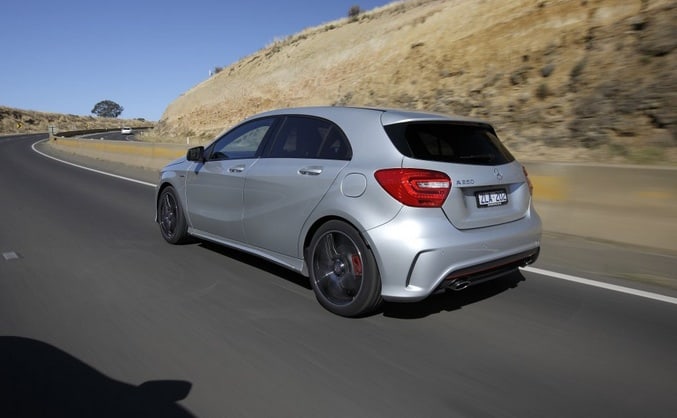
The car in the picture has a two-litre turbo, a (small-ish) hatchback, a well sorted suspension setup delivering good FWD handling and a nicely appointed interior. It’s young, edgy and it’s a Merc. Yes, a Mercedes Benz.

Whilst all the world’s a-flutter about the AMG A45 that’s going to be launched at the Geneva Motor Show next month, there’s a real world Mercedes A-class for sale right now that makes a reasonable argument for itself. It’s the new A250 Sport.

The Mercedes A-Class is no longer the triangular tipping-cow of the city-car segment. This all-new car with it’s completely revised and contemporary styling, deliberate stance and posh interior definitely puts the class into A-Class.

It’s no secret that hot hatches have gone premium, which is exactly why companies like Mercedes and BMW are joining a party once ruled by cheaper marques. Whether they’ve got the performance to match it with the Ford Focus ST, VW Golf GTI or RenaultSport Megane isn’t the point – they’ve got the brand. They’re not selling performance hot hatches to drivers, they’re selling them to brand-aware rich folks who grew up in a Golf, enjoyed the experience but want a bit more bling.

The A250 Sport is no handbag, however. It brings a turbocharged two-litre engine putting out 155kW (208hp) and 350Nm of torque. With its 7-speed dual-clutch auto the car moves from 0-100km/h in just 6.6 seconds.

That’s not going to strip the enamel from your teeth, but it’s undeniably quick.

The suspension has been tweaked by AMG and road tests so far have had nothing but praise for the car’s composure through the twisty bits. It’s NOT going to compete on the road with a focused, driver’s hot hatch (pardon the pun), but then as I wrote above, it’s not meant to.

The A250 Sport is well equipped, too, with faux-carbon, faux-suede, a flat-bottomed steering wheel, color display screen, bluetooth, iPod connectivity and six-speaker stereo, rain-sensing wipers, Xenons, panoramic sunroof and most importantly, not many options. One option is a ,500 AMG pack that adds upgraded leather trim, heated seats (which should be standard, really) and a touch of sport with red stitching throughout the cabin.

I know I’ve got a lot of current or former Saab drivers who read this site, so the obvious question is….. would you consider it?

In the negative column, it’s smaller than any of Saab’s recent cars. It might be a hatch but that contributes to the car’s looks more than to its practicality. Rear legroom and headroom are tighter than they should be (though that’s not going to worry a driver) and the cargo space would be negligible unless the seats were folded down.

The positives are considerable, however. It’s got plenty of safety kit (including 9 airbags!) and whilst the price is hefty at $49,990, fitting the Merc’s standard swag to other hot hatches will have them approaching that price with just a few strokes of a pen.

It’s a little bit of Form leading Function, but if you were in the market for a prestige hatchback with a bit of zip and a lot of good looks, would you consider it?

——

Inside Koenigsegg – The Brain

It’s time to go Inside Koenigsegg and explore another aspect of what I believe are the most advanced, extreme cars on the planet. This has been such a good series.

In this episode, you go right into the fine detail behind the electronic brain that controls Koenigsegg’s vehicle systems. It’s quite possibly just a little too much information, to be honest, but it continues the extraordinary insight that this series provides and if you want to get an understanding of what it takes to build any modern car, looking at the processes of a small producer like Koenigsegg gives you much of the bigger story but in a boutique setting.

As with other episodes in this series, the big take-away is how dedicated Koenigsegg are to designing absolutely everything in-house so that it performs as it should. There are no short cuts and the only thing that vaguely resembles a compromise is time (eventually you have to put out a product, after all).

Enjoy:

——

You can see Episode 1 of this series (Carbon Fibre) here.

You can see Episode 2 of this series (Triplex Suspension) here.

You can see Episode 3 of this series (Perfect Paint) here.

You can see Episode 4 of this series (Interior Surfacing) here.

You can see Episode 5 of this series (Test Drive) here.

——

Alfa Romeo 4C – first pics

The first images of the new Alfa Romeo 4C have just been released ahead of the production model’s debut at the Geneva Motor Show.

I can’t write fast enough as I’m too busy wetting my pants!!!!

Click to enlarge.

Alfa Romeo 4C rear view
Alfa Romeo 4C – front view

——

I am so damn excited about this car. I saw it in Geneva two years ago as a concept car and it blew everyone away. Rumour has it they made the whole concept vehicle in around six months, finishing it just before it was shown. That’s an incredible work rate.

Continue reading Alfa Romeo 4C – first pics

Exit mobile version