
Nobody feels bad for Nicolas Maduro today. The guy’s a jerk and nobody’s crying over him experiencing some consequences for his jerkery. But don’t get upset if people are, indeed, crying today. Metaphically, I mean.
Because this is not how things are meant to be done in a modern, civil, rules-based society.
The Seizing of Maduro
The US employed some precision bombing in Caracas in the middle of the night, cover for a special operations team that siezed Maduro and his wife, and spirited them away in choppers to an awaiting plane. He was then flown to New York, where he now sits waiting for a trial.
Kudos to the US military planners and soldiers for getting in and out with what sounds like minimal casualties on either side. It was impressive work – quite likely assisted from the inside – that in no way justifies its origins.
This incursion follows weeks of US military build-up in the area, and the bombing of suspected drug boats. The US administration provided no proof that those boats were carrying drugs. Not once did they try to sieze a boat, confiscate what was on board and try the crew in a court of law. They just bombed them (and bombed them again if the first bomb didn’t kill everyone on board).
This is not how things are meant to be done in a modern, civil, rules-based society.
The Reason
Officially, this is about ‘Narcoterrorism’. I hadn’t heard the word before the US used it in relation to Maduro, but it’s use actually dates back to the 1980s. Back then, it was used to describe the actions of rogues like Pablo Escobar, who’s looking sad, below.

Escobar had so much money from manufacturing drugs that he could fund his own army to intimidate the Colombian police, and eventually, the Colombian government. He committed acts of extreme violence within Colombia with one hand to show his strength and intimidate the government forces charged with stopping him. With the other hand, he provided some community goods/services, to buy the loyalty of the people. This combination of drug finances and a belief system that demonised the government trying to stop him forms the genesis of the term narcoterrorism that’s being bandied about today.
Modern Narcoterrorists have included groups like Al Queda, ISIS, and FARC. They’re groups that have a core ideological cause that they’re willing to support with violence, and they’re willing to overlook any moral conflicts that their cause might have with very marketable drugs that can finance their terrorist activities. The end justifies the means.
Regular drug manufacturers have not often been labelled narcoterrorists, except by the governments they’ve attacked as they try to protect their operations. To Escobar, the Colombian population was one to be terrorised or protected in accordance with his own ends. The American population was his personal ATM. To whatever law-abiding offices existed within the Colombian government at the time, he was a narcoterrorist. To the US government, he was just another drug dealer.
But all this is just fluff and bluster anyway. The narcoterrorism charges and the trial that will follow are really just a pretense for what this is actually all about.
The Real Reason(s)
What was Donald Trump’s primary criticism of the war in Iraq again?
“You heard me, I would take the oil,” he said. “I would not leave Iraq and let Iran take the oil.”
Reason 1 is that Venezuela has the largest confirmed oil reserves on earth. More than the Saudis, even. And because the country is such a clusterf&@k after years of ineffective government, Trump thinks that it’s OK to go in and sieze those operations. He’s even justified it as taking back something that was stolen from the USA after Venezuela nationalised their oil production – expelling US producers from their fields – back in the 1970s.
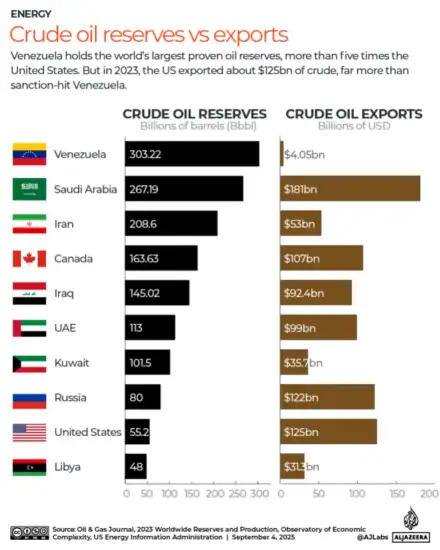
Kicking out the US producers that built a lot of your oil infrustructure was a shitty thing to do. It cost the Venezuelan people billions of dollars in growth and social services. But it wasn’t a breach of international law.
Flying in, siezing a recognised Head of State* and saying you’re going to take over another country’s resources IS a breach of international law.
And that’s not how you act in a modern, civil, rules based society.
(* Maduro was not legitimately elected. But he was recognised as the guy on the ground you had to deal with there and he did have the levers of power to control. Put it this way: Maduro was a Head of State in the same way that Putin is.)
Reason 2 was outlined in the US Administration’s recently published National Security Strategy. The US has changed its posture, no longer counting China and Russia as primary threats to its national security. Where post-war alliances were fundamentally about values-based democracies, economic cooperation, and the rule of law, the focus is now on spheres of influence – being in charge of your own backyard. Might is Right. As long as your business doesn’t conflict with my business, do as you wish in your neighbourhood. Five families stuff, capisce?
Thus, Russia can likely have Ukraine as far as Washington’s concerned. And we’ll wait and see how important Taiwan really is, I guess (esp if Americans can finally manufacture all their own chips). The US will take firmer control of the Americas.
It’s going to be a smaller pond, but Donald’s going to be a much bigger fish.
So Who Cares?
Those metaphorically crying people that I mentioned at the start of this piece. They’ll care. Those who believe that the post-war order was a workable, successful framework for lasting peace and prosperity.
Before the 20th century world wars, people would go to war over just about anything. Men would charge up hills with their shields and swords and pummel each other to death. It was hell, but it was hell on a smaller scale. Nuclear weapons changed the game.
Leaders saw, after the first and second world war, that things HAD to change. The increased destruction possible with modern, mechanised weaponry meant that the world was now in severe jeopardy. The loss of life would not be confined to villages, or cities with medieval-scale populations. We were now talking about the firepower to wipe out modern cities/nations and all of their infrastructure. And left unchecked, some fool would eventually do it. Someone still might.
Leaders created the League of Nations in 1920 to promote peace and international cooperation, but it was a flawed model and without some critical adherents, it failed. With the development and use of nuclear weapons in WWII, there was a renewed effort, leading to the United Nations we know today. It established a framework for a rules-based international legal system designed to promote cooperation between nations, prevent war, enhance economic development and humanitarian assistance.
You might think me naive for believing in it. But I do. The UN isn’t perfect, but it’s done a hell of a lot of good in its time. And it was/is a good start in preventing the spread and scale of war.
With his actions in Venezuela, Donald Trump has potentially planted a final dagger in the UN’s back.
How Do We Read Into The Future?
People might pooh-pooh me for this – especially in the US – and that’s OK. You have your inside view. This is a common outside view.
For just over a year now, the current US administration has made it increasingly clear that the post-WWII order is on its last legs. The order that brought so much to world. It brought economic prosperity to some of the darkest corners of the planet. It brought a greater understanding of world cultures. It brought better health outcomes in less fortunate nations. It restricted nuclear proliferation thanks to a framework that de-escalated conflicts.
The Trump Administration has repeatedly shit all over the allies and friends that the US built up over 8 decades. Between tarriffs and security threats, those who’ve given decades in partnership to the USA are now being sidelined. Some might say it’s just a Trump thing, but how is anyone supposed to trust America again? Half your voting population responds to this. Who’s going to commit decades of cooperation and spending in the future to an administration that’s a) so corruptable, and b) something that could turn in the blink of an eye?
The post-WWII order was not perfect, but it rewarded rules-based international law and democracy, in all their various forms. It fostered peace and cooperation in an era where we now have enough weaponry to blow the planet up several times over. That’s no small thing. It was consistent, and predictable. It should have been subject to tweaking and recalibrating for changed circumstances, for sure, but the arc of history is a long one, and the future holds plenty of potential for course corrections.
Some questions and thoughts to finish.
Now that the American president has seen something he liked in a smaller country, and taken it, what separates America from Russia?
Now that historical alliances and agreements are SO questionable, and a signal has been sent to powerful countries that they can bully less powerful ones, how far will non-nuclear countries go to develop their own nuclear defence industries?
And how much closer to nuclear conflict does such expansion and increased tension bring us?
Breaking trust is breaking trust. It takes decades of cooperation to build, and only moments to fracture. With this move against one country, the Trump administration has fractured decades of trust built by dozens of countries.

I agree on the basics: the operation was tactically impressive, and Maduro is a deeply flawed figure. You can acknowledge that without pretending a military kidnapping of a Head of State is “justified” under any normal rules-based system. From a European perspective, that’s the part that really matters—the precedent it sets. This isn’t just Latin America; it’s a signal that post-WWII norms can be ignored if the U.S. decides it wants something badly enough. That’s worrying for Europe because our security, alliances, and trust in international law all rely on those norms holding, even when inconvenient for a great power.
The bigger story isn’t the official justification—it’s what this operation signals about global behavior. For Europe, it undermines decades of trust, showing that rules-based order can be set aside when expedient. For Russia and China, it sends a clear message: the U.S. will act decisively in its hemisphere, but may tolerate maneuvering elsewhere—a factor that will shape their strategic calculations.
Finally, there’s the energy dimension. Venezuela’s reserves give the U.S. a way to reduce reliance on unstable Middle Eastern oil. That may explain this move more than any stated legal pretext, highlighting the interplay of resources, power, and strategy behind the operation.
Tactical brilliance is one thing—but the erosion of predictability, trust, and norms has consequences far beyond the operation itself.
The problem is if ‘international law’, whatever that actually is, isn’t policed in all instances it ceases to have any credibility or trust. The UN ignore blatant behaviour by certain countries and terroriat organisations,, they see no obligation to stop modern day colonialism and slavery (because neither is committed by the WASP bogeyman), they are silent on the genocide of Christians in Africa and the Middle East, Chinese persecution of Muslims, the Russian and Chinese states waging continuous soft war against western countries.
Like you I wish the world would conform to a rules based society but they don’t. I guess that sometimes means fighting fire with fire. Here in the UK the toxic mix of globalists, common purpose and Fabians are forcing through changes to our society and culture that the vast majority do not want.
It’s difficult to know what a country is anymore. In the UK we have so many who wouldn’t fight for this country for two reasons 1. Their loyalties aren’t with the UK or 2. They no longer recognise the country and causes their forefathers died for. They fee they are becoming strangers in their own land. This Labour government (and I voted Labour all my life until Jeremy Corbyn) is an utter disgrace that no longer represents the labour of this country. Just look at the cover up of massive scale rape of white working class girls.
None of that makes me wish for the sort of action Trump has taken but can you tell me what the alternatives are? The UN would have done absolutely nothing.
The UN is frustratingly toothless, it’s true. But its founding principles are right. I’m a very frustrated idealist, I guess.
That reads like a proper Guido Fawkes bingo card. The “Fabians” are the latest right-wing bogeyman, but if we’re talking real influence, the Tufton Street crowd — the IEA, Policy Exchange, Adam Smith Institute, Centre for Policy Studies — have far more sway over the country’s direction.
And the stuff about people whose loyalties “aren’t with the UK” — come on. My grandfather from the Donegal Road flew alongside a lad from the Falls Road in WWII. You can’t judge loyalty from Twitter posts. And he wasn’t alone — Irish, Caribbean, African, and Indian soldiers fought for Britain in both World Wars, only to be denied housing, pensions, or basic rights afterwards. My grandfather fought for six years and couldn’t rent a house because of “No Blacks, No Irish, No Dogs” signs. Gurkhas, colonial soldiers, the Windrush generation — the list goes on.
Even today, loyalty doesn’t follow nationality or religion. During the Bondi Beach terror attack on a Hanukkah event last month, a Muslim civilian risked his life to stop the attackers and protect Jews. History and real life show that you can’t reduce people to simplistic assumptions about “who would fight for this country.”
Agree with your post, Suade. Complaints that the UN is a “toothless tiger” ignore the fact that it has actually succeeded in its mission. I believe humans are social creatures. They wish to cooperate and work for the greater good (with a small % of exceptions of course). The UN is a cooperative body. Yes, we continue to have conflicts and persecutions of minorities but we have NOT had a nuclear conflict. We have not wiped out the planet. And numerous human rights advances have been achieved. Not in every nation, not for every minority but widespread success, even if only partial. The alternative to a cooperative global body working for peace and other universally held goods within the ‘rule of law’ is division, fighting and the risk of global destruction. The USA under Trump is every bully for himself using whatever base leverage is available like a monster capitalist entity backed by all the resources of the State, including military.
I carry a lot of hope for the cooperative model, Sarah. We all share the same 3rd rock from the sun. We’re all bound together in its future. If that makes me a globalist, then fine.
The UN’s the best model we’ve had so far and it did amazing work when big players were more onboard than they seem to be right now. Hopefully some of the more reluctant players can be encouraged back into the fray (and hopefully it doesn’t take events with severely dire consequences to get them involved again).
I know you have an extensive legal background. Did you dabble in any of this?